


Average Age To Complete Hifz – Estimate Your Child’s Finish Age
The average age to complete hifz is often the first thing parents search for once their child starts memorizing. Behind it is a simple worry: when will my child become a hafiz, and are we on track?
Maybe your child just finished a few short surahs and you’re wondering what comes next. Maybe a friend’s son finished at 11, and now you feel behind. Or maybe you’re an adult who has always wanted to memorize the Quran and you’re asking if it’s too late.
The truth is that there is no fixed age to finish hifz. Some children finish young, others finish in their teens, and many adults finish later in life. But there is a clear pattern behind it, and once you see it, planning becomes much easier.
This guide gives you the typical age range for finishing hifz. It shows how start age and daily pace work together, and why real plans often take longer than the math suggests. By the end, you’ll know how to guess your own child’s finish age and set a goal that fits your family’s life.
What You Will Learn In This Article
- The usual finish age for children and adults.
- How many pages a day hifz takes.
- Full-time vs. part-time timelines.
- The fastest and slowest ages for hifz.
- A simple finish-age formula.
What Is The Average Age To Complete Hifz?
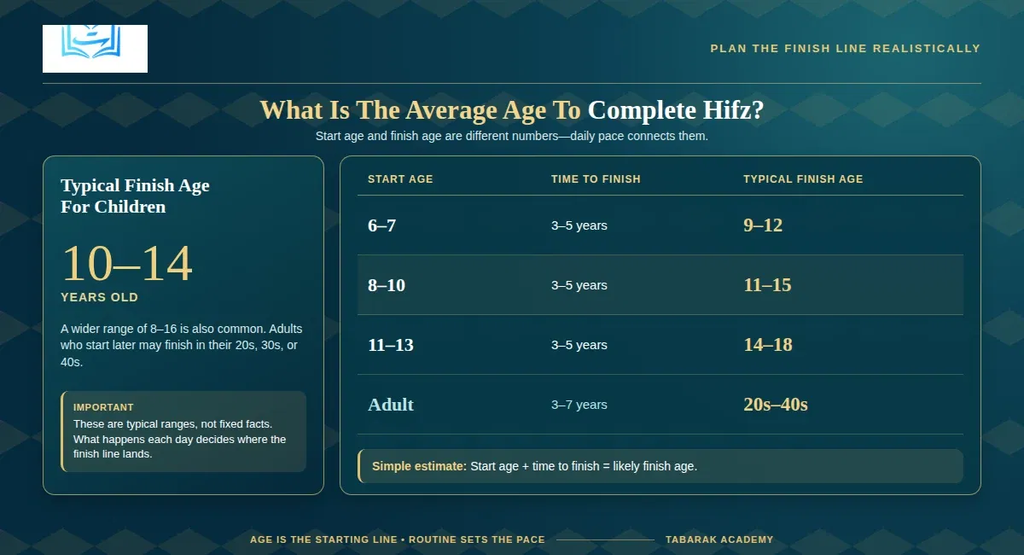
The average age to complete hifz for children is 10 to 14. A wider range of 8 to 16 is also common. Adults who start later often finish in their 20s, 30s, or 40s.
However, there is no official count of hifz finish ages around the world, so treat these as typical ranges, not exact facts.
Start Age And Finish Age Are Two Different Numbers
Many articles mix up two questions. One is the age a child starts hifz. The other is the age they finish. These two numbers are often five years apart, or more.
Start age is when your child begins to memorize with a plan and a teacher. For most children, this is between 6 and 10. Some start sooner with short surahs at home.
Finish age is when your child knows all 30 juz by heart. It also means they can recite them well on any day, not just once.
Why does this matter? A parent who reads “start at 7” may think the child will be done at 8. Then a normal four-year plan feels like a failure.
Knowing the gap from day one keeps your hopes fair. Starting first grade at 6 does not mean you finish school at 6.
Finish Age By Starting Age
To guess a finish age, add the start age to the time hifz takes. That time depends mostly on daily pace, which the next section explains.
The table below shows typical results for different starting points. Adults are on the last line.
| Start age | Time to finish | Finish age |
| 6-7 | 3-5 years | 9-12 |
| 8-10 | 3-5 years | 11-15 |
| 11-13 | 3-5 years | 14-18 |
| Adult | 3-7 years | 20s-40s |
So a child who starts at 7 and keeps going will often finish at 10 or 11. A child who starts at 12 will often finish in the middle of their teens.
These ranges are wide on purpose. Two children of the same age can move at very different speeds. One may live near a mosque with a strong hifz class, while another has a busy school with lots of homework.
Age is only the starting line. What happens each day decides where the finish line lands.
Step Inside Our Virtual Classrooms
See our engaging teaching methods in action! watch real snippets of our live classes and discover how our expert instructors make learning interactive, memorable, and inspiring for every student.
Start Your Quran Learning Journey
Join Tabark Academy today for structured online lessons with qualified tutors, customized to fit your goals.
Book Your Free Trial LessonHow Long Does It Take To Become A Hafiz?
It usually takes three to five years to become a hafiz, depending on how much your child learns each day.
The standard Madinah Mushaf has 604 pages, with 30 juz of about 20 pages each and 15 lines on each page.
The Page Math Behind Every Hifz Plan
You can find the basic timeline by dividing 604 pages by the daily amount. This math assumes your child learns new pages every single day, with no breaks.
The table below shows the most common daily goals and how long each one takes.
| New lines each day | Days needed | About how long |
| 2 pages | 302 | 10 months |
| 1 page | 604 | 1 year and 8 months |
| Half a page | 1,208 | 3 years and 4 months |
| 5 lines | 1,812 | 5 years |
| 1-2 verses | Varies | 5 to 17 years |
Two pages a day is a lot for most children. It tends to suit students who study hifz for most of the day.
Half a page to one page a day is the most common goal for children in school. Five lines a day suits young children or busy adults.
A few verses a day is a fine way to begin. But if the pace stays that slow, the whole Quran can take more than ten years.
Most teachers raise the amount slowly once the child is used to the routine.
Why Real Plans Take Longer Than The Math
The page math is a best case. In real life, almost no one learns new pages seven days a week. Most good plans keep one or two days a week for review only.
There are also juz tests, school exams, sick days, trips, and Eid breaks. Over a few years, these days add up to months.
If your child learns new pages five days a week, the timeline looks like this.
| New lines (5 days a week) | About how long |
| 2 pages | 1 year and 2 months |
| 1 page | 2 years and 4 months |
| Half a page | 4 years and 8 months |
The fast numbers you see online often leave out these normal breaks. So the slower timelines are the fairer goal for most children.
When you plan for real life, you will not feel behind. Your child will not feel like they failed when a test week slows them down. A fair plan also makes real progress easier to see, month by month.
Full-Time Vs. Part-Time Hifz
The type of study changes finish ages more than almost anything else. A full-time student spends most of the day on hifz, while a part-time student fits it around school or work. The table below shows the difference.
| Study type | Time to finish | Finish age |
| Full-time | 2-4 years | 8-12 |
| Part-time | 3-7 years | 10-16 |
| Adults | 4-10 years | Depends on start age |
Full-Time Hifz: Finishing Between 8 And 12
Full-time students often study in a hifz madrasa or a special program. They spend many hours a day with the Quran, mostly on new pages and review.
Because of this, many full-time students learn one page a day or more. That is why they often finish between 8 and 12, and some finish even sooner.
The benefits are clear. The child has one main goal, and the teacher can check every page every day. Mistakes get fixed before they become habits.
The cost is also real. Many families must pause regular school or cut it back for a few years. The child may also spend less time with friends their age.
For this reason, full-time hifz suits children who love it and have strong support at home. It is one good path, but not the only one.
Part-Time Hifz: Finishing Between 10 And 16
Part-time hifz is the most common path today. The child goes to regular school and does hifz for a short time each day. In Western countries, many part-time students finish between 12 and 16.
Most part-time students learn half a page to one page on school days. They use weekends for review or a lighter load.
The key is a fixed daily time. Twenty focused minutes every day beat two long hours once a week. A skipped day hurts more than a short one.
Part-time hifz also lets your child grow in school and in the Quran at the same time.
If this path fits your family, take a look at the Hifz for Kids Course at Tabarak Academy. Your child learns online from home, at a time that fits around school.

Read also: How Long Does Hifz Take for a 7-year-old?
Ages That Speed Up Or Slow Down Hifz
Some ages are faster for memorizing than others. Knowing these windows helps you plan ahead.
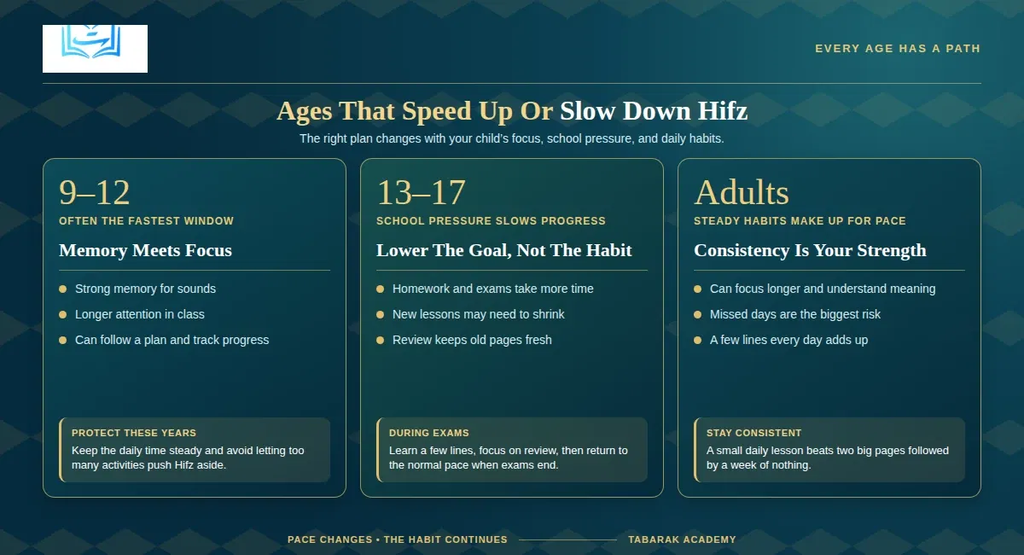
Ages 9 To 12: Often The Fastest Window
Children aged 9 to 12 are often the quickest at hifz. They still have a strong memory for sounds, like younger children. But they can also focus longer and sit through a full class.
At this age, children start to see why review matters. They can follow a plan and track their own progress. Many enjoy the proud feeling of finishing a juz.
A child who has finished Juz Amma by 8 or 9 is in a great place. They already know what learning by heart feels like, so longer surahs come with less stress.
Try to guard these years. Keep the daily time the same and the goals steady. Be careful about adding too many new clubs that push hifz aside.
A strong routine now can save years later on.
Ages 13 To 17: School Pressure Slows Progress
Teens often slow down, and school is the main reason. Homework grows and exams get harder, while sports, friends, and phones all want their time.
In many homes, hifz is the first thing dropped in exam season. A teen may do well until 13, then lose months during busy school terms.
The fix is not to stop. It is to lower the goal for a while. During exams, your teen can learn just a few lines a day and spend the rest of the time on review.
This keeps old pages fresh and the habit alive. When exams end, your teen can go back to the normal pace.
Talk with your teen about this plan before the exams start. When teens help make the plan, they are much more likely to stick to it.
Adults: Steady Habits Make Up For A Slower Pace
Adults rarely memorize as fast as children. But they have strengths children do not. They can focus longer, understand meaning, and control their own time.
Allah tells us He made the Quran easy to remember in Surah Al-Qamar (54:17). That promise has no age limit. Many people start hifz in their 30s, 40s, or later and still finish.
The biggest risk for adults is not memory. It is missed days. An adult who learns a few lines every day will finish before one who does two pages on good weeks and nothing on busy ones.
Linking verses to their meaning also helps. When you know the story behind a passage, the words stay longer.
If you are an adult just starting out, read our guide on how to memorize Quran as an adult beginner.
When Should A Child Start Hifz?
The best time to start hifz is when your child can speak clearly, sit for a short lesson, and repeat what they hear. For many children, this is between 5 and 7.
Many scholars see age seven as the point when most children can understand and remember well.
Signs Your Child Is Ready For Real Hifz
A child is ready for real hifz when they can do three things. They can repeat a verse after hearing it two or three times, sit calmly for 10 to 15 minutes, and recall yesterday’s lines with a small hint.
If your child is not there yet, use the waiting time well. Play short surahs every day from a clear reciter, and praise every small win.
Watch for signs of stress once lessons begin. If lessons often end in tears, the amount may be too big. Cut it in half before you decide to stop.
Some children are ready at 5, and others at 8. Both are normal.
A good teacher can help you judge this. Meet the tutors at Tabarak Academy, then book a free trial lesson so a tutor can see where your child is and suggest a starting pace.
How To Calculate When Your Child Will Finish Hifz
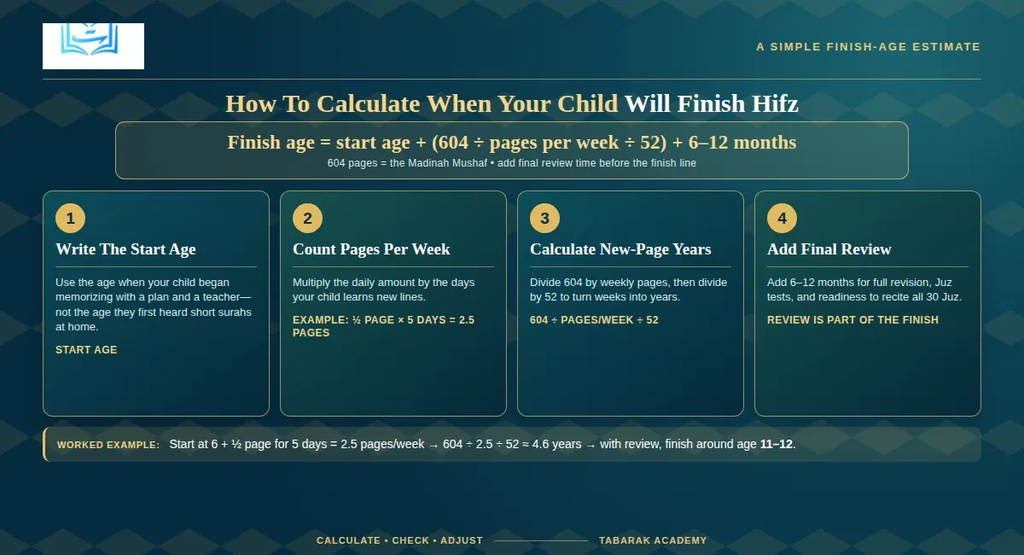
You can calculate your child’s hifz finish age in four steps. You only need their start age, how many pages they learn each week, and some extra time for final review.
Here is the full formula. The steps below show how to use it.
Finish age = start age + (604 ÷ pages per week ÷ 52) + 6 to 12 months.
Step 1: Write down your child’s start age.
This is the age your child began memorizing with a plan and a teacher, not the age they first heard short surahs at home.
Step 2: Count the pages your child learns each week.
Multiply the daily amount by the number of days they learn new lines. For example, half a page a day for five days equals 2.5 pages a week.
Step 3: Work out how many years the new pages will take.
Divide 604 (the pages in the Madinah Mushaf) by the weekly pages. Then divide the answer by 52 to turn weeks into years.
Step 4: Add 6 to 12 months for final review.
The last part of hifz is the slowest, because there is so much old work to review. These extra months cover full revisions and juz tests before your child is ready to recite all 30 juz.
Example: A child starts at 6 and learns half a page, five days a week. That is 2.5 pages a week, so 604 ÷ 2.5 ÷ 52 gives about 4.6 years. Add the review time, and the finish age is about 11 to 12.
Check the pace every morning. Test yesterday’s new lines before starting new ones. One or two small slips mean the pace is right. If your child has to learn the lines all over again, lower the daily amount and run the steps again.
Our guide on how to test your own hifz shows simple ways to do this at home.
Mistakes That Add Years To Hifz
Most hifz delays come from small planning mistakes, not a weak memory.
1. Skipping Review To Rush New Pages
This is the biggest mistake parents and students make. They watch the count of new pages and forget the old ones. After a few months, earlier juz start to fade.
The Prophet ﷺ warned that the Quran slips away faster than a camel from its rope if we stop reciting it, as reported in Sahih al-Bukhari (5033). Review is not extra work. It is part of hifz itself.
A strong daily lesson has three parts: new lines, pages from the last week or two, and older juz learned months ago.
When the third part is skipped, old pages must be learned again later. That takes far more time than the review would have.
If you already face this, read how long it takes to re-memorize a juz.
2. Mixing Up Verses That Look Alike
Many verses in the Quran look almost the same. They may differ by one word or a different ending. Scholars call these mutashabihat, which means similar verses.
Students often mix them up, most of all after the halfway point. One verse slides into another, and the recitation goes off track. The more you learn, the more of these verses you carry.
Good teachers mark these verses early. They show the student where the two verses differ, then test them side by side until the gap is clear.
You can help at home too. Keep a small notebook of the similar verses your child confuses, and go over it once a week.
Some families also use a color pen in a practice Mushaf. They mark the word that changes, so the eye learns the gap too.
Experience Our Interactive Learning
Curious about how we teach? Watch these brief video clips from our recent live sessions to see our structured curriculum, advanced learning platform, and dynamic student-teacher interactions firsthand.
Start Your Quran Learning Journey
Join Tabark Academy today for structured online lessons with qualified tutors, customized to fit your goals.
Book Your Free Trial LessonBook A Free Hifz Trial Class At Tabarak Academy Today
Your child does not need to study full-time to become a hafiz. They need a good start, a steady pace, and a teacher who keeps review on track.
Tabarak Academy helps your family do all three, online and from home.
What your family gets with Tabarak Academy:
- Hifz programs for kids, adults, and sisters
- Juz 30 and short surah courses for young beginners
- A Hifz Ijazah course for students who want to go further
- Tajweed courses to add correct recitation to memorizing
- Parent reviews on Trustpilot you can read first
- Easy WhatsApp booking and a free trial class
Start with a free trial lesson. Meet the teacher, see how your child learns, and get a realistic plan for finishing hifz.
Book your free trial class now

Conclusion
Finishing hifz is not a race against a birthday. It is a plan built one week at a time. The average age to complete hifz gives you a target, but your child’s daily routine decides when they reach it.
Start by being honest about your family’s week. Count the days your child can really sit with the Quran, and pick a daily amount that fits them. Whether your child starts at 5 or 15, the same steady steps lead to the finish line.
Next, choose the study type that suits your child. Some children do best full-time, while many others grow well with a short daily class. Both paths can end with a hafiz.
Keep an eye on your child’s age window. Push a little harder in the strong years, and ease the load when exams or big changes arrive.
Expect some slow weeks along the way. They are normal, and they don’t erase the progress your child has already made.
Celebrate each juz your child finishes, not just the final day. Small wins keep motivation high through the long years of hifz.
The Prophet ﷺ said the companion of the Quran will be told to recite and rise, and their rank will be at the last verse they recite, as reported in Sunan Abi Dawud (1464).
Every page your child learns, at any age, brings them closer to that rank.
FِAQs
Parents and adult learners often ask the same few things about hifz timelines. Below are short answers to the most common ones.
Is It Too Late To Complete Hifz After The Average Age?
No, it is never too late to complete hifz. Teens and adults finish every year with a steady daily habit.
How Many Minutes A Day Does A Child Need For Hifz?
Young children can start with 10 to 15 minutes and build up to about 20 minutes a day. Older children can often handle 30 to 60 minutes, split between new lines and review.
How Long Does It Take To Memorize Juz Amma?
Juz Amma covers about 23 pages, so half a page a day takes around two months. Many young children take longer because they are still building the habit.
Can A Child Complete Hifz Online?
Yes, a child can complete hifz online with a qualified teacher. For young children, it helps when a parent sits nearby during class.
What Should We Do If My Child Stops Hifz For A Long Time?
Start again with review before adding new pages. Our rememorization plan after a 5-year break shows how to bring old pages back step by step.
What Comes After A Child Completes Hifz?
After hifz, most students keep a daily review plan for life and polish their tajweed. Some go on to earn an ijazah, a teaching license linked to a chain of teachers.