


How to Regain Hifz After Years Away? 7 Steps to Restart Your Memorization
You open the Mushaf and the words don’t come the way they used to. A verse you once recited without thinking now sits just out of reach. This is the exact moment where most people learning how to regain hifz after years away either give up in frustration or find a method that actually works.
The gap in your memorization isn’t a sign that you failed. Life happens – work, marriage, illness, a move, years that simply get busy. What matters now is not how long you were away, but how you structure the return.
This guide covers the best way to regain hifz after years away: an honest audit of what’s left in your memory, the revision sequence that comes before any new hifz, a daily routine built around five prayers instead of one long session, and the mistakes that break most restarts in the first month.
Tabarak Academy’s tutors use this same sequence with adult students restarting after long gaps, so every step below is drawn from what actually holds up in practice.
1. Assess Your Old Hifz Before You Start Revising
Before you touch a single new page, you need to know exactly what’s still in your memory and what isn’t. Skipping this step is the biggest reason to restart stall — students either revise pages that don’t need it or avoid the ones that do.
Memory decay is the process by which unused neural pathways weaken over time. Your hifz isn’t erased when you stop reciting for months or years; the retrieval path to it just gets harder to access, the same way a trail through a forest becomes overgrown without regular use.
This is why verses often come back faster than expected once you start reciting again. The pathway isn’t gone — it just needs to be walked again, repeatedly, until it’s clear.
Use the 3-Zone Method to Identify Strong and Weak Hifz
Spend your first week testing your old memorization out loud, without looking at the Mushaf, and sort what you find into three zones.

- Anchored zone: verses you recite smoothly with one or two minor slips at most. These need light daily maintenance, not heavy repetition.
- Loose zone: verses where you know the general flow but stumble on specific word endings or transitions between ayahs. These need targeted repair, not a full restart.
- Silent zone: verses that feel completely unfamiliar, as if you’re seeing them for the first time. Treat these as new lessons (jadid) rather than forcing recall that isn’t there yet.
Sorting your memorization this way turns a vague fear of “I’ve forgotten everything” into a specific, workable list — which is exactly what a tutor at Tabarak Academy does with a new student in the first session, before building a personal revision plan around it.
2. Revise Old Hifz Before Adding New Memorization
The best way to regain hifz after years away is revision before anything new. The most common mistake in any hifz restart is trying to memorize new pages before the old ones are stable. Your recall speed after a long gap is slower than it was, and adding new material on top of shaky old material creates confusion in both directions.
Instead of hunting for one long study block, split your revision across the five daily prayers. Use 15–20 minutes before Fajr, when your mind is clearest, for your Silent-zone verses.
Use 5–10 minutes after Dhuhr, Asr, and Maghrib for quick pass-throughs of your Anchored-zone pages, and a slightly longer session after Isha for your Loose-zone repair work.
This structure works because it doesn’t compete with a busy schedule for one uninterrupted hour — it fits inside a routine you already have.
Read also: Optimal Hifz Revision Plan
Spend 2–4 Weeks Rebuilding Your Old Memorization
Plan for 2 to 4 weeks of revision-only work before adding anything new, longer if your gap was several years or covers a large portion of the Quran. This isn’t wasted time — it’s what makes every page of new memorization after it actually sticks instead of leaking away again within weeks.
If your schedule genuinely doesn’t allow for a self-paced restart, a structured program removes the guesswork.
Tabarak Academy’s Hifz for Adults course is built specifically around this revision-first structure, with a tutor checking your zones weekly instead of you having to judge your own progress alone.
Read Also: How Long Does It Take To Memorize One Page Of Quran?
Experience Our Interactive Learning
Curious about how we teach? Watch these brief video clips from our recent live sessions to see our structured curriculum, advanced learning platform, and dynamic student-teacher interactions firsthand.
3. Build a Consistent Daily Hifz Revision Routine
Consistency, not intensity, is what rebuilds hifz after a gap. A single 20-minute session every day outperforms one long session that gets skipped three days out of five.
Choose one prayer time – most students find right after Fajr or right after Isha works best — and treat it as non-negotiable. The brain relearns faster when it expects the material at a predictable time, which is why “same time, same place” beats an ideal-but-irregular schedule every time.
Read also: Daily Murajaah Plan For Hifz Students
Your brain built a visual map of where each ayah sits on the page – top-right, bottom margin, next to a specific word. Switching to a new Mushaf print forces it to build that map from scratch, which slows recall exactly when you need it fastest.
Pair this with listening to one reciter consistently (Sheikh Al-Husary and Sheikh Al-Minshawi are common choices for slow, clear recitation) during commutes or chores, so your ear primes the words before you sit down to revise formally.

4. Fix Tajweed and Similar Mutashabihat Verses
Weak Tajweed creates weak memories. When the makharij (points of articulation) are imprecise or a rule like ghunnah gets rushed, the sound pattern the brain stores is fuzzy — and fuzzy sound patterns are exactly what slip first under pressure.
Slow your recitation down deliberately during the revision-only phase and correct one rule at a time rather than trying to fix everything at once.
A page recited slowly but accurately locks in far more reliably than the same page rushed through five times.
Read also: The Ultimate Guide to Staying Motivated on Your Quran Memorization Journey
Use Active Recall to Separate Similar Ayat
Mutashabihat — verses that resemble each other across different surahs — are one of the most common sources of restart confusion. Lightly underline the differing word in each pair with pencil so your eye catches the distinction before your tongue does.
Active recall reinforces this further: close the Mushaf, picture the page layout, and mentally note where each verse begins and ends.
This “mental photography” approach cements the distinction more effectively than repeating the lines from memory alone, and it’s a technique Tabarak Academy tutors walk students through directly during one-on-one Tajweed sessions.
5. Add New Memorization Slowly After Your Hifz Is Stable
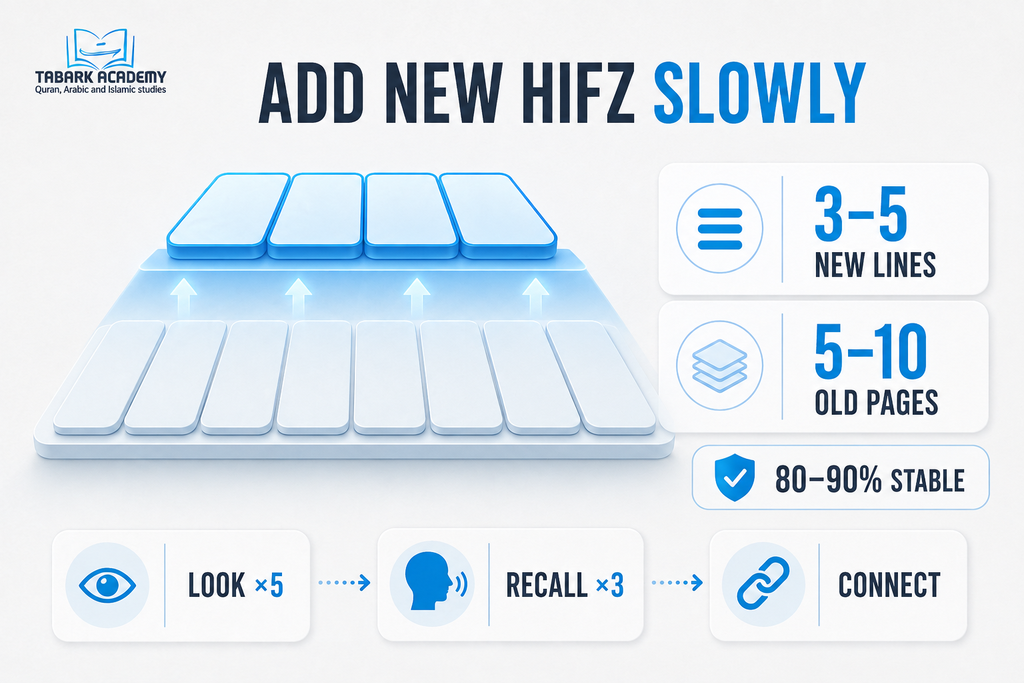
Once 80–90% of your old memorization feels stable and your daily routine runs on autopilot, you’re ready to add new material — carefully, not all at once.
For every new line you memorize, plan to revise five to ten older pages in the same period. This keeps your foundation from eroding while your new memorization grows, which is the exact imbalance that causes most second restarts.
Read also: Rememorize Quran After 5 Years: 90-Day Comeback Guide
Start With 3–5 New Lines a Day
Start with three to five lines a day, not a full page. Read each line five times while looking at the text, then recite it three times from memory before closing the Mushaf.
Connect the new lines to the verses immediately before and after them — context anchors new memorization far better than isolated repetition.
Read also: How to Tell If Your Hifz Is Strong: 9 Signs
6. Avoid Common Mistakes That Derail a Hifz Restart
These are the tips most restarts get wrong — and each one is fixable once you know to watch for it.
- Starting new memorization before old pages are stable.
- Setting a full-page daily target in the first week.
- Ignoring Tajweed mistakes because “the words matter more than the sound”.
- Revising randomly instead of working zone by zone.
- Comparing your pace to students who never stopped.
- Skipping revision the moment a session goes well.
Every one of these mistakes comes from treating the restart like a race. It isn’t one — it’s a rebuild, and rebuilds hold up better when they’re paced.
7. Set a Realistic Timeline to Regain Your Hifz
Understanding how to regain hifz after years away also means being realistic about the timeline ahead.
Regaining hifz after years away typically takes 3 to 6 months to reach stability for smaller portions (1–5 juz), and 6 months to a year or more for a full memorization, depending on the length of the gap and how consistent your revision is.
A gap under six months usually needs less intensive work than a multi-year gap.
The single biggest factor isn’t how much you memorized before — it’s how consistently you show up to revise now. Twenty focused minutes daily, done without fail, outpaces an hour done twice a week every time.
Read Also: How To Re-Memorize The Quran After Forgetting It?
Step Inside Our Virtual Classrooms
See our engaging teaching methods in action! watch real snippets of our live classes and discover how our expert instructors make learning interactive, memorable, and inspiring for every student.
Start Your Hifz Restart With Tabarak Academy
You don’t have to rebuild your hifz alone, guessing at your own zones and hoping the pace is right. Tabarak Academy pairs you with a qualified tutor who audits your memorization honestly, builds a revision-first plan around your actual gaps, and keeps you accountable week to week.

Book your free Hifz assessment with Tabarak Academy today and get a restart plan built around where you actually stand, not a generic timeline.
Our Quran Memorization / Hifz Courses:
- Online Hifz Program
- Juz 30 Memorization Course
- Hifz for Kids Course
- Hifz for Adults Course
- Hifz for Sisters Course
- Short Surah Memorization Course
- Hifz Ijazah Course

Conclusion
Learning how to regain hifz after years away comes down to seven steps held in order: audit honestly, revise before you add anything new, build a routine you can keep, fix your Tajweed, grow slowly, avoid the common mistakes, and set a timeline you can actually live with.
None of this requires speed — it requires a routine you can repeat on the days that feel hard, not just the days that feel easy.
The verses you memorized years ago are still part of you. What you’re rebuilding isn’t new — it’s a path back to something that was already there, and with Tabarak Academy‘s structured, tutor-guided approach, that path gets considerably shorter.
Start with the audit this week, hold the revision-only phase for as long as it takes, and let the new memorization come back on its own schedule.

Frequently Asked Questions
Here are the questions Tabarak Academy tutors hear most often from students restarting their hifz after a long gap, along with regaining hifz after years away tips you can act on right away.
1. Can I start new memorization before my old hifz feels stable?
No, adding new memorization before your old hifz is stable causes both to weaken. Spend 2 to 4 weeks on revision only, then reintroduce new lines gradually once your Anchored and Loose zones are consistent.
2. How do I know if my hifz is too far gone to recover?
Hifz is rarely “too far gone” — memory decay makes recall harder, not impossible, even after years away. A structured audit into Anchored, Loose, and Silent zones will show you exactly what’s recoverable, which is almost always more than it feels like at first.
3. How many minutes a day do I actually need to restart hifz?
Twenty to twenty-five focused minutes a day is enough to restart hifz effectively, especially anchored to a fixed prayer time like Fajr. Longer sessions help once your recall stabilizes, but consistency matters more than duration in the first month.
4. Does Tabarak Academy work with adults who haven’t recited in years?
Yes, Tabarak Academy’s Hifz for Adults program is built specifically for students returning after long gaps, starting with a tutor-led audit before any new memorization is assigned.
5. Should I change my Mushaf if my old one is falling apart?
Keep the same Mushaf edition even if the physical copy is worn, since your brain relies on the visual layout of the page to recall verse position. Replace the physical copy only if it’s unusable, and choose the same print and layout.
6. What’s the fastest way to fix verses that keep mixing together?
The fastest way to fix mutashabihat (similar verses) is pencil-marking the differing word in each pair, combined with active recall — closing the Mushaf and mentally picturing where each verse starts and ends on the page.