


How To Restart Hifz After A Long Break? A Step-By-Step Guide
If you’ve stopped memorizing for weeks, months, or even years, learning how to restart Hifz after a long break can feel overwhelming — but it does not mean your progress is gone. Most of what you memorized is still there; it has simply gone quiet from lack of use.
The right restart follows a fixed order: assess first, stabilize what’s shaky, and only then move forward with new memorization.
Tabarak Academy calls this sequence the 3R Restart Method – Reassess, Revise, Resume. This guide walks through it step by step, from the first honest self-assessment to a sustainable daily routine that prevents the next gap from happening.
1. Assess What You’ve Retained Before You Restart Hifz After A Long Break
Restarting Hifz after a long break starts with an honest audit, not a schedule. Spend the first week reciting from memory, without the Mushaf, and sort each portion into three categories before deciding what to work on.
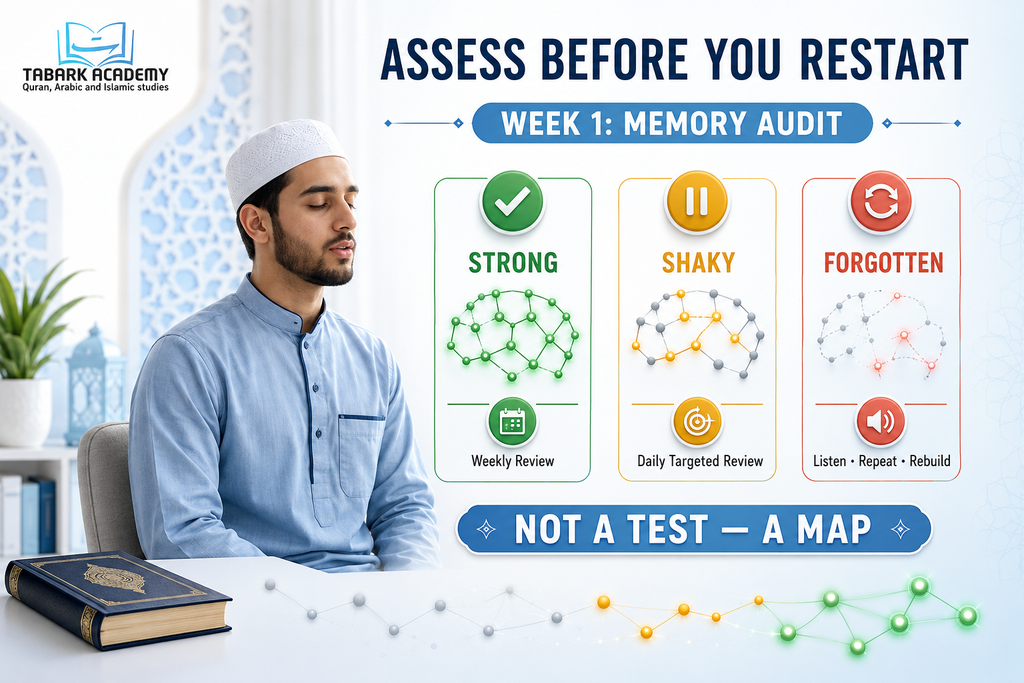
Memory decay is a normal neurological process, not a spiritual failure — when a pathway in the brain isn’t used, the connections weaken, so retrieval becomes slow rather than deleted.
This is why a page that feels “completely forgotten” often comes back within a few days of focused listening and repetition, rather than needing to be relearned from scratch.
| Memory Level | What It Looks Like | What To Do |
| Strong | Recited fluently, no prompting needed | Light revision once a week to maintain it |
| Shaky | Most words return, but with pauses or blurred verses | Daily targeted revision, isolate the weak lines |
| Forgotten | Cannot recall the text without help | Treat as new memorization: audio + text, daily repetition |
This audit is not a test. It’s a map. Skipping it is the single most common reason students waste weeks reviewing pages they already know while ignoring the ones that actually need work.
2. Reset Your Intention and Remove the Guilt
Before the technical steps go any further, guilt needs to be addressed directly. Many students returning after a pause assume the break proves they have failed or that the Quran they memorized has somehow been wasted. Neither assumption should prevent them from returning.
Allah encourages those who have fallen short to remember Him, seek forgiveness, and avoid persisting in wrongdoing:
وَالَّذِينَ إِذَا فَعَلُوا فَاحِشَةً أَوْ ظَلَمُوا أَنفُسَهُمْ ذَكَرُوا اللَّهَ فَاسْتَغْفَرُوا لِذُنُوبِهِمْ وَمَن يَغْفِرُ الذُّنُوبَ إِلَّا اللَّهُ وَلَمْ يُصِرُّوا عَلَىٰ مَا فَعَلُوا وَهُمْ يَعْلَمُونَ
“And those who, when they commit an immorality or wrong themselves, remember Allah and seek forgiveness for their sins—and who can forgive sins except Allah?—and do not persist in what they have done while they know.”— Surah Ali ‘Imran (3:135)
For a student returning to Hifz, the important step is to return sincerely rather than allowing regret over the pause to become another reason for delaying.
The Prophet ﷺ also emphasized that the value of an action is closely connected to the intention behind it:
إِنَّمَا الأَعْمَالُ بِالنِّيَّاتِ، وَإِنَّمَا لِكُلِّ امْرِئٍ مَا نَوَى
“Actions are but by intentions, and every person will have only what they intended.”— Sahih al-Bukhari (1)
Renewing the intention—returning to Hifz for Allah’s sake rather than simply trying to compensate for lost time—provides a healthier foundation for rebuilding a consistent memorization and revision routine.
Read also: How to Keep Your Hifz Motivation High When Memorization Gets Hard?
3. Revise Only for the First 2–4 Weeks
The biggest mistake in restarting Hifz after a long break is adding new pages before the old ones are stable. For the first two to four weeks, the only task is revision of previously memorized material.
This phase rebuilds the neural pathways weakened by the gap, restores fluency in your own recitation voice, and breaks the guilt-avoidance cycle that keeps many students stuck in place.
A common restart mistake worth naming directly: students add a new surah in week one to feel like they’re “making progress,” while the old memorization is still shaky. Within a month, both the new and the old material collapse together, and the student restarts the restart.
Experience Our Interactive Learning
Curious about how we teach? Watch these brief video clips from our recent live sessions to see our structured curriculum, advanced learning platform, and dynamic student-teacher interactions firsthand.
4. Fix Tajweed Before You Add Speed
Tajweed is the set of rules governing correct Quranic pronunciation, and weak Tajweed is one of the quiet reasons verses keep slipping from memory.
During the revision phase, slow down and check the makharij (the precise articulation points of each letter), the madd (elongation counts), and shadda/sukoon handling.
Compare your recitation against a trusted reciter through a recording or a live teacher rather than assuming your pronunciation is still accurate after the gap. Errors that go uncorrected at this stage get locked back into long-term memory, which is harder to undo later than fixing them now.

Read Also: How To Regain Hifz After Years Away
5. Build a Small, Fixed Daily Routine
Consistency, not duration, is what restarts Hifz successfully. A fixed 15–20 minute session at the same time each day — after Fajr works well for many students — trains the brain to expect the Quran at a predictable hour, and the routine holds up even on busy weeks.
Once that rhythm feels automatic after three to four weeks, session length can grow naturally.
Students who want structured accountability during this phase, rather than managing the schedule alone, often do better inside a guided track like the Online Hifz Program at Tabarak Academy, where a teacher tracks the audit results from Step 1 and adjusts the daily load week by week.
Read also: Effective Daily Hifz Review Plan
6. Resume New Memorization Slowly
New memorization restarts only once revision feels stable — typically half a page to five ayahs a day, read several times looking at the Mushaf, then recited from memory before the session closes.
Connect the new ayahs to what came before them before closing the Mushaf, so the sequence stays linked rather than isolated.
Never increase the amount because one day went well; hold the same load for several days and confirm accuracy stays consistent before adding more. Growth in Hifz comes from control, not from pressure to move faster.
The Best Way To Restart Hifz After A Long Break Based On Your Gap Length
The best way to restart Hifz after a long break depends heavily on how long the pause lasted. A three-month gap and a five-year gap are not the same problem, and treating them identically is why generic advice often fails.
| Gap Length | Memory State | Recovery Approach | Realistic Timeline |
| 1–3 months | Mostly intact, but shaky; confidence is the main issue | 2 weeks revision-only, then add 3–5 new lines daily | 4–6 weeks |
| 3–12 months | Significant portions forgotten; real rebuilding needed | 3–4 weeks revision-only before adding new memorization | 3–6 months |
| 1–5 years | Major loss; some parts feel like relearning; emotional toll is real | 4–6 weeks revision-only, consider a teacher for accountability | 6–12 months |
| 5+ years | Deep forgetting; near-complete relearning | Start with audio + text daily, join a structured program | 12–18+ months |
These are reference ranges, not promises – actual recovery speed depends on how much time a student can protect daily and how consistent the routine stays.
For gaps beyond a year, working inside the Online Hifz Program gives a returning student a teacher who can classify weak portions accurately, which is difficult to do alone once the gap is long.
Read more about: Effective Quran Memorization Revision Schedule
Restart Hifz After A Long Break Tips That Keep You Consistent
Beyond the six-step sequence, a handful of daily habits determine whether the restart sticks or fades out again after a few weeks.
- Recite aloud, not silently: sound anchors memory far more effectively than reading with the eyes alone.
- Use the same Mushaf every session: the eyes remember page layout and line breaks, which supports faster recall.
- Keep phones away during Hifz time: fragmented attention weakens encoding even during short sessions.
- End each session on a strong verse: this builds confidence going into the next day rather than closing on a stumble.
- Take one rest day a week: consolidation happens during rest, and skipping it increases burnout risk.
Techniques For Weak Or Forgotten Portions
Different memory problems need different fixes, and using the wrong one wastes time.
| Technique | How It Works | Best For |
| Line repetition | Repeat one verse aloud 10–15 times without the Mushaf | Verses that feel completely forgotten |
| Reverse reading | Recite a surah backward, last ayah to first, from memory | Verses that blur together in sequence |
| Audio looping | Listen to the same weak surah repeatedly while following the text | Shaky pronunciation after a long gap |
| Active recall test | Close the Mushaf and recite, then check afterward | Separating real memory from book-dependent recall |
Younger students restarting after a break often need a gentler version of this same structure, without the pressure of adult-paced timelines — the Hifz for Kids course at Tabarak Academy builds the audit and revision phases around a child’s attention span rather than an adult recovery schedule.
Adult learners balancing work or family commitments tend to do better with a track built for that reality, such as Hifz for Adults, where session length and pacing are adjusted from the start.
Read also: 9 Signs of Strong Hifz: Is Your Memorization Solid?
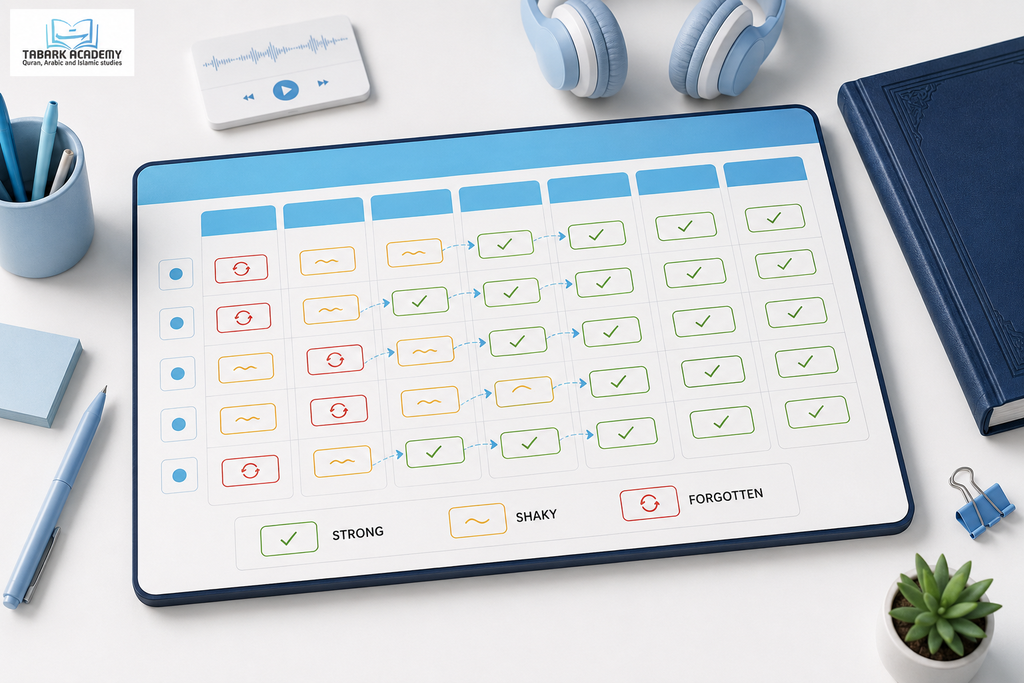
Common Mistakes That Stall A Hifz Restart
A few patterns repeat often enough among returning students that they’re worth naming directly, so the restart doesn’t repeat the same collapse.
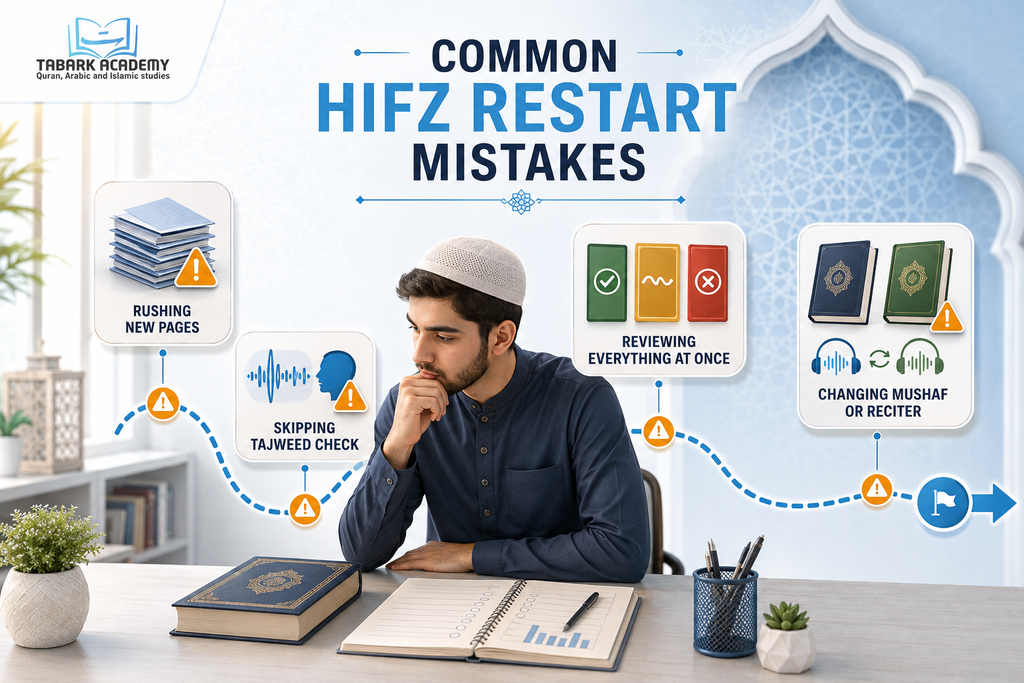
1. Rushing new memorization to prove commitment
Adding fresh pages before the old ones are stable creates two unfinished responsibilities at once — weak old memorization and fragile new memorization — and both usually fail together.
2. Skipping the Tajweed check
Students who resume reciting without correcting makharij and madd errors lock those mistakes back into long-term memory.
3. Treating the whole Hifz as one block
Reviewing everything in one long session, rather than sorting strong, shaky, and forgotten portions first, wastes time on material that didn’t need attention.
4. Changing Mushaf or reciter mid-restart
Switching references disrupts the visual and audio memory links a student is trying to rebuild — consistency in these two anchors matters more than most students expect.
If the recurring issue is pronunciation rather than memory retention itself, starting from a solid Tajweed and recitation base through Online Quran Classes before pushing forward with Hifz can prevent the same errors from repeating through the next several pages.
Read Also: Best Quran Hifz Schools for Online Quran Memorization
Step Inside Our Virtual Classrooms
See our engaging teaching methods in action! watch real snippets of our live classes and discover how our expert instructors make learning interactive, memorable, and inspiring for every student.
Start Your Hifz Restart with Tabarak Academy Today
You don’t have to plan this restart alone, and guessing at your own audit results is where most self-directed restarts lose momentum.
Tabarak Academy’s teachers build a personalized recovery plan around your actual retention level — not a generic timeline — so revision targets exactly what needs it and new memorization resumes at the right pace for your gap.

Our Quran Memorization / Hifz Courses:
- Online Hifz Program
- Juz 30 Memorization Course
- Hifz for Kids Course
- Hifz for Adults Course
- Hifz for Sisters Course
- Short Surah Memorization Course
- Hifz Ijazah Course

Conclusion
Learning how to restart Hifz after a long break comes down to a fixed order: assess what’s retained, reset the intention, revise only for two to four weeks, correct any Tajweed drift, build a small daily routine, then resume new memorization slowly.
The timeline depends on how long the pause lasted, but every gap — three months or five years — responds to the same underlying method. With consistency and the right structure, many students find their recitation becomes steadier than it was before the break.
Tabarak Academy’s teachers are there for exactly this stage, when a student is ready to return but needs a clear, personalized plan to make it stick.

Frequently Asked Questions About Restarting Hifz After a Long Break
These are the questions Tabarak Academy hears most often from students preparing to restart Hifz after a long break, along with direct, practical answers.
1. How long does it take to restart Hifz after a long break?
Recovery time depends on the length of the pause: 4–6 weeks for a gap under three months, 3–6 months for a gap under a year, and up to 12–18 months for a gap beyond five years. These ranges assume a consistent daily routine rather than occasional sessions.
2. What is the best way to restart Hifz after a long break?
The best way to restart Hifz after a long break is to audit retention first, revise-only for two to four weeks, correct any Tajweed drift, then resume new memorization gradually. Skipping the audit or the revision-only phase is the most common reason to restart a stall.
3. Should I start with new memorization or revision first?
Revision comes first, always. Adding new memorization before old material is stable creates two weak points instead of one, and both typically collapse together within a few weeks.
4. What if I keep forgetting the same verses every time I review them?
Repeated forgetting at the same spot usually points to a transition problem rather than the verse itself — the link between one ayah and the next is weak. Repeating the last phrase of one ayah joined with the first phrase of the next, several times as one unit, typically resolves it faster than repeating the full page.
5. Can forgotten Hifz really come back, or does it need to be relearned completely?
Most “forgotten” portions return faster than expected once revision, listening, and repetition are applied consistently, because the underlying memory pathway is weakened rather than erased. Only the most severely forgotten sections need to be treated as new memorization from the start.
6. Is a teacher necessary to restart Hifz after a long break?
A teacher isn’t strictly required for a short gap, but becomes increasingly valuable as the gap grows, since an outside ear catches recurring Tajweed errors and blurred transitions that are hard to notice alone.
For gaps over a year, working inside a structured program with a teacher shortens the recovery timeline meaningfully.