


How To Revise 30 Juz In One Month? – 7 Practical Revision Tips
Can you revise all 30 Juz of the Quran in one month without losing the verses you have memorized? Yes, with a structured daily revision schedule, consistent recitation, and a plan that matches your current Hifz level.
Learning how to revise 30 juz in one month requires more than reading one Juz every day. You need to recall the verses from memory, correct mistakes, and give extra attention to portions that are difficult to retain.
This guide explains seven practical ways to revise the entire Quran in 30 days, including a five-prayer schedule, active recall, weekly progress tracking, and techniques for children and adults. It also explains how Tajweed lessons and a qualified Quran teacher can support accurate revision.

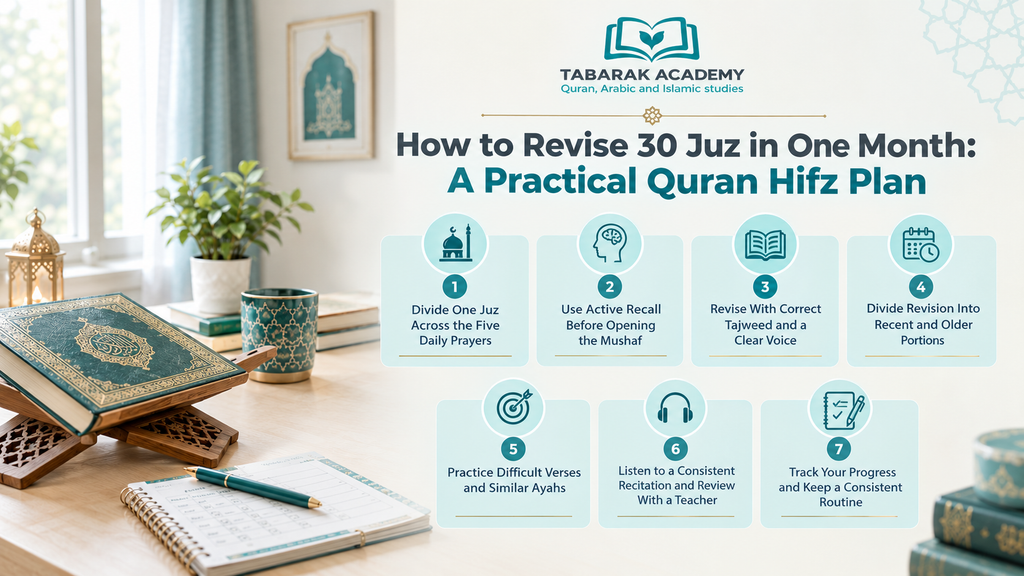
1. Divide One Juz Across the Five Daily Prayers
The best way to revise 30 juz in one month is to divide the daily Juz into five smaller portions and connect each portion to one of the five prayers. For a 20-page Juz, revise four pages after Fajr, Dhuhr, Asr, Maghrib, and Isha.
This method makes the monthly target feel more manageable because you are not completing the entire Juz in one sitting. Each prayer becomes a natural reminder to review a specific portion of the Quran.
Try to revise the pages after the prayer rather than waiting until the end of the day. If one session is missed, complete it during the next available study period without abandoning the rest of your schedule.
This approach is especially helpful for busy adults, parents, and students who cannot dedicate an uninterrupted hour to Quran revision. You can adjust the portions around your commitments while keeping the daily Juz target consistent.
Children may need smaller portions, such as one or two pages after selected prayers. Adults can combine two portions into a longer session when work, school, or family responsibilities make five separate sessions difficult.
2. Use Active Recall Before Opening the Mushaf
Begin each revision session by reciting the assigned pages from memory before opening the Mushaf. This helps you identify what you truly remember instead of relying on visual familiarity.
When you reach a hesitation or mistake, pause and check the Mushaf carefully. Mark the difficult verse, repeat it correctly, and recite the surrounding lines again until the connection becomes clear.
Active recall is one of the most important techniques for strengthening Hifz. Instead of simply reading the page, close the Mushaf and recite the verses from memory before checking the written text.
Begin each session by reciting a few pages without looking. When you make a mistake, pause, identify the correct verse, and repeat it until you can recall it accurately. This helps you distinguish between familiar-looking words and genuine memorization.
For children, a parent or teacher can listen to the recitation and mark the verses that need more practice. Adults can use a notebook to record repeated errors and revisit them during the next session.
3. Revise With Correct Tajweed and a Clear Voice
Correct Tajweed is essential during Quran revision because the goal is not simply to remember the words, but to recite them accurately. Reading aloud at a moderate pace helps you hear pronunciation errors and recognize where you hesitate.
Revision should strengthen both memory and recitation quality, so read aloud with careful attention to Makharij, Madd, Ghunnah, and other Tajweed rules. A clear voice makes pronunciation errors easier to notice.
Avoid rushing through familiar pages simply because you have memorized them before. Reciting at a steady pace allows you to maintain accuracy and prevents incorrect pronunciation from becoming part of your repeated Hifz.
If you are unsure about a rule, return to the relevant lesson before repeating the passage. A structured Tajweed course can help you improve Makharij, Madd, Noon Sakinah, Meem Sakinah, and other rules through guided recitation practice.
Tabarak Academy offers live, one-to-one Quran and Tajweed instruction for beginners and intermediate learners.

4. Divide Revision Into Recent and Older Portions
A strong revision routine includes both recently memorized material and older Hifz. Recent revision helps you retain new verses, while older revision protects the portions that may become weaker over time.
Give special attention to recently memorized pages because they are more likely to weaken before they become firmly established. Review yesterday’s portion and the pages from the previous week before moving to older Juz.
Older memorization also needs regular attention, even when it feels strong. Include a small selection of earlier pages each day so that your revision covers both recent lessons and long-term Hifz.
You can divide your daily session into two parts: revise the assigned Juz from memory, then spend a few minutes reviewing verses from a previously memorized Juz that need extra attention. If the older portion is particularly weak, give it additional time instead of moving through the pages quickly.
For learners who have a large amount of memorization, the exact ratio of new Hifz to revision should be adjusted with a teacher. A student who is struggling with retention may need to reduce new memorization temporarily and prioritize strengthening the existing portions.
Experience Our Interactive Learning
Curious about how we teach? Watch these brief video clips from our recent live sessions to see our structured curriculum, advanced learning platform, and dynamic student-teacher interactions firsthand.
5. Practice Difficult Verses and Similar Ayahs
One of the most useful tips for revising 30 juz in one month is to focus on the places where you repeatedly make mistakes. Similar verses, closely related endings, and transitions between Surahs can be challenging even for experienced memorizers.
Do not treat every page as equally difficult. Spend extra time on verses where you often hesitate, confuse similar wording, or forget how one ayah connects to the next.
You can write a short note, listen to the passage, or ask a teacher to test you from different starting points. This focused practice helps you correct weak areas instead of repeating only the portions you already know well.
Create a short list of weak passages and review them separately from the main Juz. Read the correct verse from the Mushaf, recite it several times, then test yourself again without looking.
For children, use simple questions such as “What comes after this Ayah?” or “Which Surah comes next?” These questions make revision more interactive while helping the child remember the order of the Quran.
Read also : How to Revise 30 Juz in 1 Week: Complete Plan
6. Listen to a Consistent Recitation and Review With a Teacher
Listening to the Quran from a trusted Qari can support your revision by reinforcing correct pronunciation, verse order, and familiar recitation patterns.
Choose a reciter whose pace is comfortable and use the same recitation when practicing difficult passages. Consistent listening supports accurate pronunciation and helps you notice places where your recitation differs from the correct reading.
Listening should support your own recitation, not replace it. After hearing a portion, close the audio and recite it independently. If you continue to make mistakes, ask a qualified teacher to check the passage and correct your Tajweed.
A qualified teacher can identify mistakes that you may overlook while studying alone. Regular feedback is especially helpful for similar Ayahs, Tajweed rules, and passages that repeatedly cause hesitation.
At Tabarak Academy, learners can receive live Quran recitation correction through private sessions with certified tutors. This is useful for children and adults who want feedback on their pronunciation and progress.

7. Track Your Progress and Keep a Consistent Routine
Tracking your daily revision helps you see whether you are completing the planned portion of each Juz. Use a simple calendar, notebook, or 30-day checklist to record the pages you have revised.
Mark difficult verses separately so you can return to them during the next session. This prevents weak passages from being forgotten and shows you which parts of your Hifz need additional attention.
Consistency is more important than completing every session perfectly. Choose a regular time for revision and connect it to an established habit, such as one of the daily prayers.
If you miss a day, do not try to double the entire workload immediately. Review the missed portion first, then continue with a realistic schedule that protects both accuracy and long-term progress.
At the end of each week, review your checklist and assess your recitation honestly. If the pace feels too demanding, reduce the daily portion or increase revision time before continuing with the next Juz.
Read also: How to Revise 30 Juz in 3 Days: 5 Methods
How to Revise 30 Juz in One Month: Build a Sustainable Monthly Plan
The most straightforward approach is to revise one Juz each day. In the standard Madani Mushaf, this is approximately 20 pages, giving you a total of 604 pages across 30 days.
Monthly Revision For Adults
Adults should begin by checking how much time they can consistently protect each day. A five-prayer schedule may work well for some learners, while others may prefer two longer sessions before work, after Fajr, or in the evening.
If your responsibilities are demanding, divide the Juz into smaller portions rather than postponing revision until you have a large amount of free time. Four pages after each prayer can be practical, but two focused sessions may also work when your schedule is limited.
Keep the plan flexible without removing revision completely. If you miss a session, return to the schedule as soon as possible, review the missed pages, and avoid adding too much new material until your previous portion is secure.
Adults who need more guidance can follow a structured Hifz plan for adults that combines realistic new memorization targets with systematic Muraja’ah and Tajweed correction.
Monthly Revision For Children
Children need a revision plan that matches their age, attention span, and memorization level. Instead of expecting a full 20-page Juz in one sitting, divide the portion into short sessions supported by a parent or teacher.
A child may revise one or two pages after selected prayers and listen to the same passage during another part of the day. Short, regular practice is often easier to maintain than a long session that causes tiredness or frustration.
Parents can help by tracking completed portions, listening to the child recite, and celebrating steady effort. If the monthly target becomes too demanding, reduce the daily portion and focus on accurate, confident revision rather than rushing to finish.
At Tabarak Academy, our teachers in the online Quran memorization course for kids listen carefully to your child and help them to put the right revision schedule so it matches their age, needs, and attention.
Step Inside Our Virtual Classrooms
See our engaging teaching methods in action! watch real snippets of our live classes and discover how our expert instructors make learning interactive, memorable, and inspiring for every student.

Improve Your Quran Revision with Tabarak Academy
Revising 30 Juz in one month requires more than completing a daily page target. It also requires accurate pronunciation, steady pacing, and a clear understanding of the Tajweed rules that protect your recitation.
Tabarak Academy helps learners improve their Quran recitation through structured, one-to-one lessons with a qualified teacher. Students can work on Makharij, Tajweed rules, fluency, and the correction of specific verses according to their current level.
Whether you are revising your full Hifz, strengthening recently memorized Juz, or helping your child develop a consistent Quran routine, personalized guidance can make the process more focused. Lessons can be adapted to the learner’s pace, revision needs, and available schedule.
Book a free trial lesson with Tabarak Academy to assess your recitation and build a practical learning plan. With regular feedback and a sustainable routine, you can revise more confidently while continuing to improve your connection with the Quran.
Our Quran Memorization / Hifz Courses
- Online Hifz Program
- Juz 30 Memorization Course
- Hifz for Kids Course
- Hifz for Adults Course
- Hifz for Sisters Course
- Short Surah Memorization Course
- Hifz Ijazah Course

Conclusion
Revising 30 Juz in one month is possible for many learners who already have a strong foundation in Hifz and can follow a consistent daily routine. The key is to divide the Quran into manageable portions instead of treating the entire Juz as one long session.
A five-prayer revision schedule, active recall, careful Tajweed, and focused practice of difficult verses can make the process more organized. Listening to a consistent recitation and receiving teacher feedback can also help protect accuracy throughout the month.
The plan should be adjusted according to your memorization level, daily responsibilities, and age. Adults may need flexible study blocks, while children often benefit from shorter sessions, parental support, and realistic daily targets.
Takeaway Message: Do not measure your Hifz only by how quickly you add new pages. A successful routine is one that allows you to continue learning while keeping what you already memorized accurate, accessible, and regularly reviewed.
FAQs
Can I revise the entire Quran in one month?
Yes, if you already have the Quran memorized and can consistently revise one Juz per day. This means approximately 20 pages daily, although the exact amount depends on your Mushaf edition and current revision level.
What is the best way to revise 30 Juz in one month?
The most practical approach is to divide one Juz into smaller sessions across the five daily prayers. Combine this with active recall, Tajweed correction, and extra practice for weak verses.
How many pages should I revise every day?
In the standard Madani Mushaf, aim for approximately 20 pages per day. You can divide them into five portions of four pages or use another schedule that fits your routine.
Should I revise the Quran aloud or silently?
Recite aloud at a moderate, comfortable volume whenever possible. This helps you hear pronunciation errors and practice accurate Tajweed. If your circumstances require quiet revision, you can still use active recall and check your recitation afterward.
What should I do if I miss a day of revision?
Return to the missed portion before continuing with new material. If catching up becomes difficult, adjust the schedule and seek guidance from a qualified Quran teacher rather than rushing through the verses.
Is this revision plan suitable for children?
Yes, but children may need shorter sessions, parent support, and a slower pace. A qualified teacher can help determine the child’s appropriate daily target based on their memorization and reading level.