


How To Revise 30 Juz In One Week? – A Complete Quran Revision Plan
Can you revise the entire Quran in one week while balancing work, family, and daily responsibilities? Yes, with a structured revision plan, consistent recitation, and realistic expectations.
Learning how to revise 30 juz in one week requires approximately 4-5 juz of Quran revision each day. This guide explains six different revision methods, a seven-day schedule, and practical tips for children and adults who want to strengthen their Hifz.
The goal is to complete a full revision cycle without sacrificing accurate recitation. If your memorization has become weak after a long break, you can also use this plan as a starting point for rebuilding your daily routine.

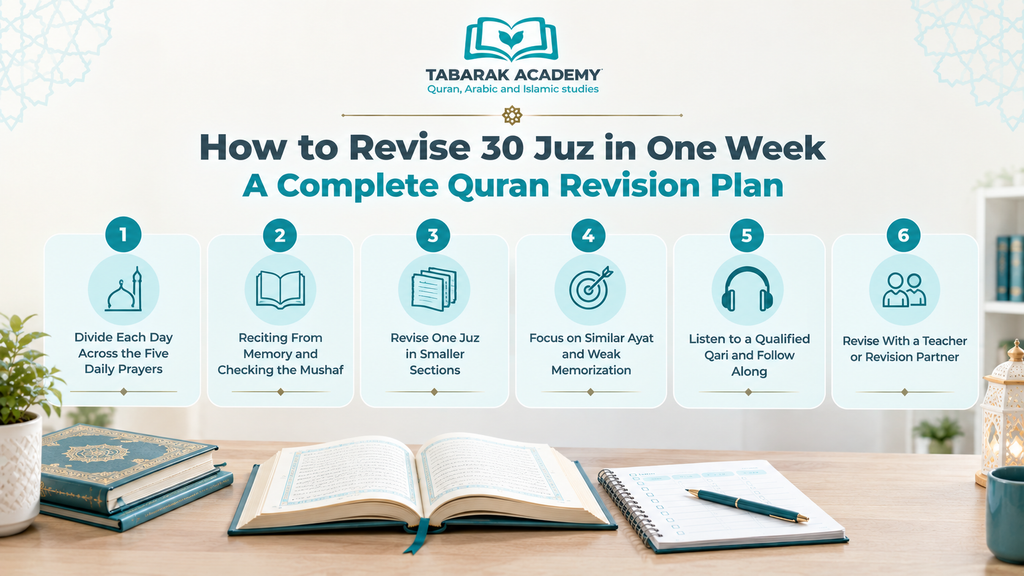
1. Divide Each Day Across the Five Daily Prayers
One of the easiest ways to maintain a demanding revision target is to connect it to the five daily prayers. Instead of trying to complete the entire daily portion in one long sitting, divide it into smaller sessions.
For example, a learner revising four juz could read approximately 17 pages after each prayer. For a five-juz day, the target becomes 20 pages per prayer.
This approach provides regular checkpoints and makes it easier to see how much remains. If your schedule is busy, use two longer sessions and smaller portions around the remaining prayers.
Children may need shorter sessions with parental support, while adults can adjust the timing around work and family responsibilities.
2. Reciting From Memory and Checking the Mushaf
Active recall is a valuable way to test whether your Hifz is available without looking. Begin with a familiar passage, close the Mushaf, and recite as much as you can remember.
When you reach a mistake, pause and check the correct wording. Mark the difficult ayah or return to it later in the session. This helps you identify gaps instead of relying only on visual reading.
In addition, you can Use the Mushaf as a Correction Tool. After completing a portion from memory, open the Mushaf and compare your recitation with the written text. Pay attention to omitted words, similar ayat, and places where you stopped or started incorrectly.
A qualified teacher in a Quran recitation course can also listen to your recitation and help identify errors that you may not notice yourself. For children, a parent or teacher can make this process encouraging rather than stressful.
3. Revise One Juz in Smaller Sections
Another practical method is to divide each juz into smaller portions throughout the day. You can revise half a juz in the morning, a quarter after Dhuhr, and the remaining quarter later in the day to maintain concentration.
This approach is especially useful when returning to Hifz after a long break. Smaller portions make it easier to repeat weak passages, manage mental fatigue, and continue your revision without feeling overwhelmed.
Begin each session by reading the assigned portion from the Mushaf and identifying difficult words or ayat. Then close the Mushaf and recite from memory, checking the text whenever you make a mistake.
Finally, connect the end of one section to the beginning of the next. This strengthens the continuity of your memorization and helps you move between passages without relying entirely on visual prompts.
Experience Our Interactive Learning
Curious about how we teach? Watch these brief video clips from our recent live sessions to see our structured curriculum, advanced learning platform, and dynamic student-teacher interactions firsthand.
4. Focus on Similar Ayat and Weak Memorization
Similar ayat, known as mutashabihat, can be challenging during a fast revision cycle. A learner may know the general meaning and still confuse the exact wording or order of verses.
When you encounter a repeated phrase, compare the surrounding ayat and note the difference. Ask yourself what comes immediately before and after the passage. This makes revision more than a visual reading exercise.
Try to Connect Each Passage to Its Context as well. Understanding the main subject of a surah can help you remember the sequence of its verses. A short review of the meaning or a reliable tafsir summary can be useful before revising a difficult passage.
Keep this step focused. During a one-week revision plan, the priority is accurate recitation and retrieval, not completing an extensive tafsir study.
Our teachers in the Quran hifz course can help you identify your weak points in a one-to-one session where you can make a plan to revise better.

5. Listen to a Qualified Qari and Follow Along
Listening to a reliable reciter is another way to support Quran revision. Choose one reciter whose pronunciation and recitation style you can follow comfortably.
You can listen to a short passage before reciting it, then repeat the same portion independently. This is particularly useful for children and learners who benefit from auditory repetition.
Then Combine Listening With Your Own Recitation. Use audio as support rather than a substitute for reciting yourself. After listening, close the Mushaf and check whether you can reproduce the ayat accurately.
A teacher can help you select suitable audio and correct Tajweed issues such as articulation, elongation, and stopping rules. If you are learning online, a Tajweed lesson can also provide regular feedback.

6. Revise With a Teacher or Revision Partner
Reciting to another person is one of the most useful ways to test Hifz. A teacher or revision partner can notice mistakes, ask you to start from different ayat, and help you maintain a steady pace.
For adults, a scheduled session with a Quran teacher can create accountability around work and family commitments. For children, parents can encourage daily practice and arrange regular lessons with a qualified instructor.
Make Revision a Consistent Habit. If you have forgotten portions of the Quran, do not assume that a single week will restore every passage. Use the week to assess your current level and build a repeatable routine.
A consistent revision program is essential for maintaining memorization. You can learn more about Tajweed classes and develop a stronger recitation foundation with qualified guidance.
Read also : Balancing Hifz and Revision Made Easy: 5 Tools
How to Revise 30 Juz in One Week
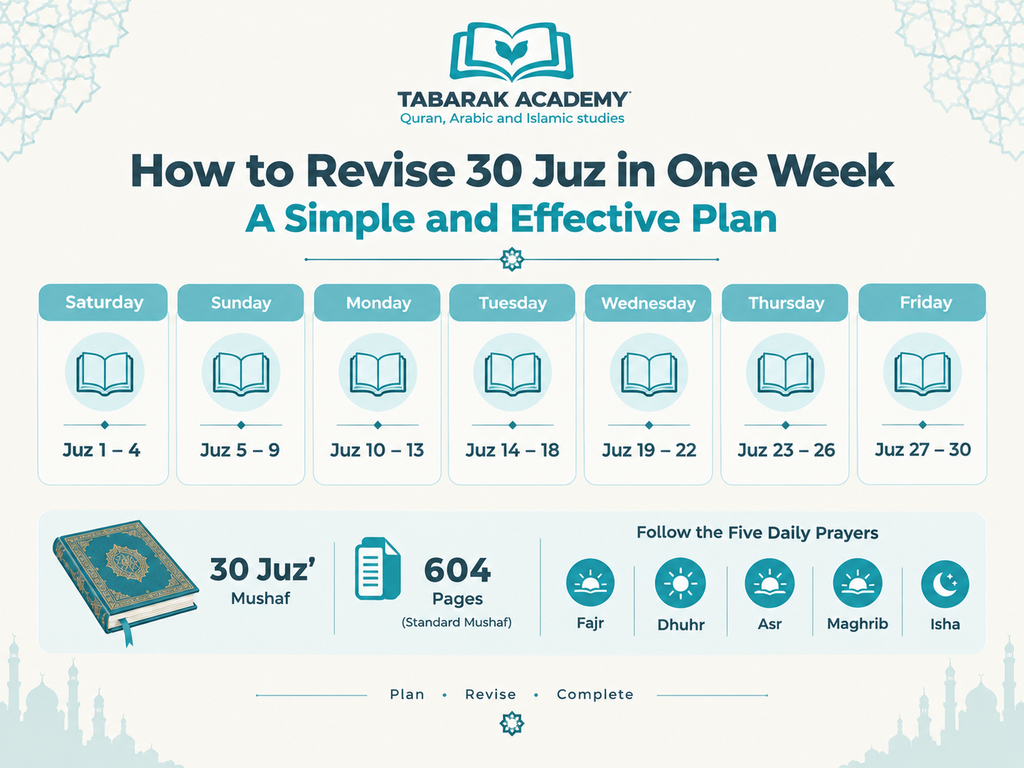
The simplest way to revise 30 juz in one week is to complete approximately 4.3 juz each day. Using the common 604-page Madinah Mushaf, this equals about 86 pages daily, or roughly 17 pages after each of the five prayers.
A seven-day revision plan should divide the 30 juz into manageable daily portions. You can follow a whole-number schedule of four or five juz per day, or distribute the pages more evenly across the week.
Your Weekly Revision Target
For a learner using a 604-page Madinah Mushaf, the daily target is approximately 4.3 juz or 86 pages. These are planning estimates, and your actual pace depends on your recitation speed, accuracy, and how much of the Quran you can recall confidently.
Seven-Day Juz Revision Schedule
This schedule covers all 30 juz in one week, with four or five juz assigned each day. If you prefer equal portions, divide the total by seven and aim for about 4.3 juz daily.
Read also: How to Revise the Full Quran in 3 Days: 5 Methods
| Day | Juz to revise |
| Saturday | Juz 1–4 |
| Sunday | Juz 5–9 |
| Monday | Juz 10–13 |
| Tuesday | Juz 14–18 |
| Wednesday | Juz 19–22 |
| Thursday | Juz 23–26 |
| Friday | Juz 27–30 |
How to Adjust Your Revision Plan for Children and Adults
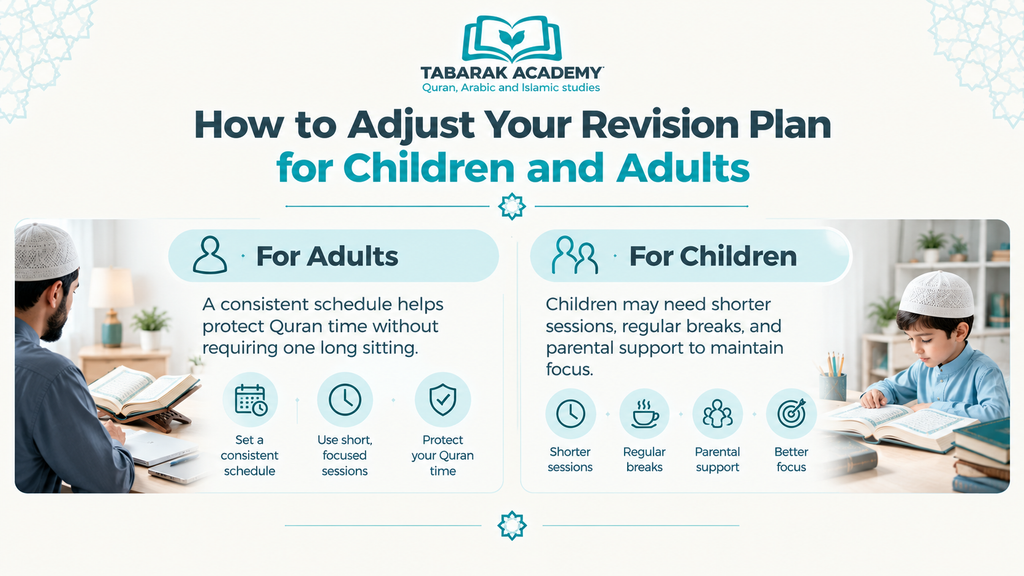
The best way to revise 30 juz in one week depends on the learner’s age, current Hifz level, and available time. Children and adults can follow the same overall goal while using different daily portions and session lengths.
For Adults
Adults with work and family responsibilities can divide their revision between early mornings, prayer breaks, and evenings. A consistent schedule helps protect Quran time without requiring one long sitting.
If you are returning to Hifz after a long break, start with manageable portions and gradually increase your daily target. A qualified Quran teacher can assess your recitation and help you choose a suitable revision plan.
For Children
Children may need shorter sessions, regular breaks, and parental support to maintain focus. Their daily target should reflect their reading fluency, memorization level, and ability to recite accurately.
Parents can encourage daily practice and arrange regular lessons with a qualified instructor. A supportive routine helps children build confidence while strengthening their Quran memorization.
Step Inside Our Virtual Classrooms
See our engaging teaching methods in action! watch real snippets of our live classes and discover how our expert instructors make learning interactive, memorable, and inspiring for every student.
Strengthen Your Quran Revision With Qualified Teachers
A demanding Hifz revision plan becomes easier to maintain when you receive guidance on pronunciation, recitation, and memorization. Tabarak Academy offers online Quran learning for children and adults, helping learners build a consistent foundation.
Through structured Tajweed, Quran recitation, and Arabic lessons, students can work on their individual learning needs. Regular feedback can help identify weak passages and support more accurate independent revision.
Whether you are rebuilding your Hifz after a break or improving your recitation before starting a weekly revision cycle, qualified teachers can provide the direction you need. Choose a learning routine that fits your schedule and supports long-term progress.
Our Quran Memorization / Hifz Courses
- Online Hifz Program
- Juz 30 Memorization Course
- Hifz for Kids Course
- Hifz for Adults Course
- Hifz for Sisters Course
- Short Surah Memorization Course
- Hifz Ijazah Course

Conclusion
Revising 30 juz in one week requires a clear plan, consistent effort, and realistic daily targets. Dividing the Quran across the five prayers or several focused sessions can make the workload easier to manage.
Active recall, smaller revision portions, listening to a Qari, and reviewing difficult passages can strengthen your memorization. Choose the methods that match your current Hifz level and available time.
Remember that completing a one-week revision plan is only one step in maintaining your Hifz. Continued daily revision is essential for protecting what you have memorized and improving your recitation.
The main takeaway is that completing one week of revision is a milestone, not the end of Hifz maintenance. Continue with a sustainable daily routine, review difficult passages, and seek qualified feedback to strengthen your memorization over time.
FAQs
Is it possible to revise 30 juz in one week?
Yes, it is possible for a learner with established memorization and enough daily time. You need approximately 4.3 juz per day, but the actual time depends on your recitation speed and how much of the Quran you can recall accurately.
How many pages of Quran should I revise each day?
Using a 604-page Madinah Mushaf, revise about 86 pages daily to complete 30 juz in seven days. You can divide this into roughly 17 pages after each prayer.
What is the best way to revise 30 juz in one week?
A combination of active recall, reciting to a teacher, and dividing the daily portion into smaller sessions is a practical approach. Choose the methods that help you maintain accuracy and consistency.
Can I revise the Quran in one week if I have forgotten parts of my Hifz?
Yes. You can use the week as a starting point, but you may need more time to restore weak memorization. Focus on rebuilding accuracy with smaller portions and regular teacher feedback before increasing your daily target.
How can children revise the Quran in one week?
Children can follow a shorter, age-appropriate schedule with parental support, rest periods, and teacher supervision. Their daily target should be based on their fluency and current memorization level rather than an adult’s pace.
How long does it take to revise 30 juz?
A week. But it is worth noting that the time varies according to the learner’s reading speed and accuracy. A full weekly revision cycle requires approximately 86 pages per day, so plan several focused sessions rather than one continuous sitting.