

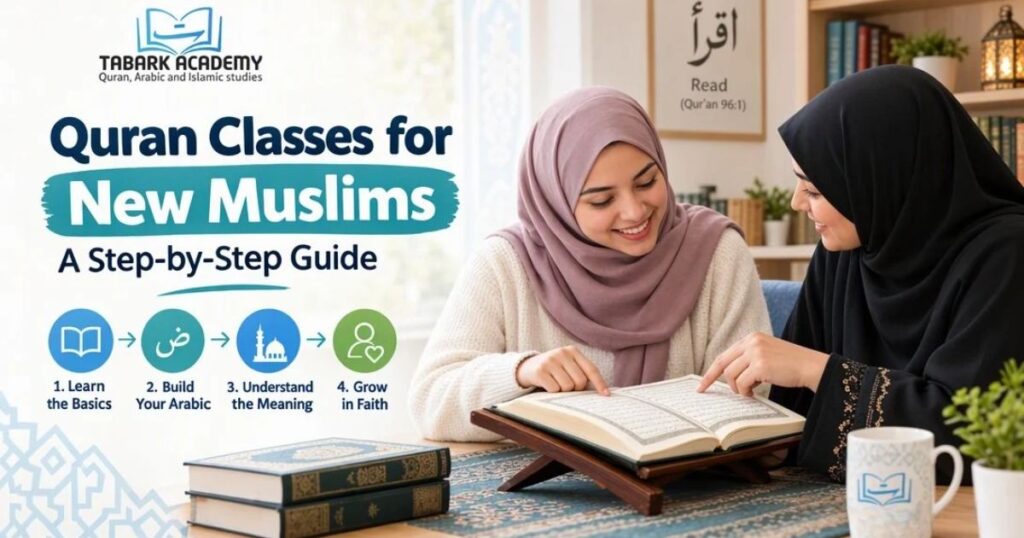
Quran Classes For New Muslims – A Step-by-Step Guide
You’ve said your Shahada, or you’re getting close. Now you open the Quran and see a script you can’t read, in a language you don’t speak, with rules you’ve never heard of. Many reverts in this position don’t know where to start, so they put it off.
Quran classes for new Muslims solve that by giving you a clear order of what to learn first, a teacher who corrects your life, and a pace that fits your life.
This guide explains what good Quran classes for new Muslims cover, what order to learn things in, how long each stage usually takes, and how to choose a teacher.
It also shows how Tabarak Academy structures its New Muslim Course, so reverts learn the Quran and the practice of Islam together instead of as two separate projects.
What you’ll learn in this article
- What Quran classes for new Muslims are and how they differ from regular Quran courses.
- The order to learn things in, so you can pray correctly while you’re still learning to read.
- What a complete New Muslim Course covers beyond recitation.
- Mistakes that slow reverts down, and how to avoid them.
- How to choose the right online teacher and academy.
What Are Quran Classes For New Muslims?
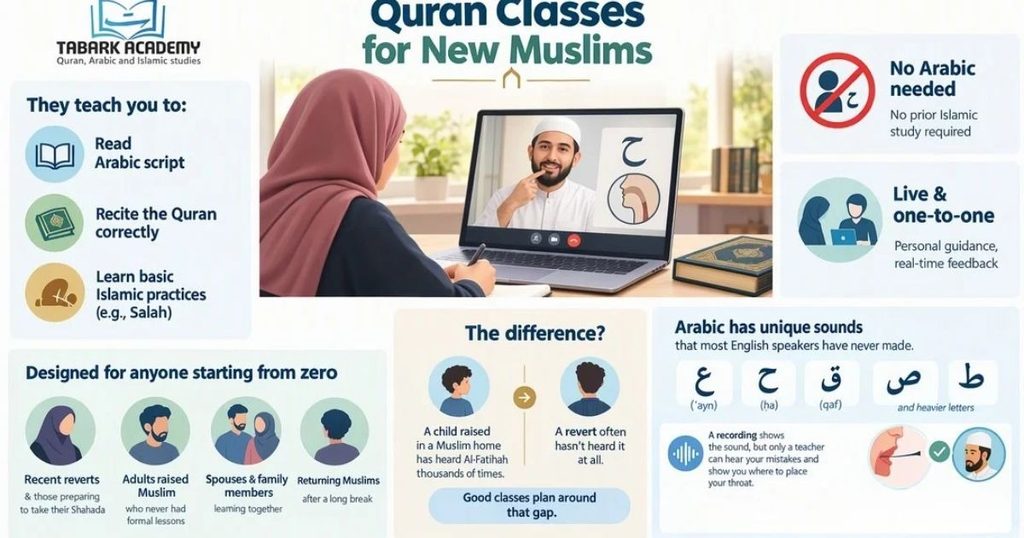
Quran classes for new Muslims are beginner lessons, usually live and one-on-one, that teach reverts to read Arabic script, recite the Quran correctly, and understand the basic practices of Islam that depend on the Quran, such as Salah. They assume no Arabic and no background in Islamic study.
The difference from a standard Quran course is the starting point. A child raised in a Muslim home has heard Al-Fatihah thousands of times before their first lesson. A revert often hasn’t heard it at all. Good classes plan around that gap instead of ignoring it.
Who these classes are designed for?
These classes work for anyone starting from zero. That includes:
- Recent reverts, and people preparing to take their Shahada
- Adults raised Muslim who never had formal Quran lessons
- Spouses and family members of Muslims who are learning alongside them
- Muslims coming back to the Quran after a long break
Arabic has sounds most English speakers have never made. Examples are ع (ʿayn), ح (ḥa), ق (qaf), and the heavy letters such as ص and ط.
A recording shows you what a sound should be, but only a teacher can hear that your ح is coming out as an English “h” and show you where to place your throat. That live correction is the main reason Quran classes for new Muslims online work better than self-study apps alone.
What A New Muslim Course Teaches Beyond The Quran?
A New Muslim Course is an online program that teaches non-Arab Muslims and reveres the basics of Islam: the pillars, how to carry out each one, and how to read the Quran. Recitation is one part of it.
A revert also needs to know how to pray, fast, give Zakat, and make dua, and those skills depend on what they’re learning in the Quran.
At Tabarak Academy, the New Muslim Course pairs Quran lessons with this practical foundation. Reverts don’t have to wait until they can read fluently before they start practicing their faith with confidence.
A. The five pillars and how to practice each
A complete course teaches each pillar as something you do, not only as an idea:
- Shahada: what the testimony means and what it commits you to
- Salah: Wudu, the five daily prayers, the positions, and what to recite in each one
- Sawm: the rules of Ramadan fasting, who is exempt, and how to make up missed days
- Zakat: who has to pay it, the nisab threshold, and who can receive it
- Hajj and Umrah: the steps of each, and how they differ
B. Dua, character, and belonging to the Ummah
New Muslims also need daily supplications, such as the duas for waking, eating, and entering the home, as well as Islamic manners. They also need something that rarely shows up in a syllabus: a sense of connection to the wider Muslim community.
A patient teacher who answers questions without judgment is often a revert’s first real link to the Ummah. That relationship matters as much as the curriculum.
Read also: Noorani Qaida Course Online
The Prayer-First Path: the order to learn in
Most courses teach in strict order: alphabet, then reading, then Tajweed, then Surahs. That is fine for children, but it has a real cost for adults.
Salah is required from the day you become Muslim, and every rak’ah requires Al-Fatihah. A revert who waits until they finish Noorani Qaida before learning Al-Fatihah might go months without praying correctly.
The Prayer-First Path runs two tracks at the same time:
- Worship you need now: learn Al-Fatihah and two or three short Surahs by listening and repeating with a teacher, so you can pray from the first weeks.
- Weading skill: learn Arabic letters through Noorani Qaida so that, over time, you read those same Surahs from the Mushaf instead of from memory.
When the two tracks meet, and you can read the Surahs you already pray with, both your reading and your memorization get stronger.
Stage 1: Wudu, Salah, and Al-Fatihah (weeks 1–4)
This stage covers how to make Wudu, the movements of prayer, and Al-Fatihah recited correctly.
Letter-by-letter accuracy in Al-Fatihah matters most here. A mistake that changes a vowel can change the meaning, so a teacher’s correction is most valuable at this point.
Stage 2: Arabic letters with Noorani Qaida (months 1–3)
Noorani Qaida is a beginner primer that teaches the Arabic letters and their sounds. It then moves through letter shapes, short vowels (fatha, kasra, damma), long vowels, sukoon, tanween, and shaddah. Each lesson builds on the one before it, so understanding matters more than speed.
Stage 3: Reading from the Mushaf (months 3–6)
Once letters join smoothly, you move to real Quranic text, usually starting with the short Surahs of Juz’ Amma that you already know.
How long this takes depends on how often you practice. Many beginners who take lessons several times a week and practice daily read simple verses within a few months. Practicing a little every day helps more than one long session a week.
Stage 4: Basic Tajweed and meaning (ongoing)
Tajweed is the set of rules for pronouncing the Quran as it was revealed. Beginners start with makharij (where each letter is pronounced from), then the rules of noon sakinah and tanween, madd (elongation), and qalqalah.
Alongside this, you learn the meaning of the Surahs you recite in prayer, so Salah becomes something you understand. If you’re unsure which stage you’re at, Tabarak Academy’s teachers start with a short level assessment and place you on the path from there. Nobody repeats lessons they don’t need.
Experience Our Interactive Learning
Curious about how we teach? Watch these brief video clips from our recent live sessions to see our structured curriculum, advanced learning platform, and dynamic student-teacher interactions firsthand.
Start Your Quran Learning Journey
Join Tabark Academy today for structured online lessons with qualified tutors, customized to fit your goals.
Book Your Free Trial LessonOnline Quran classes for new Muslims: what to expect in a lesson
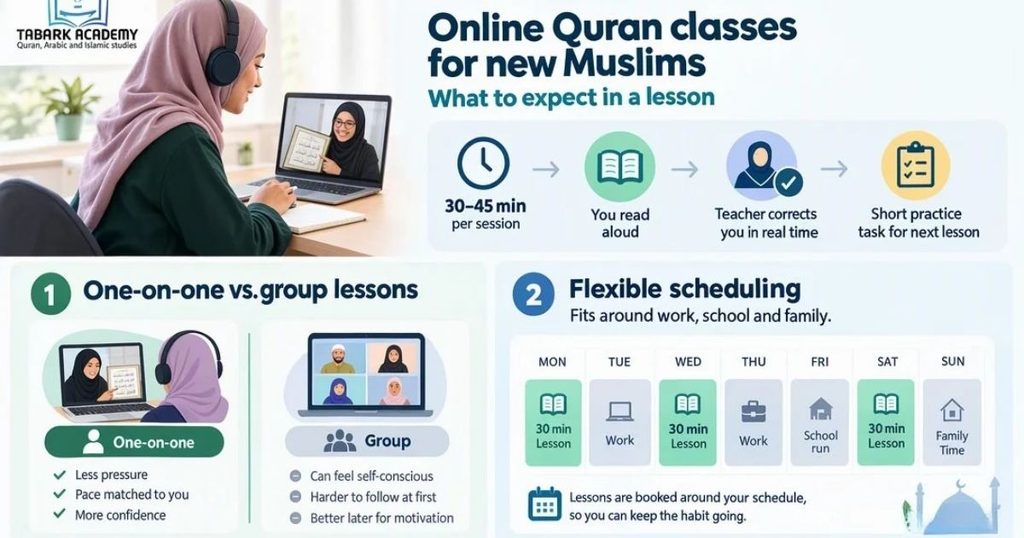
A typical session is 30 to 45 minutes over video. You read aloud, the teacher corrects you in real time, and you finish with a short practice task for the next lesson.
1. One-on-one vs. group lessons
For reverts, one-on-one classes are usually the better choice. Many adults feel self-conscious making mistakes in front of others, especially with sounds that feel strange at first.
A private lesson removes that pressure and lets the teacher change the pace from minute to minute. Group classes can help later for motivation and community, but they’re harder as a starting point.
2. Flexible scheduling around work and family
Online lessons fit around jobs, school runs, and time zones. This flexibility matters because the biggest risk for adult learners isn’t difficulty.
It’s missed lessons that turn into weeks off. Tabarak Academy’s Quran classes for new Muslims online are booked around your schedule, so you can keep the habit going even in busy seasons.
Common mistakes that slow reverts down
These come up again and again with adult beginners, and most are easy to avoid once you know about them.
1. Relying on transliteration for too long
Romanized text such as “Bismillahir Rahmanir Raheem” helps in the first week of prayer. Long term, it causes problems. English letters can’t show the difference between ه and ح, or between س and ص, so the mistakes get locked in. Use transliteration as a short bridge and drop it as soon as you can read the letters.
2. Memorizing Tajweed terms instead of applying them
Knowing that “ikhfa” means a hidden noon is useless if you can’t hear it in your own recitation. Good teachers have you apply each rule in real verses before you learn its name.
3. Trying to learn everything at once
Fiqh details, Arabic grammar, tafsir, and memorization all at once leads to burnout. Follow the stages above. Depth comes after the foundation.
4. Choosing a teacher only for their recitation voice
A beautiful reciter isn’t always a good teacher for beginners. Patience and clear explanation in your language matter more at this stage.
Read also:Which Surahs Should I Memorize First? A Beginner’s Guide
How To Choose The Right Teacher And Academy?
Use these questions when you compare Quran classes for new Muslims:
- Do they teach reverts specifically? Ask whether the teacher has worked with adult converts before, not only with children.
- Can they explain clearly in English? You need explanations you understand, not only demonstrations.
- Is there an assessment and a written learning plan? You should know which stage you’re in and what comes next.
- Do they cover Islamic practice, not only recitation? A revert needs Salah, Wudu, and the pillars along with the Quran.
- Are male and female teachers available? Many learners are more comfortable with a teacher of the same gender.
- How do they track progress? Regular feedback helps you stay motivated and shows you where to put your practice time.
Tabarak Academy built its New Muslim Course around these criteria, with qualified teachers, clear stages, and lessons that teach the Quran and the practice of Islam together.
Step Inside Our Virtual Classrooms
See our engaging teaching methods in action! watch real snippets of our live classes and discover how our expert instructors make learning interactive, memorable, and inspiring for every student.
Start Your Quran Learning Journey
Join Tabark Academy today for structured online lessons with qualified tutors, customized to fit your goals.
Book Your Free Trial LessonStart your Quran journey with Tabarak Academy today
You don’t need to know Arabic, and you don’t need to feel “ready.” You need a first lesson, a patient teacher, and a plan that gets you praying correctly while you learn to read.
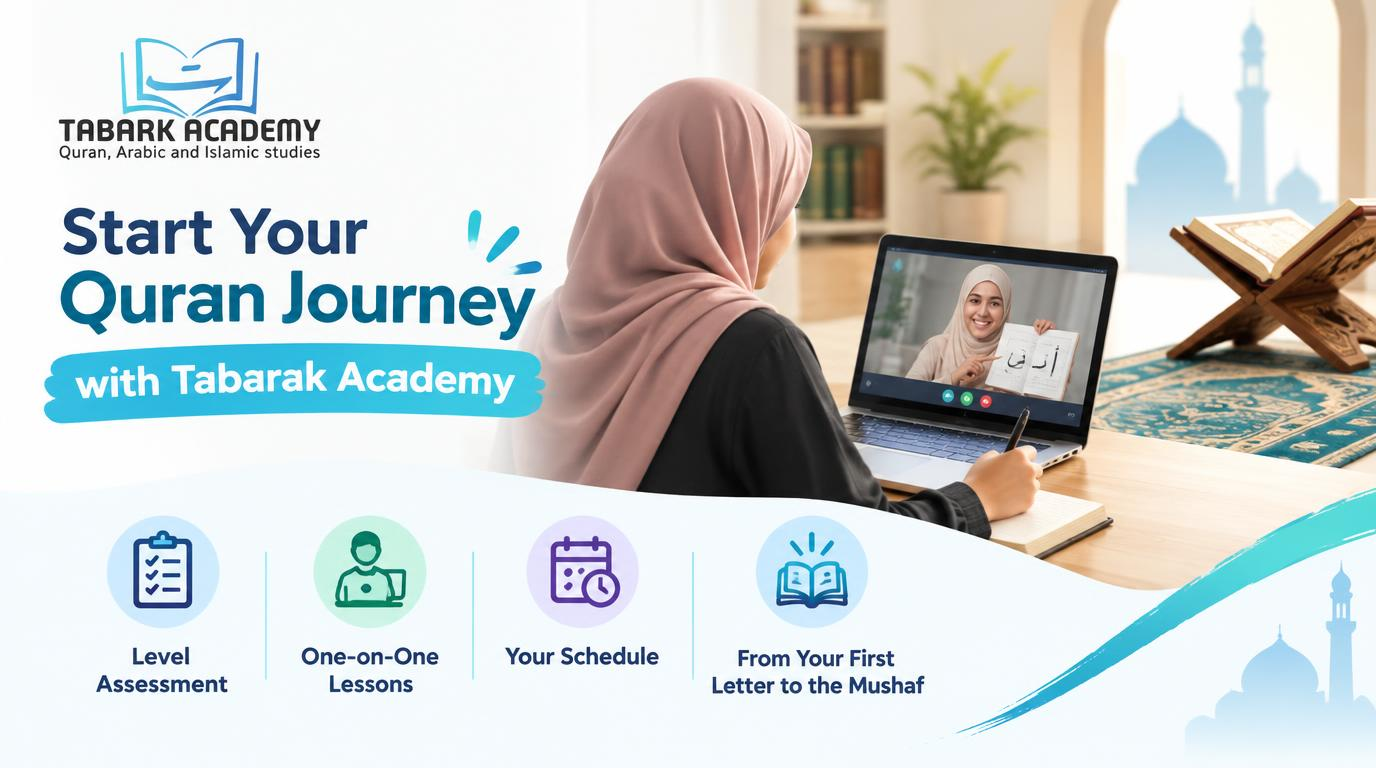
Tabarak Academy’s Quran classes for new Muslims give you a level assessment, one-on-one lessons on your schedule, and a clear path from your first letter to reading the Mushaf.
Book your first class now and recite your next Salah with confidence.
Our Quran Courses:
- Online Quran Classes for Beginners
- Online Quran Classes for Kids
- Online Quran Classes for Adults
- Online Quran Classes for Men
- Online Quran Classes for Sisters
- Quran Reading Course
- Quran Recitation Course
- Online Ijazah Course
- Online Qirat Course
- Weekend Quran Classes
- Al-Azhar Quran Course
- Noor Al-Bayan Course
Conclusion
Learning the Quran as a revert is a different starting point, not a harder one. The right Quran classes for new Muslims teach you what you need for worship first, build your reading through Noorani Qaida, add Tajweed in stages, and connect what you recite to what it means.
Avoid the common traps, like relying on transliteration too long, collecting terminology, and trying to learn everything at once, and choose a teacher who understands adult beginners.
The main takeaway: consistency matters more than speed. Short daily practice with live correction gets you further than occasional long sessions. With Tabarak Academy, that consistency comes with a structure, so each lesson builds on the one before it.
FAQs about Quran classes for new Muslims
New Muslims tend to ask the same few questions before their first lesson. Here are short, direct answers to the most common ones.
1. Do I need to know Arabic to join Quran classes for new Muslims?
No, you don’t need any Arabic. Quran classes for new Muslims start with the alphabet and teach reading step by step, with explanations in English.
2. How long does it take a new Muslim to read the Quran?
It depends on how often you practice. Many beginners who take regular lessons and practice daily can read simple verses within a few months. Fluent reading with Tajweed takes longer.
3. Are online Quran classes for new Muslims as effective as in-person classes?
Yes, for most learners. Live one-on-one lessons online give the same real-time pronunciation correction as in-person classes, with more flexible scheduling.
4. Can I choose a female or male Quran teacher?
Most reputable academies offer both. When you book Quran classes for new Muslims online, you can usually ask for a teacher of the same gender.
5. Can I pray before I can read the Quran?
Yes. You can and should pray from the start. Learn Al-Fatihah and a few short Surahs by listening and repeating with a teacher while you learn to read them from the Mushaf.
6. What is the difference between a Quran course and a New Muslim Course?
A Quran course focuses on reading and recitation. A New Muslim Course also teaches the pillars of Islam, Salah, Wudu, fasting, Zakat, and daily duas alongside the Quran.