


How to Teach a 4-Year-Old the Quran – A Step-by-Step Guide
Two minutes in, your four-year-old is upside down on the couch. She’s said the same verse wrong three times, and now she’s asking about snacks. Almost every parent hits this wall in the first week, and almost every parent reads it the same way: she’s too young.
She isn’t. Four-year-olds don’t learn the Quran the way older children do; they learn it through talqin (guided repetition), a rhythm of listening and echoing back, in sessions short enough to end before the fidgeting starts. No pressure, no drilling. Just a few minutes a day, done the right way.
Let’s find together the method itself in a simple 4-step framework, which surahs to begin with, and a weekly schedule built for a real four-year-old’s attention span. Then, We’ll understand why this age is such a good starting point and the small habits that quietly undo a child’s progress without anyone noticing
1. Use The Talqin Method With Young Children
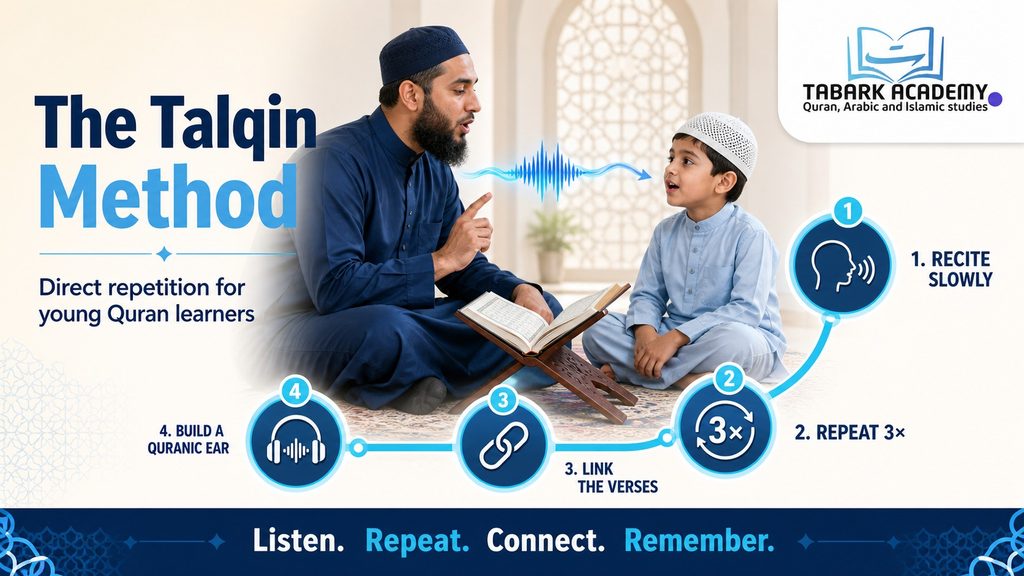
Talqin is the traditional method of teaching Quran by direct repetition. A teacher or parent recites a verse clearly, and the child repeats it back several times before moving on.
It’s how children have learned Quran for centuries, and it’s still the method certified teachers use today. But what is the correct talqin method for teaching a child the Quran?
a- How Direct Talqin Works
The process is simple by design. Recite one short verse slowly and clearly. Have your child repeat it back immediately, at least three times, until the pronunciation settles.
Only then move to the next verse — and once a short surah has two or three verses down, link them together before adding more. Rushing this step is the single most common reason memorization doesn’t stick.
b- Why Audio Repetition Builds A “Quranic Ear”
Before a child can repeat a verse correctly, their ear needs to recognize how it should sound. Playing short surahs from a reciter with clear, unhurried recitation; during quiet play, in the car, before naps, trains that recognition passively, without any “lesson” feel to it.
This matters more than it sounds. A child who has heard a surah dozens of times picks it up much faster than a child hearing it for the first time in the session itself.
Getting this pairing right; correct talqin plus the right listening habit, is exactly what a trained Quran teacher brings that a well-meaning parent without tajweed training sometimes can’t.
Tabarak Academy‘s Azhar-certified teachers are trained specifically in guiding this stage. Children build correct pronunciation from their very first verse, instead of picking up habits that have to be corrected later.
Watch Tabarak Academy in classes with young learners
Experience Our Interactive Learning
Curious about how we teach? Watch these brief video clips from our recent live sessions to see our structured curriculum, advanced learning platform, and dynamic student-teacher interactions firsthand.
2. Teach a 4-Year-Old the Quran in 4 Simple Steps
Talqin and listening are not the missed knowlegde by most parents. However, most of them don’t know how; a routine they can repeat every day without having to reinvent it each time.
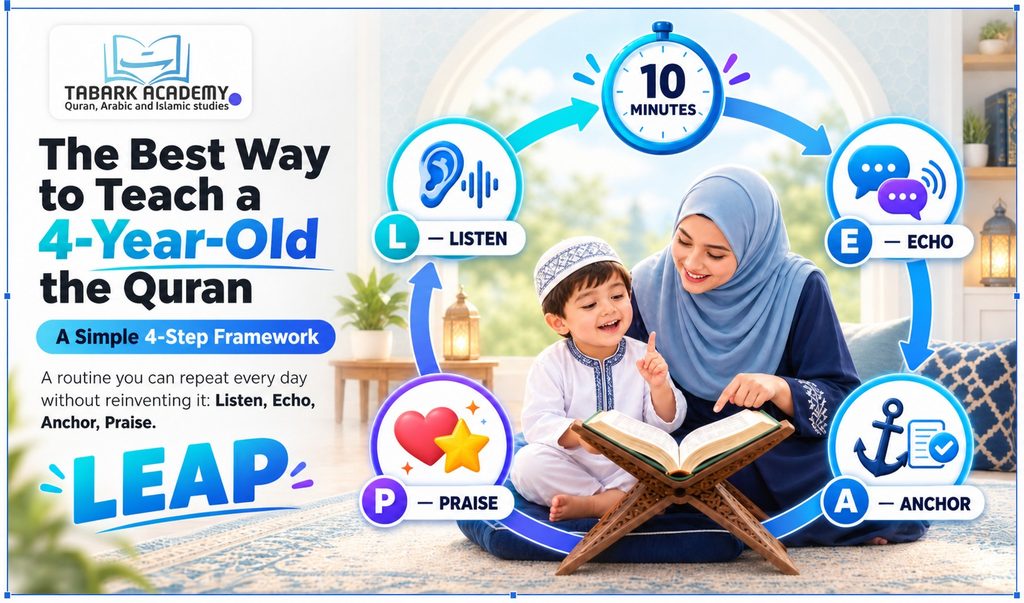
Many experienced Quran teachers organize this into four steps that fit easily into a 10-minute session, worth remembering as LEAP: Listen, Echo, Anchor, Praise.
a. Listen – Build The Quranic Ear First
Start each session by playing the target verse two or three times while your child simply listens. No repeating yet — this step exists purely to prime their ear for the sounds they’re about to produce.
b- Echo – Guided Repetition (Talqin)
Recite the verse yourself, phrase by phrase if it’s long, and have your child echo it back. Repeat this exchange three to five times before checking whether they can say it without your lead.
c- Anchor – Connect Sound To Sight
Even before a child can read, place an open mushaf in front of them, or a colored card showing the verse. This helps their eyes link shapes and word positions to sounds. That groundwork pays off later when formal reading begins.
d- Praise – Reward Progress, Not Perfection
Acknowledge the attempt, not just the correct result. A star on a simple progress chart works well. So does a specific compliment, like “you got the ending right that time.” Either builds the habit better than correcting every mispronunciation on the spot.
Read also: Guide to Memorizing the Quran with a 5-Year-Old Child
3. Choose Which Surahs To Start With
Not every surah is a good starting point for a 4-year-old. Picking the wrong one is a common reason children lose interest before they’ve memorized anything at all.
So, what are the best surahs to start the Quran hifz journey with your child?
a- Short Surahs From Juz Amma Work Best
Surahs from Juz Amma (the Quran’s final section) work well for beginners. Their verses are short, and many share similar rhyming endings.
That pattern makes them easier for a young child’s ear to predict and retain — the same reason rhyming children’s songs are easier to learn than free verse.
b- A Simple Starting Order
A practical starting sequence, moving from shortest to slightly longer:
- Surah Al-Fatiha (foundational and repeated in daily prayer, which reinforces it naturally).
- Surah Al-Ikhlas.
- Surah Al-Falaq.
- Surah An-Nas.
- Surah Al-Kawthar
- Surah Al-Asr.
Complete one surah fully; meaning your child can recite it start to finish without prompting, before introducing the next one. Layering partial surahs on top of each other is what usually causes verses to blur together.
A dedicated teacher sequences surahs this way by default and adjusts the pace to your child.
Read also: The best age to start Quran memorization for a child
4. Make A Weekly Schedule And Tips
Consistency matters more than intensity at this age. A predictable weekly rhythm prevents both burnout and the gap that resets progress.

A Simple 5-2 Weekly Rhythm
Five days for new memorization, two for review, repeated every week:
- Day 1: Memorize a new verse (10–15 minutes).
- Day 2: Reinforce yesterday’s verse before adding anything new.
- Day 3: Add the next verse and link it to the previous one.
- Review days: Recite everything memorized that week, start to finish.
How Long Each Session Should Really Take
Sessions can be between 5–10 minutes. At four years old, attention naturally drops off around that mark, and pushing past it tends to produce frustration rather than extra retention.
As a rough timeline: with daily 10-minute sessions on this rhythm, a child typically finishes a short surah like Al-Ikhlas in one to two weeks. It won’t happen in a single sitting, and it isn’t meant to.
Is 4 the Right Age To Start Teaching A Child the Quran?
Yes. At four, a child’s memory is highly flexible, and their ability to imitate sounds is at its strongest. That’s exactly what the method above depends on. Maybe, this age is the best for your child to start his Quran hifz journey, but why?

a- What Makes This Age Ideal For Memorization
A 4-year-old learns language the same way they learn a verse: by hearing it repeatedly and copying the sound before they understand the meaning. That’s a natural strength at this age, not a shortcut.
Historical accounts of early Muslim scholars describe memorization beginning well before the teenage years; several classical scholars are recorded as having completed the Quran by age six or seven. The exposure, though, typically started years earlier through listening.
b- Signs Your Child Is Ready To Start
You don’t need a formal readiness test. Look for these signs instead:
- They can sit through a short song, story, or nasheed without wandering off.
- They already try to hum or repeat words they hear often.
- They enjoy routine — the same bedtime story, the same car song.
If your child shows even one or two of these, they’re ready to begin with the steps above.
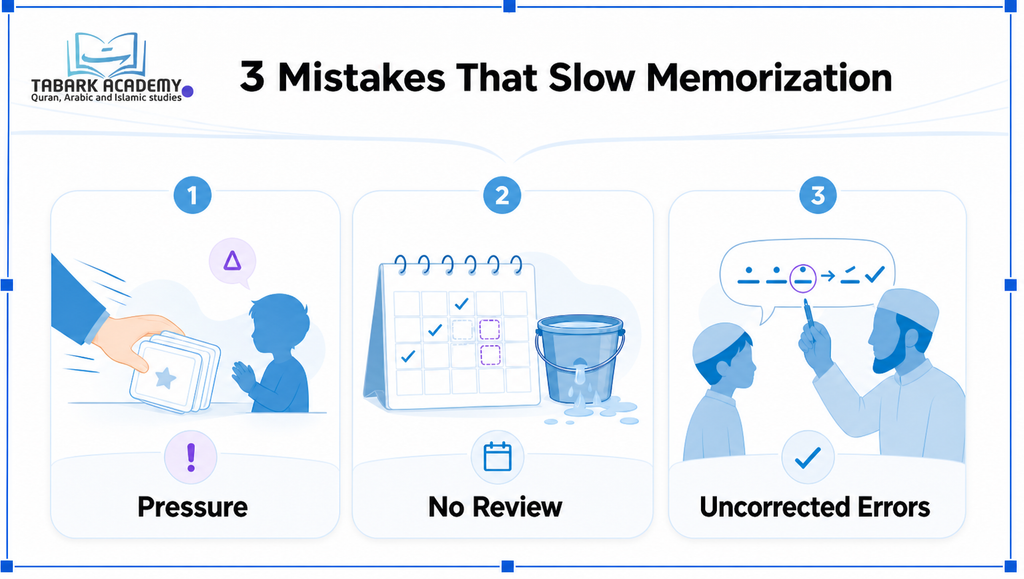
Common Mistakes That Slow Down Memorization
Most stalled progress traces back to one of three avoidable habits, not to the child’s ability.
1- Forcing Sessions Or Punishing Mistakes
The moment memorization feels like a punishment, a child starts associating the Quran with pressure instead of comfort.
The immediate goal at this age isn’t verse count; it’s building a positive association that lasts long after the counting starts to matter.
2- Skipping Review Days
New verses without review create a leaky bucket: the child adds a verse on Monday and has lost half of it by Thursday because nothing reinforced it in between. Review days aren’t optional filler; they’re what makes the new verses stick.
3- Letting Mispronunciation Go Uncorrected
A verse memorized incorrectly is far harder to unlearn than to have learned the first time correctly.
If you’re not confident your own recitation and tajweed are accurate, that’s the moment to bring in a qualified teacher. It’s better than risking an error your child memorizes as a habit.
Step Inside Our Virtual Classrooms
See our engaging teaching methods in action! watch real snippets of our live classes and discover how our expert instructors make learning interactive, memorable, and inspiring for every student.
Stop Waiting and Start your child’s Quran journey with expert guidance today
You don’t have to build this framework alone or worry about getting the pronunciation right yourself.
Tabarak Academy pairs your child with an Azhar-certified teacher trained in early-childhood Quran memorization. Monthly progress assessments let you see exactly how your child is advancing.
Tabarak Academy has over 25 years of experience, 1.5K+ certified teachers, and a 99% success rate across more than 6.8K students. Every program is one-on-one and built around your child’s pace, starting with a free trial class — no commitment required.

Check Our Courses
- Online Quran & Arabic Classes | Foundation
- Recitation Of Quran with Tajweed Course
- Islamic Studies Course Online
- Arabic Alphabet Learning Course
- Noorani Qaida Course for Adults
- Quranic Arabic Course for Kids
- Arabic and Quran Classes for Kindergarten
- Islamic Summer Camp
- Hifz for Kids Course
- Hifz Course for Sisters
- Hifz for Adults Course
- Online Hifz Program
- Noor Al-Bayan Course
Conclusion
Teaching a 4-year-old the Quran comes down to a few things done consistently. They are Correct talqin, Regular listening, Short surahs in the right order, Sessions under 10 minutes, and Praise instead of pressure. None of it requires rushing, and none of it requires your child to sit still for twenty minutes.
The children with the strongest memorization later are rarely the ones who started with the longest sessions. They’re the ones whose early sessions felt safe and enjoyable enough to want to come back to tomorrow. That, more than any single technique, is what makes four the right age to begin.
FAQs
What is the correct way to teach a 4-year-old the Quran?
The correct method is talqin: recite a short verse clearly and have your child repeat it back three or more times until it settles. Pair this with regular listening ahead of time, keep sessions to 5–10 minutes, and begin with short surahs.
What age should a child start learning the Quran?
Most Quran teachers consider ages three to four ideal for starting exposure and early memorization. A young child’s memory is especially flexible at this age, and their ability to imitate sounds is at its strongest. Formal reading instruction usually follows a bit later.
How long should a daily Quran session be for a 4-year-old?
A daily session should last 5 to 10 minutes, matching a young child’s realistic attention span. Longer sessions tend to produce frustration rather than extra retention at this age.
Which surah should a 4-year-old memorize first?
Surah Al-Fatiha is a strong first choice because it’s repeated daily in prayer, which reinforces it naturally. Short surahs from Juz Amma, like Al-Ikhlas, Al-Falaq, and An-Nas, are also ideal starting points due to their short verses and similar endings.
Should I teach my child myself or find a Quran teacher?
You can teach your child yourself if your own recitation and tajweed are accurate, since incorrect pronunciation is hard for a child to unlearn later. If you’re unsure of your own recitation, a certified teacher removes that risk from the start.
How do I keep a 4-year-old motivated to memorize Quran?
Use specific praise, a simple progress chart with stars or stickers, and small celebrations when a surah is completed. Keep the tone pressure-free — the goal at this age is building a love for the Quran, not maximizing verse count.