


A Realistic Hifz Timeline For Children
Most parents begin their child’s hifz journey with genuine enthusiasm but no clear roadmap. A realistic hifz timeline for children is not just about setting daily targets; it is about matching expectations to development, capacity, and real life.
What separates children who complete hifz from those who stop midway is rarely natural ability. It is structure, consistency, and one chronically underused factor: understanding what is being memorized.
Arabic comprehension changes how deeply the brain stores Quranic verses and opens entirely new directions of engagement with the Quran’s meaning.
What You Will Learn In This Article:
- How to build a realistic hifz timeline for children based on age and cognitive stage.
- Why Arabic understanding is the most powerful long-term retention tool available.
- Stage-by-stage daily targets from age four through thirteen.
- The most common timeline mistakes that cause dropout and how to avoid them.
- Revision structures that prevent forgetting without overwhelming the child.
Discover What Do Children Achieve in These Online Quran Classes ?

Building A Realistic Hifz Timeline For Children That Matches Their Stage
A realistic hifz timeline for children must be calibrated to the child’s current stage of cognitive development. What a ten-year-old can absorb in a single session differs fundamentally from what a six-year-old retains.
Ignoring this difference produces timelines that feel like punishment rather than progress. The plan must fit around school demands, daily energy, and the child’s natural attention cycle; not override them.
1. How Children Memorize Differently At Each Age
Children under seven absorb language primarily through listening and repetition rather than reading. They encode sounds through familiarity and emotional association, making audio-first approaches far more effective than formal sitting sessions.
Between seven and ten, children develop the ability to link written text to sounds they recognize aurally. Structured memorization becomes genuinely productive at this stage, with sessions ideally kept between twenty and thirty minutes.
From eleven onward, children process context more effectively and sustain longer focused sessions. This is exactly when introducing basic Arabic vocabulary produces measurable gains in how quickly new verses stick and how rarely they fade.
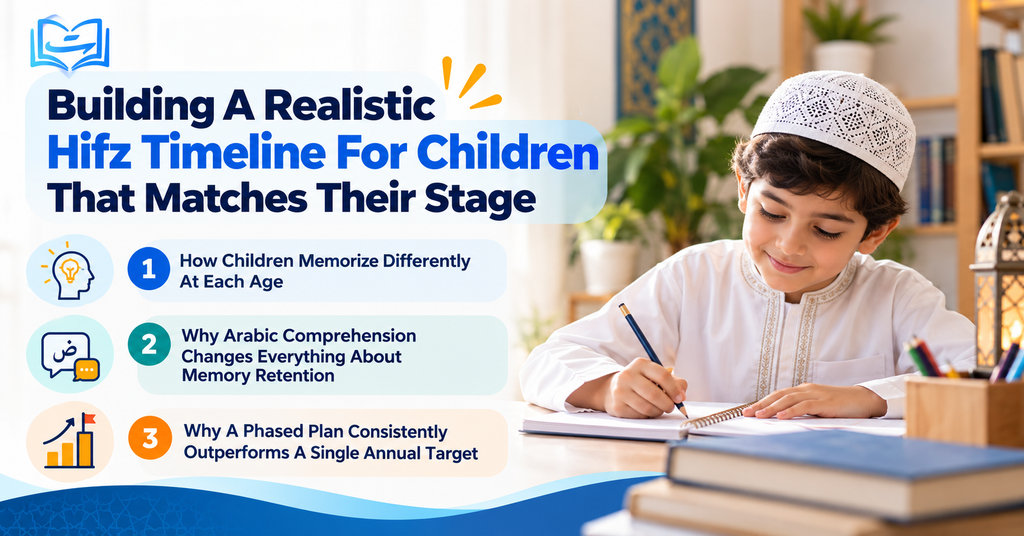
2. Why Arabic Comprehension Changes Everything About Memory Retention
Memorizing a word you understand activates semantic memory, which holds information significantly longer than phonetic memory alone. A child memorizing “rabbana” as a sound sequence forgets it faster than a child who knows it means “our Lord.”
This semantic connection creates two retrieval paths: one through sound, one through meaning. When phonetic memory weakens through time or distraction, the meaning-based path preserves the verse. Understanding the importance of the Arabic language for hifz is therefore not a side consideration.
Arabic study during the hifz years is not a competing priority. It is the tool that makes every hour of memorization more productive, while simultaneously unlocking the Quran’s deeper layers of meaning for the child in ways that pure recitation cannot provide.
3. Why A Phased Plan Consistently Outperforms A Single Annual Target
A phased timeline breaks a long journey into monthly checkpoints the child can see and feel. Parents across the US, UK, Canada, UAE, Malaysia, and Germany consistently find their children respond better to short-range visible goals than to abstract annual juz counts.
Each phase should specify the daily new target, the revision load, and a built-in weekly rest day. A child who knows what a successful week looks like is far more likely to begin each session without resistance or negotiation.
Tabarak Academy structures every hifz program around this phased approach, pairing new memorization with Arabic comprehension from the first session.
Every teacher is trained to adapt the plan as the child grows, ensuring no child is ever held to a target that no longer fits their reality.
Experience Our Interactive Learning
Curious about how we teach? Watch these brief video clips from our recent live sessions to see our structured curriculum, advanced learning platform, and dynamic student-teacher interactions firsthand.
Start Your Quran Learning Journey
Join Tabark Academy today for structured online lessons with qualified tutors, customized to fit your goals.
Book Your Free Trial LessonHow Arabic Learning Opens Deeper Directions Of Understanding The Quran
Most hifz programs treat Arabic as a separate, optional track. This is a structural error that costs children both retention strength and the opportunity to genuinely connect with what they are memorizing.
Children who receive even foundational Arabic instruction during their hifz years consistently outperform peers in retention, recitation fluency, and the depth of their personal relationship with what they recite.
1. Arabic Root Words Turn New Verses Into Familiar Territory
The Arabic root system means that understanding one root word unlocks recognition across dozens of related forms throughout the Quran.
A child who learns the root K-T-B (writing) immediately begins recognizing kitab, maktub, and kataba across multiple surahs without extra effort.
This recognition reduces the cognitive load required to memorize new verses. When the brain encounters familiar semantic patterns, it processes and stores new content faster than when encountering entirely unfamiliar material.
Learn Arabic language at any foundational level during the hifz years, and the return on that investment compounds across every single juz the child memorizes from that point forward.
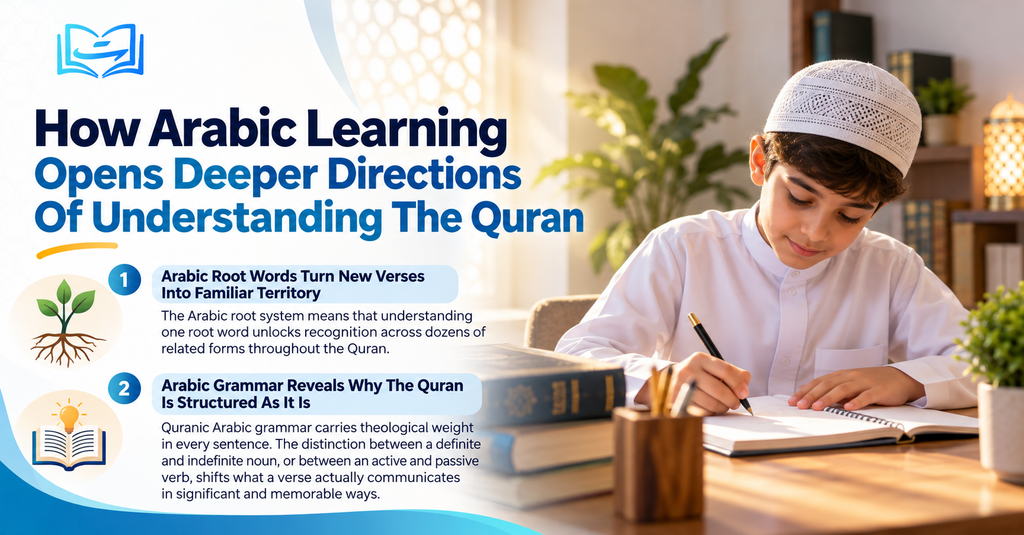
2. Arabic Grammar Reveals Why The Quran Is Structured As It Is
Quranic Arabic grammar carries theological weight in every sentence. The distinction between a definite and indefinite noun, or between an active and passive verb, shifts what a verse actually communicates in significant and memorable ways.
A child who grasps even basic grammatical concepts begins asking questions about verses rather than simply reciting them. This active engagement creates deeper neural encoding that strengthens long-term retention in ways that rote repetition alone cannot achieve.
Tabarak Academy’s Quranic Arabic grammar course introduces these concepts at an age-appropriate pace, so children build genuine comprehension without the intimidation of full classical Arabic study alongside their memorization work.
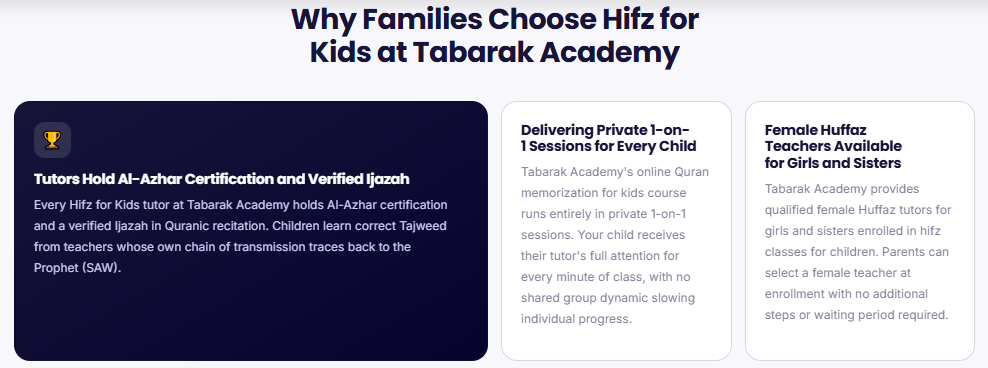
Check Why Families Choose Hifz for Kids at Tabarak Academy
The Stage-By-Stage Roadmap Parents Need To Plan Effectively
No single daily target fits every child, but developmental age provides a reliable planning framework. The roadmap below reflects what is genuinely achievable and sustainable across diverse school systems and daily routines.
Understanding which stage your child is in removes the damaging habit of comparing their progress to another child’s pace. Each stage has its own distinct goal and its own valid form of success.
1. Ages Four To Six: Audio Exposure Before Formal Memorization
At this stage, teaching a 4-year-old the Quran means prioritizing listening over sitting. Play Quran recitation during car journeys, mealtimes, and bedtime routines. The goal is familiarity and affection, not measurable daily output.
Target two to four short ayahs per week through pure audio repetition with a parent present. Pronunciation accuracy matters far more than quantity; mispronunciations that solidify now are genuinely difficult to correct at age nine.
Avoid testing or formal assessment entirely at this age. Positive emotional associations built with the Quran during this phase fuel every subsequent stage of the hifz journey more powerfully than any schedule or structure can.
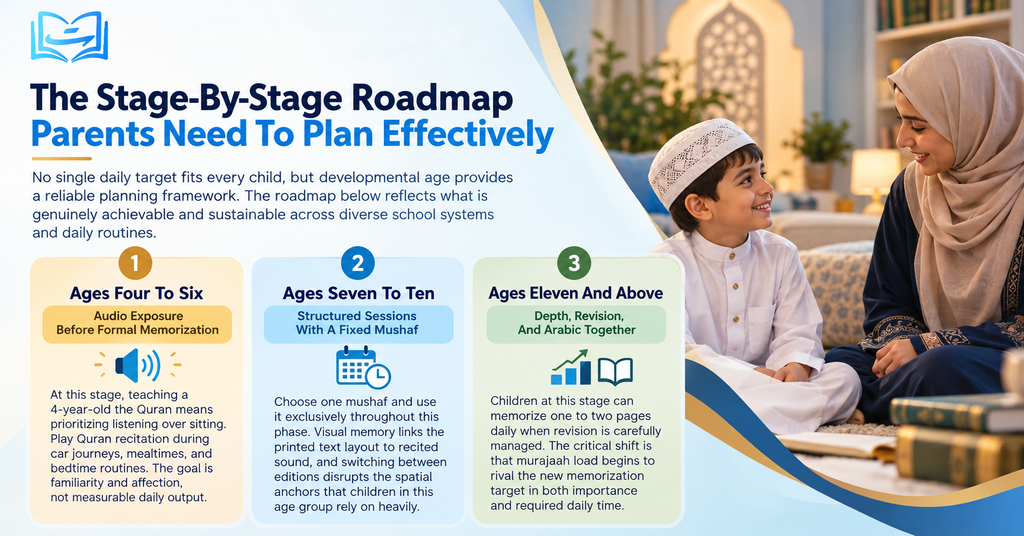
2. Ages Seven To Ten: Structured Sessions With A Fixed Mushaf
Choose one mushaf and use it exclusively throughout this phase. Visual memory links the printed text layout to recited sound, and switching between editions disrupts the spatial anchors that children in this age group rely on heavily.
Target half a page to one full page daily, five or six days per week. Online Quran learning for kids at this stage can be highly effective when sessions are supervised, time-bounded, and tied to a consistent daily revision routine.
Introduce two to four new Arabic vocabulary words weekly alongside memorization. Understanding words like “rahim” (merciful) or “sami'” (all-hearing) creates semantic anchors that protect similar-sounding verses from being confused or forgotten during review.
3. Ages Eleven And Above: Depth, Revision, And Arabic Together
Children at this stage can memorize one to two pages daily when revision is carefully managed. The critical shift is that murajaah load begins to rival the new memorization target in both importance and required daily time.
A structured daily hifz revision guide should divide review into three tiers: recent content from the past week, mid-term content from the past month, and older sections revisited on a monthly rotation.
Introduce basic Quranic Arabic grammar at this stage. When a child recognizes verb patterns and noun structures that repeat across the Quran, longer surahs become less daunting and new memorization accelerates in ways that surprise most parents.
Read also: How To Memorize The Quran Without A Teacher: 10 Helpful Steps
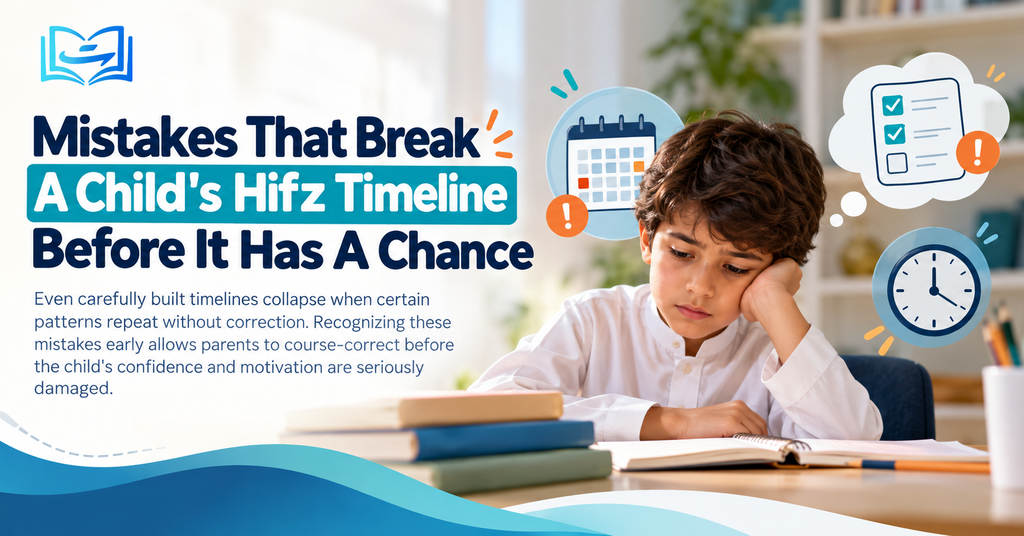
Mistakes That Break A Child’s Hifz Timeline Before It Has A Chance
Even carefully built timelines collapse when certain patterns repeat without correction. Recognizing these mistakes early allows parents to course-correct before the child’s confidence and motivation are seriously damaged.
Families in the US, UK, Canada, Australia, Germany, Bahrain, Egypt, and the Gulf encounter remarkably similar challenges regardless of their cultural context. The causes are universal; so are the practical solutions.
1. Prioritizing New Memorization While Neglecting Consistent Revision
Memorizing without reviewing is the most common and most structurally damaging mistake in children’s hifz programs. A child who memorizes ten juz without a solid revision system will lose significant portions within months of achieving them.
Understanding why you forget what you memorize of the Quran makes this clear: memory decays predictably unless reinforced at specific intervals. Murajaah is the preservation system, not an optional supplement added when time allows.
A daily murajaah plan for hifz students should allocate equal or greater time to revision than to new memorization, particularly during exam periods when new learning must be temporarily reduced.
2. Maintaining Rigid Targets Across Very Different Seasons
A child’s memorization capacity shifts with school workload, health, emotional state, and seasonal routine. Expecting identical daily output during an exam week and a summer holiday places the child in an impossible position that breeds guilt rather than growth.
Build the baseline target around the child’s most demanding week, not their most productive one. Any output above that baseline is a genuine achievement; output at that level is a fully successful day by any honest measure.
When a child starts feeling like giving up hifz, inflexible targets are almost always a primary cause. Revising the plan is not failure; it is the most responsible and effective form of hifz management available to a parent.
Start Memorizing Short Surahs With a Free Class Now

A Practical Reference Timeline For Planning By Age Group
The table below provides a planning baseline by age, session length, and realistic annual output. These ranges reflect consistent daily practice with a functioning revision system properly in place.
Use these figures as a starting framework, not a performance benchmark. A child progressing slightly below these ranges with strong retention is genuinely further ahead than one racing through targets with fragile, poorly reviewed memorization.
| Age Group | Daily Session | Daily New Target | Annual Juz Estimate |
| 4 to 6 years | 10 to 15 minutes | 2 to 4 ayahs | Short surahs only |
| 7 to 9 years | 20 to 30 minutes | Half a page | 2 to 3 juz |
| 10 to 12 years | 30 to 45 minutes | 1 page | 4 to 6 juz |
| 13 and above | 45 to 60 minutes | 1 to 2 pages | 6 to 10 juz |
Step Inside Our Virtual Classrooms
See our engaging teaching methods in action! watch real snippets of our live classes and discover how our expert instructors make learning interactive, memorable, and inspiring for every student.
Start Your Quran Learning Journey
Join Tabark Academy today for structured online lessons with qualified tutors, customized to fit your goals.
Book Your Free Trial LessonGive Your Child The Foundation They Deserve At Tabarak Academy
Tabarak Academy offers structured, age-specific hifz programs built around the principles in this article. Every child receives a personalized plan that combines new memorization with Quranic Arabic instruction and systematic revision from the very first week.
With qualified teachers and flexible online scheduling, Tabarak Academy serves families in the US, UK, UAE, Malaysia, Bahrain, Egypt, and the Gulf from a single trusted platform. World-class Islamic education reaches your child wherever your family is in the world.
Our Courses:
- Hifz Course for Sisters
- Advanced Tajweed Course
- Hifz Ijazah Course
- Hifz for Adults Course
- Online Hifz Program
- Quran Recitation Course
- Weekend Quran Classes
- Zoom Quran Classes
Book a Free One Day Trial Now and know what sets Tabarak Academy apart from other platforms

Conclusion
A realistic hifz timeline for children is a living document, not a fixed contract. It demands honest reassessment at each stage, a willingness to reduce targets when needed, and the discipline to value permanence over speed.
Arabic understanding is the factor that most hifz timelines overlook and nearly every serious hifz educator wishes they had introduced earlier.
A child who memorizes with comprehension does not merely recall verses; they return to those verses throughout their life with deepening layers of meaning that pure recitation alone never provides.
Build the plan around your child’s actual capacity, invest consistently in their Arabic alongside their memorization, and trust the compounding effect of small, daily, intentional steps.
The Quran rewards patience and sincerity; your child’s hifz journey will reflect both.
Frequently Asked Questions
What is a realistic hifz timeline for children in full-time school?
A school-going child can realistically memorize two to four juz per year with fifteen to thirty minutes of focused daily practice.
The revision system matters more than the daily new target; without consistent murajaah, memorized content erodes within months of being learned.
At what age should a child begin hifz?
Audio exposure and short surah repetition can begin from age four through listening routines at home.
Structured memorization with measurable daily targets becomes most effective from age seven, when reading ability and attention span can support regular sessions reliably.
How does Arabic study improve Quran memorization for children?
Understanding Arabic vocabulary and grammar creates semantic memory anchors.
Words with known meanings are retained significantly longer than unfamiliar sound sequences, which reduces forgetting frequency and makes revision sessions faster and considerably more productive.
How many juz can a child realistically memorize per year?
A seven to nine-year-old with consistent daily practice can memorize two to three juz annually.
An older child with Quranic Arabic comprehension and solid revision habits can reach six to ten juz, depending on individual pace and schedule consistency.
What should parents do when a child falls behind the planned hifz schedule?
Reduce the daily new memorization target immediately and increase revision time. A child with fewer but securely retained juz is always practically further ahead than one who has covered more ground with weak, unreviewed memorization.
Is online hifz effective for children living in Western countries?
Structured online hifz with qualified teachers delivers excellent results for children in the US, UK, Canada, Australia, and Germany.
Consistency, parental involvement, and a fixed daily routine determine outcomes far more than whether the session happens in-person or online.