
Many parents with children who grew up without Arabic at home carry a real concern: their child is reciting sounds they cannot understand, read, or independently review. The worry is not a lack of effort, it is a lack of the right method for a non-Arabic environment.
The good news is that how to teach Quran to a child who does not speak Arabic follows a clear, proven sequence. When each stage is done in the right order, listening, letter foundations, recitation, Tajweed, meaning, and review, non-Arabic speaking children can build a lasting relationship with the Quran that holds well into adulthood.
1. Start With Daily Listening Before Any Formal Instruction
For children aged three to six, the first step is not reading, memorization, or Tajweed. It is audio exposure. A child who grows up hearing Quranic recitation daily arrives at formal learning with phonetic familiarity that makes everything faster and easier.
Allah (SWT) made the Quran accessible to every sincere learner regardless of their native language:
“وَلَقَدْ يَسَّرْنَا الْقُرْآنَ لِلذِّكْرِ فَهَلْ مِن مُّدَّكِرٍ ”
Wa laqad yassarnal-Qur’ana liz-zikri fahal mim muddakir
And We have certainly made the Qur’an easy for remembrance, so is there any who will remember?
This verse confirms that ease of access to the Quran is a divine promise. For non-Arabic children, that ease begins with consistent listening, which builds the phonological foundation their ears need before their mouths can produce Arabic sounds correctly.
Practical daily listening habits for this stage include:
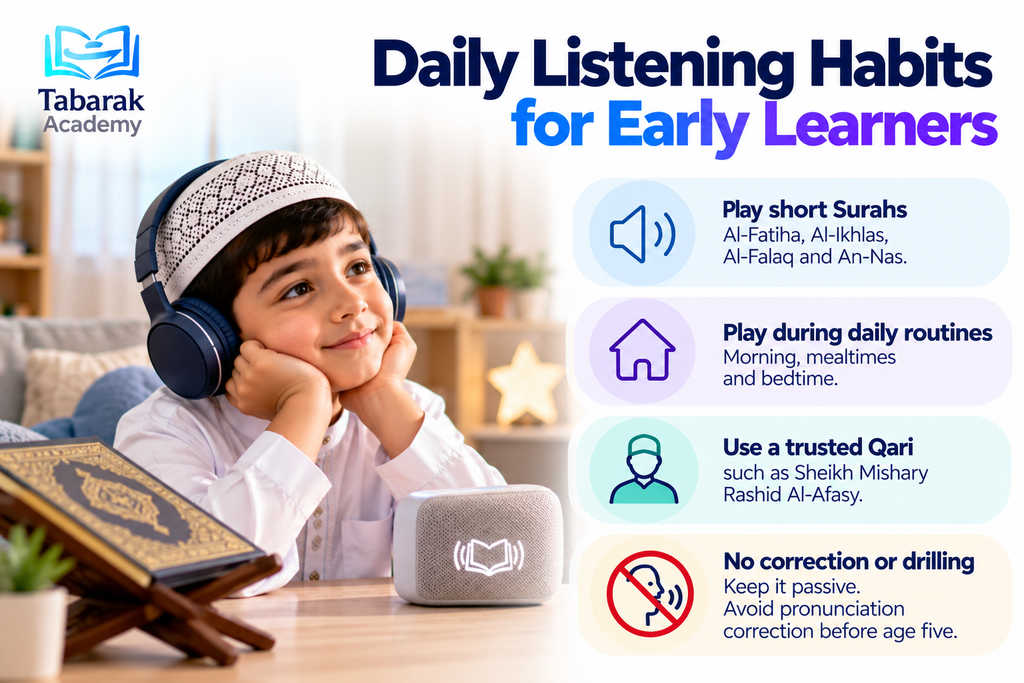
- Playing recitations of Surahs Al-Fatiha, Al-Ikhlas, Al-Falaq, and An-Nas during morning routines, mealtimes, and bedtime.
- Choosing trusted Qaris with clear, measured recitation, such as Sheikh Mishary Rashid Al-Afasy.
- Keeping this as passive exposure with no correction, no drilling, and no formal sessions.
- Avoiding pronunciation correction before age five, as fine motor skills and phonological awareness are not yet developed enough for letter-level instruction.
Children who complete this listening stage enter formal learning already recognizing rhythms, sounds, and patterns, which reduces resistance significantly at the next stage.
For children aged six and above who are starting their Quran journey without prior listening exposure, the listening phase still matters. Run two to three weeks of daily audio before introducing any formal instruction, even for older beginners.
Online Quran Classes For Kids at Tabarak Academy gives non-Arabic children a structured, age-appropriate Quran path led by certified native Arab tutors who understand exactly where each child needs to begin.
Start your child’s Quran journey today.
2. Teach Arabic Letters Through Noorani Qaida First
The single most consequential decision in how to teach Quran to a child who does not speak Arabic is whether to open the Mushaf directly or to begin with Noorani Qaida. Every qualified Quran teacher and every credible methodology agrees: Noorani Qaida comes first, without exception.
Noorani Qaida is a structured Arabic reading primer that teaches:
- Single letter recognition and correct articulation points (Makharij).
- Vowel marks (harakaat) and how they change the sound of each letter.
- Letter-joining rules and compound syllables.
- Madd (elongation) rules and Noon and Meem Sakinah in controlled, progressive steps.
Children who skip Noorani Qaida and start directly in the Mushaf memorize sounds they cannot independently read and mispronounce letters no one has taught them to produce correctly. These errors become deeply embedded habits that take far longer to fix than the original Noorani Qaida course would have taken. Completion typically requires three to six months depending on session frequency.
The Hear-Repeat-Write sequence works best for non-Arabic children learning letters through Noorani Qaida:
| Stage | Activity | Purpose |
| Hear | Child listens to the letter from a qualified audio source. | Builds accurate phonetic reference. |
| Repeat | Child says the letter aloud 5-10 times before touching a pencil. | Strengthens oral-motor memory. |
| Write | Child traces the letter on a whiteboard, sand tray, or foam pad. | Locks the visual form through kinesthetic memory. |
This three-stage sequence engages auditory, oral, and kinesthetic memory channels simultaneously, which produces significantly faster and more durable letter retention than visual drilling alone.
The best Quran teachers know that learning to read correctly, even when it requires effort, carries its own spiritual reward. The Prophet (peace be upon him) said:
“الْمَاهِرُ بِالْقُرْآنِ مَعَ السَّفَرَةِ الْكِرَامِ الْبَرَرَةِ وَالَّذِي يَقْرَأُ الْقُرْآنَ وَيَتَتَعْتَعُ فِيهِ وَهُوَ عَلَيْهِ شَاقٌّ لَهُ أَجْرَانِ”
“One who is proficient in the Qur’an is associated with the noble, upright, recording angels; and he who falters in it, and finds it difficult for him, will have two rewards.”
This hadith matters greatly for non-Arabic children who find Arabic letters hard. They are not falling behind, according to this hadith, they are earning double the reward of the proficient reciter. Share this with your child not as consolation, but as an accurate theological fact about how Allah values sincere effort.
Experience Our Interactive Learning
Curious about how we teach? Watch these brief video clips from our recent live sessions to see our structured curriculum, advanced learning platform, and dynamic student-teacher interactions firsthand.
Start Your Quran Learning Journey
Join Tabark Academy today for structured online lessons with qualified tutors, customized to fit your goals.
Book Your Free Trial Lesson3. Introduce Tajweed Rules One at a Time
Tajweed governs how each Arabic letter is produced from its specific point of articulation. For non-Arabic children, presenting all Tajweed rules at once overwhelms them and produces avoidance rather than improvement. The correct method teaches one rule per week, practiced across multiple Surahs, before advancing to the next.
This is the best way to teach Quran to a child who does not speak Arabic when it comes to pronunciation: slow, sequential, and specific.
The following table shows the recommended Tajweed introduction sequence for non-Arabic beginners:
| Stage | Rule to Introduce | What the Child Practices |
| Stage 1 | Madd (elongation) | Distinguishing short vowels from long ones. |
| Stage 2 | Ghunnah (nasalization) | Nasal sound on Noon and Meem Mushaddad. |
| Stage 3 | Noon Sakinah rules | Idgham, Iqlab, Ikhfa, and Izhar in context. |
| Stage 4 | Qalqalah letters | Bouncing sound on Qaf, Ta, Ba, Jim, Dal. |
| Stage 5 | Laam Sakinah | Izhar and Idgham rules for Laam. |
The four Arabic letters that cause the most persistent difficulty for non-Arabic children are: ع (Ayn), ح (Ha), ق (Qaf), and the Ghunnah rules governing Noon and Meem. These require live teacher correction, a parent who cannot produce these letters accurately themselves cannot reliably hear when their child mispronounces them. This is a primary signal that a qualified teacher is needed.
Noorani Qaida Course For Kids at Tabarak Academy takes children through Arabic letters, vowels, and foundational Tajweed rules in a structured sequence designed specifically for children who have no Arabic background at home.
4. Build a Memorization Plan With Review at Its Core
One of the most common mistakes parents make in teaching Quran to a child who does not speak Arabic is focusing entirely on adding new Surahs while neglecting the ones already memorized. Non-Arabic children forget faster when memorization depends only on audio, because the sounds they learned are not anchored to letter recognition or meaning.
The spaced repetition method used in professional Hifz programs worldwide addresses this problem directly:
- Day 1: Introduce the new line or verse.
- Days 2, 3, and 5: Review the same line in isolation.
- Day 7: Combine it with the previously memorized line and review the combined passage together.
A practical daily home routine for non-Arabic children does not require long sessions:
| Time | Activity | Purpose |
| 3 minutes | Listen to the assigned Surah portion. | Strengthen audio reference. |
| 5 minutes | Repeat after audio or teacher recording. | Build memory through oral repetition. |
| 4 minutes | Review one previously memorized Surah. | Prevent forgetting. |
| 3 minutes | Connect one simple meaning to the Surah. | Build genuine Quranic attachment. |
On busy days, a five-minute review of old Surahs is more valuable than abandoning the session entirely. Consistency matters more than session length for non-Arabic children whose memorization has no daily Arabic reinforcement outside the lesson.
The choice of starting Surahs matters for non-Arabic beginners:
- Begin with Surahs the child already hears in Salah, Al-Fatiha, Al-Ikhlas, Al-Falaq, An-Nas, because familiarity reduces the fear that Arabic is impossible.
- After these, add one new Surah at a time, only when the previous one is solid enough to be recited from memory without prompting.
- Never move to a new Surah if the previous one cannot survive a one-week gap without review.
Hifz For Kids Course at Tabarak Academy gives children who are ready for structured memorization a one-on-one program with certified tutors who track review, manage pacing, and correct Tajweed in real time.

Begin your Quran journey today.
5. Connect Each Surah to Its Meaning From the Start
A non-Arabic child who memorizes sounds without any connection to meaning treats the Quran as an audio exercise rather than divine guidance. Meaning is not optional, it is what transforms memorization into genuine Quranic attachment. However, meaning should be delivered in one simple sentence per Surah, not a full Tafsir lesson.
Examples appropriate for children:
- Surah Al-Ikhlas: “This Surah tells us that Allah is One and that He does not need anyone.”
- Surah Al-Falaq: “This Surah teaches us to ask Allah for protection from all harm.”
- Surah Al-Asr: “This Surah tells us that time is precious and that we must use it for good.”
- Surah Al-Fil: “This Surah tells the story of how Allah protected the Kaaba from an army of elephants.”
- Surah Al-Kawthar: “This Surah is Allah’s gift to the Prophet and a reminder to be grateful.”
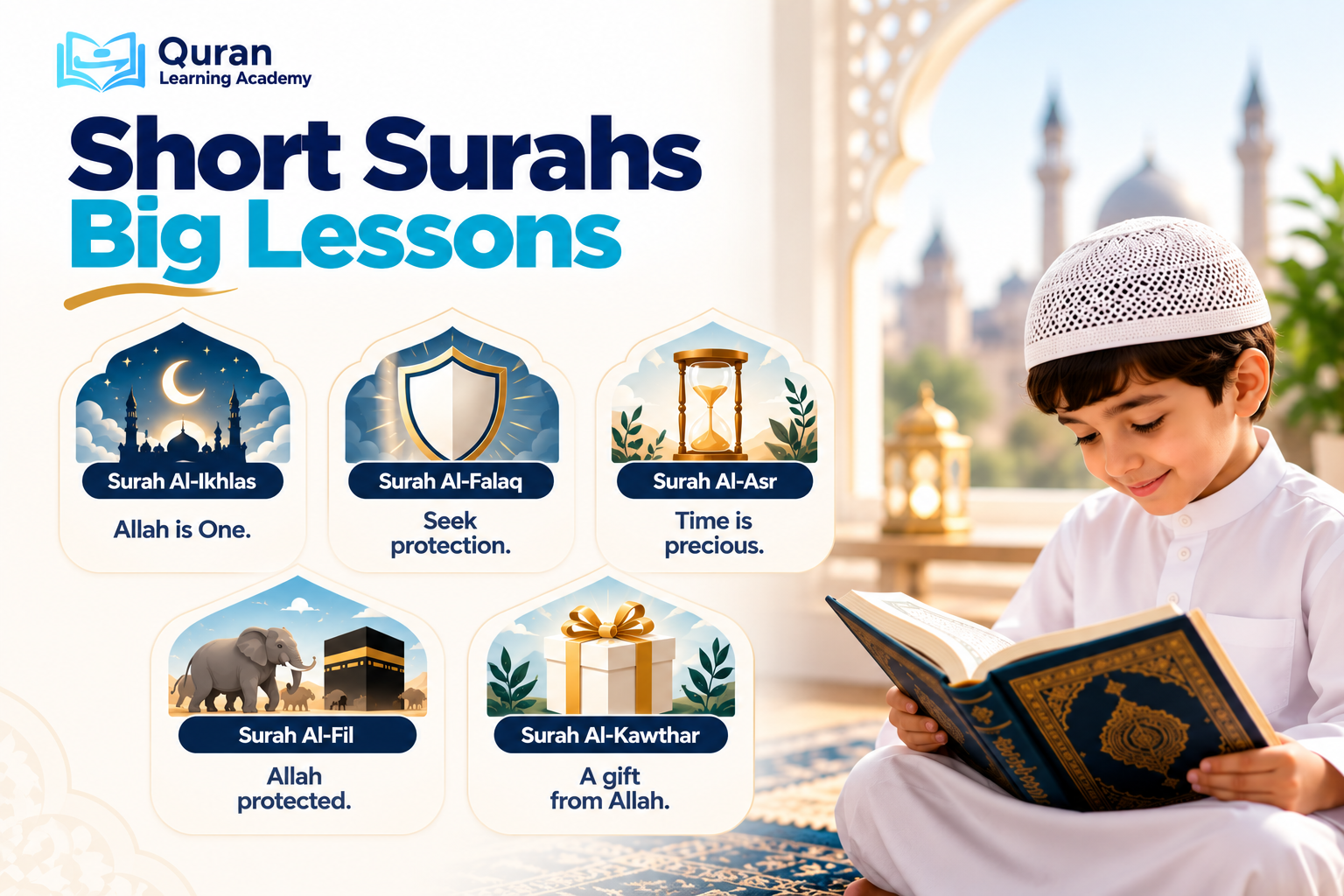
One clear sentence, said once before beginning the memorization session, gives the child a reason to care about what they are reciting. Research in educational psychology confirms that children who attach meaning to material retain it longer and engage with it more voluntarily.
Allah (SWT) describes the purpose of revelation in a way that makes meaning inseparable from the text:
“كِتَابٌ أَنزَلْنَاهُ إِلَيْكَ مُبَارَكٌ لِّيَدَّبَّرُوا آيَاتِهِ وَلِيَتَذَكَّرَ أُولُو الْأَلْبَابِ”
Kitabun anzalnaahu ilayka mubarakun liyaddabbaru ayatih wa liyatazakkara ulul albab
[This is] a blessed Book which We have revealed to you, [O Muhammad], that they might reflect upon its verses and that those of understanding would be reminded.
Tadabbur, reflection on meaning, is not reserved for scholars or Arabic speakers. It begins the moment a child understands a single Surah well enough to connect it to their daily life.
Read more: How Many Verses Should a Child Memorize Per Day.
6. Choose a Qualified Teacher Who Teaches Non-Arabic Learners
The teach Quran to a child who does not speak Arabic tips that matter most at the professional instruction stage come down to one decision: the teacher. A qualified Quran teacher for non-Arabic children must meet specific criteria that go beyond recitation skill alone.
The teacher must be able to:
- Explain Arabic letter sounds in the child’s native language, usually English.
- Produce letters such as Ayn, Ha, and Qaf correctly and help the child feel the correct articulation point.
- Identify pronunciation errors in real time and correct one issue at a time without overwhelming the child.
- Adjust session pace based on the child’s language background, not a fixed curriculum timeline.
- Send clear feedback to parents after each session with specific review instructions.
Live, one-on-one sessions are essential for non-Arabic children. Pre-recorded video lessons cannot correct pronunciation in real time. Group classes without individual interaction cannot catch each child’s specific errors. Only a live teacher working with a single child can hear the subtle mispronunciations that, left uncorrected, become permanent habits.
Parents should look for these specific signals that a teacher is working effectively with their non-Arabic child:
- The child is not correcting the same error week after week without improvement.
- The teacher targets one sound or rule per session, not multiple corrections at once.
- Sessions end with the child feeling capable, not overwhelmed.
- The parent receives specific, actionable review instructions after each session.
Step Inside Our Virtual Classrooms
See our engaging teaching methods in action! watch real snippets of our live classes and discover how our expert instructors make learning interactive, memorable, and inspiring for every student.
Start Your Quran Learning Journey
Join Tabark Academy today for structured online lessons with qualified tutors, customized to fit your goals.
Book Your Free Trial Lesson7. Build the Right Home Environment for Daily Practice
How to teach Quran to a child who does not speak Arabic at home depends not only on methods but on the environment parents create. A child who sees Quran treated as a priority at home builds a relationship with it that no external teacher alone can replicate.
The three most impactful home practices for non-Arabic households are:
Visible parent recitation:
Sit with the Mushaf and recite daily where your child can see you. A parent who tells a child to study Quran but never opens the Mushaf themselves creates a credibility gap that undermines motivation more effectively than any learning difficulty.
A dedicated Quran space:
Designate a specific, clean, quiet area for Quran sessions. A small desk or prayer mat reserved exclusively for Quran time, with the Mushaf stored respectfully and visibly, signals that Quran time is different from screen time and homework. Children transition into focus faster in a consistent physical space.
Weekly family recitation:
Have the child recite memorized Surahs to a family member once a week. A grandparent, sibling, or parent who responds with sincere appreciation and dua motivates far more consistent home practice than reminders alone.
The Prophet (peace be upon him) made clear the spiritual position of the family that prioritizes the Quran together:
“خَيْرُكُمْ مَنْ تَعَلَّمَ الْقُرْآنَ وَعَلَّمَهُ”
“The best among you (Muslims) are those who learn the Qur’an and teach it.”
Teaching the Quran to your child is not merely an act of parenting. This hadith places you, through that act, among the best of believers in Allah’s sight.
8. Avoid the Five Mistakes That Derail Non-Arabic Children
Parents who understand how to teach Quran to a child who does not speak Arabic will recognize these five mistakes and know exactly how to prevent each one.
- Skipping Noorani Qaida: Opening the Mushaf before completing Noorani Qaida leads to entrenched pronunciation errors that require more correction time than the original Qaida course would have taken.
- Adding new Surahs without reviewing old ones: Old Surahs that are not reviewed weekly disappear from memory. The rule in every serious Hifz program applies here: for every new page added, one already-memorized page must be reviewed.
- Ending sessions in frustration: A session that ends with a child upset creates a negative emotional association with the Quran that is slow to reverse. Always end at a moment of success, even if the session must be shortened.
- Correcting multiple errors at once: Targeting more than one pronunciation error per session overwhelms non-Arabic children. Correct one sound or one rule, then praise the effort before ending.
- Measuring success by quantity only: A child who has memorized fifteen Surahs with weak pronunciation and no review is in a worse position than a child who has memorized five Surahs clearly and can recite them months later without prompting.
Learn Quran With Tajweed For Kids at Tabarak Academy addresses all five of these mistakes through live one-on-one sessions that combine structured progression, real-time correction, and pacing designed for non-Arabic children.
Claim your free trial lesson today.
Join Tabarak Academy and Learn with Confidence
Tabarak Academy serves Muslim families across North America, Europe, Asia, and beyond with certified native Arab tutors who specialize in teaching children with no Arabic background.
Every student begins with a free trial class and is placed in a program matched to their exact level, age, and learning pace. One-on-one live sessions are available across all global time zones, with dedicated programs for kids, sisters, adults, men, and new Muslims.
Our Quran Courses
- Online Quran Classes For Kids
- Noorani Qaida Course For Kids
- Hifz For Kids Course
- Learn Quran With Tajweed For Kids
- Online Quran Classes for Beginners
- Online Quran Classes for Adults
- Online Quran Classes for Sisters

Book your free trial class now.
Conclusion
Learning how to Teach Quran to a Child Who Does Not Speak Arabic starts with listening, learning the Arabic letters through Noorani Qaida, and practicing Tajweed one rule at a time.
Regular revision, gradual memorization, and simple explanations of Quranic meanings help children build confidence and understanding.
With patience and consistent guidance, parents and teachers can nurture a lasting love for the Quran that grows with the child throughout their life.
Read more: How Long Does Hifz Take with a Full Time Job.
Frequently Asked Questions
Does a child need to speak Arabic to learn the Quran?
No. Quranic reading is a distinct skill from conversational Arabic fluency. A child can learn to recite correctly through Noorani Qaida and Tajweed instruction without speaking Arabic at home.
At what age should a non-Arabic child start formal Quran instruction?
Listening exposure can begin at age three. Formal reading instruction through Noorani Qaida is most effective from age six, when phonological awareness and fine motor skills are sufficiently developed.
How long does a daily Quran session need to be?
For children under eight, 10-15 focused minutes daily is enough. For ages eight to twelve, 20-25 minutes is the effective ceiling. Consistent short sessions outperform occasional long ones.
Can a non-Arabic child memorize Quran online effectively?
Yes, provided sessions are live, one-on-one, and with a certified teacher who can identify and correct pronunciation errors in real time. Pre-recorded video alone is not sufficient for non-Arabic children.
What should a parent do when their child refuses to practice?
Reduce the portion size, increase praise for effort, and focus only on listening and review for one week. Persistent refusal usually signals the portion is too large or sessions are ending in frustration, not dislike of the Quran.

0 Comments