
Open a search engine, type in a simple question about the number of verses of the Quran, and you will see three different answers. One page says 6,236 verses. Another says 6,348. A post a friend shared on social media says 6,666.
So how many verses are in the Quran, and why don’t the numbers agree? Most people just trust the first number they see. That is a shame, because the real story is short and easy to follow.
This question comes up more often than you might think. A child may ask it after a Quran class, or a new Muslim may hear it from a friend. It even appears in online debates, where a wrong number is used to raise doubts. In moments like these, a clear and correct answer matters. By the end of this article, you will be able to give that answer with confidence.
This guide gives you the exact number right away. Then it shows where each of the other numbers comes from, and which one has no basis at all. You will also see how knowing the count can help you plan your prayers and your Quran study.
What You’ll Learn In This Article
- The exact number of verses in the Quran
- What the total becomes when every basmala is counted
- Why early scholars counted some verses differently
- Why the popular number 6,666 is wrong
- How to use verse counts in prayer and memorization
- The difference between a surah, an ayah, and a ju
How Many Verses Are In The Quran?
The Quran has 6,236 verses in the standard count. This is the count used in the Hafs mushaf printed in Madinah. If you add the 112 basmalas that have no verse number, the total becomes 6,348.
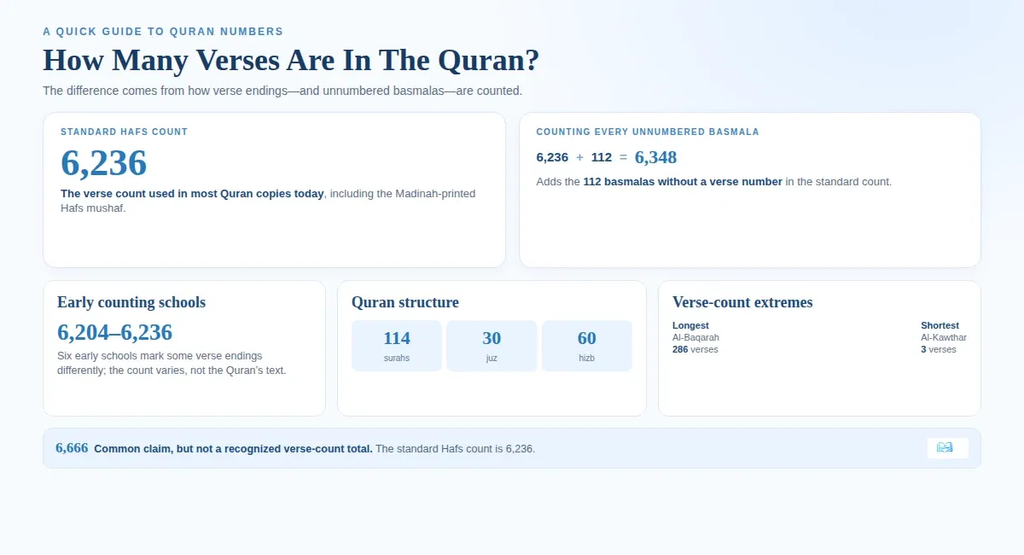
Below is a short summary of the key Quran numbers. Use it as a quick guide, then read on for the details.
| Item | Number |
| Total verses in most Quran copies today (Hafs) | 6,236 |
| Total verses if every basmala is counted | 6,348 |
| Totals in the six early counting schools | 6,204 to 6,236 |
| Chapters (surahs) | 114 |
| Parts (juz) | 30 |
| Half-parts (hizb) | 60 |
| Longest chapter | Al-Baqarah, 286 verses |
| Shortest chapter | Al-Kawthar, 3 verses |
| Common number that is wrong | 6,666 |
The first two numbers are where most of the confusion starts, so let’s begin there.
The Standard Count: 6,236 Verses
The number 6,236 comes from the Kufan count. It goes back to Ali ibn Abi Talib (RA). His students in Kufa passed it down from teacher to student.
Most printed copies of the Quran today follow this count. If your mushaf comes from Saudi Arabia, Egypt, Pakistan, or Turkey, it most likely uses it.
You can test it yourself. Look at the last verse number of each of the 114 surahs. Add them all up, and you will reach 6,236.
This count goes hand in hand with Hafs, the most common recitation in the world. To learn more about it and the chain of teachers behind it, read our guide on Ijazah in Hafs an Asim.
In this count, the basmala gets a number only once. That is at the start of Al-Fatiha (Quran 1:1), where it is verse 1.
The Count With Every Basmala: 6,348 Verses
The basmala is the phrase “Bismillah ir-Rahman ir-Rahim.” It means “In the name of Allah, the Most Gracious, the Most Merciful.” It opens 113 of the 114 surahs. Surah At-Tawbah (Quran 9:1) is the only one that does not start with it.
In the standard count, the basmala of Al-Fatiha already has a number. That leaves 112 basmalas at the top of other surahs with no number. When you add them, you get 6,236 + 112 = 6,348.
Many scholars in the Shafi’i school say the basmala is a verse at the start of each surah. For them, counting all 112 makes sense.
The number 6,348 is a sum. It is not the total of any of the early counting schools.
There is also a basmala in the middle of Surah An-Naml (Quran 27:30). It is already part of a numbered verse, so it is never added again.
What Are The Other Counts Of The Quran’s Verses?
Scholars count the verses a little differently because they mark the end of some verses in different places. All of them agree that the Quran has at least 6,200 verses.
In the first years of Islam, five big cities each kept their own count: Kufa, Basra, Damascus, Makkah, and Madinah. This is where the range in the table above comes from. The lowest total, 6,204, comes from Basra. The highest, 6,236, comes from Kufa. The others fall in between: Madinah has two counts, 6,214 and 6,217, Makkah has 6,219, and Damascus has 6,226.
Only two of these counts are common in printed copies today. Most of the world uses the Kufa count, while many copies in North and West Africa use the later Madinah count of 6,214. You will mostly find the others in books by scholars who study verse counting.
Real Examples Of Different Verse Endings
Here are three real examples of the difference.
First, look at the start of Surah Sad (Quran 38:1). The Kufan count ends the first verse after “Sad. By the Quran full of reminder.” Other schools keep reading and end the verse a little later.
Second, look at Quran 38:84. The Kufan count makes the short phrase “He said: The truth, and the truth I say” a verse on its own. Other schools join it to the words after it.
Third, look at the letters at the start of some surahs, such as “Alif Lam Mim” (Quran 2:1). The Kufan count often makes these letters a full verse. Other schools join them to what comes next.
Small choices like these, added up, explain the whole gap between the counts.
Experience Our Interactive Learning
Curious about how we teach? Watch these brief video clips from our recent live sessions to see our structured curriculum, advanced learning platform, and dynamic student-teacher interactions firsthand.
Start Your Quran Learning Journey
Join Tabark Academy today for structured online lessons with qualified tutors, customized to fit your goals.
Book Your Free Trial LessonWhy The Companions Counted Some Verses Differently
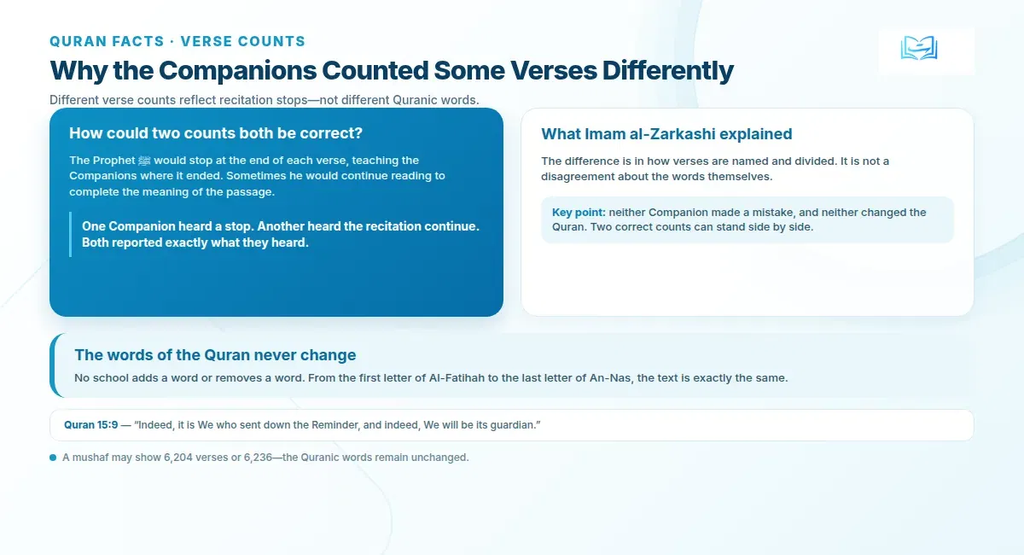
Imam al-Zarkashi gave a clear reason for these differences. The Prophet (ﷺ) used to stop at the end of each verse when he recited. This taught the Companions where each verse ended.
Once they knew the place, he would sometimes read on. He joined that verse to the next one to finish the meaning of the passage.
Now picture two Companions. One heard him stop, so he learned that a verse ended there. The other only heard him read straight through. To him, it sounded like one long verse.
Both men told others what they truly heard. Neither one made a mistake, and neither one changed anything. This is how two correct counts can stand side by side.
The Words Of The Quran Never Change
A different count does not mean a different Quran.
The scholar al-Fayruzabadi explained that the difference is only in how verses are named and split. No school adds a word. No school takes a word away.
Allah promised to protect His book: “Indeed, it is We who sent down the Reminder, and indeed, We will be its guardian” (Quran 15:9).
So one friend may read from a mushaf with 6,204 verses, and another from one with 6,236. From the first letter of Al-Fatiha to the last letter of An-Nas, they read the very same words.
Is It True The Quran Has 6,666 Verses?
No, the Quran does not have 6,666 verses. No early counting school gives this number, and no printed mushaf has it.
Still, it keeps showing up in talks and social media posts. Here is where it comes from and how to check the truth.
Where The 6,666 Number Comes From
The number 6,666 often comes from popular lists. These lists split the Quran into neat groups. For example, they may say there are 1,000 verses of commands, 1,000 verses of warnings, and 1,000 verses of promises. The groups keep going until they add up to 6,666.
These lists look tidy and are easy to remember, so people share them. But no scholar who counted the verses ever gave this number, and the groups do not match the real text.
Be careful with number puzzles built on 6,236 or 6,348 too. The number 6,236 is just one count out of six. Any pattern built on it changes when you pick a different count.
The scholars who counted the verses simply wanted to help people recite, pray, and memorize well.
How To Check The Count In Your Own Mushaf
You can check the count with your own copy of the Quran in three steps.
First, look at the last pages of your mushaf. Many printed copies say which count they follow, such as “Kufan count, 6,236 verses.”
Second, look at Al-Fatiha. If the basmala has the number 1, your copy follows the Kufan count. If the basmala has no number, your copy follows another school.
Third, if you and a friend find different verse numbers, search by the words, not the number. Find the verse by how it starts. The words will always match.
Many new students worry about small details like this before they start learning. You can see how real learners moved past those first worries in the Tabarak Academy reviews, written by students and parents from many countries.

How To Use Verse Counts In Prayer And Memorization
Knowing how many verses are in a surah isn’t just trivia. It can shape how you pray at night, how long you stand in Fajr, and how fast you memorize. Here are three simple ways to use it.
Step 1: Set A Night Prayer Goal In Verses
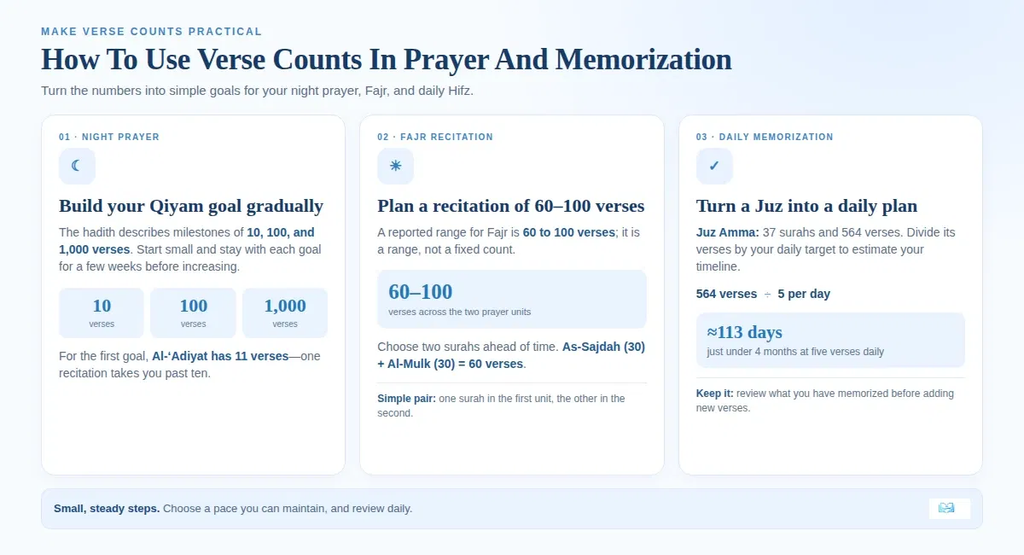
The Prophet (ﷺ) measured the night prayer in verses. He said that whoever prays at night with ten verses will not be counted among the careless, whoever prays with a hundred will be counted among the devoted, and whoever prays with a thousand will be among those with a huge reward (Sunan Abi Dawud 1398).
You can build up to these goals slowly. Begin with ten verses. Surah Al-‘Adiyat has 11 verses, so reciting it once is enough to reach the first goal.
When ten verses feel easy, work toward a hundred. Surah Al-Waqi’ah has 96 verses, and adding one short surah after it takes you past a hundred.
Stay at each goal for a few weeks before moving up. Most people find it easier to keep a small nightly habit than to start with a long recitation and stop after a few days.
Step 2: Plan Your Fajr Recitation
Abu Barzah (RA) reported that the Prophet (ﷺ) used to recite between 60 and 100 verses in Fajr (Sahih al-Bukhari 771). Scholars explain that this is a range, not a fixed number. When the verses are long, 60 is enough, and when they are short, the recitation can reach 100.
To plan your own Fajr recitation, choose two surahs and check how many verses each one has. Surah As-Sajdah and Surah Al-Mulk have 30 verses each, which makes them an easy pair.
Recite one surah in the first unit of the prayer and the other in the second. Together they give you 60 verses. On days when you have more time, choose surahs with shorter verses so you can recite closer to 100.
The Prophet (ﷺ) often made Fajr longer than his other prayers. Planning your surahs ahead of time makes this easier to follow when you pray at home.
Step 3: Split Your Memorization Into Daily Verses
A whole juz can seem like a lot to memorize. Once you know its verse count, though, you can turn it into a daily plan.
Start by choosing the part you want to memorize and looking up its verse count. Many families begin with Juz Amma, the 30th part of the Quran, which has 37 surahs and 564 verses.
Next, decide how many new verses you can learn each day. Some students manage 3 verses, while others learn a full page. Divide the total by your daily amount to estimate how long it will take. At 5 verses a day, Juz Amma takes about 113 days, which is just under 4 months.
Each day, review what you have already memorized before learning anything new. Regular review is what keeps earlier verses from fading.
For more help, read our guide on how many times you should repeat a verse to memorize it. Adults can plan with our realistic Hifz timeline for adults, or try the chunking method for Quran memorization.
What Is The Difference Between A Surah, An Ayah, And A Juz?
These three words come up a lot when people talk about the Quran, and they are easy to mix up. A surah is a chapter, an ayah is a verse, and a juz is one of 30 parts.
There are 114 surahs in the Quran, and scholars all agree on that number. Their order was set by the Prophet (ﷺ), which is why the longer surahs tend to come first and the shorter ones near the end.
An ayah is a single verse, and you can see where each one ends by the small numbered circle after it. So when people ask how many verses are in Quran, they are asking about ayahs. Some verses are only one word, while the longest one, Quran 2:282, fills most of a page.
A juz is one of 30 parts of roughly equal length. Many people read one juz a day so they can finish the whole Quran in a month.
The surahs themselves range from 3 verses to 286. Al-Baqarah is the longest, with 286 verses, and Al-‘Asr, Al-Kawthar (Quran 108:1-3), and An-Nasr are the shortest, with 3 verses each.
If you would like to learn more about how the Quran was revealed, written, and put in order, the Quranic Sciences (Uloom al-Quran) Course at Tabarak Academy covers all of this with a qualified teacher.

Step Inside Our Virtual Classrooms
See our engaging teaching methods in action! watch real snippets of our live classes and discover how our expert instructors make learning interactive, memorable, and inspiring for every student.
Start Your Quran Learning Journey
Join Tabark Academy today for structured online lessons with qualified tutors, customized to fit your goals.
Book Your Free Trial LessonBook Your Free Trial With Tabarak Academy Today
Knowing the number of verses is a first step. Reading each one correctly is the real goal, and Tabarak Academy helps you reach it from your own home.
Here is what you get when you learn with us:
- Azhar-certified teachers who know the Quran by heart and teach with patience
- One-on-one classes that follow your level, not a group’s speed
- Female teachers for sisters and young girls who prefer them
- Class times at any hour, so lessons fit around school, work, and family
- Monthly progress reports that show how far you have come
- Courses for every age, from toddlers to adults and new Muslims
- Family and long-term discounts, shown on our fees page
You can meet our teachers before you choose. Then book a free trial lesson with no payment and no pressure, and recite your first verses with a qualified teacher this week.
Our Quran Courses
Tabarak Academy offers live, one-on-one online Quran courses for kids and adults, from reading the first letters to full memorization and Ijazah.
- Online Quran Classes
- Online Quran Classes for Beginners
- Online Quran Classes for Kids
- Online Quran Classes for Adults
- Online Quran Classes for Men
- Online Quran Classes for Sisters
- Quran Reading Course
- Quran Recitation Course
- Online Ijazah Course
Conclusion
So, how many verses are in the Quran? The standard answer is 6,236 verses. If you add the 112 basmalas with no number, the total becomes 6,348.
The early scholars kept six counts, from 6,204 to 6,236. The gap comes from where some verses end, and it goes back to the way the Prophet (ﷺ) sometimes paused and sometimes read on. The Companions honestly passed on what they heard.
You also learned the basic building blocks of the Quran. It has 114 surahs and 30 juz. Its surahs run from 3 verses in Al-Kawthar to 286 verses in Al-Baqarah. And the popular number 6,666 has no place in any real count.
The next time you see 6,666 in a post or hear it in a talk, you can kindly share the real number and where it comes from. You can also look at the last page of your own mushaf to see which count it follows.
If you are just starting out, you don’t need perfect Arabic or a beautiful voice to begin reading. What helps most is reading a little every day with someone who can correct your mistakes early. Over time, those small daily steps add up to far more of the Quran than most people expect.
Most of all, these numbers can shape your worship. Ten verses at night, 60 verses at Fajr, and a few new verses memorized each day are goals that grow with time. Each verse you learn to read well brings you one step closer to the book of Allah.
FAQs
Many readers still have questions after learning the verse count. Here are short, clear answers to the most common ones.
How Many Verses Are In The Quran?
The Quran has 6,236 verses in the standard Hafs count used in most printed copies. Other early counts give totals between 6,204 and 6,226.
Does The Quran Have 6,666 Verses?
No, the Quran does not have 6,666 verses. Real counts range from 6,204 to 6,236.
How Many Words Are In The Quran?
The Quran has about 77,400 words. Scholars give slightly different totals, such as 77,437 and 77,439, because they count joined words in different ways.
How Many Sajdah Verses Are In The Quran?
The standard mushaf marks 15 places of prostration (sajdah) in the Quran. Scholars differ on a few of these places, so some schools count 14.
How Many Verses Are In Surah Al-Fatiha?
Surah Al-Fatiha has 7 verses in every count. Some counts make the basmala verse 1, while others start with “Alhamdulillah” and end verse 6 at “an’amta ‘alayhim.”
How Many Verses Are In Surah Yasin?
Surah Yasin has 83 verses in the standard count. It is the 36th surah of the Quran.
How Many Verses Are In Surah Al-Kahf?
Surah Al-Kahf has 110 verses in the standard count. It is the 18th surah, and many Muslims read it every Friday.
How Many Verses Should I Read Daily To Finish The Quran In A Month?
You need to read about 208 verses a day to finish the Quran in 30 days. That equals about one juz a day.


0 Comments