

What Is Noorani Qaida? Meaning And Lessons Explained
Your child can recite the alphabet, but opens the Mushaf and freezes at the first joined word. Or you’re an adult who has listened to Quran recitation for years and still can’t read one line from the page. Both problems have the same starting point, and it’s a small booklet.
What is Noorani Qaida? It is a beginner’s reading book that teaches Arabic letters, their sounds, vowel marks, and basic Tajweed rules in a fixed step-by-step order, so a learner can read the Quran correctly from the start. At Tabarak Academy, it’s the first book most of our students begin with.
This guide explains the Noorani Qaida meaning, who wrote it, what each stage teaches, how long it takes, and how to know when a learner is ready to move on to the Quran.
What you’ll learn in this article
- The Noorani Qaida meaning and what the book is for.
- Who wrote Noorani Qaida and how later editions differ.
- What Noorani Qaida teaches, stage by stage.
- How long it takes to finish, depending on age.
- A simple test to check whether a learner is ready to read the Quran.
What is Noorani Qaida? Noorani Qaida explained?
The easiest way to understand Noorani Qaida is to look at what it’s for and what it isn’t for. It’s a reading book, and it helps to be clear on where its job starts and stops.
Noorani Qaida meaning
Noorani Qaida is an introductory Arabic reading book. It trains beginners to recognize letters, read vowel signs, and pronounce each sound from its correct articulation point before they start reading the Quran.
The name has two parts. “Noorani” refers to its compiler, Sheikh Noor Muhammad Haqqani, and also carries the Arabic sense of “light.” “Qaida” (قاعدة) means “base” or “foundation.” So the Noorani Qaida meaning is simply “the foundation book of Noor Muhammad.”
What does Noorani Qaida do and doesn’t teach?
Noorani Qaida teaches you to read Arabic script. It doesn’t teach you what the words mean. Vocabulary, translation, and Arabic grammar are separate skills that you study alongside it or afterwards.
Reading is also different from memorizing. A child who knows Surah Al-Fatiha by ear may still be unable to read it from the page. The Qaida closes that gap: the written symbol should cue the correct sound without anyone saying it first.
What Does Noorani Qaida Teach, And In What Order?
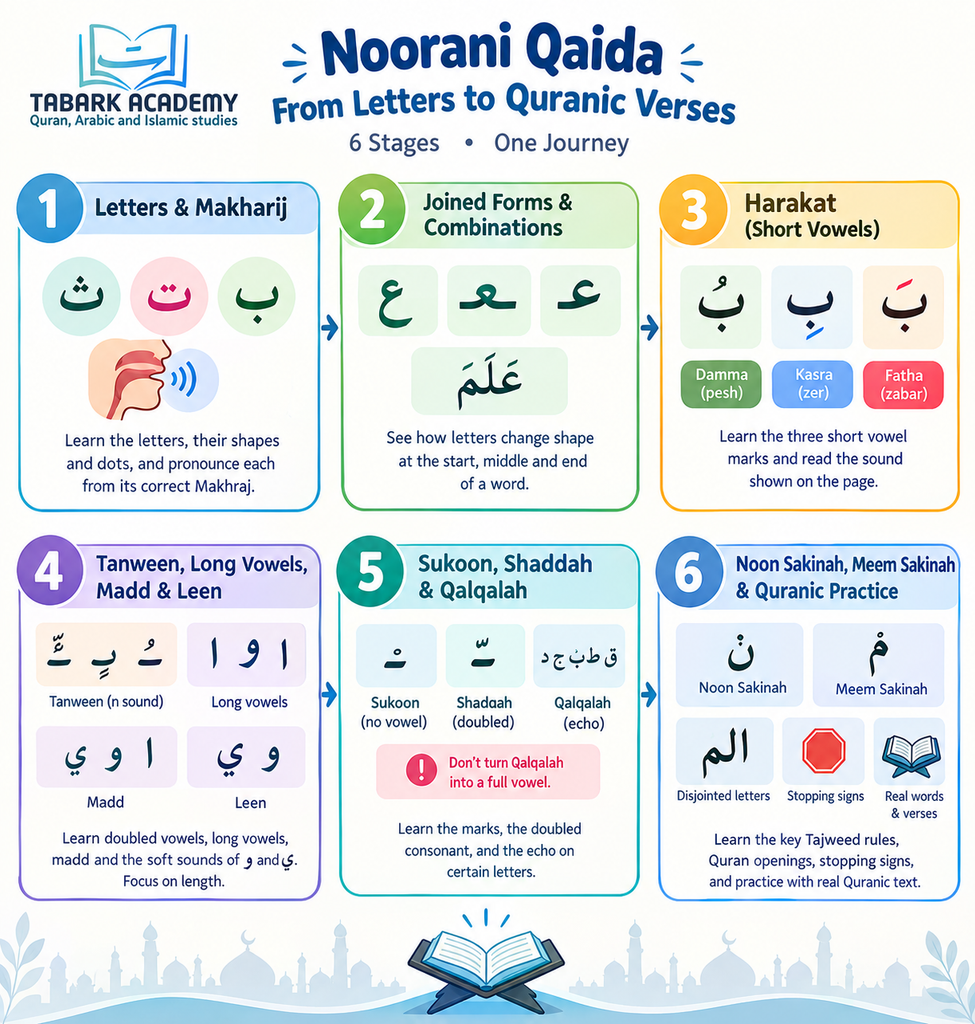
Each stage of Noorani Qaida adds one new reading skill on top of the last. The sequence below groups the main stages. Your edition may split or number them differently, but the logic stays the same.
Stage 1: Individual Letters And Makharij
The learner first recognizes the Arabic letters by shape and dots, and pronounces each one from its Makhraj, the exact point in the throat, tongue, or lips where the sound is produced.
Similar shapes need extra attention. ب, ت, and ث share one body and differ only by their dots. A common beginner mistake is reciting the alphabet chart in order but hesitating when these letters appear in a mixed sequence.
Stage 2: Joined Forms And Letter Combinations
Arabic letters change shape depending on whether they come at the start, middle, or end of a word. This stage teaches the learner to spot a familiar letter even after its shape has changed.
For example, ع looks different in عـ, ـعـ, and ـع. If a learner can’t find the letter inside a combination, go back to the shapes before adding more pronunciation work.
Stage 3: Harakat (short vowels)
Harakat are the three short vowel marks: Fatha (Zabar), Kasra (Zer), and Damma (Pesh). In بَ بِ بُ, the letter stays the same and only the mark changes the sound. What to watch for: learners guessing the vowel from the previous item instead of reading the mark that’s actually printed.
Stage 4: Tanween, Long Vowels, Madd, And Leen
Tanween is a doubled vowel sign that adds an “n” sound (ـً ـٍ ـٌ). Madd teaches how long to stretch a vowel, and Leen covers the soft sounds of و and ي after a Fatha.
Some editions also introduce the standing signs, Khari Zabar, Khari Zer, and Khari Pesh. The key skill here is length. Reading every vowel with the same duration hides a distinction that matters in recitation.
Stage 5: Sukoon, Shaddah, And Qalqalah
Sukoon (ـْ) marks a consonant with no vowel of its own. Shaddah (ـّ) marks a double consonant. Qalqalah is the slight echo on the letters ق ط ب ج د when they carry a Sukoon.
A frequent mistake is turning Qalqalah into an extra full vowel, for example reading “qad” as “qada.” A teacher’s ear catches this quickly; a PDF can’t.
Stage 6: Noon Sakinah, Meem Sakinah, And Quranic Practice
The final lessons introduce the basic Tajweed rules for Noon Sakinah and Meem Sakinah, the disjointed letters at the openings of some Surahs (such as الم), stopping signs, and combined practice with real Quranic words and short verses.
If you want this stage taught with the Tajweed rules explained in full, our Noorani Qaida with Tajweed Course builds on each rule as it appears in the book.
Experience Our Interactive Learning
Curious about how we teach? Watch these brief video clips from our recent live sessions to see our structured curriculum, advanced learning platform, and dynamic student-teacher interactions firsthand.
Master the Arabic Language with Tabark Academy
Learn to read, write, and speak Arabic confidently with our structured online courses and expert native tutors.
Book Your Free Trial LessonWhy is Noorani Qaida important before reading the Quran?
Noorani Qaida matters because pronunciation mistakes in Arabic can change the meaning, and habits formed early are hard to undo.
1. Small sound errors change meaning
In Arabic, one sound can separate two unrelated words. قَلْب (qalb) means “heart,” while كَلْب (kalb) means “dog.” The only difference is ق, pronounced from the back of the tongue, versus ك, pronounced slightly further forward.
Noorani Qaida trains the tongue to produce these sounds correctly from the first lesson, before the wrong version becomes automatic.
2. Skipping the Qaida costs time later, especially for Hifz
Students who skip straight to the Mushaf usually read slowly, stop at every word, and need constant correction. For Hifz students it’s worse: if you read a word wrongly, you memorize the mistake along with the verse.
Unlearning a pronunciation habit takes much longer than learning it correctly the first time. That’s why Tabarak Academy places every new reader in the right Qaida lesson before any Quran reading or memorization begins.
Read Also: How Long Does It Take to Memorize Juz Amma?
Who should learn Noorani Qaida?
Anyone who can’t yet read Arabic script accurately should start with Noorani Qaida, whatever their age. Where you start in the book depends on what you can already do.
1. Children (ages 4–10)
Most children are ready somewhere between ages 4 and 7, depending on attention span and interest. Short, playful lessons with visual support work best at this age.
A tip for parents: point to the item and wait. If you give the answer straight away, you can’t tell whether your child read the letter or just repeated you.
Our Noorani Qaida for Kids course is built around this kind of patient, one-to-one listening.
2. Adults, returning learners, and new Muslims
Adults sometimes feel shy about starting with letters. In practice, they often move faster than children because they can follow explanations about how each sound is made. Someone returning after years away may need a focused review rather than every page.
New Muslims and non-Arabic speakers get a clear, structured place to start. The Noorani Qaida for Adults and Noorani Qaida for Beginners courses at Tabarak Academy explain each rule in English while you practice the Arabic text itself.
How Long Does It Take To Finish Noorani Qaida?
Most learners finish Noorani Qaida in about 2 to 9 months. How long it takes depends on age, how often you practice, and whether a teacher corrects you as you go.
| Learner | Typical time with regular lessons |
| Ages 4–6 | 6–9 months |
| Ages 7–10 | 4–6 months |
| Ages 11–15 | 3–5 months |
| Adults (16+) | 2–4 months |
Short daily practice of 20–30 minutes usually beats one long weekly session. Irregular study, not age, is the most common reason learners take longer.
How To Know You’re Ready To Move From Qaida To Quran?
Finishing every page doesn’t automatically mean a learner is ready. Many students memorize the book’s rows by sound and repeat them without really reading.
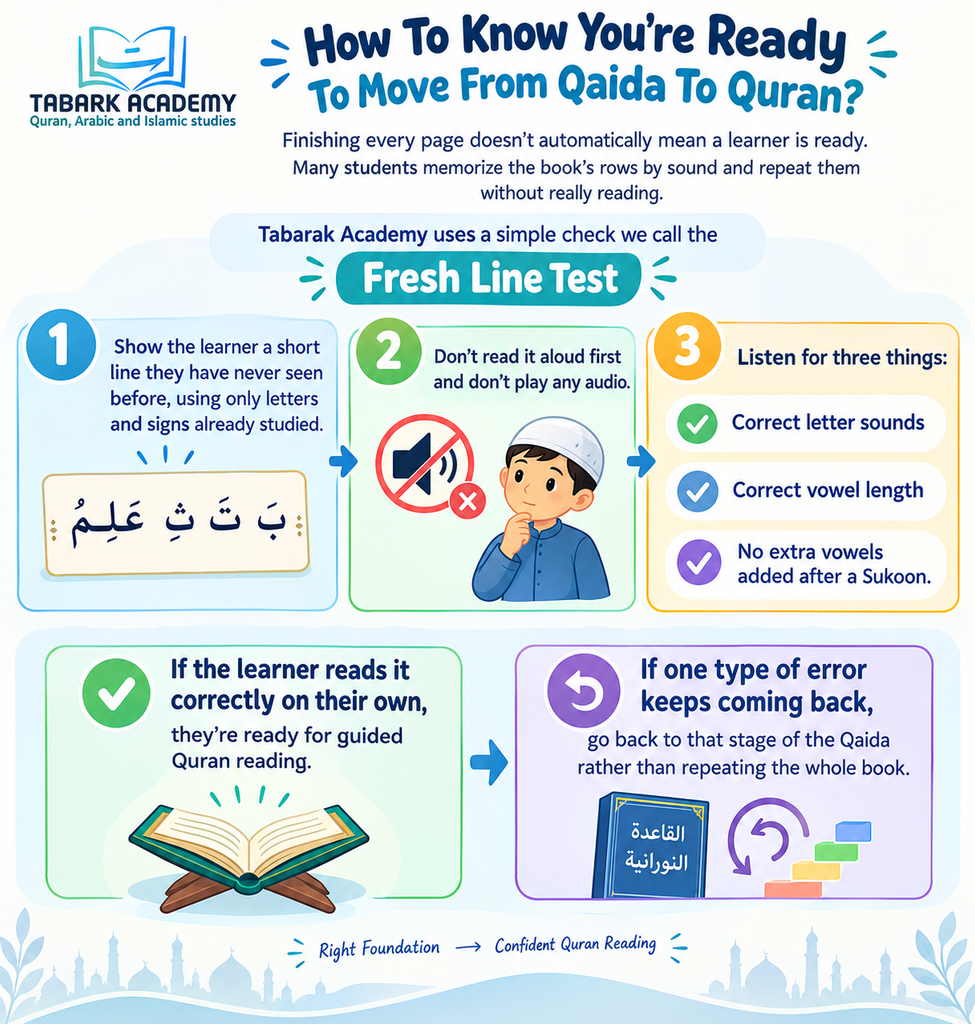
Tabarak Academy uses a simple check we call the Fresh Line Test:
- Show the learner a short line they have never seen before, using only letters and signs already studied.
- Don’t read it aloud first and don’t play any audio.
- Listen for three things: correct letter sounds, correct vowel length, and no extra vowels added after a Sukoon.
If the learner reads it correctly on their own, they’re ready for guided Quran reading. If one type of error keeps coming back, go back to that stage of the Qaida rather than repeating the whole book.
Read Also: Is It Too Late to Learn to Read the Quran as an Adult?
Noorani Qaida vs. Noor Al-Bayan: which should you choose?
Both books teach beginners to read the Quran. The main differences are pace and presentation.
| Aspect | Noorani Qaida | Noor Al-Bayan |
| Presentation | Mostly text, relies on repetition | More visuals and charts |
| Pace | Faster | Slower and more gradual |
| Tajweed | Built in from early lessons | Introduced gradually |
| Best fit | Non-Arabic speakers, older kids, adults | Young children who learn visually |
| Where it’s most common | Worldwide, especially non-Arab countries | Arabic-speaking countries |
A simple rule: under age 6 and learning mainly through pictures? Noor Al-Bayan may keep them more engaged.
Older learners, adults, and non-Arabic speakers usually progress faster with Noorani Qaida. Tabarak Academy offers both, including a dedicated Noor Al-Bayan Course.
Step Inside Our Virtual Classrooms
See our engaging teaching methods in action! watch real snippets of our live classes and discover how our expert instructors make learning interactive, memorable, and inspiring for every student.
Master the Arabic Language with Tabark Academy
Learn to read, write, and speak Arabic confidently with our structured online courses and expert native tutors.
Book Your Free Trial LessonStart Noorani Qaida Today With A Tabarak Academy Tutor
A PDF can show you the letters, but it can’t hear your mistakes. At Tabarak Academy, a qualified tutor listens to every sound, corrects Makharij on the spot, and places you in the right lesson from your first class, whether you’re 5 or 55.
Choose one-to-one online classes at times that suit you, with a structured plan, regular progress reports, and a tutor who explains every rule in plain English. Join the Noorani Qaida Online Course and read your first Quranic words correctly.
Our Noorani Qaida Courses:
- Noorani Qaida Online Course
- Noorani Qaida for Beginners Course
- Noorani Qaida for Kids Course
- Noorani Qaida for Adults Course
- Noorani Qaida with Tajweed Course

Conclusion
So, what is Noorani Qaida? It’s the foundation book that takes a beginner from recognizing single Arabic letters to reading Quranic words with correct pronunciation and basic Tajweed. It teaches reading, not meaning or memorization, and editions differ in lesson and page counts.
It suits children, adults, and new Muslims alike, and usually takes a few months. The real finish line isn’t the last page. It’s passing the Fresh Line Test: reading an unfamiliar line correctly with no help. With steady practice and a teacher’s ear, such as the tutors at Tabarak Academy, every learner can get there.
Frequently Asked Questions About Noorani Qaida
These are the questions parents and adult learners ask us most often before starting Noorani Qaida at Tabarak Academy.
1. Is Noorani Qaida the Quran?
No. Noorani Qaida is a teaching book that prepares you to read the Quran. It includes Quranic words and short examples, but it isn’t a Mushaf.
2. What is Noorani Qaida in simple words?
Noorani Qaida is a beginner’s book that teaches you how to read Arabic letters and Quranic words correctly. It moves step by step from single letters to vowel marks, joined words, and basic Tajweed rules.
3. Does Noorani Qaida teach the meaning of Arabic words?
No. Noorani Qaida teaches reading and pronunciation. To understand the meaning of the Quran, you need separate study of vocabulary, grammar, and tafseer.
4. Can I learn Noorani Qaida from a PDF alone?
A Noorani Qaida PDF is useful for practice, but it can’t correct your pronunciation. Errors in sounds like ع, ح, or ق usually go unnoticed without a teacher listening to you.
5. Who wrote Noorani Qaida?
Noorani Qaida was compiled by Sheikh Noor Muhammad Haqqani of Ludhiana, India. His grandson, Muhammad Farooq Al-Raee, later edited it and helped spread it in the Arab world.
6. What if I already know the Arabic alphabet?
If you already know the Arabic alphabet, start by checking joined letters and vowel marks. A short placement assessment, like the one at Tabarak Academy, finds the right lesson so you don’t repeat what you already know.