

How To Learn The Quran When You Converted Late In Life?
You accepted Islam at 34, or 45, or 58. You pray five times a day using sounds you learned from a transliteration card, and every time you stand for salah you wonder whether you are saying the words correctly.
Learning how to learn the Quran when you Converted late in life is not the same problem as teaching a seven-year-old the alphabet — and treating it as the same problem is why many converts stall in their first year.
This guide is built for that exact situation: an adult who came to Islam without Arabic, without a family that recites, and often without anyone nearby who can hear a mistake and correct it.
You will get a realistic sequence, honest timelines, the mistakes that cost converts the most months, and the specific decisions that separate a reader who progresses from one who quietly gives up.
Tabarak Academy teaches adult converts every day, and the path below reflects how that progression actually works — not how it looks in a textbook.
Step 1: Fix Your Prayer Recitation Before Anything Else
The best way to learn the Quran when you converted late in life is to protect your salah first, then build reading underneath it.
Here is the problem nobody warns converts about. A child learning the Quran has no deadline — nobody needs them to recite Al-Fatiha correctly tonight. A convert does. You are already praying, so you need usable recitation immediately, while your actual reading ability is still months away from that level.
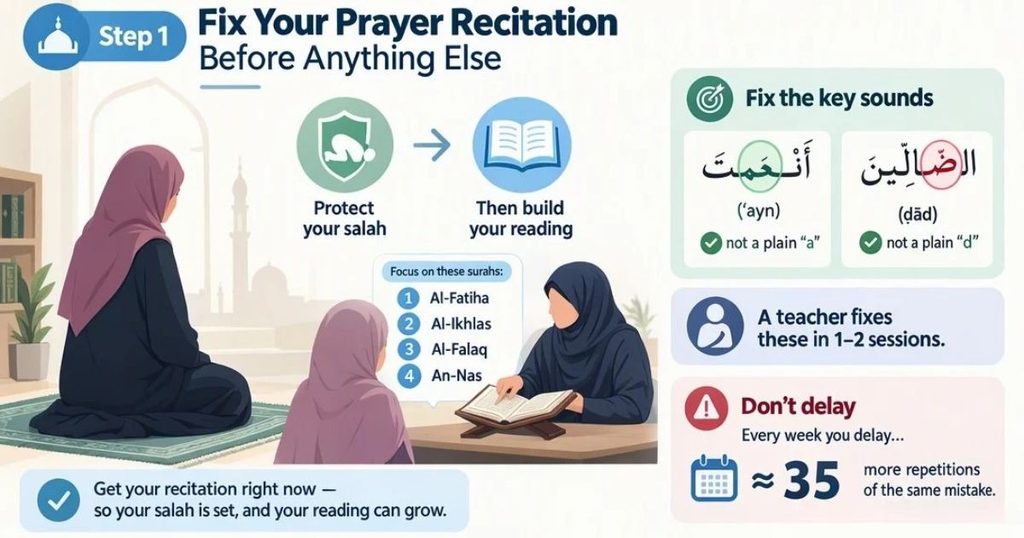
Book a session focused only on the surahs you currently recite: Al-Fatiha, then Al-Ikhlas, Al-Falaq, An-Nas. The goal is not understanding or full Tajweed. It is removing errors that change meaning — including the ع in أَنْعَمْتَ and the ض in الضَّالِّينَ, which English speakers routinely replace with a plain “d” sound.
A teacher fixes these in one or two sessions. Left alone, they harden into muscle memory over years of daily prayer. Every week you delay roughly thirty-five repetitions of the same mistake.
Step 2: Learn the Arabic Alphabet With Its Articulation Points
Once your prayer is safe, the next stage in how to learn the Quran when you converted late in life is the foundation itself — letters, not surahs.
Begin Noorani Qaida, the standard foundational text for Quran reading, used because it introduces letters, vowels, and joins in a tested order.
Learn each of the 28 letters with its makhraj (where in the mouth or throat the sound originates), not just its name. Five letters carry nearly all convert pronunciation errors because they have no English equivalent: ع، ح، خ، غ، ق.
A practitioner’s rule: if you cannot produce ح and خ as clearly different sounds on demand, you are not ready for the next step.
Expect three to five weeks at 20 minutes daily. Rushing here is the most expensive shortcut in adult Quran learning, because every later habit is built on these sounds.
Step 3: Learn Vowels, Sukoon, Shaddah, and Tanween
This is the stage where separate letters become readable words. You learn the short vowels (Fathah, Kasrah, Dammah), then the long vowels, then sukoon, shaddah, and tanween — the marks that control length and doubling.
Read slowly and deliberately at this stage. Accuracy now is worth more than speed later, because every habit formed here gets carried into thousands of verses you have not met yet.
You are ready for Tajweed when you can sound out an unfamiliar three-letter word correctly without guessing from memory.
Step 4: Apply Basic Tajweed, One Rule At A Time
Tajweed is the set of rules governing correct Quranic recitation — how each letter is articulated and how letters behave beside one another.
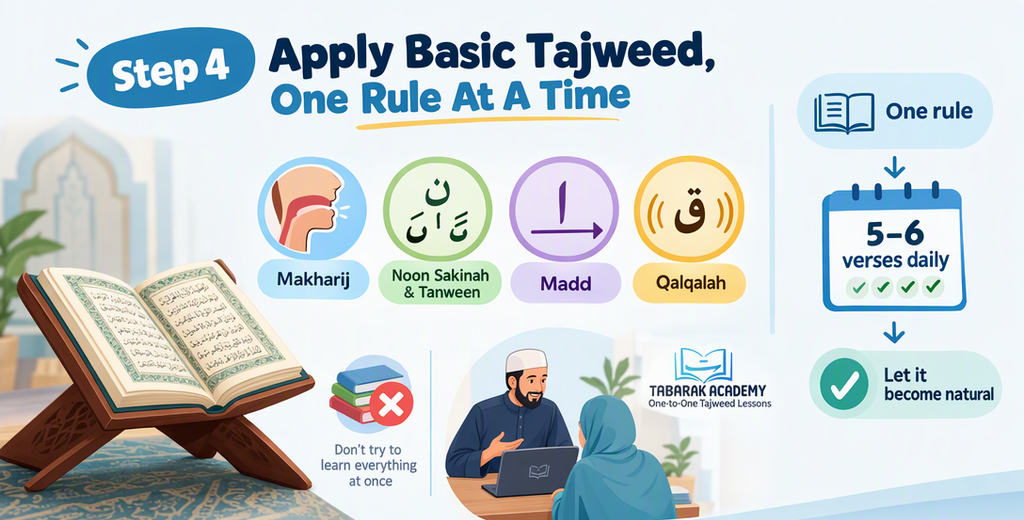
Do not study the full system. For an adult beginner, four areas carry the load: Makharij (articulation points), Noon Sakinah and Tanween rules, Madd (elongation), and Qalqalah.
Take one rule, apply it to five or six verses daily, and leave the rest of your reading alone until that rule is automatic. Trying to apply every rule at once is the single most common reason adult learners describe Tajweed as “too complicated.”
Learning at your own pace, with no group to fall behind: one-to-one lessons at Tabarak Academy introduce Tajweed rule by rule, so a late start never means a rushed one.
Step 5: Read Aloud Every Single Day
Silent reading hides mistakes. Loud reading exposes them while they are still cheap to fix. Your tongue, ear, and eye have to work together, and only recitation out loud trains all three at once.
Record the same short surah once a week and compare. Converts often resist this because of self-consciousness — but hearing your recitation from four weeks ago is the most reliable motivation available, and it surfaces errors a teacher might only catch at your next session.
Start slow. Fluency is a by-product of accurate repetition, never a target you chase directly.
Step 6: Build Revision In Before You Build Volume
Adults forget faster than they expect, and new material is what feels like progress — which is exactly the trap. The working rule is old before new: spend the first 30–40% of every session revising what you already covered, then move forward.
Without structured revision, material learned a fortnight ago degrades quickly. Learners over-invest in new content, then discover they can no longer read last month’s surah cleanly and have to relearn it. Revision is not a delay; it is what stops you paying twice.
Start revision from your most recently learned portion and work backwards. This puts your weakest material first, while your attention is sharpest.
Experience Our Interactive Learning
Curious about how we teach? Watch these brief video clips from our recent live sessions to see our structured curriculum, advanced learning platform, and dynamic student-teacher interactions firsthand.
Start Your Quran Learning Journey
Join Tabark Academy today for structured online lessons with qualified tutors, customized to fit your goals.
Book Your Free Trial LessonStep 7: Add Meaning Once Reading Is Stable
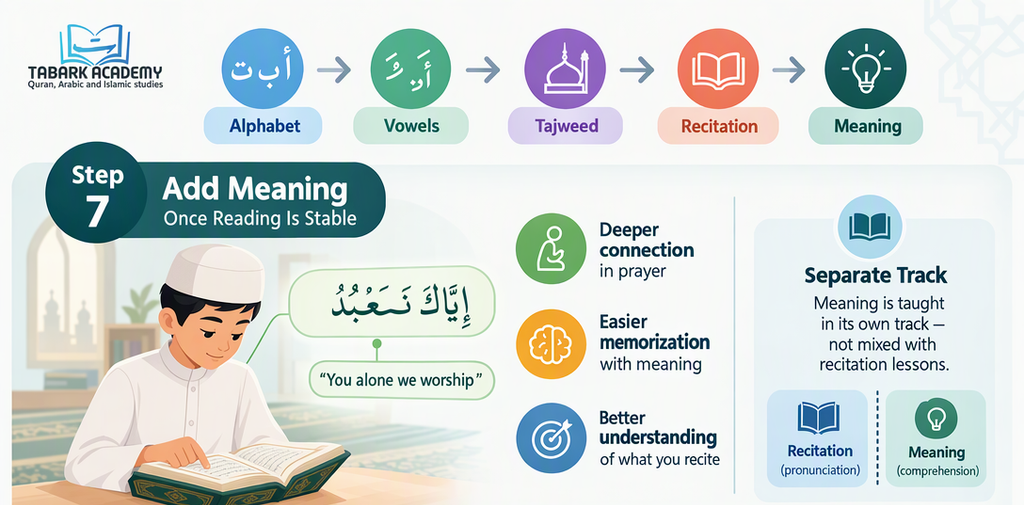
Once you can read Juz Amma with reasonable accuracy, start attaching meaning — keyword by keyword, not full tafsir.
- Start with the words you already recite: Knowing what iyyaka na’budu means changes how you stand in prayer. It also makes memorization lighter, because the mind retains meaningful sequences far better than abstract sound.
- Keep it a separate track:Tabarak Academy structures meaning as its own track rather than mixing it into recitation lessons, which is how it should be sequenced — comprehension should never compete with pronunciation accuracy for attention inside the same session.
Read also: Quran Classes for New Muslims
Why Converting Late Changes the Method, Not the Outcome?
Three things genuinely differ for a late convert compared with a born-Muslim adult beginner, and each one changes how to learn the Quran when you converted late in life in practice.
A. You have no passive exposure
A born Muslim who never studied formally has still heard thousands of hours of recitation. Your ear starts from zero, which makes listening a training activity for you, not background noise.
B. You are learning the whole deen at once
Quran competes for bandwidth with fiqh of wudu, prayer times, and fasting rules. Shorter, fixed sessions survive this competition; ambitious ones do not.
C. You likely have nobody at home to correct you
This single factor is why self-study fails more often for converts than for any other group of learners — and why correction, not effort, is the variable to solve for.
How Long Does It Take to Learn the Quran When You Converted Late in Life?
There is no fixed timeline, and anyone promising one is selling something. What can be described is the sequence of milestones and what each depends on.
Realistic milestone expectations:
- Weeks 1–2: Prayer surahs corrected. You stop worrying about mid-salah.
- Weeks 3–8: Alphabet and vowels. You can sound out simple words slowly.
- Months 3–6: Reading Juz Amma with a teacher correcting you. Slow but accurate.
- Months 6–12: Fluency improving, basic Tajweed applied without conscious effort.
These assume 20–30 minutes daily with regular correction. Two hours once a week produces noticeably worse results, because recitation is a motor skill — it consolidates through frequency, not duration.
What actually changes your timeline
Four variables matter: how often you practise, whether a teacher hears you, how disciplined your revision is, and your starting familiarity with Arabic sounds. Notice that age is not on that list.
The 5 Mistakes That Stall Late Converts
These failure patterns show up repeatedly in adult convert learning, and each one costs months.
- Relying on transliteration: English transliteration cannot represent Arabic sounds — there is no Latin letter for ع. It is a temporary bridge for prayer in week one; used past month two, it actively builds errors you will later unlearn.
- Learning silently to avoid embarrassment: Many converts practise silently because they are self-conscious in a community where everyone seems fluent. Privacy is a legitimate need — the answer is a private one-to-one setting, not silence.
- Starting with long surahs: Ambition points toward Al-Baqarah. Start with surahs under ten ayat. Completion creates momentum, and momentum carries you through month four, when novelty has worn off and fluency has not yet arrived.
- No fixed study time: when I get a chance” never arrives. Anchor the session to an existing fixed point — after Fajr, or immediately after Isha — so the decision is already made.
- Practising without correction: The decisive one for converts. Un-corrected practice does not plateau — it regresses, because every repetition reinforces the error along with the verse.
Read also: Shortest Surahs In The Quran To Memorize First
How To Choose A Quran Teacher As An Adult Convert?
Not every qualified Quran teacher is a good fit for a late convert. Qualification and fit are separate questions.
- Verify the qualification: Ask whether the teacher holds an ijazah — a certification in Quranic recitation transmitted through a chain of teachers. This is the recognised standard for Tajweed instruction.
- Ask the question most people skip: Have you taught adult converts before? A teacher used to children will drill without explaining. An adult needs the reasoning — why this letter comes from the throat, why this madd is longer — because adult memory holds explanations better than drills.
- Request what you actually need: Say directly that you are a convert starting from zero, and ask for Al-Fatiha correction in the first session.
Request a female teacher if that is what makes you comfortable — Tabarak Academy provides female tutors for sisters who prefer it, and that comfort materially affects whether you keep showing up.
Step Inside Our Virtual Classrooms
See our engaging teaching methods in action! watch real snippets of our live classes and discover how our expert instructors make learning interactive, memorable, and inspiring for every student.
Start Your Quran Learning Journey
Join Tabark Academy today for structured online lessons with qualified tutors, customized to fit your goals.
Book Your Free Trial LessonStart Learning the Quran With Tabarak Academy Today
You have waited long enough to start. The gap between where you are and reading the Quran confidently is not years of impossible effort — it is a correct sequence, daily practice in minutes rather than hours, and a teacher who hears every mistake and fixes it before it sets in.
Tabarak Academy teaches adult converts one-to-one, online, at times that fit around work and family.
Book your free trial lesson with Tabarak Academy and recite your first corrected verse this week.
Our Quran Courses:
- Online Quran Classes for Beginners
- Online Quran Classes for Kids
- Online Quran Classes for Adults
- Online Quran Classes for Men
- Online Quran Classes for Sisters
- Quran Reading Course
- Quran Recitation Course
- Online Ijazah Course
- Online Qirat Course
- Quran for Toddlers / Young Children
- Weekend Quran Classes
- Intensive Quran Course
- Al-Azhar Quran Course
- Zoom Quran Classes
Conclusion
Knowing how to learn the Quran when you converted late in life is a sequencing problem, not an age problem.
Protect your prayer recitation first, build the alphabet and vowels properly, add Tajweed one rule at a time, recite aloud daily, revise before you advance, and attach meaning once reading is stable.
The mistakes that stall people are predictable and avoidable: transliteration dependence, silent practice, overambitious surahs, no fixed time, and above all no correction. Solve for correction and consistency, and the timeline takes care of itself.
You came to Islam as an adult, which means you came to it by choice — and that same deliberate choice is what carries adult learners through to fluent recitation. Start this week, with guidance, and let Tabarak Academy walk the path with you.

Frequently Asked Questions
Below are the questions adult converts ask most often before starting, answered directly so you can decide your next step without guessing.
1. Is it too late to learn the Quran if I converted in my 40s or 50s?
No, it is not too late to learn the Quran when you converted late in life at any age. Adults bring focus, discipline, and clear motivation that often outperform childhood learning. What determines progress is consistency and correction, not starting age.
2. Can I learn the Quran if I don’t speak any Arabic?
Yes. Learning to read the Quran does not require speaking Arabic. You begin by recognising the 28 Arabic letters and their sounds, then short and long vowels, building reading as a separate skill from conversation.
3. How do I fix my prayer recitation if I learned it from transliteration?
Book a focused session on Al-Fatiha and the short surahs with a qualified teacher. Transliteration-based recitation usually contains a small set of predictable errors — particularly ع، ح، ض — which a teacher can correct within one or two lessons.
4. How many minutes a day should I study the Quran as an adult convert?
Twenty to thirty minutes daily is more effective than longer weekly sessions. Recitation is a motor skill that consolidates through frequent repetition, so a short daily habit outperforms infrequent long study for nearly every adult learner.
5. Should I learn Tajweed or Quran reading first?
Learn basic reading and correct letter pronunciation first, then introduce Tajweed rules gradually alongside recitation. Attempting full Tajweed before you can read fluently is the most common cause of frustration among adult beginners.
6. What are the most useful tips for learning the Quran when you converted late in life?
The most effective tips for how to learn the Quran when you converted late in life are a fixed daily time, 20–30 minutes of practice, reading aloud instead of silently, revising old material before new, and never practising without correction from a qualified tutor.