


Shortest Surahs In The Quran To Memorize First
When beginners ask themselves, “Which surah should I actually begin with?” Most beginners assume there’s a single “correct” answer, but the real starting point depends on some factors. These factors include your current reading level, your goal, and how much time you can commit to daily review.
The shortest surahs in the Quran to memorize first are the ones that let you build momentum quickly while keeping the memorization workload light enough to stay consistent.
This guide points out the actual shortest surahs by ayah count. It also explains why Juz Amma works well as a starting point for most beginners. Moreover, it gives you a practical framework for choosing the right surah for your own situation, instead of a generic “best surah” list copied from someone else’s plan.
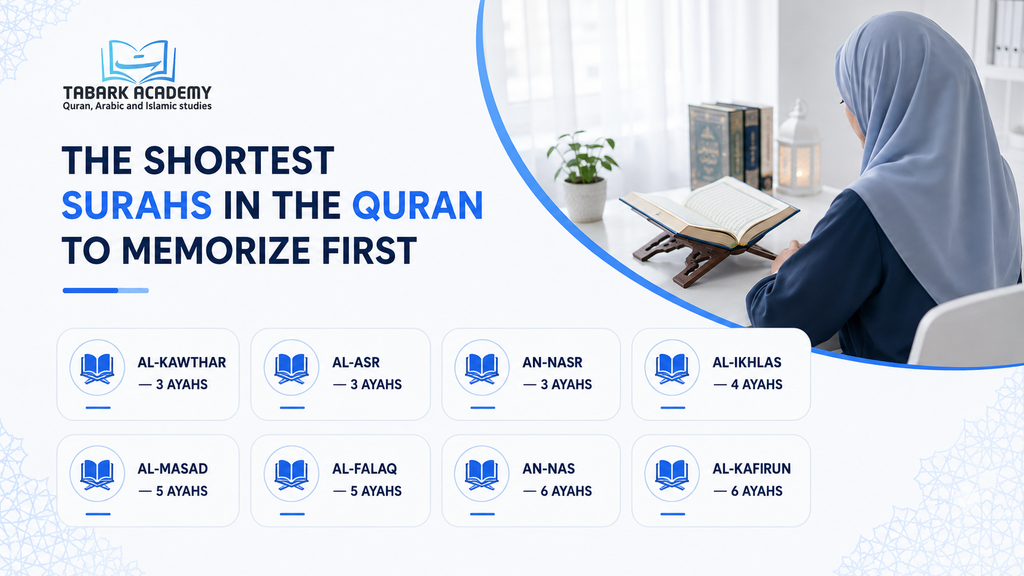
1. Surah Al-Kawthar
The shortest surah in the Quran is Surah Al-Kawthar (108:1–3). It contains only three ayahs and is located in Juz 30 (Juz ‘Amma), the final Juz of the Quran.
Al-Kawthar is one of the first surahs many beginners memorize because of its brevity. Several other short surahs from the same Juz also provide a manageable, low-pressure starting point for building a consistent memorization habit.
Surah Al-Kawthar celebrates the abundant goodness Allah granted Prophet Muhammad ﷺ. The Prophet ﷺ also explained that Al-Kawthar is a river in Paradise that Allah has given him:
فَإِنَّهُ نَهْرٌ وَعَدَنِيهِ رَبِّي عَزَّ وَجَلَّ عَلَيْهِ خَيْرٌ كَثِيرٌ، هُوَ حَوْضٌ تَرِدُ عَلَيْهِ أُمَّتِي يَوْمَ الْقِيَامَةِ، آنِيَتُهُ عَدَدُ النُّجُومِ
“It is a river which my Lord, the Exalted and Glorious, has promised me, and there is an abundance of good in it. It is a reservoir upon which my people will come on the Day of Resurrection, and its vessels are as numerous as the stars.”— Sahih Muslim (400a)
This authentic hadith explains the meaning and special virtue of Al-Kawthar, giving beginners an opportunity to connect memorization with the meaning of the Surah.
Read also: Quick Surahs to Memorize: Perfect for Beginners
2. Surah Al-Asr
Surah Al-Asr is ideal for beginners because it contains only three short ayahs with a clear rhythm and memorable endings. Its concise structure makes repetition easier and helps new learners build confidence in recitation and memorization.
Despite its brevity, the Surah summarizes essential qualities connected to salvation: faith, righteous deeds, encouraging one another to truth, and encouraging one another to patience.
وَالْعَصْرِ إِنَّ الْإِنسَانَ لَفِي خُسْرٍ إِلَّا الَّذِينَ آمَنُوا وَعَمِلُوا الصَّالِحَاتِ وَتَوَاصَوْا بِالْحَقِّ وَتَوَاصَوْا بِالصَّبْرِ
“By the ˹passage of˺ time! Surely humanity is in ˹grave˺ loss, except those who have faith, do good, and urge each other to the truth, and urge each other to perseverance.”— Surah Al-Asr (103:1–3)
This combination of short verses and profound meaning makes Surah Al-Asr particularly suitable for beginners to memorize, understand, and recite regularly in Salah.
3. Surah An-Nasr
Surah An-Nasr is an excellent choice for beginners because it contains only three short ayahs with a smooth rhythm and closely connected endings. Its concise structure makes repetition and memorization easier.
Its message teaches believers to glorify and praise Allah and seek His forgiveness when His help and victory come. Once memorized, beginners can recite it regularly in Salah and reinforce it through daily practice.
Its special place in the sequence of revelation is also mentioned in an authentic report from Ibn ‘Abbas:
عَنْ عُبَيْدِ اللَّهِ بْنِ عَبْدِ اللَّهِ بْنِ عُتْبَةَ قَالَ قَالَ لِي ابْنُ عَبَّاسٍ تَعْلَمُ آخِرَ سُورَةٍ نَزَلَتْ مِنَ الْقُرْآنِ نَزَلَتْ جَمِيعًا قُلْتُ نَعَمْ إِذَا جَاءَ نَصْرُ اللَّهِ وَالْفَتْحُ قَالَ صَدَقْتَ
‘Ubaidullah ibn ‘Abdullah reported that Ibn ‘Abbas asked him, “Do you know which Surah of the Quran was revealed last, in its entirety?” He replied, “Yes, ‘When Allah’s help and victory come.’” Ibn ‘Abbas said, “You have spoken the truth.”— Sahih Muslim (3024a)
This report gives Surah An-Nasr particular significance for learners: despite being only three ayahs long, it carries an important message about responding to Allah’s help with praise, gratitude, and seeking forgiveness.
Read also: How To Memorize The Quran?
4. Surah Al-Ikhlas
Surah Al-Ikhlas is an ideal starting point for beginners because its four short, rhythmic ayahs are easy to repeat, memorize, and recite in Salah.
More importantly, it establishes a central foundation of Islamic Aqeedah: Allah is One, self-sufficient, and without offspring, parent, or equal. Memorizing it therefore builds Quranic confidence while reinforcing the meaning of Tawhid.
The exceptional virtue of this short Surah is also established in an authentic hadith. The Prophet ﷺ said:
وَالَّذِي نَفْسِي بِيَدِهِ إِنَّهَا لَتَعْدِلُ ثُلُثَ الْقُرْآنِ
“By Him in Whose Hand my soul is, it is equal to one-third of the Quran.”— Sahih al-Bukhari (5013)
This hadith highlights the remarkable status of Surah Al-Ikhlas. Memorizing it places a concise declaration of Allah’s oneness in the heart and gives beginners a Surah they can recite regularly in Salah and throughout their daily worship.
Experience Our Interactive Learning
Curious about how we teach? Watch these brief video clips from our recent live sessions to see our structured curriculum, advanced learning platform, and dynamic student-teacher interactions firsthand.
5. Surah Al-Masad
Surah Al-Masad is suitable for beginners because its five short, rhythmic ayahs are easy to repeat and memorize. While learning it and memorizing it, students also discover the story of Abu Lahab and his wife, Umm Jamil, and understand the consequences of opposing the truth and harming the Prophet ﷺ.
Surah Al-Masad was revealed after the Prophet Muhammad ﷺ publicly warned Quraysh about Allah’s punishment. According to Ibn ʿAbbas, the Prophet ﷺ gathered them after ascending Al-Safa and called them to heed his warning. Abu Lahab responded with hostility.
قَالَ أَبُو لَهَبٍ: تَبًّا لَكَ أَلِهَذَا جَمَعْتَنَا
Abu Lahab said, “May you perish! Is it for this that you have gathered us?”— Sahih al-Bukhari (4973)
Allah then revealed the opening of Surah Al-Masad:
تَبَّتْ يَدَا أَبِي لَهَبٍ وَتَبَّ
“May the hands of Abu Lahab perish, and he ˹himself˺ perish!”— Surah Al-Masad (111:1)
The authentic narration explicitly connects Abu Lahab’s hostile response with the revelation of the opening verse of Surah Al-Masad.
revealed: “May the hands of Abu Lahab perish, and perish he!” (Quran-1), condemning his hostility toward the truth.
Read also: Best Quran Hifz Schools for Online Quran Memorization
6. Surah Al-Falaq
Surah Al-Falaq is one of the Quranic chapters recited for seeking Allah’s protection. Its five short ayahs are also manageable for beginners to repeat and memorize, making it a meaningful starting point in a Quran memorization journey.
The Prophet ﷺ highlighted the special importance of the Mu‘awwidhatayn—Surah Al-Falaq and Surah An-Nas—for seeking refuge in Allah. ‘Uqbah ibn ‘Amir reported that the Prophet ﷺ said:
أَلَمْ تَرَ آيَاتٍ أُنْزِلَتِ اللَّيْلَةَ لَمْ يُرَ مِثْلُهُنَّ قَطُّ قُلْ أَعُوذُ بِرَبِّ الْفَلَقِ وَقُلْ أَعُوذُ بِرَبِّ النَّاسِ
“Have you not seen verses revealed tonight, the like of which has never been seen? ‘Say: I seek refuge in the Lord of daybreak’ and ‘Say: I seek refuge in the Lord of mankind.’”— Sahih Muslim (814)
Memorizing Surah Al-Falaq also makes it easy to incorporate it into the daily Sunnah. The Prophet ﷺ instructed ‘Abdullah ibn Khubayb:
قُلْ هُوَ اللَّهُ أَحَدٌ وَالْمُعَوِّذَتَيْنِ حِينَ تُمْسِي وَحِينَ تُصْبِحُ ثَلاَثَ مَرَّاتٍ تَكْفِيكَ مِنْ كُلِّ شَيْءٍ
“Recite ‘Say: He is Allah, One’ and Al-Mu‘awwidhatayn three times in the evening and in the morning. They will suffice you against everything.”— Sunan Abi Dawud (5082)
The Prophet ﷺ also practiced these surahs before sleeping. ‘Aishah reported:
كَانَ إِذَا أَوَى إِلَى فِرَاشِهِ كُلَّ لَيْلَةٍ جَمَعَ كَفَّيْهِ ثُمَّ نَفَثَ فِيهِمَا فَقَرَأَ فِيهِمَا قُلْ هُوَ اللَّهُ أَحَدٌ وَقُلْ أَعُوذُ بِرَبِّ الْفَلَقِ وَقُلْ أَعُوذُ بِرَبِّ النَّاسِ
“Whenever the Prophet ﷺ went to bed each night, he would cup his hands together, blow into them, and recite ‘Say: He is Allah, One,’ ‘Say: I seek refuge in the Lord of daybreak,’ and ‘Say: I seek refuge in the Lord of mankind.’”
He would then wipe his hands over as much of his body as he could, beginning with his head, face, and the front of his body, and he would do this three times.- Sahih al-Bukhari (5017)
Read also: Counting the Surahs in Juz Amma: A Quick Guide
7. Surah An-Nas
Surah An-Nas is easy for beginners to memorize because its six short, rhythmic ayahs contain familiar repeated words. It teaches learners to seek Allah’s protection from the whisperings of humans and jinn.
The Prophet ﷺ recommended reciting it with Al-Ikhlas and Al-Falaq three times every morning and evening, and he also recited these surahs three times before sleeping, blew into his hands, and wiped them over his body.
Read also: Is It Too Late to Learn to Read the Quran as an Adult? Practical Steps to Start Today
8. Surah Al-Kafirun
Surah Al-Kafirun is an excellent choice for beginners because its six short ayahs use repeated phrases and a strong rhythm that support memorization. Learners should pay particular attention to the similar verses to avoid mixing their order, while regular recitation can help strengthen retention.
The Surah delivers a powerful lesson in Tawhid, clearly separating the worship of Allah from shirk and rejecting compromise in matters of worship. Its connection to freedom from shirk is also mentioned in the Sunnah. The Prophet ﷺ instructed a Companion to recite Surah Al-Kafirun before sleeping:
اقْرَأْ قُلْ يَا أَيُّهَا الْكَافِرُونَ ثُمَّ نَمْ عَلَى خَاتِمَتِهَا فَإِنَّهَا بَرَاءَةٌ مِنَ الشِّرْكِ
“Recite ‘Say: O disbelievers,’ then sleep after finishing it, for it is a declaration of freedom from shirk.”— Sunan Abi Dawud (5055)
Surah Al-Kafirun was also part of the Prophet’s ﷺ regular voluntary prayers. Ibn ‘Umar reported:
رَمَقْتُ النَّبِيَّ ﷺ أَرْبَعًا وَعِشْرِينَ مَرَّةً يَقْرَأُ فِي الرَّكْعَتَيْنِ قَبْلَ الْفَجْرِ وَالرَّكْعَتَيْنِ بَعْدَ الْمَغْرِبِ قُلْ يَا أَيُّهَا الْكَافِرُونَ وَقُلْ هُوَ اللَّهُ أَحَدٌ
“I observed the Prophet ﷺ twenty-four times reciting in the two rak‘ahs before Fajr and the two rak‘ahs after Maghrib: ‘Say: O disbelievers’ and ‘Say: He is Allah, One.’”— Jami‘ at-Tirmidhi (431)
Another narration describes the virtue of Surah Al-Kafirun:
قُلْ يَا أَيُّهَا الْكَافِرُونَ تَعْدِلُ رُبُعَ الْقُرْآنِ
“‘Say: O disbelievers’ is equivalent to one-quarter of the Quran.”— Jami‘ at-Tirmidhi (2894)
Memorizing Surah Al-Kafirun therefore gives beginners a short Surah for regular recitation while reinforcing the fundamental Islamic principle of worshipping Allah alone.
Read also: Easy Ways to Learn Reading the Quran in Arabic Today
Read also: How To Start Memorizing The Quran As A Beginner?
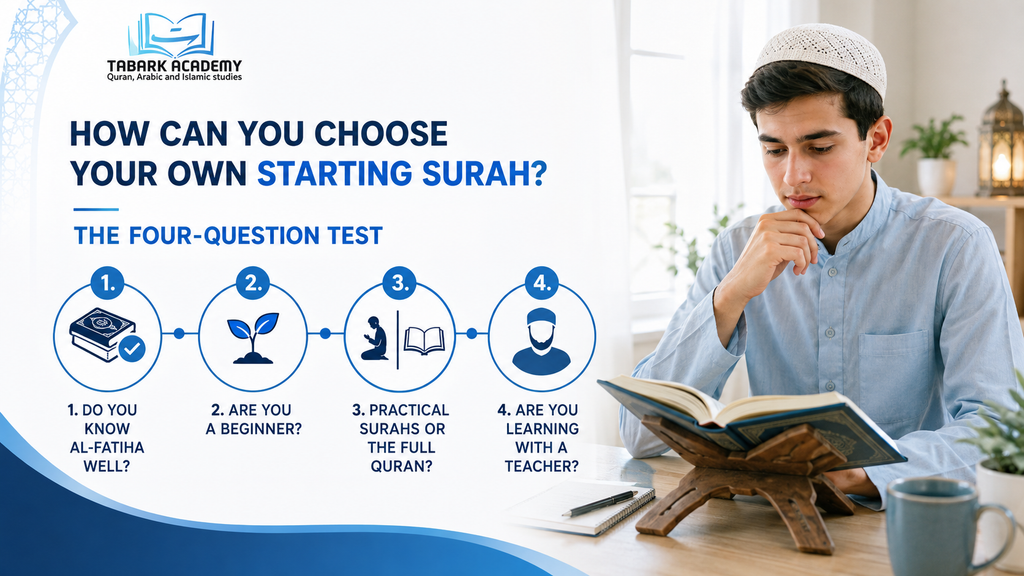
How Can You Choose Your Own Starting Surah? – The Four-Question Test
There isn’t one surah that’s the right starting point for everyone. The question worth asking isn’t “what’s the best surah to memorize first?” It’s “what’s the best starting point for my level and goal?”
Use these four questions as a quick test whenever you’re unsure where to begin.
1. Do You Know Al-Fatiha Well?
Start with Surah Al-Fatiha if you haven’t fully memorized it and made it accurate yet, before anything else. It’s recited in every unit of every prayer. That’s why getting it right has an immediate, daily benefit. Its short length makes it a natural first step regardless of your broader goal.
Read also: 5 Creative Games to Help Your Kids Memorize the Quran Faster
2. Are You A Beginner To Memorization?
If this is your first serious attempt at Hifz, the short surahs from Juz Amma are usually such an easier starting point. Beginning with a long surah for the sake of a bigger accomplishment often backfires. In this case, the length becomes a burden before the memorization method is even established.
3. Is Your Goal Practical Surahs Or The Full Quran?
Start with short, familiar surahs, such as Al-Ikhlas, Al-Falaq, and An-Nas, if your goal is to memorize surahs you’ll actually use in prayer.
But if your goal is to complete the full Quran and your reading is already strong, you can start from Surah Al-Baqarah and follow the Mushaf’s order, ideally with a structured program or teacher.
4. Are You Learning With A Teacher?
If you don’t currently have a structured plan, this is exactly where working with a Quran teacher makes the biggest difference. Someone who can assess your level directly and adjust the starting point instead of applying a generic sequence to everyone.
If you’re working with a teacher or a structured program, follow the sequence they’ve set for you, as long as it fits your current level.
A teacher can adjust pacing based on how you’re actually retaining material. It is something a fixed list can’t do.
Read also: 10 Strategies Of How To Memorize Quran Fast And Never Forget
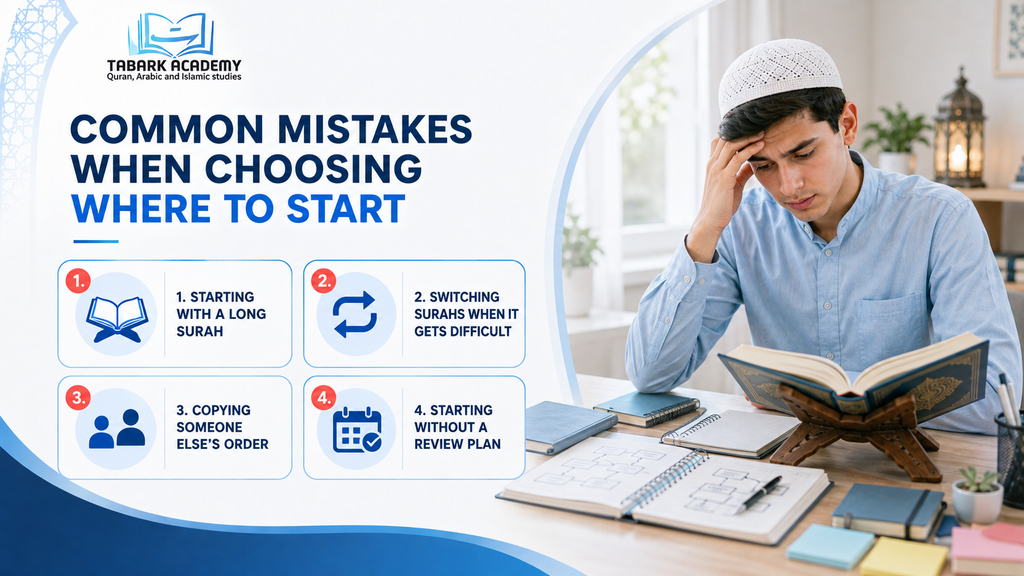
Common Mistakes When Choosing Where To Start
A few common mistakes make early memorization harder than it needs to be. Most of them aren’t about picking the “wrong” surah. They’re about the approach around it.
1. Starting With A Long Surah For A Bigger Sense Of Achievement
Choosing a long surah as a first trial often turns into a burden quickly. A shorter starting point lets you build a memorization and review method before taking on longer passages.
Read also: Which Surahs to Memorize First As a Beginner
2. Switching Surahs Every Time It Gets Difficult
Moving between Al-Baqarah, then Juz Amma, then another surah rarely solves the underlying problem. Pick one path and give it real time before deciding to change it.
3. Copying Someone Else’s Order Without Considering Your Own Level
Someone else’s success starting from Al-Baqarah doesn’t mean that’s the right path for you. The same goes for An-Nas. It’s a common starting point, not a rule everyone has to follow.
Read also: Is It Too Late to Memorize the Quran? The Honest Answer for Adult Learners
4. Choosing A Starting Point Without Planning For Review
The real question isn’t only “which surah should I start with?” It’s also “can I actually review what I memorize?” Choose an amount and a path you can keep track of as soon as the new memorization stops and daily review begins.
Read also: Quran Hifz Classes for Sisters – Everything You Need to Start Memorizing Today
Step Inside Our Virtual Classrooms
See our engaging teaching methods in action! watch real snippets of our live classes and discover how our expert instructors make learning interactive, memorable, and inspiring for every student.
Start Your Quran Memorization Journey The Right Way
Picking the right starting surah is only the first step. Consistent, corrected memorization is what actually gets you through the Quran. Tabarak Academy‘s certified online teachers assess your current level.
They also build a realistic memorization and review plan around your goals, and correct your recitation as you go. That holds whether you’re starting with Al-Kawthar or getting ready for Surah Al-Baqarah.
Our Quran Memorization / Hifz Courses
- Online Hifz Program
- Juz 30 Memorization Course
- Hifz for Kids Course
- Hifz for Adults Course
- Hifz for Sisters Course
- Short Surah Memorization Course
- Hifz Ijazah Course
Conclusion
There’s no single surah that’s the best starting point for everyone learning to memorize the Quran.
The right choice depends on whether you’ve mastered Al-Fatiha, whether you’re new to memorization, what your long-term goal is, and whether you’re following a teacher’s plan.
For most beginners, the shortest surahs in the Quran to memorize first, such as Al-Kawthar, Al-Asr, An-Nasr, Al-Ikhlas, Al-Falaq, and An-Nas, offer an achievable, practical starting point that builds both confidence and a habit of daily review.
What matters more than the “perfect” first surah is choosing a path you can actually sustain, and treating consistent review as part of the plan from day one.
Frequently Asked Questions
What Is The Shortest Surah In The Quran?
Al-Kawthar is the shortest surah in the Quran, with 3 ayahs. It’s located in Juz 30 and is commonly one of the first surahs beginners memorize because of its brevity.
Which Surah Should I Memorize First If I Don’t Know Al-Fatiha Well?
If Al-Fatiha isn’t fully memorized yet, start there before any other surah. It’s recited in every prayer, so mastering it first has a direct, daily benefit regardless of your broader memorization goal.
Is Al-Ikhlas Really Equal To A Third Of The Quran?
Surah Al-Ikhlas is regarded as equal in reward to a third of the Quran, despite being only 4 ayahs long. This makes it one of the most commonly recommended short surahs for early memorization.
Should Children And Adults Start With The Same Surahs?
Children generally benefit from short, familiar surahs that are easy to repeat and help build a memorization habit early. Adults can choose their starting point based on reading level and goal. A strong reader working toward full Quran memorization may start from Surah Al-Baqarah instead.
What Should I Do If My Starting Surah Feels Too Difficult?
Before switching surahs, try to reduce your daily new memorization and increase your review time. Only change your starting point if the difficulty clearly doesn’t match your current stage, not because one or two sessions felt slow.
Should I Memorize Scattered Surahs Or Complete A Full Juz?
Scattered short surahs work well if your goal is building a habit or learning surahs for prayer. If you’re working toward memorizing the full Quran, completing a connected juz, such as Juz Amma, is usually easier to review and organize long-term.