


How To Memorize Quran By Listening Only—A Simple Step-By-Step Guide
You love the Quran, but reading Arabic feels hard. Maybe you never learned the letters. Maybe your eyes get tired after one page. The good news is that you can still learn how to memorize Quran by listening only.
This is how the Quran was first passed down, from teacher to student, by ear. For centuries, people learned whole surahs by hearing them, long before printed copies were common.
Today, it is even easier. You can play any surah on your phone, repeat one verse as many times as you like, and learn while you drive, cook, or walk. All you need is a good recording, a little time each day, and a plan you can stick to.
Still, many people start with great energy and stop after a few weeks. The reason is rarely a weak memory. Most of the time, they listen without a clear method, or they never check what they learned.
This guide gives you that method. You’ll get seven simple steps, a weekly review routine, and the mistakes that trip up most listeners, so you can avoid them from day one.
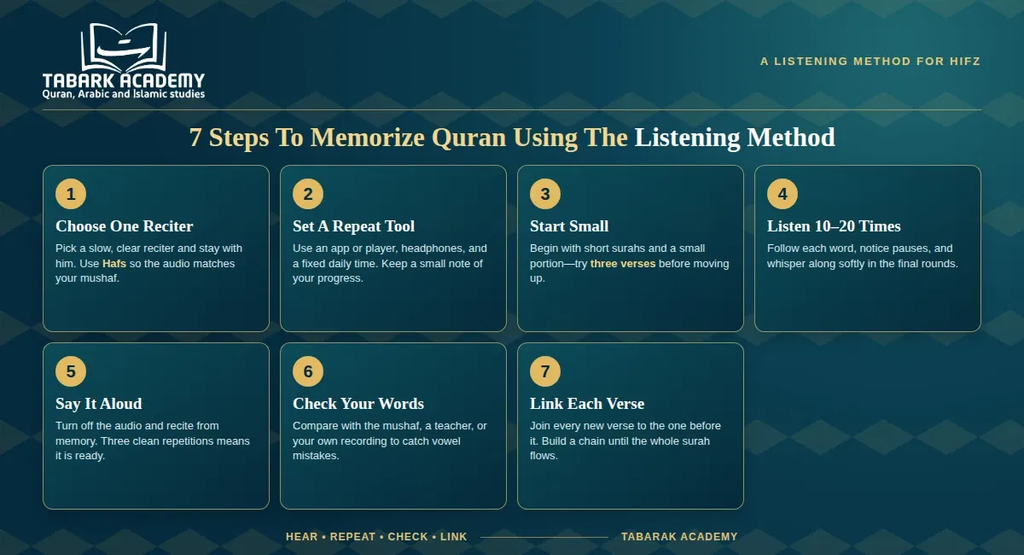
Step 1: Choose One Clear And Slow Reciter
Pick a reciter who reads slowly and clearly. Good choices are Sheikh Mahmoud Khalil Al-Husary and Sheikh Muhammad Siddiq Al-Minshawi. Their calm pace lets you hear every sound.
Here is an easy way to choose. Play Surah Al-Fatiha by three reciters. Keep the one you can follow word by word without getting lost.
Make sure the recording uses the Hafs reading. It is the most widely used reading today, and most printed copies of the Quran follow it. This way, what you hear will match the page.
Then stay with your reciter for everything you learn. Each reciter has his own tune and his own places to stop. Your memory holds on to that tune.
If you change reciters halfway through a surah, your mind must learn a new tune. That slows you down and causes mix-ups.
Step 2: Use An App That Repeats Verses And Pick A Daily Time
You need an app or player that can play one verse again and again. Some, like Tasmee, let you choose how many times a verse plays.
Wear headphones if you can. They block out noise and help you catch small sounds. Put your phone on silent so messages do not break your focus.
Next, pick one fixed time each day. Choose a time when your mind feels fresh, not when you are tired. Doing it at the same hour turns it into a habit.
Keep a small note of what you learn each day. It shows your progress and tells you what to review.
How long should you study? That depends on your day. Our guide on how much time adults need for hifz per day helps you find a time that fits your real life.
Step 3: Start With Short Surahs And A Small Portion
Begin with short surahs from Juz Amma, the last part of the Quran. A quick win early on gives you the push to keep going.
Keep your daily portion small. People who have learned half of the Quran by heart often advise starting with just three verses a day. When that feels easy, move up to five.
Do not start with a full page a day. It feels exciting on day one, but by day ten many people quit.
The size of your portion matters less than how well you hold it. Three verses you know well are worth more than a page you only half remember.
If a verse is very long, you do not have to learn it all at once. Split it into two or three parts. Learn each part, then join them into one.
Step 4: Listen To One Verse 10 To 20 Times
Pick one verse, or two short ones. Play it 10 to 20 times in a row. Give it your full attention each time.
This is active listening, not sound in the background. Follow each word in your head. Notice where the reciter stops to breathe and where his voice rises or falls.
If your app lets you slow the audio, try it for hard verses. A slower speed helps you catch letters that pass by too fast.
As you listen, try to guess the next word before you hear it. When you can guess every word, you are ready for the next step.
Count your rounds with the app or on your fingers, so you do not lose track. In the last few rounds, whisper along softly. This gets your ears and your mouth working as a team.
Experience Our Interactive Learning
Curious about how we teach? Watch these brief video clips from our recent live sessions to see our structured curriculum, advanced learning platform, and dynamic student-teacher interactions firsthand.
Step 5: Stop The Audio And Say The Verse Out Loud
Now turn the audio off. Say the verse out loud from memory. Repeat it a few times in a clear voice.
Saying it out loud trains your tongue and lips. This is a different kind of memory from hearing. When both kinds work together, the verse sticks much better. This mouth memory is also what you will use when you recite in prayer.
Speak at a calm, steady pace. Rushing hides small slips, while a slow voice lets you hear every sound you make.
Use this quick test. If you can say the verse three times in a row with no help, it is ready. If you stop or forget a word, go back and listen a few more times.
Do not feel bad if a verse needs extra rounds. Being patient here saves you from fixing errors later.
Step 6: Check Your Words With The Mushaf Or A Teacher
Even when you learn by ear, check your verse from time to time. Look at the mushaf, or ask someone who reads Arabic to listen to you.
Audio can hide small vowel mistakes. One wrong vowel can change what a word means. You may not hear the difference yourself, so a check catches it before it becomes a habit.
If you cannot read Arabic yet, record yourself on your phone. Play your recording next to the reciter, and compare them slowly, one word at a time.
A weekly check by a teacher or skilled reader is often enough.
You can also learn to read while you memorize. It is never too late to start from the first letter, as our guide to an adult beginner Quran reading course shows.
Step 7: Link Each New Verse To The One Before It
After you learn a new verse, join it to the verse before it. Say both from memory. Then add the next one, and say all three.
This builds a chain, like steps on a staircase. Without linking, you may know each verse alone but get stuck in between.
Pay close attention to the end of one verse and the start of the next. Say the last word of one verse and the first word of the next a few extra times. If you freeze at the same spot twice, practice that gap first tomorrow before adding anything new.
When you finish for the day, say today’s part in one go with the audio off. When you finish a full surah, say it from its first verse. Do not move on until the whole surah flows with no stops.
Would you like a kind teacher by your side? Tabarak Academy’s Online Hifz Program gives you a patient tutor who listens to every verse with you, one on one.

Start Your Quran Learning Journey
Join Tabark Academy today for structured online lessons with qualified tutors, customized to fit your goals.
Book Your Free Trial LessonRead also: Listening Method vs Reading Method for Quran Memorization
A Simple Review Plan To Keep Your Memorization Strong
Learning new verses is only half the work. The Prophet ﷺ warned that the Quran slips away faster than a camel runs off when its rope is loose (Sahih al-Bukhari 5033, Sahih Muslim 791).
Daily review needs repeating more than deep focus. Play recent verses while you drive, cook, or walk, then try a few with the audio off. Reciting your new surahs in your sunnah prayers is a great test, because there is no audio to lean on.
Older surahs fade first, because you stop hearing them. When you finish a juz, stop learning new verses for one or two weeks and go over the whole juz.
A simple weekly plan keeps new and old verses strong. You can change this example to fit your life:
| Day | New Verses | Review |
| Saturday to Wednesday | 3 to 5 verses a day | Verses from the last 3 days |
| Thursday | None | Everything from this week |
| Friday | None | Older surahs |
When studying alone, our guide on how to revise Quran without a teacher gives you a clear system to follow at home.
Habits That Help You Memorise Quran By Listening Only
The steps above cover what to do in each session. These two habits help you stay consistent and keep what you learn for the long run.
Learn The Meaning Before You Listen
Before you start a new part, read a simple explanation of it. When you know what a verse means, your mind has a story to hold. The words stop being just sounds.
For beginners, Tafsir al-Muyassar is short and easy. Even one line of tafsir for each verse is enough to start. Later, you can move to Tafsir As-Sa’di or Tafsir Ibn Kathir for more detail.
If English is your language, read a trusted translation of the verses first. Then listen. You will see how the meaning helps you guess the next word.
Meaning also helps with order. When you know a surah tells a story, you can remember which part comes next.
Knowing the meaning changes your prayer too. When you recite a verse you understand, your heart joins your tongue.
Find A Partner And Keep Your Daily Promise
Learning with a friend or family member helps a lot. When one of you feels lazy, the other one pushes ahead. You can also test each other. A partner can follow along in the mushaf while you recite, and catch slips you cannot hear in yourself.
Set a small goal together each week, like one short surah. Call or meet at the end of the week, and recite it to each other.
Treat your daily portion as a promise. If life forces a break, keep it to one or two days at most. Even on those days, listen to some Quran.
Celebrate when you finish a surah or a juz. Tell your family so they can share your joy. A small treat for yourself can lift your energy and carry you through hard days.
Not sure if learning online can work for you? See what real families share in Tabarak Academy’s student reviews. Many of them started right where you are now.

Memorize Quran By Listening Only Tips
These three tips protect you from the most common listening traps.
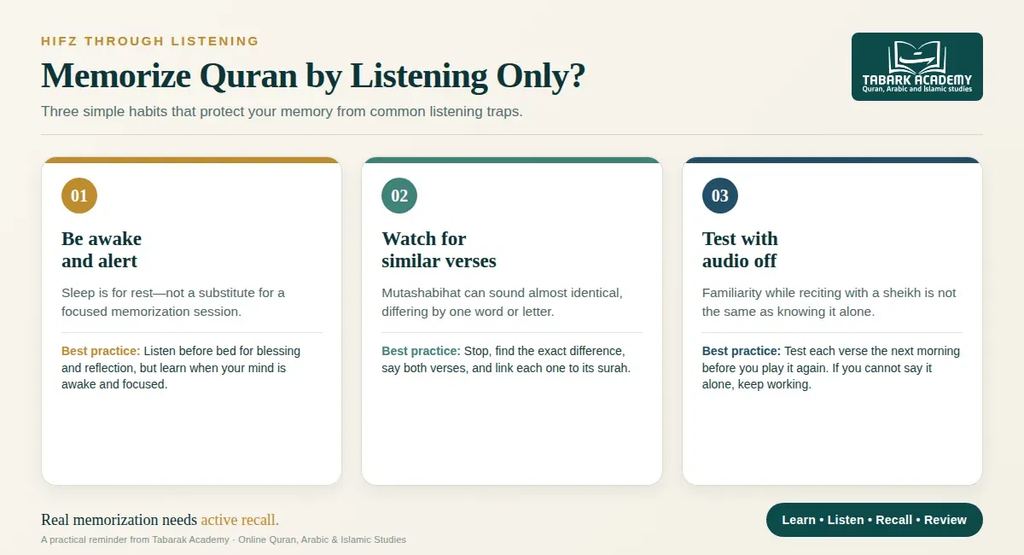
Memorize When You Are Awake And Alert
Some people say that playing the Quran while you sleep helps your mind memorize it. They point to Surah Ar-Rum 30:23 as proof. Scholars say this claim is not proven.
They also say no scholar of tafsir ever explained the verse this way. Ibn Kathir explains that the verse shows sleep as a sign of Allah, a time to rest after a tiring day.
This trap is costly because it feels like free progress. People play audio all night and think the work is done. Then they skip their real session the next day.
Playing the Quran before bed is still good. It brings blessing into your home, and you may wake up to Allah’s words.
But real memorizing needs a mind that is awake and focused. Learn when you are alert, and let sleep be a time for rest.
Learn The Difference Between Verses That Sound Alike
Many verses in the Quran sound almost the same. They may differ by just one word or one letter. Scholars call these mutashabihat, and every surah has a few.
Listeners mix them up more often than readers do. Without care, you may blend them together.
When you meet a verse that sounds like one you know, stop. Find the exact word that is different. Say both verses out loud, and notice the change.
Then link each verse to its own surah in your mind. Ask yourself, “Which surah am I in right now?” Knowing where you are helps you pick the right version.
Write the difference on a small card or in a note on your phone. Look at it before each review. This small step saves you from an error that is hard to undo.
Test Every Verse With The Audio Off
After you hear a verse many times, it feels familiar. You can say it along with the reciter, so you think you know it.
But saying a verse while you hear it is far easier than saying it alone. A verse is not truly yours until you can say it with no sound playing.
This trap catches listeners more than anyone. Your ears hear the Quran all day, so many verses start to feel known. Some of them are only familiar.
The fix is simple. Always test yourself with the audio off. If you cannot say it alone, keep working on it. A good rule is to test each verse the next morning, before you play it again.
Want more ways to check your memory? Our guide on how to test your own hifz gives you five easy methods to try at home.
Step Inside Our Virtual Classrooms
See our engaging teaching methods in action! watch real snippets of our live classes and discover how our expert instructors make learning interactive, memorable, and inspiring for every student.
Start Your Quran Learning Journey
Join Tabark Academy today for structured online lessons with qualified tutors, customized to fit your goals.
Book Your Free Trial LessonStart Your Quran Memorization With Tabarak Academy Today
Listening helps you learn the words. A qualified teacher makes sure every word is right. At Tabarak Academy, you get both.
For 25 years, Tabarak Academy has helped Muslims of all ages learn the Quran. When you join, you get:
- Tutors certified by Al-Azhar, each with a verified ijazah
- Private one-on-one live classes, never group lessons
- Female tutors for sisters and girls at no extra cost
- Morning, evening, and weekend times that fit work and school
- Monthly progress reports, so you always know where you stand
- A free trial class with no card needed, confirmed within 24 hours
Your tutor will fix your tajweed and build a review plan around your life, so you never have to guess if a word is right.
Book your free trial class now, and take your first step with a teacher beside you.

Our Quran Courses
Browse our Quran courses and start your Quran memorization journey today.
- Online Quran Classes
- Online Quran Classes for Beginners
- Online Quran Classes for Kids
- Online Quran Classes for Adults
- Online Quran Classes for Men
- Online Quran Classes for Sisters
- Quran Reading Course
- Quran Recitation Course
Conclusion
Learning how to memorize Quran by listening only comes down to a simple plan you follow every day. Pick one slow, clear reciter. Start with short surahs and only a few verses. Then repeat the same routine each time: listen with focus, say the verse alone, check it, and link it to the one before.
Check your words often, even if you learn mostly by ear. A quick look at the mushaf or a weekly session with a teacher catches small vowel mistakes before they stick.
Review is what holds it all together. Play recent verses during the small gaps in your day, and give each finished juz a week or two of its own. Reciting your new surahs in your sunnah prayers is one of the best ways to test yourself. Watch for verses that sound alike, and don’t count a verse as memorized until you can say it with the audio off.
Small habits make a big difference too. Read the meaning before you listen, and find a partner who can test you each week. Playing the Quran while you sleep won’t do the work for you, so save your memorizing for when you are awake and alert.
None of this has to be fast. A small portion you know well beats a big one you half remember. Keep a steady pace, and with Allah’s help, the Quran you listen to today will stay with you for life.
FAQs
Many people ask the same things when they start learning by ear. Here are short answers to the most common ones.
How Long Does It Take To Memorize The Quran By Listening Only?
It depends on how many verses you learn each day. The Quran has 6,236 verses, so at five verses a day, it takes a little over three years. More verses a day means less time, as long as your review keeps up.
Can Children Memorize The Quran By Listening Only?
Yes. Young children learn very well by ear. Play short surahs often, recite with them, and keep lessons short and happy.
Can I Memorize The Quran If I Do Not Speak Arabic?
Yes, you can. Many people who do not speak Arabic have learned large parts of the Quran by ear. Reading a translation first helps the verses make sense to you.
Is It Okay To Listen To The Quran While Driving Or Working?
Yes, it is allowed. The order to listen in silence in Surah Al-A’raf 7:204 is mainly about prayer and the Friday sermon. This is the view of most scholars of tafsir. Still, give full focus when you learn new verses.
Do I Need Wudu To Memorize The Quran By Listening?
No, you do not need wudu to listen to the Quran or to recite it from memory. Most scholars say wudu is needed only to touch the mushaf.
What Should I Do If I Am Not Sure About A Word?
Stop and check it before you go on. Look at the mushaf, play the verse again slowly, or ask a teacher. Never guess, because a guessed word can stick in your memory.
What Should I Do If I Forget A Surah I Learned By Ear?
Go back to the audio and relearn it in small parts, just like the first time. Then add it to your daily review, so it stays strong.