


Daily Murajaah Plan For Hifz Students – The Complete Daily Schedule
Every Hifz teacher has watched it happen. A student memorizes Juz’ 1 beautifully, moves on to Juz’ 4 and 5, and then returns to Juz’ 1 to find it has crumbled. The ayaat that were once flawless now come out hesitant, and the connections between verses have blurred. This isn’t a memory failure — it’s what happens without a proper daily murajaah plan for hifz students.
Murajaah (مُراجَعَة) is the discipline of returning to previously memorized Quran to keep it alive in long-term memory. Scholars have described it as at least half the work of Hifz, sometimes more, because memorization without structured review simply produces material that will need to be relearned later.
A student who follows a daily murajaah plan for hifz students builds a Hifz that gets stronger with time. A student who doesn’t spend years relearning the same pages.
At Tabarak Academy, this is one of the most common gaps we see in students who arrive after memorizing independently or with informal review habits: strong new memorization, weak or inconsistent revision.
This guide breaks down exactly how a working daily murajaah schedule is structured, what the science says about why it works, and how to build one that actually holds up under a growing memorization load.
What you’ll learn in this article
- What murajaah means and how it differs from new memorization (Hifz al-Jadid)
- The three-tier revision system — Sabqi, Dhor/Manzil, and Sabak — that every daily plan is built on
- A sample hour-by-hour daily murajaah schedule you can adapt
- How your daily revision load changes as your Hifz grows, and how to plan for it
- The most common mistakes that quietly derail a murajaah routine
- A practical decision rule for knowing when to move forward and when to hold back
The Foundations Of A Daily Murajaah Plan For Hifz Students
Before building a schedule, it helps to understand what murajaah is actually protecting against, and why “reviewing when you get to it” doesn’t work for Quran memorization the way it might for other material.
Hifz al-Jadid is the memorization of new material — the pages you’re learning today. Murajaah is the maintenance work that comes after: the process of moving what you’ve already memorized from fragile, short-term recall into deep, automatic memory.
The two are not competing tasks. A daily murajaah plan for hifz students treats them as two separate, non-negotiable blocks of the same daily session, not as new work first and old work “if there’s time.”
Read also: Why Do We Forget the Quran After Memorizing It? (And How to Fix It)
What Happens When Daily Review Is Skipped?
Cognitive psychology research on memory retention is blunt about what happens without review: a person typically retains around 58% of newly learned material after 20 minutes, roughly 44% after an hour, about 33% after a day, and around 21% after six days, with retention continuing to drop the longer the gap goes unaddressed.
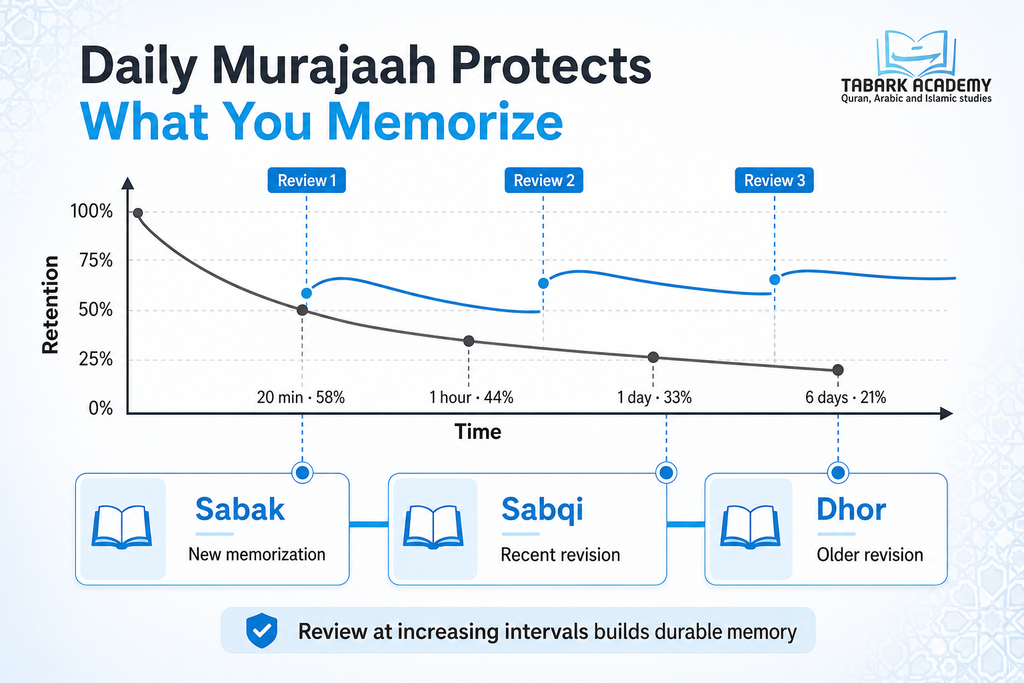
Each act of review flattens this curve — a portion reviewed once after a day is retained far longer than one left untouched, and a portion reviewed several times at increasing intervals becomes genuinely durable.
This is exactly what the traditional Sabak-Sabqi-Dhor system was built to do, centuries before anyone called it “spaced repetition.”
Reviewing recent material daily, and older material on a rotating cycle, is the practical version of reviewing at increasing intervals — the same principle memory science now documents directly.
Experience Our Interactive Learning
Curious about how we teach? Watch these brief video clips from our recent live sessions to see our structured curriculum, advanced learning platform, and dynamic student-teacher interactions firsthand.
The Three Essential Tiers Every Daily Murajaah Plan Should Use to Protect Hifz
A daily murajaah plan for hifz students isn’t one block of “revision” — it’s three distinct categories of material, each reviewed at a different frequency because each sits at a different stage of consolidation.
| Tier | Arabic | Covers | Review frequency |
| Sabak | سَبَق | Today’s new portion (typically ½–1 page) | Same day, then again the next day |
| Sabqi | سَبْقِي | The last 7–20 days of memorized material | Daily, or at minimum every other day |
| Dhor / Manzil | دَوْر / مَنْزِل | All older memorized material beyond Sabqi | Cycled on a fixed weekly or fortnightly schedule |
1. Sabqi: Review Recent Memorization Daily Before It Becomes Weak
Sabqi is the most fragile tier and the one most often skipped when a student feels confident about their new Sabak.
It covers roughly the last one to three weeks of memorization – material that has left initial memorization but hasn’t yet been consolidated. It needs to be recited from memory, without looking at the Mushaf, every day or close to it.
One practical marker: Sabqi should be recited a little faster than Sabak. The student isn’t learning the material anymore — they’re reinforcing it.
Noticeable hesitation during Sabqi is a signal that the portion isn’t as solid as it looked, and needs more direct attention before it’s allowed to move into the Dhor rotation.
Read also: Stop Forgetting the Quran: Simple Steps to Permanent Retention
2. Dhor / Manzil: Cycle Through Older Memorization to Maintain Long-Term Hifz
Dhor is how a student keeps everything they’ve ever memorized alive, not just the recent portions. The classical approach divides the full Quran into seven Manzil sections and rotates through them so the entire memorized corpus gets touched on a regular cycle.
| Manzil | Surahs | Approximate length |
| 1 | Al-Fatiha – An-Nisa | ~4 Juz’ |
| 2 | Al-Ma’idah – At-Tawbah | ~3 Juz’ |
| 3 | Yunus – An-Nahl | ~3 Juz’ |
| 4 | Al-Isra – Al-Furqan | ~3 Juz’ |
| 5 | Ash-Shu’ara – Ya-Sin | ~3 Juz’ |
| 6 | As-Saffat – Al-Hujurat | ~3 Juz’ |
| 7 | Qaf – An-Nas | ~3 Juz’ |
A student who has completed all 30 Juz’ and cycles through one Manzil per day completes a full Quran review every week.
A student still building their Hifz scales this down proportionally — reviewing only the Manzil sections that fall within what they’ve memorized so far.
Getting Dhor pacing right, and having someone verify it’s actually being recited correctly rather than half-remembered, is exactly the kind of oversight a qualified teacher provides.
This is one of the areas our instructors at Tabarak Academy spend the most one-on-one time on, and it’s built into our Online Ijazah Course for students working toward certified, verified mastery of their full memorized portion.
3. Sabak: Review Each New Hifz Lesson Twice Before Moving to the Next Portion
New Sabak is memorized and recited to the teacher the same day, then recited again the next day before any new material is introduced. If it isn’t solid on that second recitation, new Sabak is withheld — the student stays on the same portion until it holds.
This is the single most frequently broken rule in Hifz education, because both students and teachers feel pressure to show forward progress. But a Sabak layer that was never verified twice is the weak point where the whole structure starts to crumble months later.
Read also: The Exact Amount of Quran You Should Revise Every Day
A Sample Daily Murajaah Schedule For Hifz Students
Here’s how the three tiers translate into an actual day. This structure works around the five daily prayers, using the natural breaks in the day rather than fighting against them.
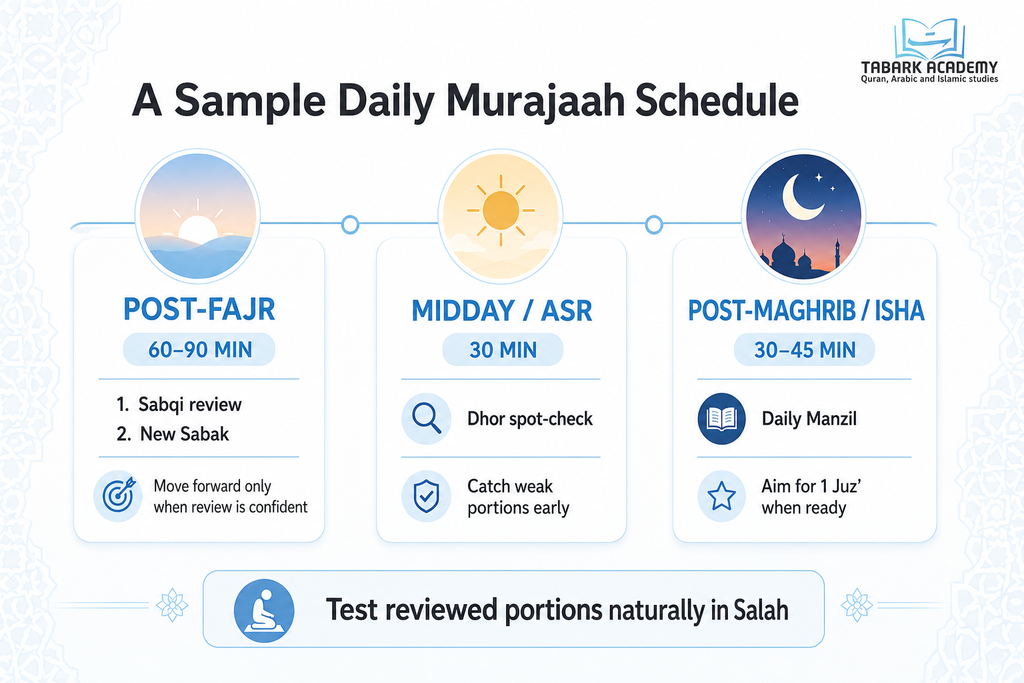
Post-Fajr (60–90 minutes)
Complete Sabqi review first, while focus is sharpest and the mind hasn’t absorbed the day’s other input yet. Only move to new Sabak once the Sabqi recitation is confident and error-free.
Midday or Asr (30 minutes)
Spot-check Dhor/Manzil sections — this is a lighter session, not a full re-memorization pass, meant to catch early signs of a portion slipping before it becomes a real gap.
Post-Maghrib or Isha (30–45 minutes)
Recite the day’s designated Manzil portion, aiming for roughly one Juz’ if the student’s memorized corpus is large enough to support that pace.
Using the Sunnah and Fard prayers themselves as informal testing grounds — reciting recently reviewed portions in Salah is one of the most natural ways to confirm a portion has actually settled.
Correct pronunciation matters as much as recall during these sessions — recitation that’s fluent but tajweed-incorrect isn’t solid Sabqi, it’s a habit that will need correcting later.
If a student’s daily reviews keep surfacing the same tajweed errors, that’s usually a sign the issue needs direct correction rather than repetition, which is the kind of gap our Quran Recitation Course is built to close.
Read also: Is Your Hifz Strong? 9 Signs to Look For
How Does Your Daily Revision Load Grow As Your Hifz Grows?
One of the most common planning mistakes is designing a daily murajaah plan for hifz students around where they are today, without accounting for how the Dhor loads compounds as memorization progresses.
| Hifz stage | New Sabak/day | Sabqi load | Dhor load | Total daily recitation |
| Juz’ 1–5 | ½–1 page | 5–7 pages | 5–10 pages | ~15–20 pages |
| Juz’ 6–15 | ½–1 page | 5–7 pages | 10–20 pages | ~20–30 pages |
| Juz’ 16–25 | ½–1 page | 5–7 pages | 20–35 pages | ~30–45 pages |
| Juz’ 26–30 | ½–1 page | 5–7 pages | 30–50 pages | ~40–60 pages |
Hifz doesn’t get harder because the new material is harder — it gets harder because the Dhor tier keeps expanding while daily hours stay the same. A daily murajaah plan for hifz students has to be revisited and rebalanced at each stage, not set once and left alone.
Read also: Starting Over With Your Hifz? How to Re-Memorize the Quran Fast
Common Mistakes That Can Weaken or Break a Daily Murajaah Plan for Hifz Students
A strong Murajaah plan can still fail when small mistakes are repeated consistently. Students may continue adding new Sabak while neglecting recent Sabqi, revise older portions without a fixed Dhor rotation, or rely too heavily on reading from the Mushaf instead of testing recall from memory.
Over time, these habits create uneven retention, where new portions appear strong while previously memorized sections gradually weaken.
The following mistakes are among the most common reasons a daily Hifz revision system stops protecting memorization effectively, along with the practical correction for each one.
| Mistake | What it causes | Fix |
| Tracking only Sabak, not Sabqi or Dhor | Student progresses on paper while losing earlier material | Record all three tiers explicitly, every session |
| Skipping Sabqi when new Sabak looks strong | Creates a gap between fresh and consolidated memory | Make Sabqi non-negotiable regardless of Sabak quality |
| No fixed Dhor schedule | Some sections get over-revised, others forgotten entirely | Assign and follow a set weekly Dhor rotation |
| Advancing Sabak before the old portion is solid | Builds new memorization on an unstable foundation | Hold new Sabak until the previous portion passes review twice |
| Revising silently from the Mushaf | Strengthens reading fluency, not memory recall | All murajaah must be recited from memory, Mushaf closed |
Read Also: How To Memorize The Quran?
Step Inside Our Virtual Classrooms
See our engaging teaching methods in action! watch real snippets of our live classes and discover how our expert instructors make learning interactive, memorable, and inspiring for every student.
Start Your Murajaah Plan With A Teacher Who Verifies Every Tier
A written schedule tells you what to review. A qualified teacher tells you whether it actually held.
At Tabarak Academy, every student’s Sabak, Sabqi, and Dhor are tracked and heard individually, not accepted on self-report, so revision gaps get caught in weeks rather than months.

Whether you’re a beginner building foundational reading skills, an active Hifz student needing a structured daily murajaah plan, or a sister looking for a dedicated learning track through our Online Quran Classes for Sisters, Tabarak Academy has a class built for that stage.
Our Quran Memorization / Hifz Courses
- Online Hifz Program
- Juz 30 Memorization Course
- Hifz for Kids Course
- Hifz for Adults Course
- Hifz for Sisters Course
- Short Surah Memorization Course
- Hifz Ijazah Course

Conclusion
A daily murajaah plan for hifz students isn’t an add-on to memorization — it’s the structure that decides whether that memorization lasts. The three tiers of Sabqi, Dhor, and Sabak each protect a different part of the timeline: what was just learned, what’s fully consolidated, and what’s being built today.
Skip any one of them consistently, and the gaps show up exactly where the opening story of this article does — a beautifully memorized Juz’ that quietly falls apart months later.
The schedule matters, but consistency and verification matter more. A student reviewing on a fixed daily rhythm, with a teacher actually listening to each tier, builds a Hifz that strengthens over years.
At Tabarak Academy, that structured, teacher-verified approach to murajaah is the foundation of every Hifz track we run.
Frequently asked questions
The questions below come up most often from parents and students building their first structured murajaah routine.
1. How many pages should a daily murajaah plan for hifz students include?
It depends on the student’s total memorized portion — early Hifz students typically manage 15–20 total daily pages across Sabak, Sabqi, and Dhor combined, while advanced students nearing Juz’ 30 may recite 40–60 pages daily as their Dhor load grows. The exact figure should scale with the stage table above, not stay fixed for the whole journey.
2. How long should Sabqi review last before material moves into Dhor?
Most schools define Sabqi as the most recent 7 to 20 days of memorization. Once a portion has been recited daily without hesitation for that window, it typically moves into the Dhor rotation for longer-interval review rather than daily repetition.
3. Can murajaah be done without a teacher?
Self-review can maintain some material, but it misses one critical piece: a listener who can catch tajweed errors and false confidence the student can’t hear in their own recitation. A verified, teacher-supervised routine catches revision gaps at two weeks instead of two months.
4. Is Dhor still necessary after completing the full Quran?
Yes — arguably more than during active Hifz. A Hafiz who stops structured Dhor after completion typically loses their memorization faster than they built it, since there’s no new Sabak creating daily momentum. Post-completion programs usually keep a full Quran review cycle running weekly to fortnightly indefinitely.
5. What’s the biggest sign a murajaah plan isn’t working?
A student whose Sabqi is consistently strong but whose Dhor keeps slipping — meaning they can recall what they just learned but are steadily losing older material. This pattern is easy to miss without a teacher actively tracking all three tiers rather than just new pages completed.