


How Much Quran Should I Revise Daily? A Complete Revision Guide
If you’ve ever asked yourself how much Quran should I revise daily, the honest answer depends on how much you have already memorized, but the short version is this: revise at least as much as you can recite with zero mistakes, and never let a single day pass without touching your Hifz.
Many students pour all their energy into memorizing new pages, then watch old Surahs quietly slip away within a few weeks.
This happens in Quran schools, at home, and even among serious Hifz students who study for hours every day. The real issue is rarely a weak memory. It is the absence of a clear, daily Quran revision schedule. Without planned review, old Surahs fade fast, small mistakes creep into Salah, and confidence during recitation drops.
This guide from Tabarak Academy breaks down exactly how much the Quran to revise each day at every stage of memorization, plus the weekly and monthly cycles that keep an entire Hifz fresh for life.
How Much Quran Should You Revise Daily?
The amount of Quran you should revise daily depends on how much you already have memorized, not on a fixed number that works for everyone.
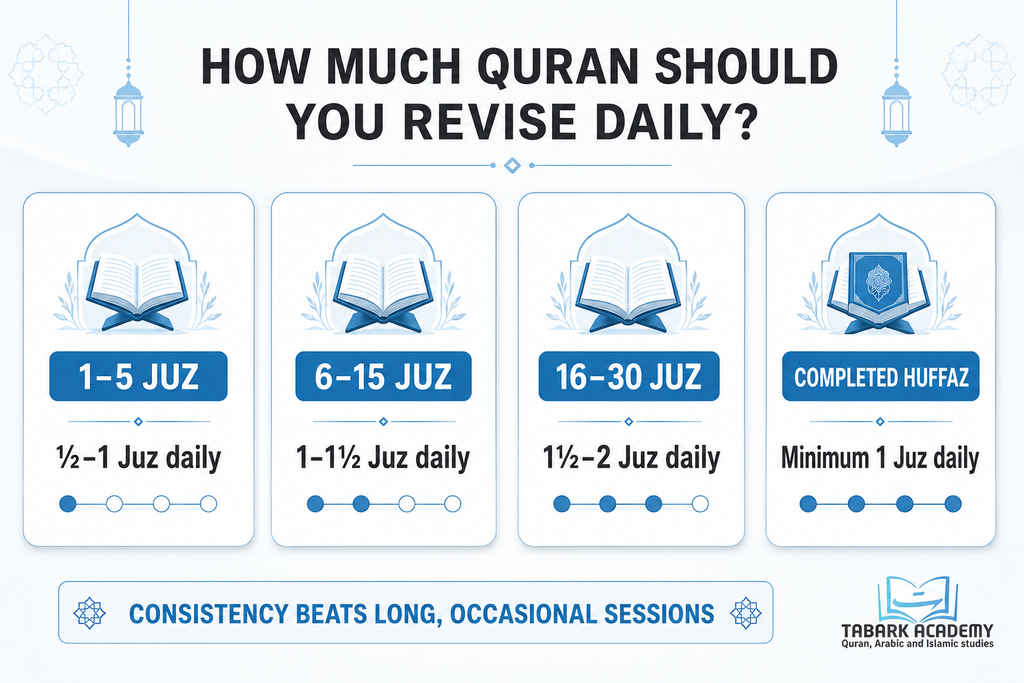
As a general guide: students with 1–5 Juz should revise ½ to 1 Juz daily. Students with 6–15 Juz should aim for 1 to 1½ Juz daily.
Students with 16–30 Juz need at least 1½ to 2 Juz every day. Completed Huffaz should never go below 1 full Juz of daily revision.
These ranges assume daily consistency, not occasional long sessions. A student who revises for 30 minutes every single day retains far more than one who revises for three hours once a week. Revision speed matters less than revision frequency.
Each stage below carries its own risk if daily revision drops below the recommended amount, and its own reason why.
A. Students With 1–5 Juz: Revise ½–1 Juz Daily to Strengthen Early Memorization
At this stage, memorization is still fragile. Half a Juz to a full Juz of daily revision is usually enough to keep everything solid, because the total amount memorized is still small enough to cycle through in a few days.
Skipping revision here is where most early dropouts happen — the student memorizes fast, revises rarely, and loses confidence when old pages come back wrong.
B. Students With 6–15 Juz: Revise 1–1½ Juz Daily to Maintain a Consistent Revision Cycle
By this stage the workload has grown enough that revision needs real structure, not just habit.
Revising 1 to 1½ Juz daily keeps the rotation short enough that no Surah goes untouched for more than one to two weeks. Students who try to revise everything at once at this stage usually burn out; a fixed daily portion works better than an irregular marathon session.
C. Students With 16–30 Juz: Revise 1½–2 Juz Daily to Protect Older Memorized Portions
This is the heaviest phase of the Hifz journey. Revising 1 1⁄2 to 2 Juz daily is necessary because the gap between one revision cycle and the next grows wider as more Quran is memorized.
A student who slows revision down here often finds that the earlier Juz — the ones memorized months ago — are the first to weaken.
Read also: The Hidden Mistakes Causing You to Forget Your Quran Memorization
D. Completed Huffaz: Revise at Least 1 Juz Daily to Maintain Long-Term Fluency
Finishing the Quran does not end the work; it changes it. A completed Hafiz who revises less than 1 full Juz a day typically starts losing fluency within a few months, even after years of solid memorization.
Daily revision at this stage is what separates a Hafiz who can recite confidently on demand from one who needs constant refreshing before every recitation.
If you are working through any of these levels, Tabarak Academy’s Online Quran Classes pair each student with a tutor who builds the daily revision portion around what has actually been memorized, rather than a generic page count.
For students still building foundational memorization habits, the Online Quran Classes for Beginners start with smaller, sustainable daily targets before increasing the load.
Experience Our Interactive Learning
Curious about how we teach? Watch these brief video clips from our recent live sessions to see our structured curriculum, advanced learning platform, and dynamic student-teacher interactions firsthand.
Why Revision Matters More Than New Memorization?
Revision is what protects the Quran that is already in the heart. New memorization feels like progress because it is visible, but it stays weak until it survives repeated review.
Most recitation mistakes come from old lessons that were never revisited, not from newly memorized pages.
A student who skips revision for a week rarely notices immediately. The damage shows up two or three weeks later, when a Surah recited confidently before suddenly comes out wrong.
By then, correcting it takes far longer than the revision that would have prevented it — this is the practical reason revision has to happen daily rather than “when there’s time.”
How Strong Revision Improves Salah and Confidence?
Students who revise consistently recite more smoothly in Salah and in front of others, because the words come from habit rather than effort.
This matters beyond memorization itself: a Hafiz who hesitates in prayer often has a revision gap, not a memory problem.
Read also: Hifz Ratio: Balancing New Memorization & Revision
Practical Daily Hifz Revision Schedules for Different Student Types and Routines
Many students who ask how much Quran should I revise daily really want a schedule that fits their actual day, not just a number in Juz. The schedules below split the three pillars — Sabak, Sabqi, and Manzil — across realistic time slots for four common situations.
1. Full-Time Hifz Student: Balance Daily Sabak, Sabqi, and Manzil Across Three Revision Sessions
This schedule is built for students whose main daily responsibility is Hifz, whether in a madrasah or an intensive home program, and it divides the day into three clear revision blocks.
| Time Slot | Revision Type | Portion |
| Morning | Sabak | 1 page |
| Midday | Sabqi | 3 pages |
| Evening | Manzil | 1 Juz |
2. School-Going Hifz Student: Fit Sabak, Sabqi, and Manzil Around School Hours
This schedule fits students who are balancing Hifz with regular school hours, spreading lighter revision across the morning, afternoon, and night so it never competes directly with schoolwork.
| Time Slot | Revision Type | Portion |
| Morning | Sabak | ½ page |
| Afternoon | Sabqi | 2 pages |
| Night | Manzil | ½ Juz |
This plan respects school hours and limited energy. A smaller Sabak keeps progress steady without adding pressure on top of schoolwork. Consistency matters more than volume at this stage — half a Juz revised every night without fail beats a full Juz revised twice a week.
Read Also: 9 Strategies Of How To Revise Memorized Quran
3. Working Adult Hafiz: Build Daily Revision Around Fajr, Maghrib, and Isha
This schedule is designed for working adults who can only revise around the five daily prayers, using Fajr, Maghrib, and Isha as fixed anchors instead of relying on free time that rarely appears.
| Time Slot | Revision Type | Portion |
| Fajr | Sabqi | 2 pages |
| Maghrib | Sabak | ½ page |
| Isha | Manzil | 5–7 pages |
Busy adults get the most out of high-focus windows rather than long blocks of free time. Fajr revision benefits from a quiet mind and sharper accuracy.
A light Sabak after Maghrib avoids adding fatigue at the end of a work day. Even 20–30 minutes spread across these three prayer times is enough to protect a working Hafiz’s memorization.
Read also: The Complete Hifz Murajaah PDF: Get Your Stage-by-Stage Timetable
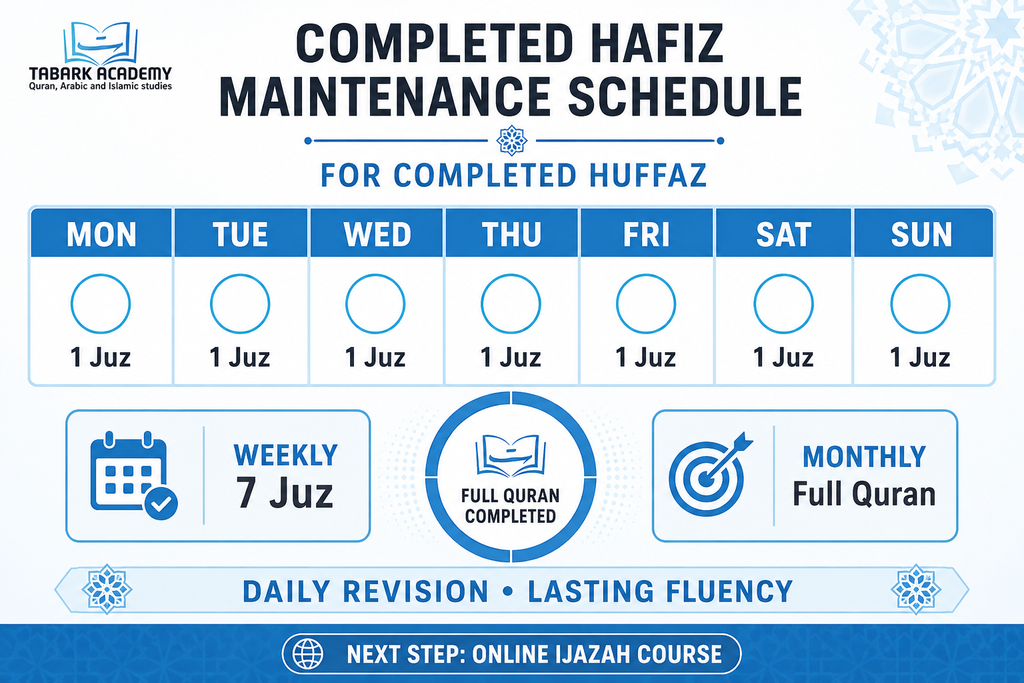
4. Completed Hafiz: Follow a Daily, Weekly, and Monthly Maintenance Schedule to Preserve the Full Quran
This schedule applies to Huffaz who have already completed the entire Quran and now need a maintenance routine that prevents fluency loss rather than a memorization plan.
| Frequency | Revision Portion |
| Daily | 1 Juz |
| Weekly | 7 Juz |
| Monthly | Full Quran |
This plan suits Huffaz who has finished memorizing the entire Quran. Daily revision maintains fluency, the weekly target ensures every part of the Quran gets covered, and the monthly Khatm keeps the full text fresh.
A completed Hafiz aiming to formalize their command of the Quran may also look into an Online Ijazah Course, where certified transmission is added on top of maintained memorization.
Weekly And Monthly Revision Cycles
Daily targets need a weekly and monthly structure around them, or revision becomes uneven — some Surahs get revised constantly while others are forgotten for months.
The 7-Juz-Per-Week Rule
A simple rule many experienced teachers use is 7 Juz per week, which works out to roughly 1 Juz per day. This keeps every part of the Quran active on a rolling basis rather than letting any single section sit untouched for weeks.
Monthly revision means completing a full read-through of everything memorized once every 30 days, dividing the Quran into manageable weekly blocks — for example, four parts per week.
This cycle prevents the long gaps where a Surah starts to feel unfamiliar the moment it comes up in Salah.
Students who want this pace but need guided structure often benefit from a Quran Reading Course alongside their Hifz revision, since accurate reading fluency directly speeds up how quickly a monthly Khatm can be completed.
Using Salah As A Daily Revision Tool
Salah is one of the most efficient revision tools available, because it adds review time without requiring extra hours in the day. Reciting memorized Surahs in Fard and voluntary prayers reinforces both flow and confidence.
Longer Surahs work well in Fajr, Maghrib, or Isha, when there is more time for extended recitation.
A practical method: choose the portion to revise before the prayer, read it silently from the Mushaf two or three times, then recite it from memory during Salah. This removes the fear of freezing mid-prayer and turns every prayer into a low-pressure revision check.
How To Track Mistakes And Weak Surahs?
Knowing how much Quran should I revise daily only helps if the same mistakes aren’t repeating inside that daily portion week after week. Every Hafiz has weak spots — Surahs that consistently produce the same error no matter how many times they are revised in general rotation. Treating all Surahs equally in revision wastes time on portions that are already solid.
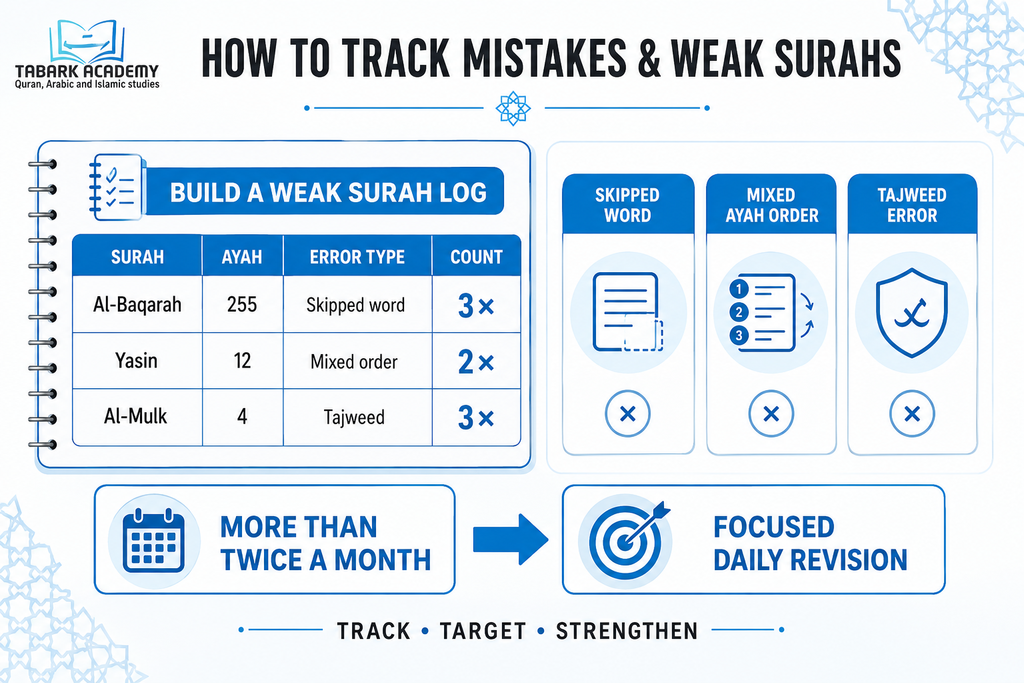
A simple, effective practice is keeping a written log of every mistake, noting the exact Surah, Ayah, and the type of error — a skipped word, a mixed-up Ayah order, or a Tajweed rule applied incorrectly.
Any Surah that appears in the log more than twice in a month gets pulled out for focused daily revision until the error stops recurring. This targeted approach fixes weak spots in days rather than letting them resurface for months inside the general revision cycle.
Read also: How to Do Quran Revision Alone: 7-Step System
Common Mistakes Students Make When Revising Quran
The weakest Hifz doesn’t come from a bad memory — it comes from a handful of habits that quietly undo good memorization work, even when a student already knows how much the Quran should I revise daily. Here are the ones Tabarak Academy tutors see most often.
- Measuring progress only by new pages memorized, while treating revision as optional
- Revising in long, infrequent sessions instead of shorter daily ones
- Skipping Sabqi (recent lessons) because it feels less urgent than brand-new Sabak
- Reciting revision portions silently in the mind instead of out loud, which hides real mistakes
- Ignoring recurring errors instead of logging and targeting them specifically
Read Also: Daily Murajaah Plan For Hifz Students
Step Inside Our Virtual Classrooms
See our engaging teaching methods in action! watch real snippets of our live classes and discover how our expert instructors make learning interactive, memorable, and inspiring for every student.
Build Your Daily Revision Plan With Tabarak Academy
A revision schedule only works when it is built around your actual memorization level, your daily schedule, and the mistakes you personally tend to repeat — not a generic template.
Tabarak Academy’s certified tutors design a personalized Hifz and revision plan for each student, correct recitation and Tajweed errors as they happen, and adjust the daily portion as memorization grows.

Our Quran Memorization / Hifz Courses:
- Online Hifz Program
- Juz 30 Memorization Course
- Hifz for Kids Course
- Hifz for Adults Course
- Hifz for Sisters Course
- Short Surah Memorization Course
- Hifz Ijazah Course

Conclusion
Whenever you ask yourself how much the Quran should I revise daily, remember that the answer always starts with your current memorization level, not a one-size-fits-all number.
Half to one Juz for early-stage students, up to two Juz for those nearing completion, and a minimum of one full Juz for completed Huffaz — these targets, combined with the Sabak, Sabqi, and Manzil system, are what keep a Hifz strong for life.
A clear daily, weekly, and monthly revision schedule turns memorization from something fragile into something permanent. When revision becomes a fixed habit rather than an afterthought, mistakes drop, recitation becomes smoother, and confidence in Salah follows naturally.

Frequently Asked Questions
These are the questions students and parents ask most often about daily Quran revision, based on common gaps left after a Hifz session ends.
1. How much of the Quran should a beginner revise daily?
A beginner with 1–5 Juz memorized should revise ½ to 1 Juz daily, split between the most recent lesson and slightly older ones. Smaller, consistent daily sessions work better than long, irregular ones at this stage.
2. What is the difference between Sabak, Sabqi, and Manzil?
Sabak is the newest lesson, reviewed daily. Sabqi is recent memorization from the past few weeks, rotated weekly. Manzil is the fully memorized Quran, revised on a monthly cycle. Together they cover every stage of memorization from brand-new to long-established.
3. Can I revise the Quran during Salah?
Yes, reciting memorized Surahs in Fard and Sunnah prayers is an effective and time-efficient way to revise. Longer Surahs suit Fajr, Maghrib, or Isha, when there is more time to recite extended portions confidently.
4. How long does it take to revise the whole Quran?
Following the 7-Juz-per-week rule, a full revision cycle of the entire Quran takes about one month. Students who revise less than 1 Juz a day will need proportionally longer to complete a full cycle.
5. What should I do if I keep forgetting the same Surah?
Keep a written log of repeated mistakes by Surah and error type. Any Surah that appears more than twice in a month should be pulled out for focused daily revision until the specific error stops occurring, rather than relying on general rotation alone.
6. How many Juz should a Hafiz revise daily to avoid forgetting?
A completed Hafiz should revise at least 1 full Juz daily. Going below this amount for extended periods is one of the most common causes of weak recall in Huffaz who finished memorizing months or years earlier.