


How To Memorize One Page Of Quran A Day
The Madinah Mushaf has 604 pages. That means if you memorize just one page a day, you finish the entire Quran in about twenty months — less time than a single university degree.
Most people who want to know how to memorize one page of Quran a day don’t fail because the page is too hard. They fail because they treat memorization as a burst of effort instead of a repeatable daily system with built-in review.
This guide gives you that system. You’ll get five tested memorization methods used by traditional teachers and modern hifz programs, a realistic daily time budget, a review schedule that stops you from forgetting last week’s pages, and answers to the questions that stall most beginners.
Whether you’re a parent starting a child on hifz or an adult squeezing memorization between work and family, there is a method here that fits your day.
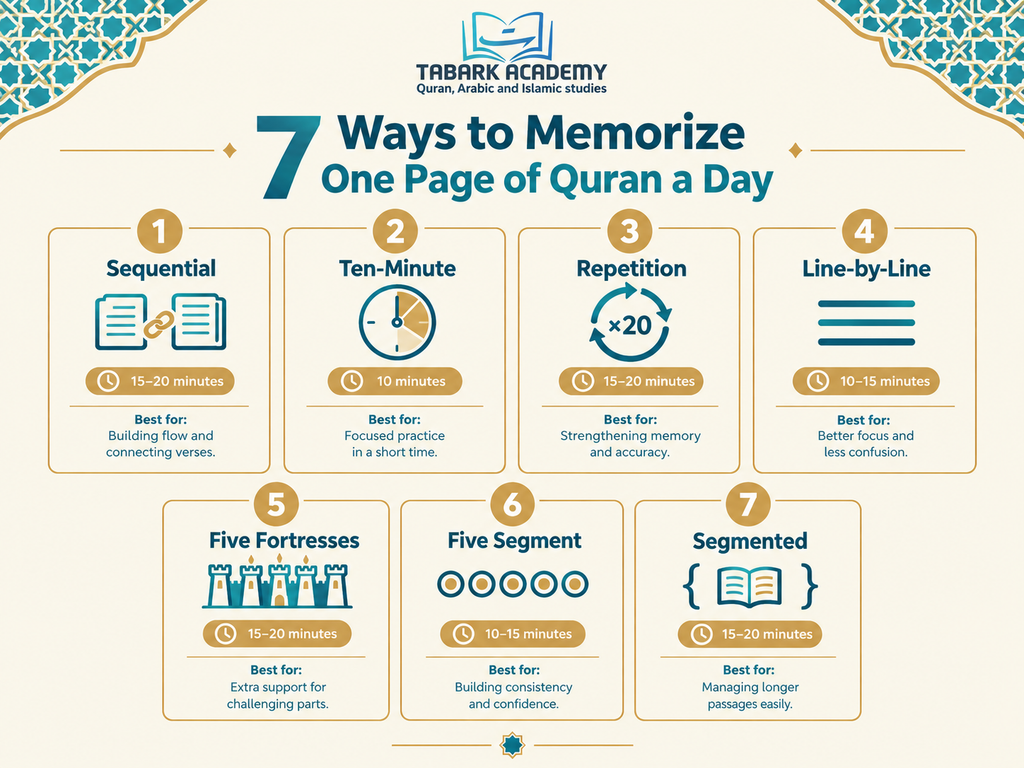
1. Sequential Memorization (Al-Hifz Al-Tasalsuli)
You memorize verse one by repeating it at least twenty times, then recite it from memory until it’s stable. Then you do the same with verse two.
Before moving on, you join verses one and two together at least three times. Verse three follows the same pattern, then all three are joined again.
This is the strongest classical method because it links every verse to the one before it — the exact place where most people stumble.
What makes this method reliable is that it never leaves a gap between two verses unpractised. Every joining point on the page gets rehearsed several times before you reach the end of it, so your memory never has to guess what comes next.
If a verse is unusually long, split it at a natural stopping place that doesn’t break the meaning, and treat each half as its own unit. Once both halves are secure, join them before you move to the following verse.
2. The Ten-Minute Method (Five Prayers, Five Chunks)
Split your 15-line page into five chunks of three lines. Memorize one chunk for ten minutes after each of the five daily prayers.
After Witr, spend ten more minutes reciting the whole page from memory. You’ve memorized a full page without ever sitting for a long session.
This method is built for students, working adults, and mothers — anyone whose day has no single free hour but plenty of ten-minute gaps.
The reason it works so well is that it attaches memorization to a habit you already have. You never need to remember to memorize — the prayer itself is the reminder, and you’re already sitting on the prayer mat with a calm mind.
The one rule you cannot bend is the final session after Witr. Without that closing recitation, you end the day holding five separate fragments instead of one connected page, and by morning the joins will have slipped.
3. The Repetition Method
Read verse one twenty times, verse two twenty times, verse three twenty times, verse four twenty times. Then read all four together twenty times to bind them.
Repeat the same cycle for verses five through eight, then join those four twenty times. Finally, recite verses one to eight together twenty times.
The repetition count looks heavy, but it produces memorization that survives months without review. Don’t exceed one-eighth of a juz per day with this method.
Twenty is not an arbitrary number. It is roughly the point at which recitation stops being an act of reading and becomes automatic recall, which is exactly the state you want a memorized verse to be in.
Always repeat aloud, never silently. Hearing your own voice adds a second memory channel alongside the visual one, and it lets you catch a tajweed slip in the moment rather than fossilising it into your hifz.
4. The Line-by-Line Method
This method is called Memorize It Like Al-Fatihah. In this method, you read the whole page twenty times normally, without trying to memorize. Then memorize line one with ten repetitions, line two with ten repetitions, and join the two lines ten times.
Continue line by line to the end of the page, then recite the full page from memory ten times. The next day, recite yesterday’s page together with today’s before anything else.
Because it works in lines rather than verses, this method suits pages with very long verses — like Surah Al-Baqarah.
Those first twenty relaxed readings are doing more than they appear to. They are the preparation stage in disguise, so that by the time you start memorizing line one, the page already feels familiar rather than foreign.
Reciting yesterday’s page immediately before today’s builds a rolling chain that never breaks. Over a month, that single habit turns thirty isolated pages into one continuous passage you can recite without pausing.
5. The Five Fortresses (Al-Husun Al-Khamsa)
This is a complete system rather than a single technique, and it’s the most reliable for long-term hifz. The first three fortresses all happen before and during memorization. You keep up a general reading portion of one to two juz daily while listening to at least one hizb from a murattal reciter, so the Quran is constantly in your ears.
Then comes preparation: you read next week’s pages every day of this week, and on the night before, you listen to tomorrow’s page and read it from the Mushaf for about fifteen minutes each.
The last two fortresses are what keep the whole structure standing. Near review covers the twenty pages directly before today’s page, recited every single day without exception, which is what stops fresh memorization from evaporating within a week.
Far review handles everything older on a rotation, starting at around forty pages a day while you memorize the first half of the Quran and rising to sixty and then eighty pages a day as your memorized portion grows. Nothing you have memorized is ever left unattended for long.
If you’re unsure which of these five fits you, this is exactly what a qualified teacher diagnoses in a first session.
Tabaraka Academy’s Quran memorization circles start by assessing your recitation level and daily availability, then assign the method that matches — rather than handing every student the same plan.
Read also: How To Memorize Half A Page Of Quran Daily In 4 Steps?
6. The Five Segment Method
This method treats memorization as a session with a proper beginning, not something you drop into cold. It moves through five stages: preparation, warm-up, focus, repetition, and linking.
You start by preparing yourself rather than the page — renewing your intention, making wudu, and sitting somewhere calm where you won’t be interrupted. Then you warm up for about ten minutes by reciting a few pages you already know well, from anywhere in the Quran, in a good voice.
Now open the Mushaf to today’s page and focus. Fix your eyes on the first verse without letting them wander, and recite it aloud with correct tajweed while looking directly at the words on the page.
Repeat that verse three or more times until your mind absorbs it, then close your eyes and picture where the words sit on the page as you recite. Open the Mushaf, read it once more, then close your eyes and recite a final time.
The last stage is linking. Read the end of the first verse and continue straight into the second without pausing, repeating that join at least five times before moving on.
7. The Segmented Meaning-Based Method (Al-Hifz Al-Muqassam)
This method groups verses by meaning instead of by count, which makes it the gentlest option for anyone who finds pure repetition difficult.
You begin by selecting a group of verses that share a single theme or story, then read a short, reliable tafsir of that group before memorizing a word of it. Understanding what you are about to memorize gives your memory something to hold onto besides sound.
Then repeat that segment aloud at least twenty times with full concentration, read it several times from the Mushaf, and recite it from memory until it’s stable.
The distinguishing rule of this method is the next morning: before touching a new segment, you review everything you’ve memorized from the beginning of the surah. That daily rebuild is what welds the segments into a single connected chapter rather than a set of fragments.
For long surahs, split the review across several days, keeping it at no fewer than ten pages daily so the cycle stays manageable.
How to Memorize One Page of Quran a Day
There is no single correct technique. These five approaches mentioned above to how to memorise one page of Quran a day all work — they simply suit different memories, ages, and schedules. Pick one and commit to it for at least three weeks before judging it.
One page a day is achievable for almost anyone, but only when the page is broken into smaller units and supported by review. The page itself is not the workload — the page plus its maintenance is.
What Counts as “One Page” in Your Mushaf?
A standard page in the Madinah Mushaf is 15 lines and roughly 100–110 words. Every juz is exactly 20 pages, so one page a day means one juz every three weeks.
Use the same copy of the Mushaf every single day. Visual memory is a real part of hifz — your mind stores where a verse sits on the page, not just its sound.
If you memorize from a phone or tablet, fix the display so the page breaks never move. A page that reflows into different line lengths quietly erases the visual map your memory has been building for months.
Experience Our Interactive Learning
Curious about how we teach? Watch these brief video clips from our recent live sessions to see our structured curriculum, advanced learning platform, and dynamic student-teacher interactions firsthand.
The Three Stages Every Daily Page Passes Through
Each page moves through three stages: preparation, which is reading and listening before you memorize; memorization, repetition until it’s secure; and review, recitation from memory on later days.
Skipping preparation is the single biggest reason memorization feels slow. Five minutes of listening to a reciter before you start can cut your memorization time in half.
Give each stage its own slot in the day rather than blending them. Preparation works best the night before, new memorization in the morning when the mind is clearest, and review in whatever pocket of time remains.
Read also: How Many Lines Of Quran Should I Memorize Per Day?
How Much Time Does One Page Actually Take?
Plan for 45–60 minutes total per day: about 15–20 minutes on the new page, 20 minutes on recent review, and 10–15 minutes on older review.
That number drops as your memory trains. Students who stay consistent for two months often memorize a new page in 12–15 minutes.
Expect that ratio to shift as you progress. In your first juz, most of the hour goes to new memorization, but once you pass ten juz, review will take up two-thirds of your session — and that is a sign of progress, not a problem.
The Best Way to Memorize One Page of Quran a Day for Your Situation
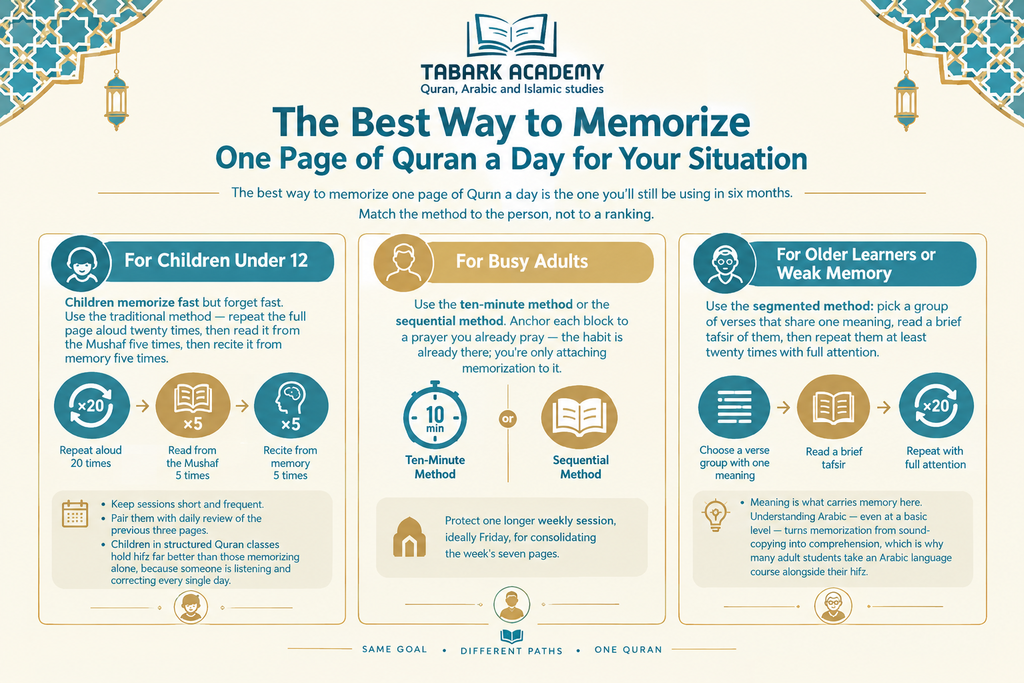
The best way to memorize one page of Quran a day is the one you’ll still be using in six months. Match the method to the person, not to a ranking.
For Children Under 12
Children memorize fast but forget fast. Use the traditional method — repeat the full page aloud twenty times, then read it from the Mushaf five times, then recite it from memory five times.
Keep sessions short and frequent, and pair them with daily review of the previous three pages. Children in structured Quran classes for kids hold hifz far better than those memorizing alone, because someone is listening and correcting every single day.
For Busy Adults
Use the ten-minute method or the sequential method. Anchor each block to a prayer you already pray — the habit is already there; you’re only attaching memorization to it.
Protect one longer weekly session, ideally Friday, for consolidating the week’s seven pages.
For Older Learners or Weak Memory
Use the segmented method: pick a group of verses that share one meaning, read a brief tafsir of them, then repeat them at least twenty times with full attention.
Meaning is what carries memory here. Understanding Arabic — even at a basic level — turns memorization from sound-copying into comprehension, which is why many adult students take an Arabic language course alongside their hifz.
Memorize One Page of Quran a Day: Tips That Protect Your Hifz
Memorizing is the easy half. These tips address the harder half — keeping what you’ve memorized.
1. Build Review Into the Same Session
Review the five pages immediately before today’s page, every day. As your memorized portion grows, expand that window to ten, then twenty pages — but no further.
Everything older gets a separate rotation: ten pages a day at first, then a full juz, then two or three juz daily once you’ve memorized a significant portion.
2. Fix Your Recitation Before You Memorize
A verse memorized with a tajweed error is memorized wrong, and correcting it later takes three times the effort of learning it correctly.
Listen to your page before memorizing it, and recite it to a qualified teacher afterwards. Tabaraka Academy’s tajweed and recitation classes exist precisely for this step — a teacher catching a madd or a ghunnah mistake on day one saves you months of re-learning.
3. Recite What You’ve Memorized in Your Nafl Prayers
Use your Sunnah and night prayers to recite the pages you memorized this week. Standing in prayer forces recall without a safety net, and it exposes weak spots far faster than reading review does.
4. Common Mistakes to Avoid
Don’t chase speed. Repeating a verse only until you “have it” is not enough — repeat it so that you don’t lose it.
Don’t memorize from a different Mushaf, don’t skip Friday review, and never let a missed day become a missed week. Consistency beats intensity in hifz, without exception.
Read also: How Many Verses Should I Memorize A Day?
Step Inside Our Virtual Classrooms
See our engaging teaching methods in action! watch real snippets of our live classes and discover how our expert instructors make learning interactive, memorable, and inspiring for every student.
Start Your Daily Page With a Certified Tabaraka Academy Teacher
You already know the methods. What most students are missing is someone listening on the other side of the page — correcting the error before it sets, and holding the schedule when motivation dips.
Tabaraka Academy offers one-to-one online Quran memorization, tajweed and recitation circles, and Arabic language classes for both children and adults. Every student gets a certified teacher, a memorization plan built around their real schedule, and a structured review system — not a generic timetable.
Book a free trial session today and recite your first page to a teacher this week. Your hifz journey doesn’t need more information; it needs the first scheduled session.
Our Quran Memorization / Hifz Courses
- Online Hifz Program
- Juz 30 Memorization Course
- Hifz for Kids Course
- Hifz for Adults Course
- Hifz for Sisters Course
- Short Surah Memorization Course
- Hifz Ijazah Course

Conclusion
Learning how to memorize one page of Quran a day comes down to three things: breaking the page into small units, repeating far more than feels necessary, and reviewing every single day without exception.
You’ve now seen seven methods — sequential, the ten-minute split across five prayers, the twenty-repetition cycle, line-by-line, the Five Fortresses, the Five T’s, and the segmented meaning-based method. None is universally best; the right one is the one that fits your age, your memory, and your daily schedule.
Don’t spend another week comparing methods. Choose one tonight, prepare tomorrow’s page before you sleep, and give the method three full weeks before you judge whether it suits you.
And treat a missed day as a single missed day, nothing more. The students who finish are not the ones who never fall behind — they’re the ones who return to the same page the next morning and carry on.
Take-away message: one page a day, protected by consistent review, completes the Quran in roughly twenty months. The page is never the obstacle — the missing review and the missing teacher are. Start today, start small, and recite to someone who can correct you.
FAQs
How long does it take to memorize the Quran at one page a day?
About 604 days — roughly one year and eight months — since the Madinah Mushaf has 604 pages. Allowing for rest days and review weeks, most students finish in two to two and a half years.
How many times should I repeat a verse to memorize it?
A minimum of twenty repetitions for beginners, aloud and with full attention. Don’t be misled by remembering a verse after two or three reads — repetition is what makes it survive, not what makes it stick initially.
Can I memorize one page of Quran a day without knowing Arabic?
Yes, many non-Arabic speakers do. However, learning basic Arabic and reading a short tafsir of your daily page significantly speeds up memorization, because meaning gives your memory something to hold onto.
What is the best time of day to memorize Quran?
After Fajr is traditionally considered best — the mind is rested and undistracted. If that’s not possible, the ten-minute method spread across the five daily prayers works just as well.
How do I stop forgetting what I memorized?
Review daily, not occasionally. Recite the 20 pages before your new page every day, and run a separate rotation through older material so that every memorized page is revisited at least once every few weeks.
Is it better to memorize alone or with a teacher?
With a teacher. A teacher corrects tajweed errors before they become permanent, verifies that no verse was silently skipped, and provides the accountability that makes daily memorization sustainable.