

How Many Verses Should I Memorize A Day?
Almost every new hifz student asks the same question in their first week: how many verses should I memorize a day? Some hear “one page daily” and burn out by the end of the month. Others memorize two verses, forget them a week later, and assume they simply have a weak memory.
Neither problem is about talent. It’s about choosing a daily portion that matches your level, your schedule, and your review capacity — and then holding that number steady.
This guide gives you concrete daily verse ranges for children, teenagers, and busy adults, plus the repetition and revision routine that makes any amount actually stay in your heart. You’ll also learn how to calculate your own target instead of copying someone else’s plan.
What You’ll Learn
- The realistic daily verse range for beginners, intermediate, and advanced memorizers
- How many verses a child should memorize compared to an adult
- Why review (murāja’ah) — not new memorization — decides how much you can take on
- A simple formula to calculate your personal daily portion
- The warning signs that your daily amount is too high or too low
How Many Verses Should I Memorize a Day?
Most learners should memorize 3 to 5 verses a day, while complete beginners start with 1 to 2 verses, and advanced students who already have strong revision habits can handle half a page to one full page (roughly 10–15 verses) daily.
The reason for the range is simple: verses are not equal in length. Five verses of Surah Al-Baqarah can take three times longer than five verses of Surah An-Naba’. That’s why experienced teachers measure hifz by lines or pages, not only by verse count.
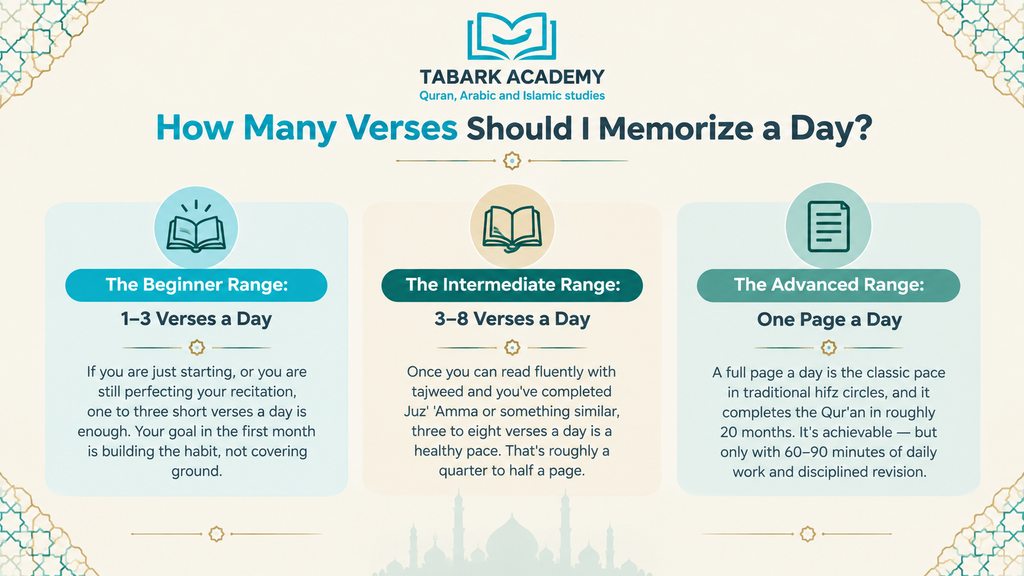
The Beginner Range: 1–3 Verses a Day
If you are just starting, or you are still perfecting your recitation, one to three short verses a day is enough. Your goal in the first month is building the habit, not covering ground.
At this stage, most of your session time should go to correcting pronunciation with a teacher. Memorizing a verse with the wrong makhraj means re-learning it later — twice the work.
Start with the short surahs at the end of the Mushaf, where verses are brief and already familiar from daily prayer. Hearing them recited in salah reinforces your memorization without adding a single minute to your study time.
The Intermediate Range: 3–8 Verses a Day
Once you can read fluently with tajweed and you’ve completed Juz’ ‘Amma or something similar, three to eight verses a day is a healthy pace. That’s roughly a quarter to half a page.
At this level, your review load starts to grow. Every new day adds material you must revisit, so the amount you memorize should never exceed what you can revise comfortably.
A useful checkpoint at this stage is the weekend audit: on one fixed day, recite the whole week’s portion from memory in a single sitting. If you can’t get through it cleanly, the next week’s target should stay where it is rather than climb.
The Advanced Range: One Page a Day
A full page a day is the classic pace in traditional hifz circles, and it completes the Qur’an in roughly 20 months. It’s achievable — but only with 60–90 minutes of daily work and disciplined revision.
This pace suits full-time students or adults enrolled in a structured program with daily accountability. Without a tutor listening to you every day, one page a day usually collapses within weeks.
Plan for the long surahs before you reach them. Pages in Al-Baqarah, An-Nisa’ and Al-A’raf carry denser lines and similar-sounding verses, so many students drop to half a page there and return to a full page once the passage is secure.
Read also :7-Step System to Revise Quran Without a Teacher
How Many Verses Should I Memorise a Day at Different Ages?
The right daily portion depends far more on age, attention span, and available time than on ambition. The same plan that works for a nine-year-old will frustrate a working adult, and vice versa.
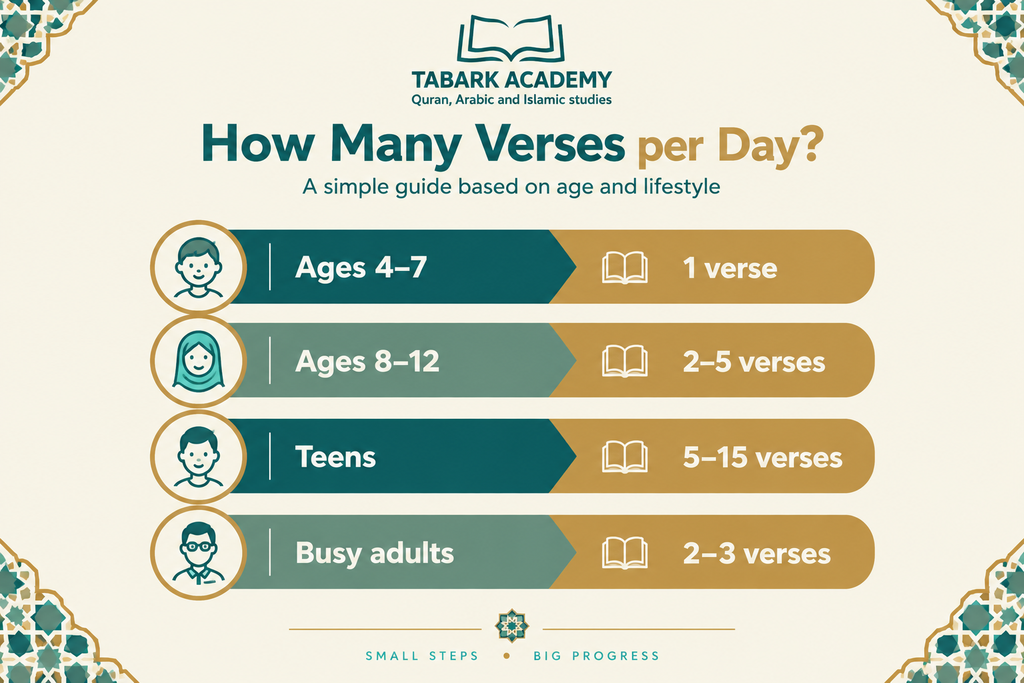
a. Children Aged 4–7
One short verse a day, split across two mini-sessions of 10 minutes, is ideal. Young children memorize quickly through hearing and repetition, but they lose focus fast.
Repetition should feel like play: recite together, clap the rhythm, let the child repeat after the teacher. Consistency at this age matters more than any verse count. Structured Quran classes for kids usually build the lesson around exactly this short-burst format.
b. Children Aged 8–12
Two to five verses a day works well for this group, especially when the session is tied to a fixed time — right after Fajr or straight after school.
Children at this age can also start light revision of the previous week’s verses. That second habit is what turns short-term memorization into lasting hifz.
c. Teenagers and Young Adults
This is the strongest memorization window. Five to fifteen verses a day — up to a full page — is realistic when school or university allows a dedicated hour.
If the schedule is tight during exam season, dropping to two verses a day is far better than pausing. Stopping entirely is what breaks the chain.
At Tabark Academy, there are Quran and Tajweed lessons for teenagers and young adults where the time could fit their schedule.
d. Busy Adults
Two to three verses a day is a sustainable, respectable target for an adult with a job and a family. Over a year, that’s around 900 verses — more than a tenth of the Qur’an.
Adults often underestimate how much a small, protected daily slot achieves. Fifteen focused minutes beats a two-hour session once a week, every time.
Read also: How To Memorize One Page Of Quran A Day
Experience Our Interactive Learning
Curious about how we teach? Watch these brief video clips from our recent live sessions to see our structured curriculum, advanced learning platform, and dynamic student-teacher interactions firsthand.
Why Consistency Beats Quantity in Quran Memorization
A student who memorizes two verses every single day finishes the year with more retained Qur’an than one who memorizes twenty verses for two weeks and then stops.
Hifz is cumulative. Each day’s portion only survives because it gets revisited dozens of times in the weeks that follow. Break the rhythm, and the earlier material fades first.
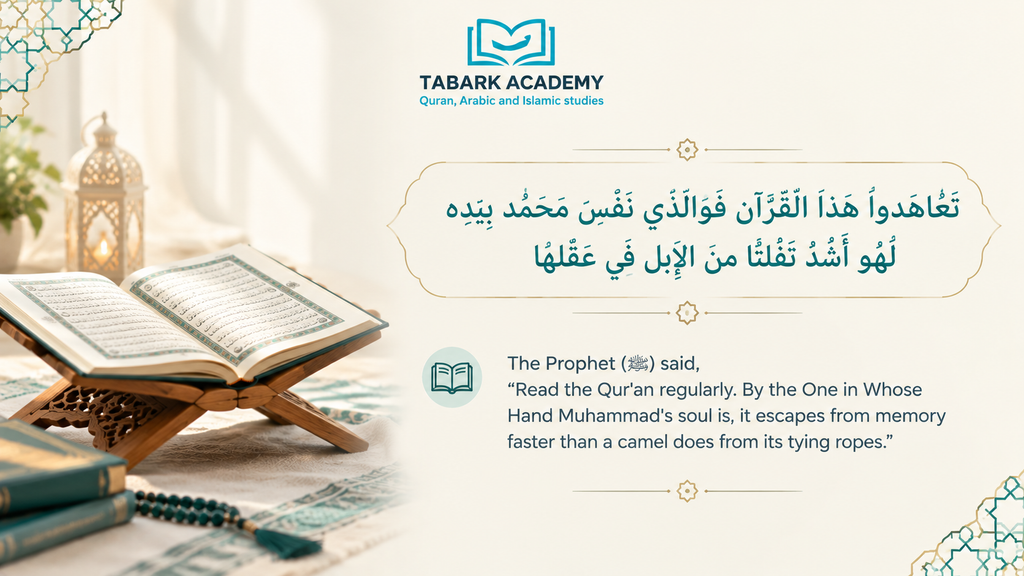
Classical teachers said it plainly: “Whoever memorizes little and reviews much is better than one who memorizes much and reviews little.” The Prophet ﷺ also warned us, in a narrated hadith, that “Read the Qur’an regularly.
By the One in Whose Hand Muhammad’s soul is, it escapes from memory faster than a camel does from its tying ropes,” which is why revision is not optional.
“تعاهدوا هذا القرآن فوالذي نفس محمد بيده لهو أشد تفلتًا من الإبل في عقلها”
Read also: Can You Memorize the Quran in One Year?
The Daily Routine That Makes Any Amount Stick
Choosing your number is step one. Building the session around it is what makes the memorization permanent.
Repeat Far More Than Feels Necessary
Read the new verse aloud 15–20 times while looking at the Mushaf, then 10 more times from memory. Many teachers recommend even higher counts for difficult passages.
Then connect the new verse to the one before it and recite both together five times. This linking step prevents the common problem of knowing verses individually but stumbling between them.
Protect Your Revision Time
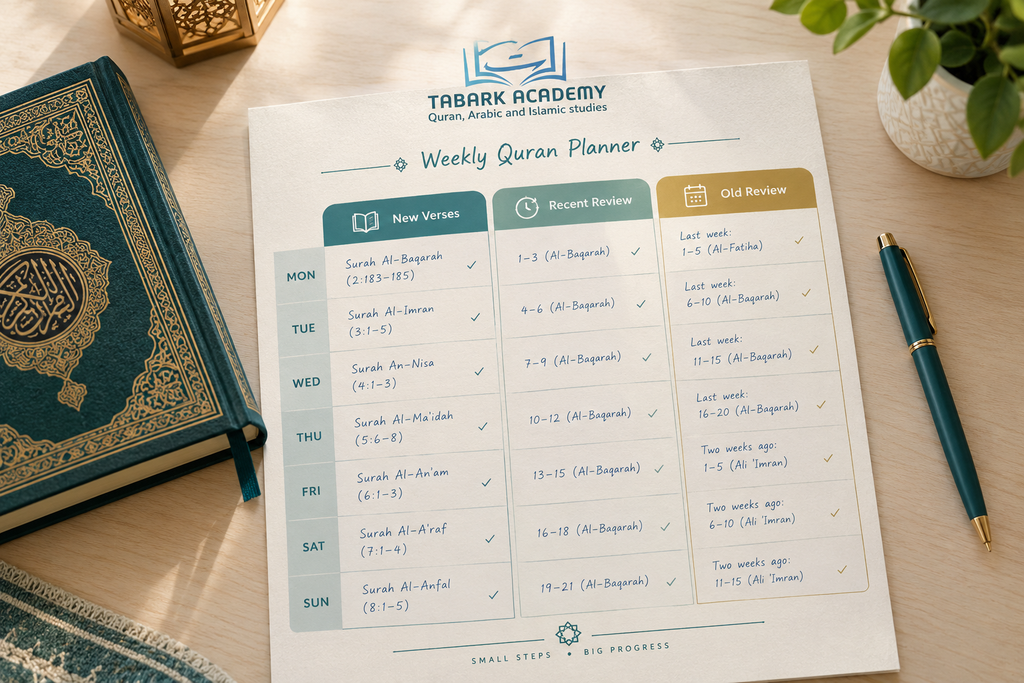
Split your session into three: new memorization, revision of the past seven days, and a rotating review of older material — ideally one juz’ per day once you have that much.
If you only have twenty minutes, give ten to revision. New verses are worthless if last month’s are gone. Guided Hifz programs build this three-part split into every lesson so nothing is left to guesswork.
Read also: 30 Juz Revision Plan: How to Do It in 1 Week
Memorize at the Right Time of Day
Early morning after Fajr is the most effective window for most people — the mind is fresh, and distractions are minimal. The time just before sleep works well for review.
Use one single Mushaf and never switch. Your visual memory of page position is a real part of how you recall verses.
Read also: How Many Lines Of Quran Should I Memorize Per Day?
How to Calculate Your Own Daily Verse Target
Start with the time you can genuinely commit every day, not your best day. Then work backwards.
Take your available minutes, give half to revision, and see how many verses you can fully master in the remaining half. Whatever that number is — even if it’s one — that’s your portion.
If you finish today’s verses but can’t recite yesterday’s without prompting, your daily amount is too high. Cut it in half for two weeks. If you finish in five minutes and feel no challenge at all, add one or two verses.
The portion should take real effort but never leave you dreading the session. Another clear signal: your tajweed slips when you rush. Pronunciation errors are the first casualty of an overloaded plan, which is why many students pair their hifz with dedicated Tajweed classes.
Test it for two weeks without changing it. If revision stays comfortable, increase by one verse. If not, hold steady. And if reading the verses is itself the bottleneck, the fix is fluency first, usually through Noorani Qaida or Arabic reading lessons.

Step Inside Our Virtual Classrooms
See our engaging teaching methods in action! watch real snippets of our live classes and discover how our expert instructors make learning interactive, memorable, and inspiring for every student.
Start Your Daily Hifz Plan With a Certified Tutor
Stop guessing how many verses you should memorize a day — get a plan built around your actual level and schedule.
At Tabarak Academy, Al-Azhar-certified tutors set your daily portion after a free level assessment, then listen to your recitation one-on-one every session. You memorize with correct tajweed from day one, so nothing has to be re-learned later.
Classes are private, flexible, and designed for both children and adults, with separate female tutors for sisters. Whether you’re starting with Surah An-Nas or completing your last juz’, your tutor adjusts the pace as you progress.
Book your free trial lesson today and finish your first week with verses you can actually recite from memory — and keep.
Our Quran Memorization / Hifz Courses
- Online Hifz Program
- Juz 30 Memorization Course
- Hifz for Kids Course
- Hifz for Adults Course
- Hifz for Sisters Course
- Short Surah Memorization Course
- Hifz Ijazah Course

Conclusion
How many verses should I memorize a day? For most learners, 3 to 5 verses is the sweet spot — 1 to 2 for absolute beginners and young children, and up to a full page for advanced students with solid revision habits.
The number itself matters less than two things: keeping it consistent and protecting enough time to review what you’ve already memorized. A small daily portion held for a year will always outperform an ambitious plan abandoned in month two.
Expect your target to change over time, and let it. The portion that suits you during a quiet month is not the one that survives exam season, travel, or a newborn at home — lowering it temporarily is a strategy, not a setback.
What you should never negotiate is the daily appointment itself. Even on your worst day, one verse recited and reviewed keeps the chain intact and makes tomorrow’s session easy to return to.
Takeaway message: Choose the largest amount you can memorize and revise every single day comfortably — then don’t change it until that amount feels easy.
Read also: How To Memorize Half A Page Of Quran Daily In 4 Steps?
FAQs
How long does it take to memorize the whole Quran?
At one page a day, roughly 20 months of continuous work. At 5 verses a day, about 3–4 years. At 2 verses a day, around 8 years — still a complete hifz within a lifetime.
Is it better to memorize a little every day or a lot on weekends?
Daily is far better. Memory consolidates through repeated exposure across days, so short daily sessions produce stronger retention than one long weekend session.
How many times should I repeat a verse to memorize it?
At least 20 repetitions for most learners — around 15 while reading and 10 from memory. Difficult or long verses may need considerably more.
Should my child memorize from the end of the Quran or the beginning?
Most teachers start children with Juz’ ‘Amma (the last juz’). The surahs are short, rhythmic, and frequently used in prayer, which builds early confidence.
Can I memorize the Quran without knowing Arabic?
Yes, many non-Arabic speakers complete hifz. But learning to read Arabic correctly first makes memorization significantly faster and prevents pronunciation errors from becoming permanent.
What should I do if I keep forgetting what I memorized?
Reduce your new daily portion and increase revision time. Forgetting is almost always a revision problem, not a memory problem.