

Most beginners can read Arabic letters correctly in isolation and still mispronounce half the Quran — because the rules change the moment two letters meet.
Izhar in tajweed is where that story starts. It is the first ruling students learn for noon sakinah, tanween, and meem sakinah, and it is the baseline every other rule is measured against.
So what is izhar in tajweed, exactly? Izhar in tajweed means pronouncing a letter clearly and separately, with no nasal merge and no hidden sound. If you understand izhar properly, idgham, ikhfa, and iqlab become easy, because you will know exactly what “normal” sounds like before a rule changes it.
This guide covers the izhar in tajweed meaning, the six throat letters, the three types of izhar, Quranic examples for each letter, and the specific mistakes that keep learners stuck — the same mistakes Tabarak Academy instructors correct in the first few sessions.
What You’ll Learn in This Article
- The exact answer to what is izhar in tajweed, linguistically and technically.
- The six izhar letters and the mnemonic that locks them into memory.
- The three types of izhar: halqi, shafawi, and mutlaq.
- Clear Quran examples for every izhar letter.
- The three throat levels and why they change how izhar feels.
- The four most common izhar mistakes and how to fix them.
What Is Izhar in Tajweed? Definition and Meaning
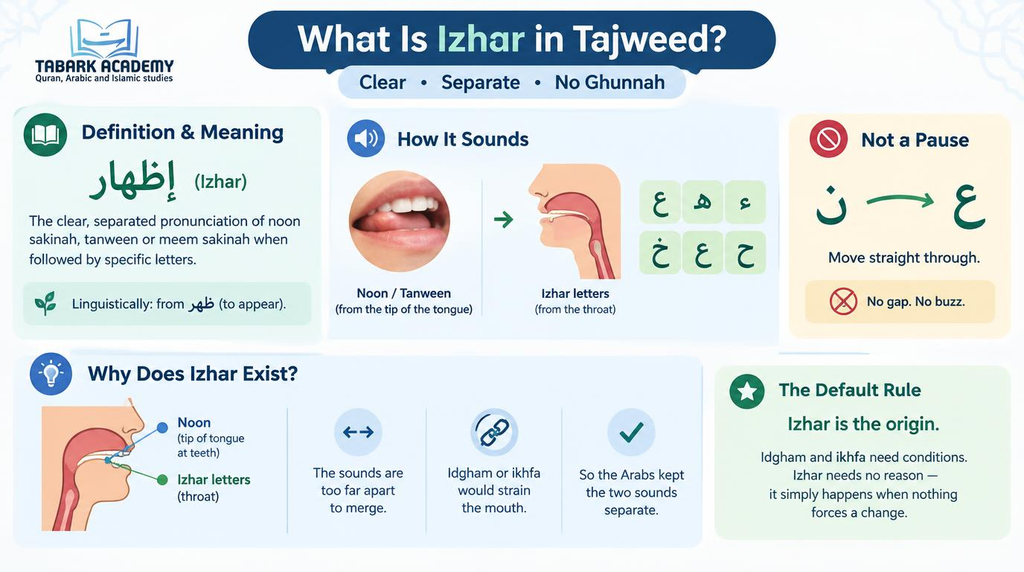
Izhar (إظهار) is the clear, separated pronunciation of noon sakinah, tanween, or meem sakinah when it is followed by specific letters, with no ghunnah added to the following letter.
Linguistically, izhar comes from the root ظهر, meaning “to appear” or “to become evident.” Technically in tajweed, it means producing each letter from its own makhraj (articulation point) without merging it into the next letter and without lingering on it.
That last part is where learners slip. Izhar is not a pause. You do not stop at noon and then start the next letter — you move straight through, cleanly, with no gap and no buzz.
Why does Izhar Exist as a Rule?
Izhar exists because the noon and the throat letters are articulated too far apart to merge comfortably. The noon comes from the tip of the tongue against the gum line of the upper front teeth. The izhar letters come from the throat. Bridging that distance with idgham or ikhfa would strain the mouth, so the Arabs kept the two sounds separate.
This is why classical scholars call izhar the origin — it is the default state of the letters. Idgham and ikhfa need conditions to occur; izhar needs no reason at all. It simply happens when nothing forces a change.
Izhar in Tajweed Explained in One Line
Say the noon or tanween fully, then say the next letter fully. Nothing blends, nothing hides, nothing stretches.
Experience Our Interactive Learning
Curious about how we teach? Watch these brief video clips from our recent live sessions to see our structured curriculum, advanced learning platform, and dynamic student-teacher interactions firsthand.
Izhar in Tajweed Letters: The Six Throat Letters
The izhar letters are six, all produced from the throat (huruf al-halq):
| Letter | Name | Throat position |
| ء | Hamzah | Deepest throat |
| هـ | Haa | Deepest throat |
| ع | Ayn | Middle throat |
| ح | Haa | Middle throat |
| غ | Ghayn | Nearest throat |
| خ | Khaa | Nearest throat |
Memorize this phrase and you own all six letters:
أخي هاك علماً حازه غير خاسر — “Akhii haaka ‘ilman haazahu ghayru khaasir”
The first letter of each word gives you the six izhar letters in order of throat depth.
The Three Throat Levels and Why They Matter
Each pair of izhar letters comes from a different section of the throat, and the depth changes how much effort the sound takes. The deepest throat (aqsa al-halq), closest to the chest, produces ء and هـ. The middle throat (wasat al-halq) produces ع and ح. The nearest throat (adna al-halq), closest to the mouth, produces غ and خ.
This matters practically: deep-throat letters like هـ are soft and easily swallowed, so learners drop them. Near-throat letters like خ are heavy, so learners over-gargle them. Knowing which level you’re in tells you which error to watch for.
The 3 Types of Izhar in Tajweed
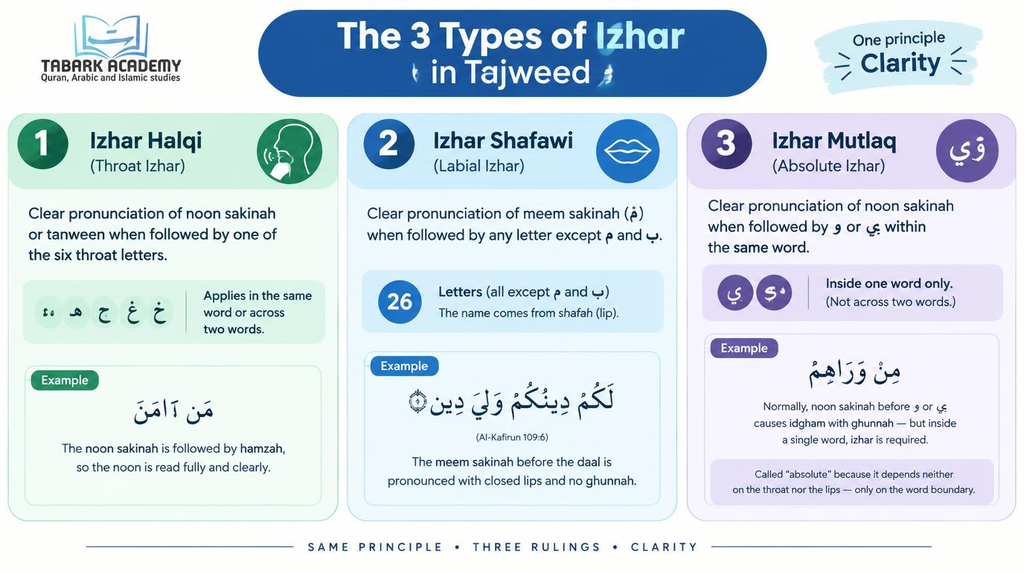
Izhar is not one rule — it is three rulings that share one principle: clarity. Each type applies to a different letter and a different set of conditions. Mixing them up is one of the most common sources of confusion among self-taught learners, which is why Tabarak Academy teaches them as three separate units rather than one lesson.
1. Izhar Halqi (Throat Izhar)
Izhar halqi is the clear pronunciation of noon sakinah or tanween when followed by one of the six throat letters. It applies whether the noon and the letter appear in the same word or across two words. With tanween, it always occurs across two words, since tanween only falls at the end of a word.
Example: مَنْ آمَنَ — the noon sakinah is followed by hamzah, so the noon is read fully and clearly.
Read also: 10 Benefits of Tajweed
2. Izhar Shafawi (Labial Izhar)
Izhar shafawi is the clear pronunciation of meem sakinah (مْ) when followed by any Arabic letter except م and ب. The name comes from shafah (lip), because the meem is a labial letter. Here the rule is reversed in scope: instead of six permitted letters, you have twenty-six. Only two letters break the rule — meem (which triggers idgham shafawi) and baa (which triggers ikhfa shafawi).
Example: لَكُمْ دِينُكُمْ وَلِيَ دِينِ (Al-Kafirun 109:6)
The meem sakinah before the daal is pronounced with closed lips and no ghunnah.
3. Izhar Mutlaq (Absolute Izhar)
Izhar mutlaq is the clear pronunciation of noon sakinah when followed by و or ي within the same word. Normally noon sakinah before و or ي produces idgham with ghunnah. But that only applies across two words. Inside a single word, merging would destroy the word’s meaning, so izhar is required instead.
It is called “absolute” because it depends neither on the throat nor on the lips — only on the word boundary condition.
The Only Four Words of Izhar Mutlaq in the Quran
There are exactly four words in the entire Quran where izhar mutlaq occurs:
- الدُّنْيَا — as in إِذْ أَنتُم بِالْعُدْوَةِ الدُّنْيَا (Surah Al-Anfal 8:42).
- بُنْيَانٌ — as in كَأَنَّهُم بُنْيَانٌ مَّرْصُوصٌ (Surah As-Saff 61:4).
- قِنْوَانٌ — as in مِن طَلْعِهَا قِنْوَانٌ دَانِيَةٌ (Surah Al-An’am 6:99).
- صِنْوَانٌ — as in وَنَخِيلٌ صِنْوَانٌ وَغَيْرُ صِنْوَانٍ (Surah Ar-Ra’d 13:4).
Memorize these four and izhar mutlaq is permanently solved. This is the single highest-return memorization in the whole noon sakinah chapter — four words, zero exceptions.
Studying tajweed on your own? The rules are readable, but pronunciation is not self-correcting. Tabarak Academy pairs you with certified Egyptian Quran tutors who hear the error you cannot hear yourself.
Start Your Quran Learning Journey
Join Tabark Academy today for structured online lessons with qualified tutors, customized to fit your goals.
Book Your Free Trial LessonIzhar In Tajweed Examples From The Quran
Below is at least one Quranic example for each of the six izhar halqi letters, covering both noon sakinah and tanween.
Examples With Hamzah (ء)
- وَيَنْأَوْنَ عَنْهُ — noon sakinah followed by hamzah in a single word. This is the only occurrence of its kind in the Quran.
- وَجَنَّاتٍ أَلْفَافًا — tanween followed by hamzah across two words.
Examples With Haa (هـ)
- وَيَنْهَوْنَ عَنِ الْمُنكَرِ — noon sakinah followed by haa within one word.
- سَلَامٌ هِيَ حَتَّىٰ مَطْلَعِ الْفَجْرِ — tanween followed by haa.
Examples With Ayn (ع)
- أَنْعَمْتَ عَلَيْهِمْ — noon sakinah followed by ayn in one word, from Surah Al-Fatihah.
- عَذَابٌ عَظِيمٌ — tanween followed by ayn.
Examples With Haa (ح)
- فَصَلِّ لِرَبِّكَ وَانْحَرْ — noon sakinah followed by haa in one word.
- عَلِيمٌ حَكِيمٌ — tanween followed by haa.
Examples With Ghayn (غ)
- فَسَيُنْغِضُونَ إِلَيْكَ رُءُوسَهُمْ — the only occurrence of noon sakinah with ghayn inside one word.
- مِنْ عَذَابٍ غَلِيظٍ — tanween followed by ghayn.
Examples With Khaa (خ)
- الْمُنْخَنِقَةُ — the only Quranic word with noon sakinah and khaa in a single word.
- عَلِيمٌ خَبِيرٌ — tanween followed by khaa.
Examples of Izhar Shafawi
- الْحَمْدُ لِلَّهِ رَبِّ الْعَالَمِينَ — meem sakinah before daal.
- أَلَمْ يَجْعَلْ كَيْدَهُمْ فِي تَضْلِيلٍ — meem sakinah before yaa.
Step Inside Our Virtual Classrooms
See our engaging teaching methods in action! watch real snippets of our live classes and discover how our expert instructors make learning interactive, memorable, and inspiring for every student.
4 Common Izhar Mistakes and How to Correct Them
Knowing the rule and applying it are different skills. These four errors account for most izhar mistakes in beginner recitation.
- Adding Ghunnah to the Noon: Learners carry the nasal sound from idgham and ikhfa into izhar. The fix: hold your nose lightly while practicing. If you feel a vibration at noon, you are nasalizing.
- Stopping on the Noon: A brief pause between the noon and the throat letter is a separate error called sakt. Izhar requires separation of sound, not separation in time — the two letters must flow consecutively.
- Dropping the Haa (هـ): Because هـ is a soft, deep-throat letter, learners often lose it entirely in words like مِنْ هَادٍ. Practice the هـ in isolation first, then attach the noon.
- Treating Tanween as a Written Noon Only: Tanween is a noon sound, not a noon letter. If a student reads only what is written, they miss izhar entirely in phrases like غَفُورٌ حَلِيمٌ. Train the ear, not just the eye.
Read also: 7 Daily Hifz Schedule Templates That Work For Every Learner
A Practical 3-Step Method for Mastering Izhar
Here is the sequence Tabarak Academy instructors use with beginners, in order.
- Isolate the letters: Spend one session on the six throat letters alone, by throat level: ء/هـ, then ع/ح, then غ/خ. Do not attach a noon yet.
- Attach the noon in one word: Use single-word examples first: أَنْعَمْتَ, وَانْحَرْ, الْمُنْخَنِقَةُ. One word removes the complication of word boundaries.
- Move to two words and tanween: Only now practice عَلِيمٌ خَبِيرٌ and مِنْ هَادٍ. Record yourself and compare against a slow murattal recitation.
The decision rule to carry into any page of Quran: see a sukoon on a noon or a tanween → look at the next letter → if it is one of the six throat letters, read it clearly and move on. That single check takes under a second once it becomes a habit. Reading about izhar builds recognition. Reading aloud to a qualified teacher builds muscle.
Tabarak Academy offers one-to-one online tajweed classes for adults, children, and sisters, scheduled around your week.
Start Your Quran Learning Journey
Join Tabark Academy today for structured online lessons with qualified tutors, customized to fit your goals.
Book Your Free Trial LessonStart Reciting The Quran Correctly With Tabarak Academy
Izhar is the first of dozens of tajweed rulings — and every one of them is learned faster with a teacher listening. Tabarak Academy connects you with certified Quran and tajweed instructors who teach noon sakinah rules, meem sakinah rules, makharij, and full Quran recitation through structured one-to-one sessions.
Flexible timing, native Arabic tutors, and a free trial before you commit anything.
Our Tajweed Courses:
- Online Tajweed Classes
- Tajweed Course for Beginners
- Tajweed Course for Kids
- Tajweed Course for Adults
- Tajweed Course for Sisters
- Advanced Tajweed Course
- Amali (Practical) Tajweed Course
- Learn Quran with Tajweed
- Learn Quran with Tajweed for Kids
- Learn Quran with Tajweed for Sisters

Conclusion
If you remember one thing about what is izhar in tajweed, make it this: izhar is the clear, unmerged pronunciation of noon sakinah, tanween, or meem sakinah before specific letters — and it is the foundation the rest of tajweed is built on.
You now have the full picture: the six throat letters and their mnemonic, the three throat levels, the three types of izhar (halqi, shafawi, and mutlaq), the four izhar mutlaq words in the Quran, and the four mistakes that slow learners down most.
The takeaway is simple: izhar is the default. Everything in the noon sakinah chapter is a departure from it. Master the clear sound first, and idgham, ikhfa, and iqlab will fall into place. When you are ready to be heard and corrected, Tabarak Academy is one trial class away.
Frequently Asked Questions About Izhar in Tajweed
These are the questions learners ask most often once they begin applying izhar in real recitation. Each answer is short enough to use as a quick reference while you practice.
1. What is izhar in tajweed in simple words?
Izhar in tajweed means pronouncing noon sakinah, tanween, or meem sakinah clearly and separately, without merging it into the next letter and without any nasal sound. It applies when a throat letter follows.
2. What are the 6 letters of izhar?
The six izhar letters are ء (hamzah), هـ (haa), ع (ayn), ح (haa), غ (ghayn), and خ (khaa). All six are produced from the throat, which is why the rule is called izhar halqi.
3. What is the difference between izhar and idgham?
Izhar keeps the noon sakinah separate and fully pronounced, while idgham merges it into the following letter. Izhar is the default state; idgham requires specific letters (ي ر م ل و ن) and conditions to apply.
4. How many words have izhar mutlaq in the Quran?
Four words: الدُّنْيَا, بُنْيَانٌ, قِنْوَانٌ, and صِنْوَانٌ. Izhar mutlaq applies in each of them wherever they occur in the Quran, with no exceptions.
5. Does izhar have ghunnah?
No. Izhar has no ghunnah. The noon sakinah or tanween is pronounced from its own articulation point with the nasal passage uninvolved, which is the defining feature separating izhar from idgham with ghunnah and from ikhfa.
6. Can I learn izhar in tajweed without a teacher?
You can learn the theory of izhar independently, but pronunciation errors are difficult to self-diagnose because you hear your own recitation differently than a listener does. Guided correction with a certified tutor, such as those at Tabarak Academy, is the reliable path.




0 Comments