


Hifz For Adults Over 40 – A Realistic Plan
Most people who ask about hifz after 40 are not asking whether memorization is possible. They are asking whether it is possible for them — with a job, a family, and a memory that no longer absorbs text the way it did at age nine.
A realistic hifz for adults over 40 plan answers that question honestly: it is built on small daily portions, strict revision, and a pace you can hold for years, not on speed.
Age does not remove the ability to memorize. It changes what works. An adult brain learns through meaning, repetition, and routine rather than raw absorption, which means the plan below looks nothing like a full-time children’s hifz program — and that is exactly why it survives a real schedule.
This guide gives you the daily amounts, the realistic timelines, the three-window routine, the revision ratio that prevents forgetting, and the mistakes that quietly end most adult hifz journeys before year one.
What you’ll learn in this article
- The daily portion size that is realistic after 40 — and the timeline each pace produces.
- The three-window daily routine that fits around a full-time job (25–40 minutes total).
- The revision ratio that stops memorized pages from unravelling.
- The Tajweed decision you must make before you memorize a single line.
- The five mistakes that end most adult hifz attempts in the first year.
Is hifz for adults over 40 realistic?
Yes, hifz for adults over 40 is realistic when the plan is built around retention rather than completion speed. Adults beginning at 40, 50, or later regularly memorize the Quran by taking 2 to 4 lines a day, revising daily, and studying with a qualified teacher who corrects errors before they are set.

The brain continues forming new memory connections throughout life. What changes with age is not capacity but method: a child memorizes largely by sound and sheer repetition, while an adult memorizes faster when meaning, structure, and routine are attached to the text. That is an advantage, not a handicap — provided the plan uses it.
The honest part is the timeline. An adult working a full-time job will not memorize like a full-time student, and a plan that pretends otherwise collapses within two months. The target is a habit that never fully stops.
Realistic means a daily portion you can complete on your worst day, not your best one. If your plan only works on a quiet Saturday, it is not a plan — it is a wish.
Realistic also means accepting a multi-year horizon. Memorizing 2 solid lines a day places the full Quran roughly 8 to 12 years away. That number discourages people only when they assume the whole Quran is the sole acceptable goal, which it is not.
Choosing between full hifz and milestone hifz
Many adults over 40 are better served by milestone goals: Juz Amma, Surah Al-Kahf, Surah Yasin, Al-Mulk, or the short surahs used most often in Salah. These take months, not decades, and each completed milestone produces the momentum that carries the next one.
A practical decision rule: if you cannot protect 20 minutes daily for the next three years, start with milestones. Commit to full hifz once the habit has proven itself for six months.
At Tabarak Academy, adult learners are commonly placed on a milestone track first precisely because a finished Juz builds more confidence than a half-remembered attempt at the whole Mushaf.
How much Quran should an adult over 40 memorize each day?
An adult over 40 should memorize 2 to 4 lines of new material per day, five days a week, with equal or greater time spent on revision. Beginners with weaker Arabic reading should start at 2 to 3 lines; confident readers with more available time can work up to half a page.
The portion size is not a measure of ambition. It is a measure of what you can still recite accurately three weeks later without re-learning it.
Daily portions by level:
- New beginners: 2 to 3 lines daily.
- Comfortable Quran readers: 3 to 5 lines daily.
- Strong readers with more time: half a page daily.
- Very busy adults: 1 to 2 lines daily with heavy revision.
The bad-day minimum:
Every adult hifz plan needs a floor, not just a target. On chaotic work or family days, you do not drop to zero — you fall back to the bad-day minimum: recite yesterday’s portion once from memory and close the Mushaf.
This single rule does more for long-term hifz than any memorization technique. Missing entirely is what breaks momentum; doing a little keeps the habit alive and costs ninety seconds.
Read also: How to Read the Quran Without Knowing Arabic
How long does hifz take for an adult over 40?
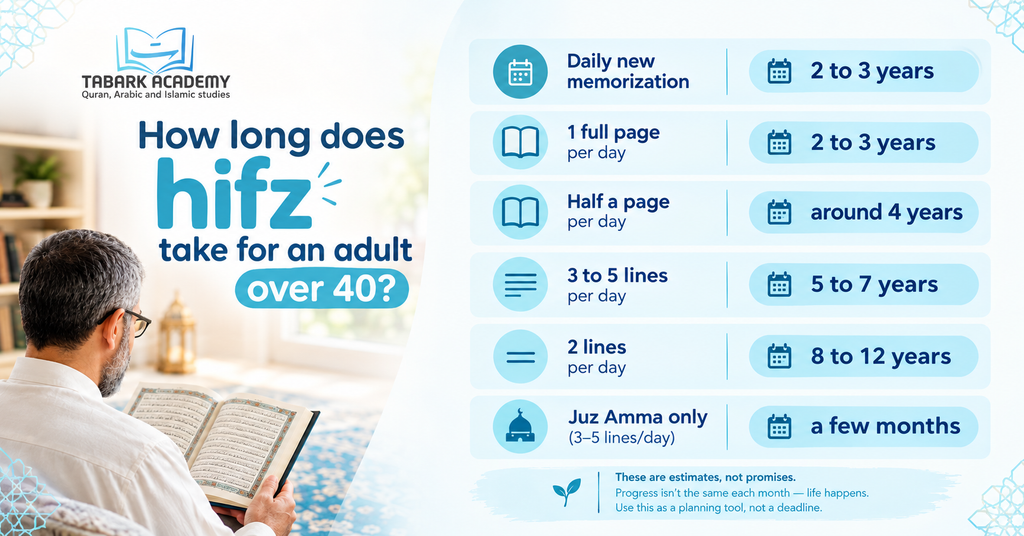
Hifz for an adult over 40 typically takes 3 to 12 years for the full Quran, depending entirely on the daily portion and the strength of revision. The pace you choose determines the timeline, and the figures below assume consistent daily work with proper review.
| Daily new memorization | Approximate time to complete the Quran |
| 1 full page per day | 2 to 3 years |
| Half a page per day | around 4 years |
| 3 to 5 lines per day | 5 to 7 years |
| 2 lines per day | 8 to 12 years |
| Juz Amma only (3–5 lines/day) | a few months |
These are estimates, not promises. Progress is never equal across months — Ramadan, travel, illness, and work cycles all move the line. Treat the table as a planning tool for choosing your pace, not as a deadline to beat.
Why does finishing faster usually finish slower?
Adults who push past their sustainable portion size almost always experience the same pattern: rapid progress for six to ten weeks, followed by the discovery that the earliest juz has quietly dissolved. They then spend months re-memorizing what they already “finished.”
A smaller portion memorized to the point of effortless recall is worth more than three times that amount held loosely. Strong hifz beats fast hifz, and this is the single most common correction teachers make with adult students.
Step Inside Our Virtual Classrooms
See our engaging teaching methods in action! watch real snippets of our live classes and discover how our expert instructors make learning interactive, memorable, and inspiring for every student.
Start Your Quran Learning Journey
Join Tabark Academy today for structured online lessons with qualified tutors, customized to fit your goals.
Book Your Free Trial LessonThe Three-Window Method: A Daily Routine That Fits A Working Life
The Three-Window Method splits hifz into three short touchpoints across the day — morning, dead time, and night — totalling 25 to 40 minutes. Only the first window requires quiet focus; the other two use time that would otherwise be lost.
This structure exists because a single 40-minute block is the first thing a busy week deletes. Three small blocks attached to fixed anchors survive far better.
A. Morning: new memorization (15–20 minutes)
Right after Fajr is the classic window: the mind is sharpest and the house is quiet. Take your portion of 2 to 4 lines, read it with correct Tajweed ten times while looking at the Mushaf, then close it and test yourself piece by piece — half a line, then a line, then the full portion.
The “test yourself” step is the one adults skip most often, and it is where memorization actually happens. Reading something twenty times builds familiarity; recalling it without looking builds memory.
B. Commute and dead time: by-ear reinforcement (10 minutes)
Play your chosen reciter during a drive, walk, or household chores, and recite along quietly from memory. This anchors rhythm and pronunciation, and it catches errors your eyes miss on the page.
Use one reciter consistently. Switching between reciters mid-journey disrupts the rhythm your memory is attaching itself to.
C. Night: lock-in and review (5–10 minutes)
Before sleeping, recite today’s new lines once or twice from memory, then review yesterday’s portion. Sleep consolidates short-term memory into long-term storage, which makes this the highest-value five minutes in the day relative to its length.
If you only have energy for one of the three windows on a given day, make it this one.
Muraja’ah: The Revision System That Decides Everything
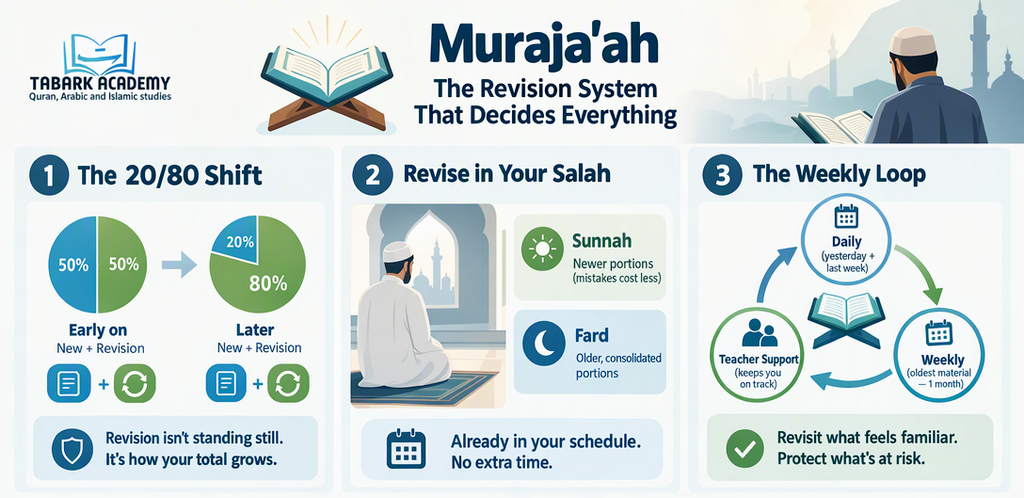
Muraja’ah is systematic revision of previously memorized Quran, and for adults over 40 it is not optional support work — it is the main job. Forgetting happens faster than memorizing when review is neglected, which is why revision time should match or exceed new memorization time from day one.
A simple diagnostic: if you cannot recite last month’s portion in Salah without hesitation, you are memorizing too fast and reviewing too little.
1. The 20/80 ratio shift
Early on, a 50/50 split between new lines and revision works well. As your memorized library grows past a few juz, the ratio must shift — roughly 20% of your time on new material and 80% on reviewing old material.
Adults resist this shift because revision feels like standing still. It is not. Protecting what you have is what makes the total number grow.
2. Revise inside your Salah
Reciting your portions inside daily Fard and Sunnah prayers is the most reliable revision method available, because the prayers are already fixed in your schedule and already demand full attention.
Rotate deliberately: newer portions in Sunnah prayers where mistakes cost less, older consolidated portions in Fard. Over a week, this alone can carry a substantial share of your revision load without adding a single minute to your day.
3. The weekly revision loop
Daily review covers yesterday and the past week. Once a week, add a pass over the oldest material you hold — the portions you have not touched in a month are the ones at risk, not the ones you memorized on Tuesday.
Adult learners enrolled in structured programs such as the Hifz track at Tabarak Academy typically have this loop managed by a teacher, which removes the most common failure point: revising only what feels comfortable.
Read also: How Much Time Do Adults Need for Hifz Per Day?
Five Mistakes That End Most Adult Hifz Attempts
These are the errors teachers correct most frequently with learners over 40. Each one is avoidable before it costs you a year.
1. Memorizing before fixing Tajweed
Do not memorize with incorrect pronunciation. A mispronounced verse stored for two years takes roughly twice the effort to correct as it would have taken to learn properly the first time, because you are now un-learning and re-learning simultaneously.
Fix your recitation first with a qualified teacher, even if that delays the start of memorization by a few weeks.
2. Switching between different Mushaf layouts
Stick to one physical Mushaf — ideally the 15-line Madani print — and do not alternate with apps that break lines differently. Your brain photographs the page: verse position, line endings, and where the page turns all become retrieval cues.
Change the layout and you lose cues you did not know you were using.
3. Treating revision as optional on busy days
When the week compresses, adults cut revision and keep new memorization because new lines feel like progress. This is backwards. On a bad day, revise and skip the new portion — never the reverse.
4. Studying with no one to correct you
Self-study works for reading. It fails for hifz, because the errors you cannot hear are exactly the ones that become permanent. One or two sessions a week with a teacher, or a committed hifz partner who listens to your recitation, is enough to catch drift before it sets.
5. Comparing your pace to someone else’s
A working parent memorizing three lines a day consistently will finish far ahead of a fast starter who burns out in month four. Your pace is a function of your schedule, your Arabic level, and your revision discipline — not your sincerity.
Reading The Translation: The Adult Advantage
Reading the translation of your portion before memorizing it gives adults a retrieval thread that children memorizing purely by sound do not have. When you understand how a verse connects to the one before it, the sequence becomes logical rather than arbitrary.
Spend two minutes on the meaning before the ten repetitions. This is not extra work — it reduces the number of repetitions needed and makes the portion far more resistant to forgetting.
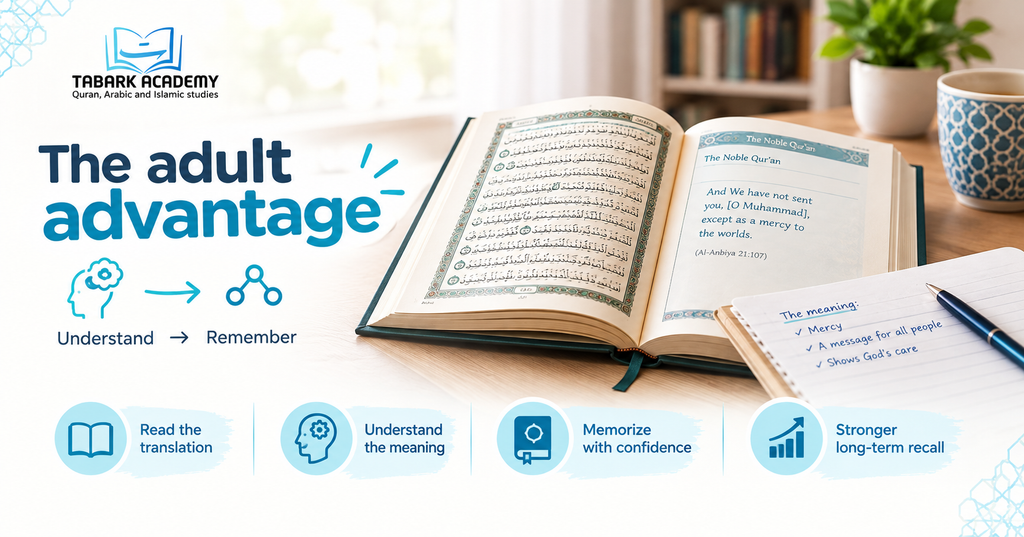
Pairing hifz with basic Quranic Arabic, Tajweed correction, and tafsir study compounds the effect, which is why most adult Quran programs build them into the same track rather than treating them as separate courses.
Experience Our Interactive Learning
Curious about how we teach? Watch these brief video clips from our recent live sessions to see our structured curriculum, advanced learning platform, and dynamic student-teacher interactions firsthand.
Start Your Quran Learning Journey
Join Tabark Academy today for structured online lessons with qualified tutors, customized to fit your goals.
Book Your Free Trial LessonStart Your Hifz Journey With A Plan Built For Your Schedule
You do not need a free year or a perfect memory. You need 25 focused minutes a day, a portion size you can defend on a bad week, and a teacher who hears your mistakes before they harden.
Tabarak Academy builds Hifz plans around adult schedules — one-on-one sessions with certified Azhari tutors, Tajweed correction before memorization begins, a revision timetable matched to your pace, and flexible class times that fit around work and family.
Whether your goal is Juz Amma in three months or the full Quran over the next decade, the plan is written for the life you actually have.
Our Quran Memorization / Hifz Courses
- Online Hifz Program
- Juz 30 Memorization Course
- Hifz for Kids Course
- Hifz for Adults Course
- Hifz for Sisters Course
- Short Surah Memorization Course
- Hifz Ijazah Course

Conclusion
Hifz for adults over 40 is realistic, and the realistic plan is unglamorous: 2 to 4 lines a day, a bad-day minimum you never skip, three short windows instead of one long sitting, and revision that grows to occupy most of your time as your memorized portion grows.
Your timeline depends entirely on your daily portion — 2 to 3 years at a page a day, 5 to 7 years at a few lines, a few months for Juz Amma. None of those numbers matters as much as whether you are still doing it in year two.
Fix your Tajweed first, keep one Mushaf, revise in your Salah, and find someone to correct you. With those four in place, a realistic hifz for adults over 40 stops being a question of age and becomes a question of consistency — which is entirely within your control.

Frequently Asked Questions About Hifz For Adults Over 40
These are the questions adult learners ask most often before starting. Each answer is kept short and practical so you can use it to shape your own plan.
1. Is 40 too late to start memorizing the Quran?
No, 40 is not too late to start memorizing the Quran. Adults beginning at 40, 50, or later complete hifz through small daily portions and consistent revision. Age affects pace, not ability.
2. How many lines should an adult over 40 memorize per day?
An adult over 40 should memorize 2 to 4 lines of new Quran per day, five days a week. Beginners should start at 2 to 3 lines and only increase once last month’s portion can still be recited without hesitation.
3. How long will it take me to memorize the whole Quran after 40?
It takes roughly 2 to 3 years at one page a day, about 4 years at half a page, and 5 to 12 years at 2 to 5 lines a day. Your revision strength, not your starting age, is what moves this timeline most.
4. Can I do hifz online while working full time?
Yes. Online Hifz programs for adults, including the adult track at Tabarak Academy, schedule short one-on-one sessions around work hours and assign daily portions sized for 25 to 40 minutes of total practice across the day.
5. Do I need to know Tajweed before starting hifz?
Yes, you should be able to read the Quran correctly with basic Tajweed before beginning hifz. Memorizing with incorrect pronunciation creates errors that take roughly twice the effort to remove later than to avoid at the start.
6. What if I forget what I memorized?
Forgetting is normal and is solved by revision, not by re-memorizing from scratch. Review yesterday’s portion and the past week daily, revise older portions inside your Salah, and shift to roughly 80% revision time as your memorized library grows.