

Do I Need to Learn MSA to Understand the Quran?
The relationship between Modern Standard Arabic and the language of the Quran raises several questions for anyone beginning this journey.
Each path offers its own perspective, and the best way to approach them may depend on your goals, background, and expectations.
In this guide, we’ll explore the connection between MSA and Quranic Arabic and answer the question about do you need to learn MSA to understand the Quran. We’ll consider some of the factors that may shape your learning experience.
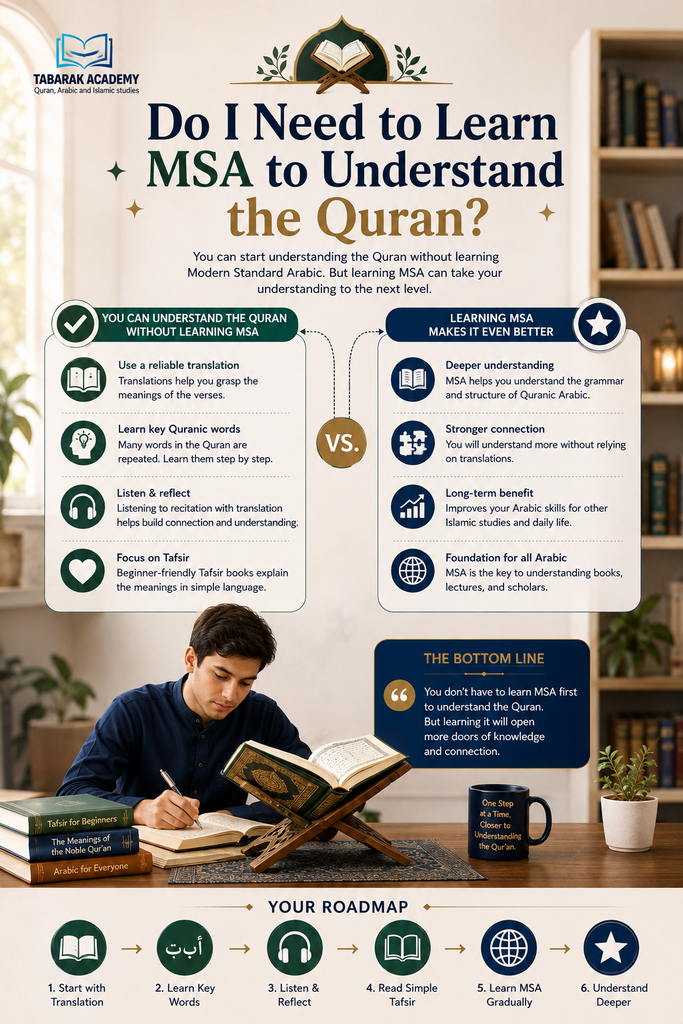
Do I need to learn MSA to understand the quran?
No, you do not need to learn Modern Standard Arabic (MSA) to understand the Quran.
The Quran is in Classical Arabic, and while MSA shares much of its grammar, vocabulary, and root system, MSA is not the same as Quranic Arabic.
If your main goal is understanding the Quran, you can study Quranic Arabic directly. MSA can still be very helpful, especially if you also want to read modern Arabic, understand formal Arabic content, or develop broader language skills.
Can You Understand the Quran If You Only Know MSA?
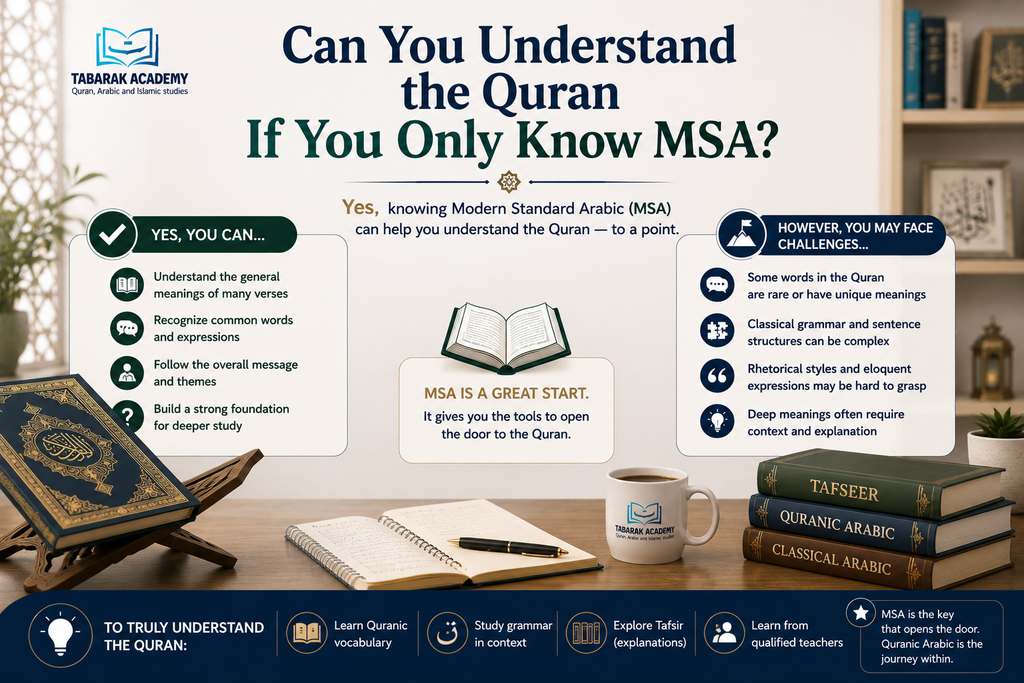
Yes, MSA can help you understand parts of the Quran, but knowing MSA alone does not guarantee complete Quranic comprehension. If you have a good foundation in MSA, you may recognize many familiar words, grammatical structures, and sentence patterns while reading the Quran.
- However, understanding individual words is different from understanding the full meaning of a verse. Quranic Arabic can include less common vocabulary, classical grammatical structures, and rhetorical expressions that may not appear regularly in modern Arabic.
- Your level of MSA also makes a difference. A beginner may recognize only familiar words, while an advanced MSA learner may be able to understand much more of the basic structure and meaning. To move from recognition to deeper comprehension, it is helpful to study Quranic vocabulary, Arabic grammar and morphology, and reliable Tafsir.
So, if you are wondering, “Do I need to learn MSA to understand the Quran?”, the answer is no. MSA is helpful, but it is one possible foundation rather than a mandatory first step.
Experience Our Interactive Learning
Curious about how we teach? Watch these brief video clips from our recent live sessions to see our structured curriculum, advanced learning platform, and dynamic student-teacher interactions firsthand.
How Much Does MSA Help With Understanding the Quran?
Learning Modern Standard Arabic (MSA) can give you a valuable head start when you begin studying the Quran.
Because MSA and Quranic Arabic share core grammar, word roots, and many vocabulary patterns, MSA learners can often recognize familiar words and understand basic sentence structures more easily.
However, the amount of the Quran you can understand through MSA depends on your Arabic level and how much Quran-focused vocabulary you know.
A learner with basic MSA may recognize individual words, while someone with stronger grammar and morphology skills may understand the general meaning of more verses.
Read also:The Key Differences Between Quranic and Modern Standard Arabic
What Makes the Quran Difficult for MSA Learners?
Even learners with a good foundation in Modern Standard Arabic may find some parts of the Quran challenging.
The difficulty is not necessarily because the languages are unrelated, but because the Quran contains linguistic features that require more specialized knowledge and context.
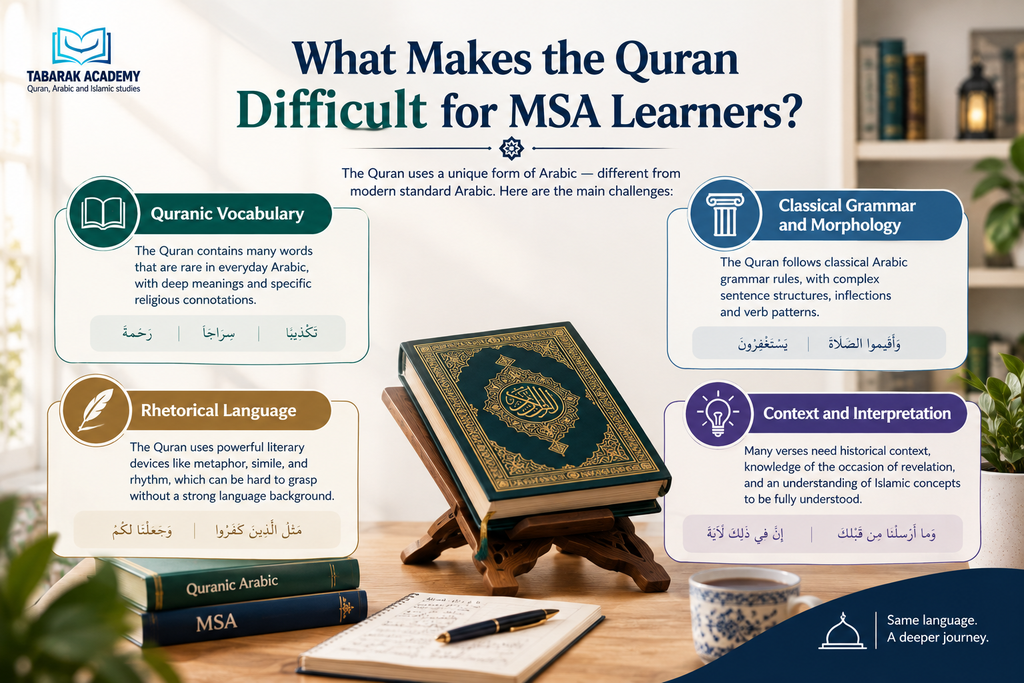
a. Quranic Vocabulary
Some Quranic words and expressions are less common in modern Arabic. Learning high-frequency Quranic vocabulary can help you recognize meanings more quickly instead of relying on a general Arabic dictionary for every verse.
Read also:Learning Quran as an Adult Non-Arabic Speaker
b. Classical Grammar and Morphology
The Quran contains grammatical and morphological patterns that may not receive much attention in beginner or intermediate MSA courses. Understanding Nahw (grammar) and Sarf (morphology) can help you see how words function and how their forms contribute to meaning.
c. Rhetorical Language
The Quran uses powerful rhetorical techniques, including changes in word order, emphasis, repetition, imagery, and concise expressions.
Recognizing these features can add depth to your understanding beyond the basic translation of individual words.
d. Context and Interpretation
Knowing the dictionary meaning of every word does not always mean you fully understand a verse. Context and Tafsir can provide important explanations of meaning, usage, and interpretation.
For this reason, MSA can give you a strong linguistic foundation, while focused Quranic Arabic study helps you understand the language of the Quran more confidently and accurately.
Read also: Easy Ways to Read the Quran Without Knowing Arabic
Do You Need to Learn Classical Arabic to Understand the Quran?
You do not need to become an expert in Classical Arabic before you can start understanding the Quran. Many learners can make meaningful progress by studying the Arabic vocabulary, grammar, and structures that occur frequently in the Quran.
It is helpful to think of Quranic Arabic as a focused learning goal. You can gradually develop the skills needed to understand verses without first mastering every aspect of Classical Arabic literature and linguistics.
Should You Learn MSA or Quranic Arabic First?
The best choice depends on why you want to learn Arabic. If understanding the Quran is your main goal, you do not necessarily need to spend years studying MSAtea before beginning Quranic Arabic.
If Your Main Goal Is Understanding the Quran
Starting with Quranic Arabic can be a direct approach. You can focus on frequently used Quranic vocabulary, basic grammar, word patterns, and the structures you encounter while reading the Quran.
If You Want to Learn Modern Arabic as Well
MSA may be the better starting point if you want to read modern Arabic books, follow news, or develop broader formal Arabic skills. You can then add Quranic Arabic to understand the language of the Quran more deeply.
If You Already Know MSA
You already have a useful foundation. Rather than starting from the beginning, focus on expanding your Quranic vocabulary and studying the classical grammar, morphology, and expressions that are especially relevant to the Quran.
Read also: How to Start Reading the Quran in Arabic With Ease
If You Are a Complete Beginner
You can begin with foundational Arabic skills and gradually introduce Quranic vocabulary and grammar. A structured learning program can help you progress without trying to master everything at once.
Ultimately, there is no single path that works for every learner. MSA is helpful, but it is not a prerequisite for beginning your journey toward understanding the Quran.
Step Inside Our Virtual Classrooms
See our engaging teaching methods in action! watch real snippets of our live classes and discover how our expert instructors make learning interactive, memorable, and inspiring for every student.
Step Inside Our Virtual Classrooms
See our engaging teaching methods in action! watch real snippets of our live classes and discover how our expert instructors make learning interactive, memorable, and inspiring for every student.
Learn Quranic Arabic With Tabarak Academy
If your goal is to understand the Quran more deeply, you do not have to wait until you master Modern Standard Arabic. A focused approach to Quranic Arabic can help you develop the vocabulary, grammar, reading, and comprehension skills needed to engage with the Quran in its original language.
- At Tabarak Academy, learners can study the Quran online with structured guidance designed to make learning accessible and consistent.
- Whether you are starting from the basics or building on previous Arabic knowledge, guided lessons can help you progress step by step toward a stronger connection with the Quran.
- If you have been asking yourself, “Do I need to learn MSA to understand the Quran?”, the answer is no, but having the right learning path can make the journey easier.
- Start building your Quranic Arabic skills with Tabarak Academy and take a meaningful step toward understanding the words of the Quran with greater confidence.
Our Quranic Arabic Courses
- Quranic Arabic Classes
- Quranic Arabic Course for Kids
- Quranic Arabic for Beginners
- Quranic Arabic Grammar Course
Our Arabic Language Courses
- Online Arabic Classes
- Arabic Course for Beginners
- Arabic Alphabet Learning Course
- Online Arabic Classes for Kids
- Arabic Classes for Adults
- Arabic Grammar Course
- Intermediate Arabic Course
- Arabic Speaking Course
Ready to begin? Explore Tabarak Academy’s online Quran classes and find a learning path that fits your goals.
Conclusion
So, do you need to learn MSA to understand the Quran? No. Modern Standard Arabic can give you a useful foundation in vocabulary, grammar, morphology, and sentence structure, but it is not a prerequisite for beginning Quranic Arabic.
If understanding the Quran is your primary goal, you can start directly with frequently occurring Quranic vocabulary, essential grammar, Arabic roots and word patterns, and the linguistic structures you encounter in Quranic verses. As your knowledge develops, Tafsir and more advanced study can help you understand meanings and contexts that vocabulary and grammar alone cannot fully explain.
MSA becomes especially valuable if your goals extend beyond Quran comprehension to reading modern Arabic books, following news and media, academic study, or developing broader formal Arabic skills. The best path therefore depends on what you ultimately want to achieve.
Rather than waiting until you have mastered an entire form of Arabic, start with the Arabic skills that directly support your goal and build your knowledge gradually.
Ready to start your journey toward understanding the Quran? Explore Tabarak Academy’s online Quran classes and take your next step with structured, supportive learning.
FAQs
Can I understand the Quran without speaking Arabic?
Yes. Understanding Quranic Arabic does not require conversational fluency. You can focus specifically on reading, vocabulary, grammar, and comprehension without first becoming fluent in everyday Arabic conversation.
Is MSA useful for learning Quranic Arabic?
Yes. MSA can provide a strong foundation in Arabic grammar, vocabulary, morphology, and sentence structure. Learners who already know MSA may find it easier to recognize many Quranic words and structures.
Should beginners learn MSA or Quranic Arabic?
If your primary goal is understanding the Quran, you can begin with Quranic Arabic rather than treating advanced MSA as a prerequisite. If you also want to read modern Arabic or develop broader formal Arabic skills, MSA can be an excellent part of your learning path.
Can I learn Quranic Arabic online?
Yes. Online Quranic Arabic lessons can provide structured instruction in vocabulary, grammar, reading, and comprehension. Working with a qualified teacher can also help you understand difficult concepts and stay consistent with your studies.
How long does it take to understand Quranic Arabic?
There is no universal timeline. Your progress depends on your starting level, study frequency, learning approach, and the depth of understanding you want to achieve. Consistent, structured learning is more important than following an arbitrary deadline.