

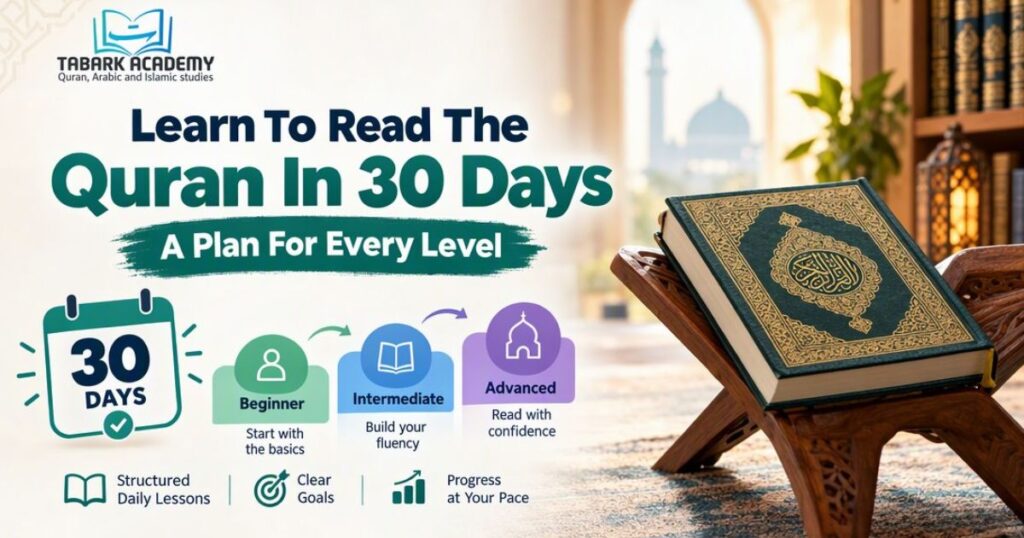
Learn To Read The Quran In 30 Days – A Plan For Every Level
Can you really learn to read the Quran in 30 days? Yes, if you know what a month can realistically give you. A complete beginner can use 30 days to learn the letters, the vowels, and the first short surahs.
A fluent reader can use the same 30 days to finish the whole Quran by reading one Juz’ a day.
This guide walks you through the process in ten clear steps. Beginners follow Steps 1–5 as their 30-day foundation. Readers go from Step 1 straight to Step 6 to finish a full Khatmah. Everyone uses Steps 7–10 to keep the habit going, with guidance from the teachers at Tabarak Academy.
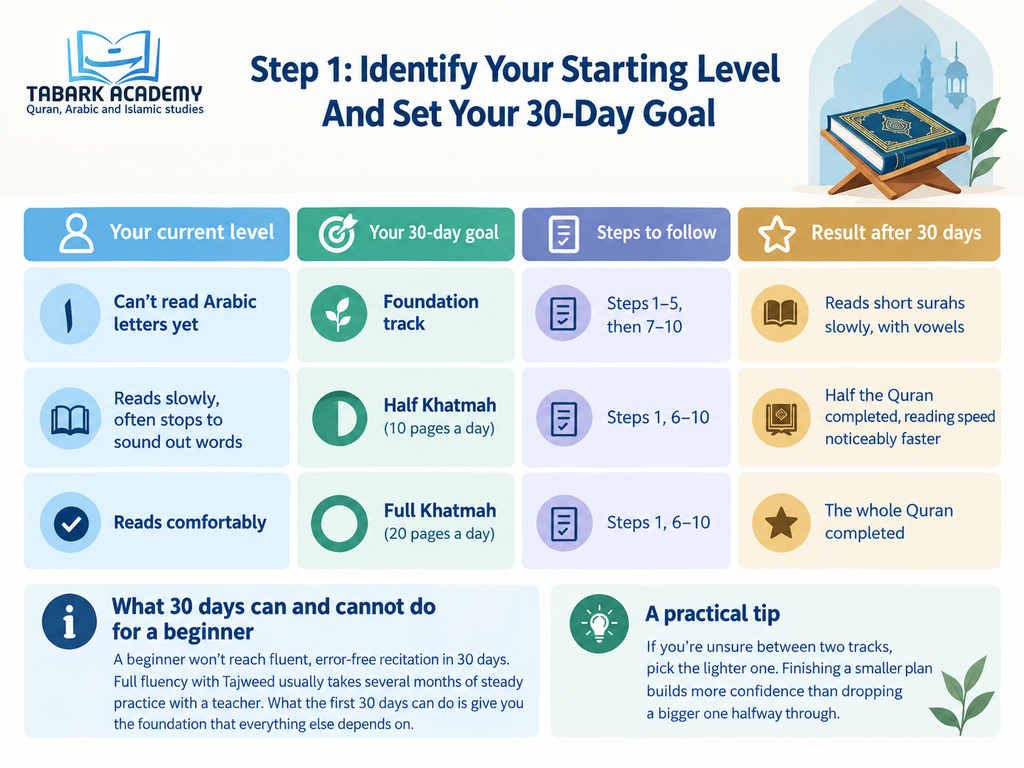
Step 1: Identify Your Starting Level And Set Your 30-Day Goal
To learn to read the Quran in 30 days, first decide which goal fits your level: building the reading basics from scratch, or finishing the entire Quran in one month. The right goal is what separates a plan you complete from a plan you drop in week two.
The table below shows the three realistic 30-day tracks. Find your level, then follow the steps listed for your track.
| Your current level | Your 30-day goal | Steps to follow | Result after 30 days |
| Can’t read Arabic letters yet | Foundation track | Steps 1–5, then 7–10 | Reads short surahs slowly, with vowels |
| Reads slowly, often stops to sound out words | Half Khatmah (10 pages a day) | Steps 1, 6–10 | Half the Quran completed, reading speed noticeably faster |
| Reads comfortably | Full Khatmah (20 pages a day) | Steps 1, 6–10 | The whole Quran completed |
What 30 days can and cannot do for a beginner
A beginner won’t reach fluent, error-free recitation in 30 days. Full fluency with Tajweed usually takes several months of steady practice with a teacher. What the first 30 days can do is give you the foundation that everything else depends on.
A practical tip: if you’re unsure between two tracks, pick the lighter one. Finishing a smaller plan builds more confidence than dropping a bigger one halfway through.
Step 2: Learn The 28 Arabic Letters And Their Sounds (Days 1–10)
The first step for a beginner who wants to learn to read the Quran in 30 days is to master the 28 Arabic letters in their isolated forms. Study about three letters a day, say each one aloud, and write it several times so both the shape and the sound stick.
Group letters by shape to learn faster. For example, ب ت ث share one form and differ only in their dots, so learning them together helps you tell them apart.
Why does letter accuracy matter from day one?
Letters that sound alike to English speakers come from completely different places in the mouth and throat. If you read قَلْب (qalb, “heart”) as كَلْب (kalb, “dog”), you’ve changed the meaning of the word.
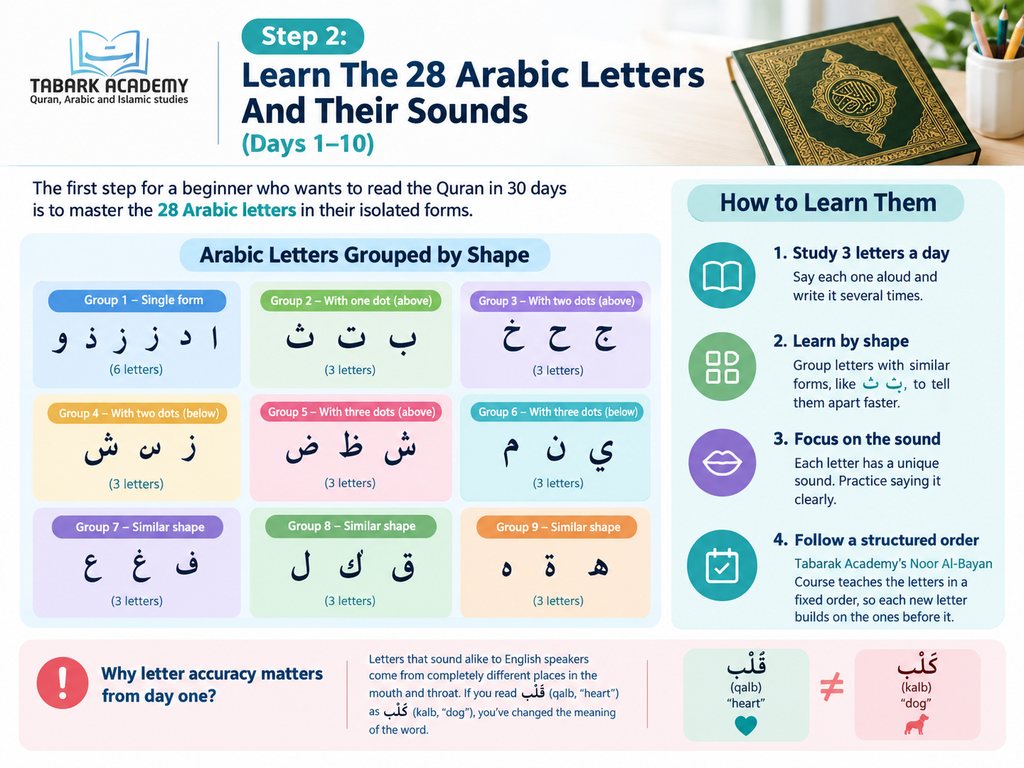
That’s why a structured primer helps so much at this stage. Tabarak Academy’s Noor Al-Bayan Course teaches the letters in a fixed order, so each new letter builds on the ones before it.
Step 3: Learn How Arabic Letters Connect (Days 11–17)
Arabic letters change shape depending on whether they come at the start, middle, or end of a word. In this step, you practice reading letters in their joined forms until you recognize them as easily as in isolation.
Pay special attention to the six letters that never connect to the letter after them: ا د ذ ر ز و. Once you spot them, you’ll see where each word breaks apart, and reading gets much easier.
Step 4: Learn The Vowel Marks (Harakat) (Days 18–24)
Vowel marks are the small signs above and below the letters that tell you which sound to make. Learning them is what turns separate letters into readable words.
Learn them in this order:
- Fatha (َ): a short “a” sound, written above the letter.
- Kasra (ِ): a short “i” sound, written below the letter.
- Damma (ُ): a short “u” sound, written as a small و above the letter.
- Sukoon (ْ): the letter has no vowel after it.
- Shaddah (ّ): the letter is doubled.
- Tanween (ً ٍ ٌ): an “n” sound added at the end of a word.
Practice with simple three-letter words. For example, ك + َ + ت + َ + ب + َ reads “kataba” (he wrote).
Read Also: How Long Does It Take To Learn To Read The Quran?
Step 5: Read Your First Short Surahs (Days 25–30)
In the last week of the foundation track, you move from practice words to the Mushaf itself. Start with Juz’ Amma, the final part of the Quran, because its surahs are short and their verses are easy to handle.
Read in this order: Al-Fatiha, Al-Ikhlas, Al-Falaq, then An-Nas. Read each verse word by word first, then join two words, then read the whole verse.
For example, قُلْ هُوَ اللَّهُ أَحَدٌ becomes Qul / Huwa / Allahu / Ahad before you read it in one breath.
If you want a guided version of Steps 2–5, the Online Quran Classes for Beginners at Tabarak Academy follow these same letters, vowels, then surah’s path with a live teacher.
Experience Our Interactive Learning
Curious about how we teach? Watch these brief video clips from our recent live sessions to see our structured curriculum, advanced learning platform, and dynamic student-teacher interactions firsthand.
Start Your Quran Learning Journey
Join Tabark Academy today for structured online lessons with qualified tutors, customized to fit your goals.
Book Your Free Trial LessonStep 6: Divide Your Daily Reading Into One Juz’ (For Readers)
If you can already read, you can read the Quran in 30 days by finishing one Juz’ each day. Scholars divided the Quran into 30 equal parts for this reason. In the standard Madani Mushaf of 604 pages, each Juz’ is about 20 pages.
This is also the pace the Prophet ﷺ first advised when he told Abdullah ibn Amr:
“Recite the Quran in one month” (Sahih al-Bukhari 5054).
Here are the two most practical ways to split the daily 20 pages.
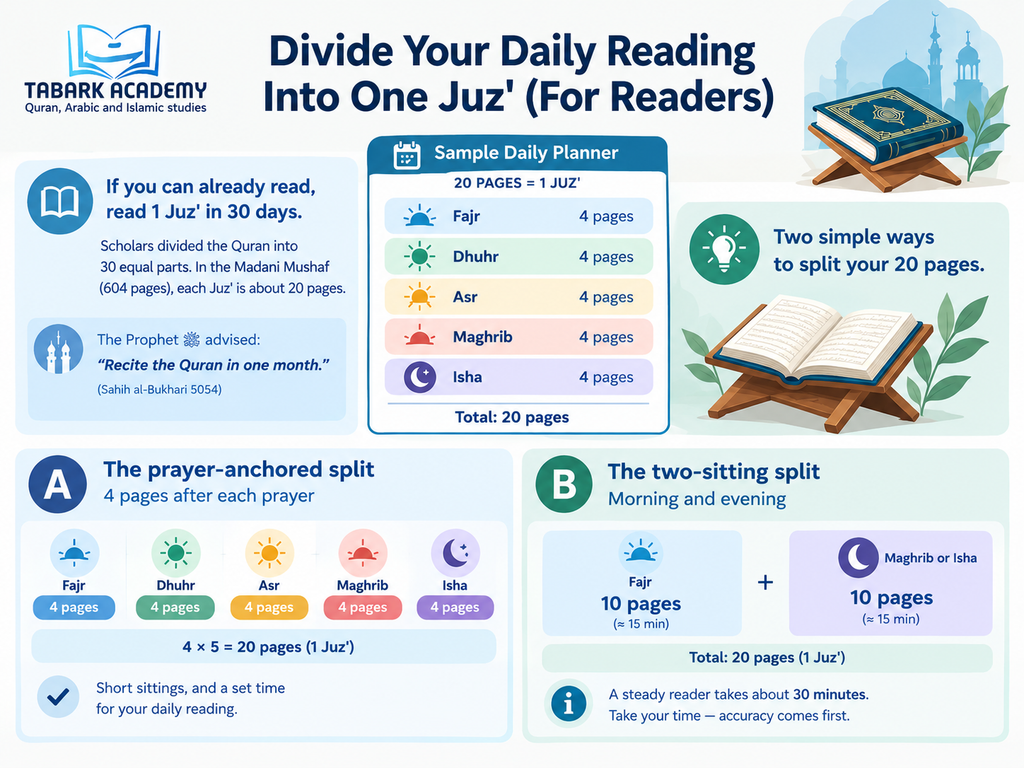
A. The prayer-anchored split: 4 pages after each prayer
Read 4 pages after each of the five daily prayers: 4 pages × 5 prayers = 20 pages, which is one full Juz’. For the half Khatmah track, read 2 pages after each prayer to reach 10 pages a day.
Each sitting takes only a few minutes, and you never have to ask yourself “when will I read today?”, because the prayer answers that for you.
B. The two-sitting split: morning and evening
Read 10 pages after Fajr and 10 pages after Maghrib or Isha. For a steady reader, a full Juz’ takes about 30 minutes. It takes longer at a careful Tarteel pace, which is completely fine, because accuracy comes before speed.
Step 7: Fix Your Reading Time, Place, And Mushaf
Consistency depends on your surroundings more than your willpower. Fixing when, where, and from what you read removes the small decisions that usually break a new habit. Set these three things up before your first day.
A. Choose a fixed time tied to a habit
Link your reading to something you already do every day, like your prayers. After Fajr is the classic time, because the mind is clear and distractions are few. Start with Wudu so you’re ready both physically and mentally.
B. Pick a quiet place
Many people drop their plan in the first week because of distraction, not difficulty. Keep one quiet spot for your reading and go back to it every day.
C. Use a comfortable Mushaf
A color-coded Tajweed Mushaf marks where each rule applies, and it shows the Juz’ and Hizb divisions. That makes both reading and tracking your progress easier.
Step 8: Listen To And Repeat After A Clear Reciter
Recitation is learned by ear before it’s learned by eye. Play one verse from a clear, measured reciter such as Sheikh Mahmoud Khalil Al-Husary. Pause, repeat it aloud, then compare your version to his.
Stay with one reciter so your ear gets used to one consistent pace. Once a week, record yourself: the recording will catch mistakes you didn’t hear while you were reading. Keep a translation nearby too, and reflect on the meaning of at least a few verses from each session.
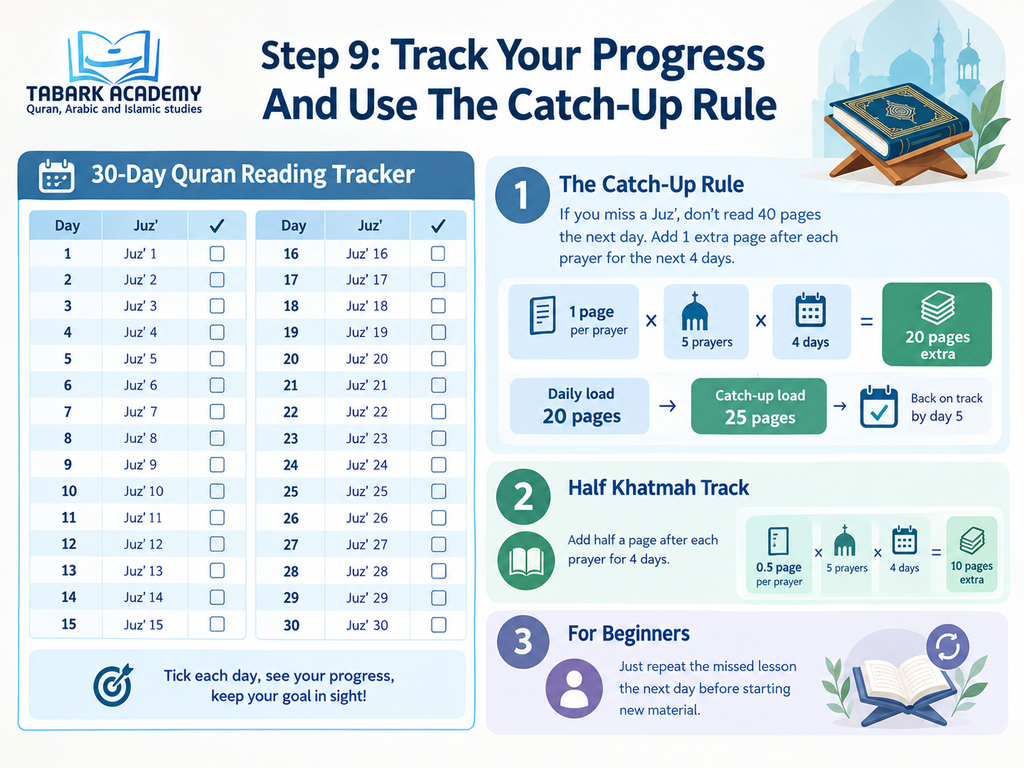
Step 9: Track Your Progress And Use The Catch-Up Rule
Make a 30-row table with the day and its Juz’ number (or lesson number for beginners), and tick each row when you finish it. Missed days become obvious right away, and the growing list of ticks keeps you motivated.
If you miss a Juz’, don’t try to read 40 pages the next day. Add one extra page after each prayer for the next four days instead: 1 page × 5 prayers × 4 days = 20 pages. Your daily load goes from 20 to 25 pages, and you’re back on schedule by day five.
On the half Khatmah track, add half a page after each prayer for four days. Beginners just repeat the missed lesson the next day before starting new material.
Step 10: Read With A Teacher Who Corrects Your Mistakes
A teacher hears the mistakes you can’t hear in your own recitation, and corrects them before they become habits. This is the step that turns a 30-day plan into accurate, lasting reading. These are the most common mistakes a teacher will help you avoid.
A. Reading too fast
Speed without accuracy means letters get dropped and elongations get cut short. The Quran commands measured recitation:
“And recite the Quran with measured recitation (Tarteel)” (Quran 73:4).
B. Ignoring the Madd (elongation)
Flat, rushed recitation usually comes from not holding long vowels for their proper count of two, four, or six beats. Counting the Madd correctly changes how your recitation sounds almost immediately.
C. Confusing similar letters
Pairs like ك / ق, س / ص, د / ض, and ز / ظ change the meaning of words. They need separate drilling with live feedback, which is what the Quran Reading Course at Tabarak Academy provides.
D. Practicing only on weekends
Twenty focused minutes a day is better than two hours once a week. The Prophet ﷺ said the deeds most beloved to Allah are the consistent ones, even if small (Sahih al-Bukhari 6464).
Step Inside Our Virtual Classrooms
See our engaging teaching methods in action! watch real snippets of our live classes and discover how our expert instructors make learning interactive, memorable, and inspiring for every student.
Start Your Quran Learning Journey
Join Tabark Academy today for structured online lessons with qualified tutors, customized to fit your goals.
Book Your Free Trial LessonRead also: How Long Does It Take to Memorize Juz Amma?
Start Your 30-Day Quran Plan With Tabarak Academy Today
A 30-day plan gives you the structure. A qualified teacher makes sure every page you read is read correctly. At Tabarak Academy, teachers match your track: first letters for beginners, fluency and Tajweed for readers who want to finish their Khatmah with confidence.
Our Quran Courses:
- Online Quran Classes for Beginners
- Online Quran Classes for Kids
- Online Quran Classes for Adults
- Online Quran Classes for Men
- Online Quran Classes for Sisters
- Quran Reading Course
- Quran Recitation Course
- Online Ijazah Course
- Online Qirat Course
- Weekend Quran Classes
- Al-Azhar Quran Course
- Zoom Quran Classes
- Noor Al-Bayan Course
Conclusion
To learn to read the Quran in 30 days, start with an honest look at your level and pick the goal that fits it. Beginners spend the month on letters, joining, vowels, and their first short surahs. Readers finish one Juz’ a day, spread across their prayers.
Whichever track you’re on, Steps 7–10 keep you going: a fixed time and place, a reciter to imitate, a tracker with a catch-up rule, and a teacher who corrects your mistakes.
The key takeaway: consistency matters more than intensity. Start small, stay daily, and let Tabarak Academy guide you from your first 30 days toward confident, lifelong reading.
Frequently Asked Questions About Reading The Quran In 30 Days
Here are short answers to the questions beginners and returning readers ask most often before they start a 30-day Quran plan. Use them to settle any doubts and pick your first step.
1. Can a beginner learn to read the Quran in 30 days?
Yes. A beginner can learn to read the Quran in 30 days at a foundation level: all 28 letters, the vowel marks, and short surahs like Al-Fatiha, read slowly. Fluent recitation with Tajweed usually takes several more months with a teacher.
2. How many pages a day to read the Quran in 30 days?
You need about 20 pages a day, which is one Juz’, to read the Quran in 30 days. The easiest split is 4 pages after each of the five daily prayers.
3. Do I need a teacher to learn to read the Quran?
A teacher isn’t strictly required, but it makes a big difference. Similar-sounding letters and Tajweed mistakes are hard to hear in your own recitation, and a teacher corrects them early.
4. How long does it take to read one Juz’ of the Quran?
A steady reader usually finishes one Juz’ in about 30 minutes. At a careful Tarteel pace, it can take 45 minutes or more, and that still fits a 30-day plan.
5. What should I do if I fall behind in my 30-day Quran plan?
If you fall behind, add one extra page after each prayer for the next four days. That covers one missed Juz’ without doubling your reading on a single day.
6. Is it better to read the Quran quickly or slowly?
Slowly and correctly is better, especially at the start. The Quran commands Tarteel, measured recitation (Quran 73:4), and accuracy builds the fluency that speed later depends on.