

What Is Tajweed? A Complete Guide to Quran Recitation Rules
Have you ever listened to a Quran reciter and wondered why their recitation sounds so different from your own? The answer usually comes down to one word: tajweed. So, what is tajweed? Tajweed is the Islamic science of pronouncing the Quran correctly, giving every Arabic letter its proper articulation point and characteristics as the Prophet Muhammad ﷺ recited it.
For non-Arabic-speaking Muslims and international Quran learners, tajweed can feel like a maze of unfamiliar terms makharij, madd, ghunnah, idgham.
This article breaks tajweed down into clear, practical explanations so you understand not just the rules themselves, but why they matter for your recitation and your connection to the Quran.
By the end of this guide, you will understand the meaning of tajweed, its core rules, why scholars consider it essential, and how you can start learning it correctly with proper guidance.
What You Will Learn
- The exact meaning of tajweed in Arabic and in practical recitation terms.
- Why tajweed exists and how it protects the Quran from mispronunciation.
- The main categories of tajweed rules, including makharij, sifaat, noon sakinah, and madd.
- Whether learning tajweed is religiously obligatory for every Muslim.
- The most effective way to learn tajweed correctly, with guided practice.
What Is Tajweed?
Tajweed is the set of Arabic pronunciation rules that governs how each letter of the Quran should be articulated, including its precise articulation point (makhraj) and its inherent and situational characteristics (sifaat).
In simple terms, tajweed means reciting the Quran the way it was revealed to the Prophet Muhammad ﷺ and taught by him to his companions.
Tajweed Meaning in Arabic
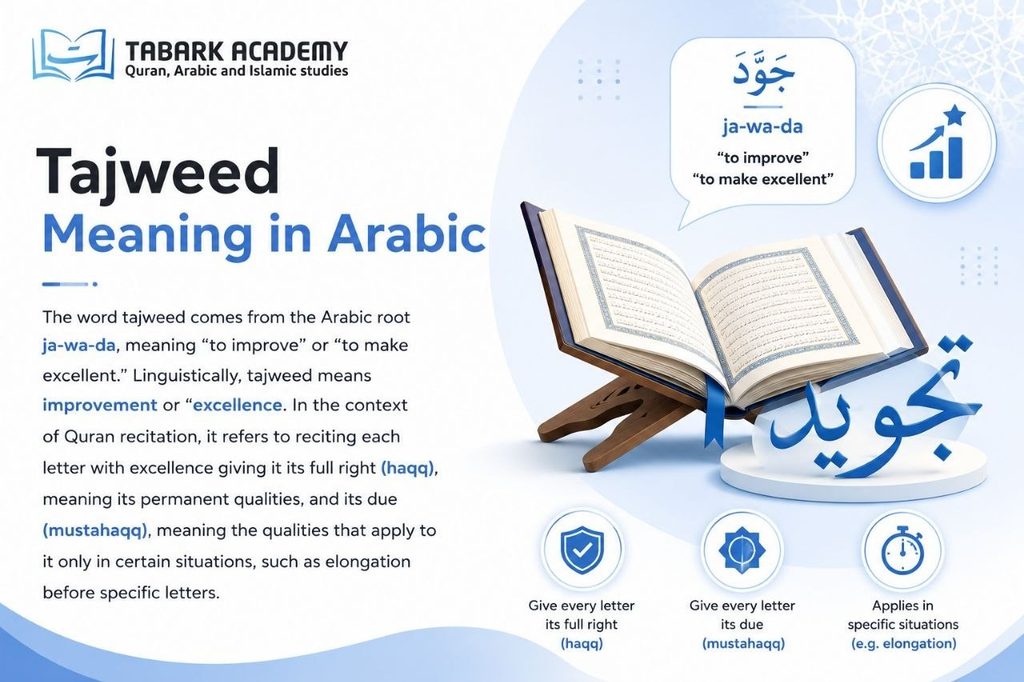
The word tajweed comes from the Arabic root ja-wa-da, meaning “to improve” or “to make excellent.” Linguistically, tajweed means improvement or excellence.
In the context of Quran recitation, it refers to reciting each letter with excellence giving it its full right (haqq), meaning its permanent qualities, and its due (mustahaqq), meaning the qualities that apply to it only in certain situations, such as elongation before specific letters.
Tajweed Explained in Simple Terms
If tajweed feels technical, think of it this way: every language has an accent and a correct way certain sounds should be produced.
Tajweed explained simply is the Quran’s “correct accent” a system that prevents a reciter from blending letters that should stay distinct, shortening sounds that should be elongated, or softening letters that should be pronounced with emphasis.
Without tajweed, a reciter risks changing the sound of a word enough to alter its meaning. This is why tajweed is not treated as an optional style choice but as a discipline tied directly to preserving the accuracy of the Quranic text as it was revealed.
Why Tajweed Is Essential for Preserving Correct Quran Recitation and Meaning
Tajweed matters because the Quran was revealed with a specific oral form, not only a written one. Allah commands measured, deliberate recitation in the Quran itself:
وَرَتِّلِ الْقُرْآنَ تَرْتِيلًا
“And recite the Qur’an with measured recitation.”
Classical scholars, including the companion Ali ibn Abi Talib, explained this verse to mean reciting with correct tajweed and clear, deliberate pauses, not simply reading quickly.
Beyond the religious basis, tajweed protects meaning. Arabic is a language where a single letter’s pronunciation its length, emphasis, or point of articulation can change a word’s meaning entirely. Correct tajweed ensures the reciter preserves the Quran exactly as it has been transmitted, unbroken, from teacher to student for over fourteen centuries.
This is also where structured learning becomes valuable. Many students studying alone from books or apps unintentionally develop habits that are difficult to correct later.
Guided practice with a qualified teacher, such as the live online tajweed classes offered by Tabarak Academy, helps learners catch and correct these mistakes early rather than reinforcing them over years of self-study.
Experience Our Interactive Learning
Curious about how we teach? Watch these brief video clips from our recent live sessions to see our structured curriculum, advanced learning platform, and dynamic student-teacher interactions firsthand.

The Basic Rules of Tajweed
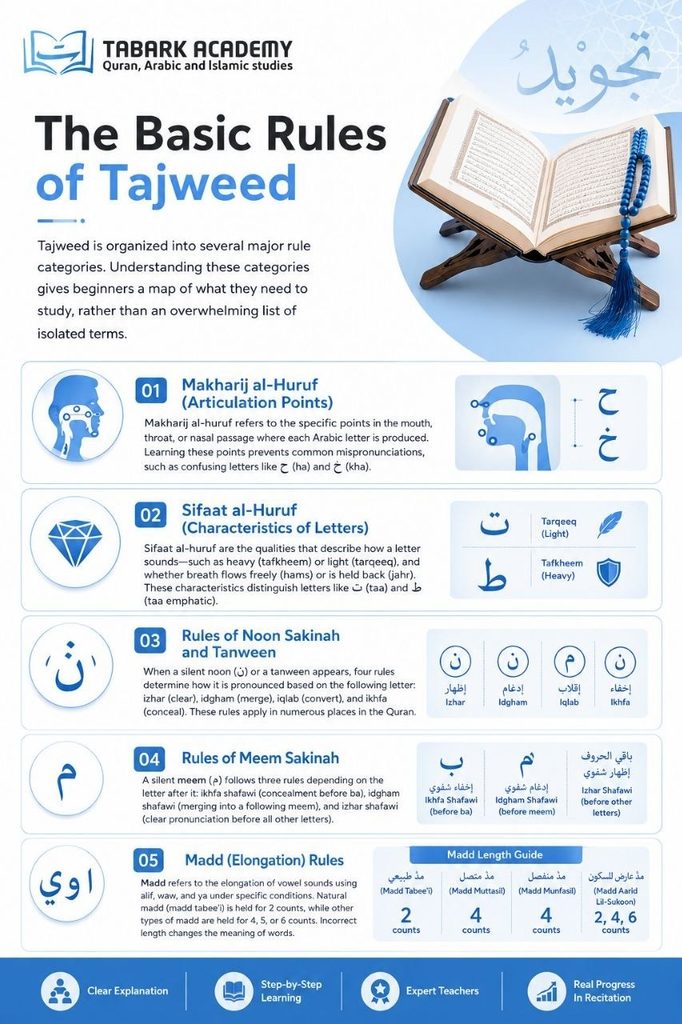
Tajweed is organized into several major rule categories. Understanding these categories gives beginners a map of what they need to study, rather than an overwhelming list of isolated terms.
a. Makharij al-Huruf (Articulation Points)
Makharij al-huruf refers to the specific points in the mouth, throat, or nasal passage where each Arabic letter is produced. Scholars identify five main articulation zones: the throat, the tongue, the lips, the nasal cavity, and the open cavity of the mouth and throat that produces long vowel sounds.
Learning these points prevents common mispronunciations, such as confusing letters that sound similar to an English speaker’s ear but are produced in entirely different places, like the Arabic letters ha (ح) and kha (خ).
Read more about: Basic Tajweed Rules for Beginners: A Step-by-Step Guide
b. Sifaat al-Huruf (Characteristics of Letters)
Sifaat al-huruf are the qualities that describe how a letter sounds once it leaves its articulation point for example, whether it is pronounced with a heavy, emphatic sound (tafkheem) or a light sound (tarqeeq), and whether breath flows freely during pronunciation (hams) or is held back (jahr).
These characteristics distinguish letters that share the same articulation point but sound noticeably different, such as ت (taa) and ط (taa emphatic).
c. Rules of Noon Sakinah and Tanween
When a silent noon (ن) or a tanween appears in the Quran, four rules determine how it is pronounced depending on the letter that follows it: izhar (clear pronunciation), idgham (merging into the next letter), iqlab (converting the sound to a meem), and ikhfa (a partial, nasalized concealment).
These four rules affect an enormous number of words throughout the Quran, making them one of the first topics beginners study.
d. Rules of Meem Sakinah
A silent meem (م) follows three rules depending on the letter after it: ikhfa shafawi (concealment before the letter ba), idgham shafawi (merging into a following meem), and izhar shafawi (clear pronunciation before all other letters).
These rules are narrower in scope than the noon sakinah rules but follow the same underlying logic of adjusting sound based on neighboring letters.
Read also: What Sequence Should You Follow When Learning Tajweed Rules?
e. Madd (Elongation) Rules
Madd refers to the elongation of specific vowel sounds using the letters alif, waw, and ya under defined conditions.
Natural madd (madd tabee’i) is held for two counts, while several types of secondary madd, triggered by a hamzah or a sukoon, are held for four, five, or six counts.
Getting madd length wrong is one of the most common beginner mistakes, since shortening or lengthening a vowel can change a word’s grammatical meaning.
Read more about: Is Applying Tajweed Rules Compulsory for Quran Recitation?
Is Learning Tajweed Obligatory?
cholars distinguish between applying Tajweed correctly in recitation and studying its technical rules in detail. This distinction is important because the ruling is not necessarily the same for both.
Applying Tajweed Correctly While Reciting the Quran
The majority view among classical and contemporary scholars is that reciting the Quran correctly and avoiding pronunciation errors that alter its words or meanings is an individual responsibility for every Muslim who recites it.
One of the primary verses cited in discussions of careful Quran recitation is:
وَرَتِّلِ الْقُرْآنَ تَرْتِيلًا
“And recite the Qur’an with measured recitation.”
A second verse often cited on this point describes those who recite the Book “as it should be recited”:
الَّذِينَ آتَيْنَاهُمُ الْكِتَابَ يَتْلُونَهُ حَقَّ تِلَاوَتِهِ أُولَـٰئِكَ يُؤْمِنُونَ بِهِ
“Those to whom We have given the Book recite it as it should be recited; it is they who believe in it.”
Read also: How to Improve Your Quran Recitation With Easy Tips
Studying Every Theoretical Tajweed Rule Is Not Required From Every Reciter
Learning correct recitation does not necessarily mean memorizing every Tajweed term, classification, and technical rule from a textbook.
Detailed theoretical mastery of Tajweed is generally treated as a communal obligation (Fard Kifayah), meaning that sufficient scholars and qualified teachers should preserve, understand, and teach this knowledge.
A student can therefore learn to pronounce and recite the Quran correctly through Talaqqi — listening to and reciting directly to a qualified teacher — without memorizing the technical name of every rule they apply.
This distinction explains why practical, teacher-guided recitation is so important: knowing Tajweed terminology supports learning, but consistently applying correct pronunciation is what ultimately matters during Quran recitation.

How Can You Learn Tajweed Correctly?
Tajweed cannot be fully learned from books or videos alone, because many of its finer points, such as pauses, breath control, and subtle vowel sounds, require a teacher who can listen and correct you directly.
This method of learning, called talaqqi (direct reception from a teacher), has been the standard way tajweed has been transmitted since the time of the Prophet ﷺ.

How Tabarak Academy Connects Families Worldwide with Quran Teachers
For most non-Arabic speaking learners, the most practical path is one-on-one instruction where a teacher can hear your specific pronunciation habits and adjust their teaching accordingly.
This is the model Tabarak Academy uses in its online Quran and tajweed classes, connecting children, adults, and families worldwide with certified teachers for live, personalized sessions rather than generic pre-recorded lessons.
Adults, and families around the world, taught by certified teachers who correct your recitation in real time and adapt lessons to your pace and schedule.
Real teacher. Real-time correction. Zero cost to start.

Watch a real life at our academy:
Our Tajweed Courses
- Online Tajweed Classes
- Tajweed Course for Beginners
- Tajweed Course for Kids
- Tajweed Course for Adults
- Tajweed Course for Sisters
- Advanced Tajweed Course
- Amali (Practical) Tajweed Course
- Learn Quran with Tajweed
- Learn Quran with Tajweed for Kids
- Learn Quran with Tajweed for Sisters

Conclusion
Tajweed as the Foundation of Correct Quran Recitation
So, what is tajweed? It is the science of reciting the Quran exactly as it was revealed giving each letter its correct articulation point and characteristics through rules like makharij al-huruf, noon sakinah, meem sakinah, and madd.
Applying these rules correctly while reciting is considered an individual obligation on every Muslim, while mastering the full theoretical detail is a communal responsibility fulfilled by qualified teachers and scholars.
Tajweed protects both the sound and the meaning of the Quran, and it is best learned directly from a qualified teacher through consistent, guided practice rather than self-study alone.
Frequently Asked Questions About Tajweed
What does tajweed mean in English?
Tajweed means “improvement” or “making something excellent” in Arabic, and in the context of Quran recitation it refers to pronouncing each letter correctly according to its articulation point and characteristics.
It is the discipline that ensures the Quran is recited the way it was revealed to the Prophet Muhammad ﷺ.
Is tajweed only for Arabic speakers?
No, tajweed applies to every reciter of the Quran regardless of their native language. Non-Arabic speakers often need more structured, teacher-guided practice since Arabic articulation points and sounds may not exist in their first language.
How long does it take to learn tajweed?
The basic rules of tajweed can be introduced within a few months of consistent one-on-one lessons, though refining pronunciation is an ongoing process that continues for years. Progress depends on lesson frequency, prior familiarity with Arabic sounds, and the amount of practice between sessions.
Can I learn tajweed online?
Yes, tajweed can be learned effectively online through live sessions with a qualified teacher who listens to your recitation and corrects it in real time.
This is the format used by platforms such as Tabarak Academy, which pairs students worldwide with certified teachers for one-on-one instruction.
Do I need to memorize all tajweed rules to recite correctly?
No, applying correct pronunciation while reciting is what scholars consider obligatory on every Muslim, not memorizing every technical rule by name.
Learning directly from a teacher through listening and repetition can fulfill this obligation even without full theoretical mastery of tajweed terminology.
What happens if I recite without tajweed?
Reciting without attention to tajweed can change the pronunciation of letters enough to alter a word’s meaning, and classical scholars consider correct application of tajweed rules an individual obligation during recitation.
Many scholars also note that unintentional mistakes made despite genuine effort to learn are treated with leniency, which is why continued learning matters more than perfection from day one.