


How Many Times Should I Repeat A Verse To Memorize It? 9 Practical Methods That Work
The question of how many times should I repeat a verse to memorize it does not have one number that fits every student or every verse.
You read the verse twelve times and still can’t say it from memory. You try twenty. It slips again three days later. This is not a memory problem; it is a method problem.
Your retention speed, the verse length, your Tajweed accuracy, and how your repetitions are structured across time all change the answer significantly.
Students in the UK asking how many times should I repeat a verse to memorise it, and students in the Gulf aiming for intensive Hifz, are asking the same question. The same core answer: the structure of each repetition matters more than the count. These nine methods give you that structure.
How Many Times Should I Repeat a Verse to Memorize It? Why There Is No Fixed Number
Most resources name a number between 10 and 40 and stop there. That oversimplifies what actually happens in memory formation.
Three variables determine your real repetition count: your retention speed, the verse’s length and rhythm, and the mastery level you are targeting.
Traditional Hifz scholars never prescribed a single fixed number. They taught frameworks that responded to each student’s pace and starting point. These two ranges, in brief, reflect what those frameworks consistently produce in practice.
First: beginners should read from the mushaf 10 to 20 times, then recall it 5 to 10 times from memory. Second: advanced hifz students need 60 to 200 total repetitions, spread over multiple days for lasting mastery.
The following are nine structured methods that explain how to repeat, not just how many times.
Discover How Do Students Progress Through Juz Amma Memorization?

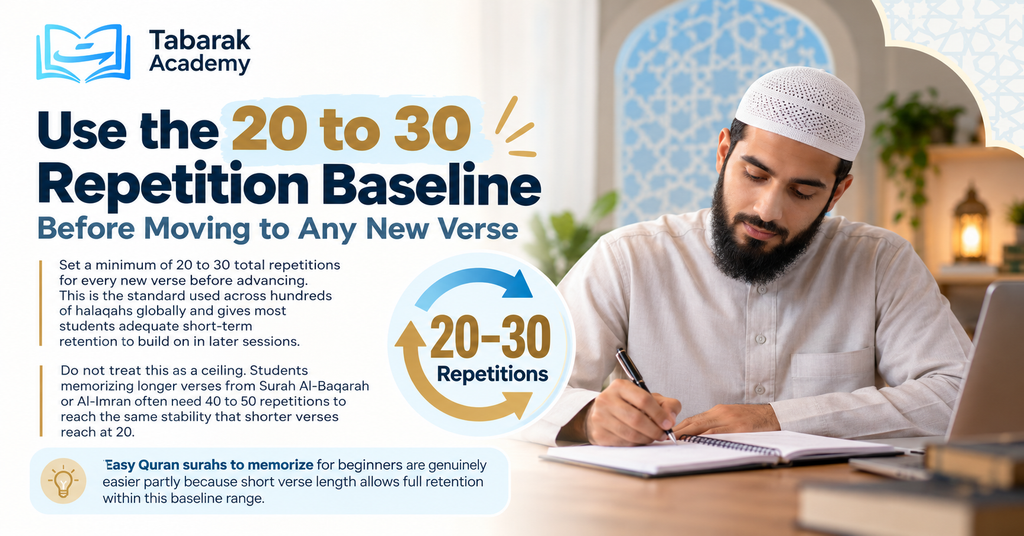
1. Use the 20 to 30 Repetition Baseline Before Moving to Any New Verse
Set a minimum of 20 to 30 total repetitions for every new verse before advancing. This is the standard used across hundreds of halaqahs globally and gives most students adequate short-term retention to build on in later sessions.
Do not treat this as a ceiling. Students memorizing longer verses from Surah Al-Baqarah or Al-Imran often need 40 to 50 repetitions to reach the same stability that shorter verses reach at 20.
Easy Quran surahs to memorize for beginners are genuinely easier partly because short verse length allows full retention within this baseline range.
2. Follow the Halaqah Protocol
Apply the structured method used in traditional institute and mosque settings. Repeat the verse alone five times.
Then connect it to the verse before it and repeat both five times. Then read the full page twenty times. Finally, test yourself from memory ten times without looking.
This totals 40 targeted repetitions per verse, but the quality shifts across each phase. Early reps build recognition; page-level reading builds contextual fluency; off-book testing builds retrieval strength.
Tabarak Academy‘s Hifz curriculum is built around this structured repetition principle, delivered through live online sessions with Ijazah-certified teachers.
Experience Our Interactive Learning
Curious about how we teach? Watch these brief video clips from our recent live sessions to see our structured curriculum, advanced learning platform, and dynamic student-teacher interactions firsthand.
Start Your Quran Learning Journey
Join Tabark Academy today for structured online lessons with qualified tutors, customized to fit your goals.
Book Your Free Trial Lesson3. Apply Spaced Quran Repetition
Spaced repetition means distributing your repetitions across time rather than completing them in one sitting. Cognitive science consistently demonstrates that five repetitions on Day 1, five more on Day 3, and five across the first week produce stronger retention than fifteen repetitions in a single session.
This is the most underused principle in self-directed Hifz practice. Students who stack all repetitions into one session feel productive during that session but find the verse gone by Day 4.
A. Day One: Build Familiarity Through Focused, Slow Reading
On Day 1, read the verse from the mushaf 10 to 12 times slowly, prioritizing Tajweed accuracy over speed. Then attempt it from memory 5 to 7 times, noting exactly where you hesitate or break down.
A daily hifz revision guide structures this format for you so you are not rebuilding your routine from scratch each session.
B. Day Three Onward: Switch from Reading to Pure Recall Practice
On Day 3, do not re-read the verse first. Open with a memory attempt, note where it breaks, then return to the text only for those specific words. This retrieval-first approach is measurably more effective than passive re-reading at the same stage.
A best revision schedule for hifz ensures you schedule these retrieval sessions before the forgetting curve erases what you built.
Check Why Families Choose Tabarak Academy’s Weekend Quran Classes

4. Commit to 60 to 200 Repetitions for Verses
Intensive Hifz schools in Egypt, Saudi Arabia, and the Gulf require a minimum of 60 to 70 repetitions before a verse is considered memorized at the basic level. For quality-grade retention, the requirement rises to 130 to 150.
For mastery, it climbs to 180 to 200 or more. These numbers exist because traditional educators observed that short-term apparent memorization collapses within days if repetitions have not pushed the verse into long-term storage.
Students who reach the 130-plus range rarely need to re-memorize the same verse from scratch. Why do I forget what I memorize of the Quran is almost always answered by an insufficient total repetition count, not by weak memory.
Stay consistent with Quran memorization across weeks to accumulate these totals without burning out on any single session.

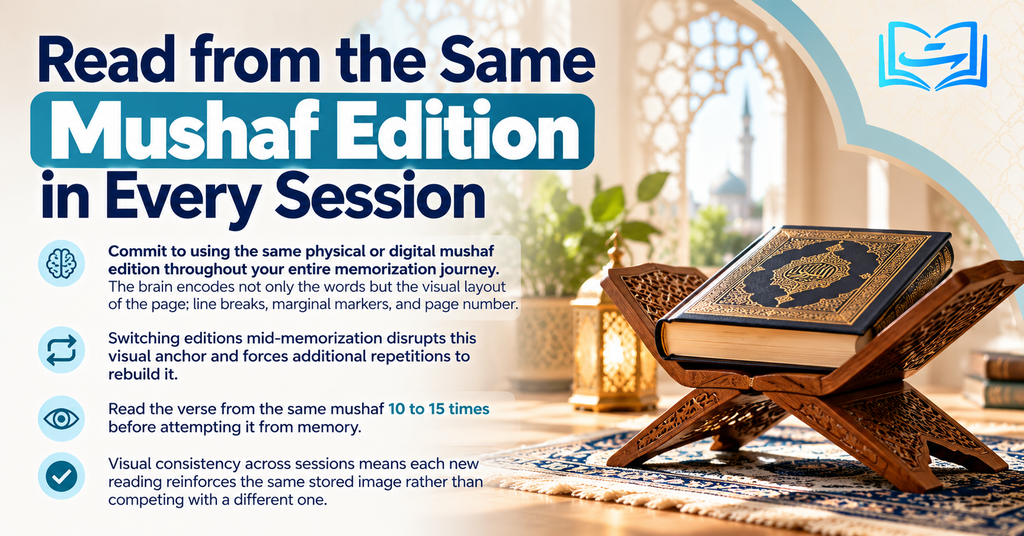
5. Read from the Same Mushaf Edition in Every Session
Commit to using the same physical or digital mushaf edition throughout your entire memorization journey. The brain encodes not only the words but the visual layout of the page: line breaks, marginal markers, and page number.
Switching editions mid-memorization disrupts this visual anchor and forces additional repetitions to rebuild it. Read the verse from the same mushaf 10 to 15 times before attempting it from memory.
Visual consistency across sessions means each new reading reinforces the same stored image rather than competing with a different one. Memorize one page of Quran efficiently relies partly on this visual consistency principle.
6. Write the Verse from Memory by Hand
Write the verse from memory, without looking, then compare what you wrote to the mushaf. Handwriting activates a distinct retrieval pathway and produces significantly stronger encoding than reading the same verse an equivalent number of times. It is qualitatively different from passive repetition.
Students who add written recall to their practice typically reach stable retention in 20 to 25 percent fewer total sessions.
Writing forces complete word-by-word retrieval, which is harder and more effective than passive recognition. This is one of the most efficient ways to memorize Quran by yourself without relying on external prompts at every step.
Begin Hifz for Adults With a Free Trial Now

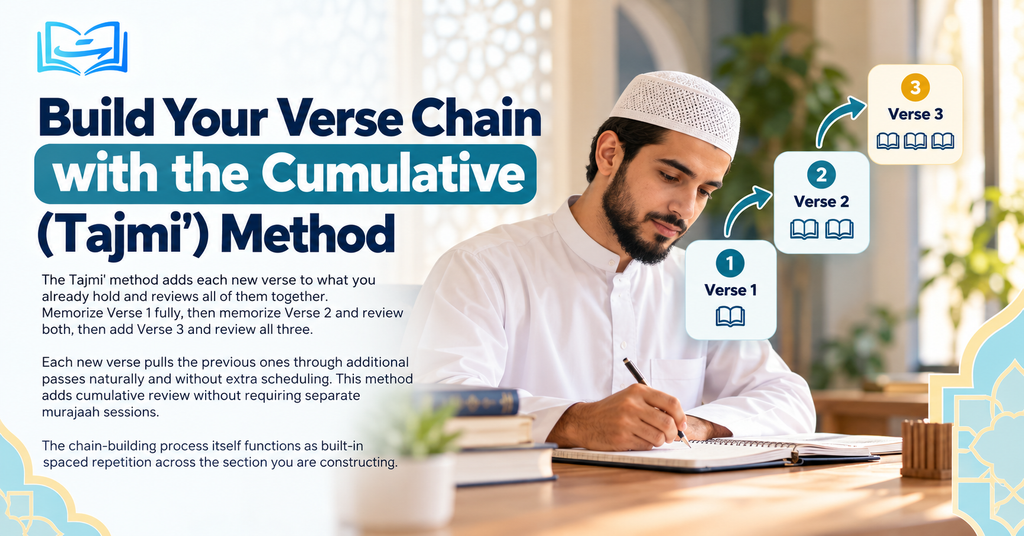
7. Build Your Verse Chain with the Cumulative (Tajmi’) Method
The Tajmi’ method adds each new verse to what you already hold and reviews all of them together. Memorize Verse 1 fully, then memorize Verse 2 and review both, then add Verse 3 and review all three.
Each new verse pulls the previous ones through additional passes naturally and without extra scheduling. This method adds cumulative review without requiring separate murajaah sessions.
The chain-building process itself functions as built-in spaced repetition across the section you are constructing.
How To Memorize The Quran? at a sustainable pace nearly always involves some version of this chain-building approach, whether students name it or not.
8. Recite to a Teacher or Study Partner
Recite every verse you practiced in that session to another person before closing your book. This is the Talqeen and Tasmi’ model used in traditional Hifz circles globally.
Public recitation activates accountability and reveals pronunciation and Tajweed errors that self-testing consistently misses. Students who recite to others make significantly fewer long-term errors than students who rely solely on personal assessment.
The knowledge that you will recite at session’s end also raises the quality of your earlier repetitions within the session itself.
Ijazah certified Quran teachers provide this accountability structure with the added benefit of an authenticated chain of transmission.
9. Track Repetitions with Apps Designed for Quran Memorization
Use a dedicated Quran memorization app to log your repetitions, set daily targets, and schedule automatic revision reminders. Purpose-built apps remove the mental load of counting and scheduling, freeing your attention for the quality of each repetition.
Recommended options include Ayat (King Saud University), Al-Mosaly, Tarteel (AI-powered recitation feedback), Tekrar Quran, and House of Quran.
A. For New Students: Set Up Loop Repetition with Ayat or Al-Mosaly
Both apps allow you to loop a single verse for a defined number of repetitions with audio from a professional reciter. Use this for your mushaf-reading phase.
Hearing the verse between each of your own attempts trains your ear while your eye tracks the text simultaneously. Improve Quran recitation faster when audio and visual input reinforce each other in every single session.
B. For Advanced Students: Use Tarteel or Tekrar Quran for Intelligent, Automated Review
Tarteel detects recitation errors in real time using AI, correcting your Tajweed passively during practice without requiring a teacher to be present.
Tekrar Quran schedules automatic spaced revision based on your personal performance data over time. Both apps transform your repetition count from a manual tally into a structured, evidence-based system.
Students in best online hifz program formats regularly pair these apps with live teacher sessions for maximum accuracy and accountability.

Learn Arabic to Make Every Repetition More Meaningful
Repetition builds memory. Understanding builds retention. A student who knows the meaning of every word in a verse retains it faster and forgets it slower, because the words carry recognized roots and semantic context rather than arbitrary sounds.
How many times you need to repeat a verse to memorise it drops noticeably once you understand Quranic Arabic. Root recognition, familiar grammatical patterns, and semantic context all shorten the repetition path to mastery.
The importance of the Arabic language to Quran memorization is not a side point; it is a direct accelerant to retention.
If I learn Arabic, will I understand the Quran completely from day one? Building real comprehension takes time, but even introductory Quranic Arabic shifts the memorization experience from phonetic repetition to meaningful recall.
Step Inside Our Virtual Classrooms
See our engaging teaching methods in action! watch real snippets of our live classes and discover how our expert instructors make learning interactive, memorable, and inspiring for every student.
Start Your Quran Learning Journey
Join Tabark Academy today for structured online lessons with qualified tutors, customized to fit your goals.
Book Your Free Trial LessonStart Your Hifz Journey with a Teacher Who Corrects Every Repetition
Memorizing without structured guidance often means repeating a mispronounced or slightly incorrect verse hundreds of times.
A qualified teacher catches errors in Tajweed, pronunciation, and verse sequencing before they become embedded habits, ensuring every repetition reinforces the correct version.
Tabarak Academy connects students worldwide with Ijazah-certified teachers for live online Hifz sessions, available seven days a week.
Students across North America, Europe, Southeast Asia, and the Gulf complete structured repetition plans, track measurable progress, and recite to qualified teachers who provide immediate, accurate feedback.
Our Courses:
- Online Quran Memorization Course
- Modern Standard Arabic Online Course (Fusha)
- Online Ijazah Course
- Recitation Of Quran with Tajweed Course
- Intensive Arabic Course
- Tafseer al Quran Course
- Hifz for Kids Course
- Hifz Course for Sisters
Book Your Free Trial Class Today and Learn How Structure Transforms Every Repetition

Conclusion
The most important lesson from these nine methods is not a specific number. Students who repeat 20 times using retrieval practice, spacing, and live correction outperform students who repeat 100 times passively and without structure.
The question of how many times should I repeat a verse to memorize it is really asking: “Am I repeating in a way that builds durable retention?” Use 20 to 30 repetitions as your baseline for new verses.
Apply spaced repetition across multiple days. Push toward 130 to 150 total repetitions for verses you intend to hold for years. Add a teacher or partner for real-time correction.
For students who want to reduce their total repetition count significantly, the answer is Quranic Arabic comprehension. When every word carries meaning, every repetition carries weight.
The Hifz journey requires both a strong method and a meaningful connection to the text, and these nine approaches give you both.
Frequently Asked Questions
How Many Times Should I Repeat a Short Verse Like Al-Kawthar?
Short surahs like Al-Kawthar typically require 20 to 30 repetitions for basic retention. For lasting mastery that holds across months, push to 60 to 80 total repetitions distributed across three to five separate sessions over a week.
Is 20 Repetitions Enough to Memorize a Verse Permanently?
Twenty repetitions establish short-term retention in most students, but they are not sufficient for long-term durability.
Most Hifz educators recommend reaching at least 60 to 70 total repetitions, spread across multiple days, before considering a verse durably held.
Does Reciting a Verse in Salah Count as a Memorization Repetition?
Yes. Reciting a memorized verse in salah counts as a high-quality repetition because it activates recall under natural pressure, reinforces correct pronunciation, and creates a new memory context. Deliberately using memorized sections in your daily prayers accelerates long-term retention.
How Many Times Should I Repeat a Verse If I Keep Forgetting It?
If a verse keeps slipping, the issue is usually insufficient retrieval practice rather than an insufficient total repetition count. Add at least five retrieval-only attempts per day, attempting the verse from memory before consulting the mushaf.
How Do I Know When I Have Repeated a Verse Enough Times to Move Forward?
A verse is memorized well enough to advance when you can recite it correctly from memory three consecutive times without any hesitation, after a gap of at least 30 minutes since your last practice.