

Most people give up on Hifz for one reason: they start too fast. They memorize a page a day for three weeks, forget most of it, and conclude that Quran memorization is not for them.
Learning how to memorize the Quran in 5 years solves that problem. Five years is long enough to let every page settle into long-term memory, and short enough to keep you motivated. It is the pace most working adults, university students, and school-age children can actually sustain.
The Quran has 604 pages in the standard Madinah Mushaf. Spread across five years, that is a portion small enough to finish before breakfast, yet consistent enough to reach a complete Hifz.
In this guide, you will find the exact daily portion, a weekly schedule you can copy, a revision system that stops forgetting, and the five habits that separate students who finish from students who restart.

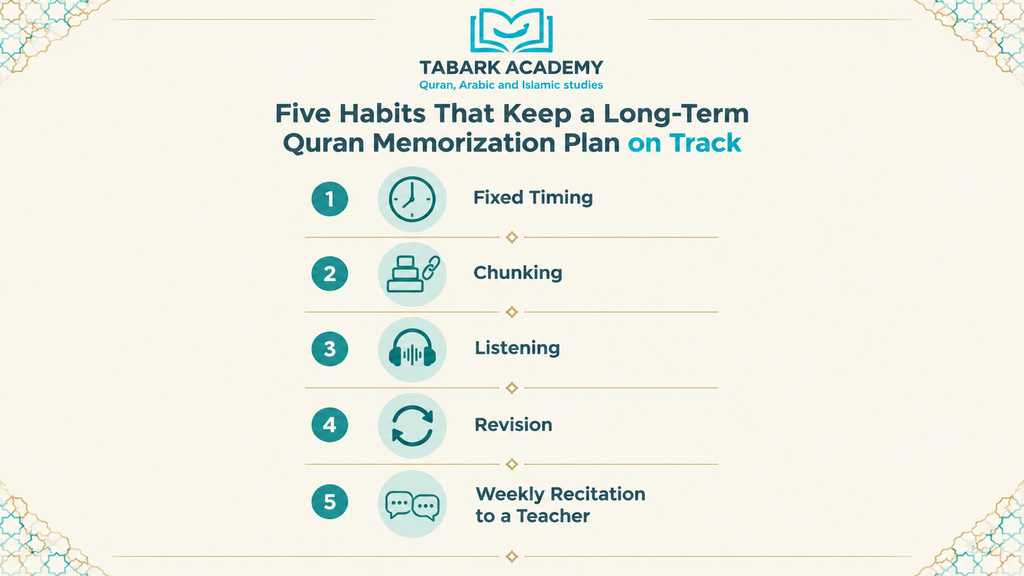
1. Fix One Daily Time And Protect It
A consistent daily routine makes Quran memorization easier to maintain, even when life gets busy. Choose a time that suits your schedule and protect it as an important part of your day.
Morning memorization can help you begin the day with focus and purpose. However, the most effective time is the one you can follow regularly without unnecessary interruptions.
Besides knowing the portion is only half the answer. So, memorize at the same hour every day, ideally after Fajr, when the mind is clearest and interruptions are fewest.
A fixed slot removes daily negotiation. You are no longer deciding whether to memorize, only executing a decision you already made.
Keep the session between 25 and 45 minutes. For children under ten, two short sessions of 15 minutes work better than one long one.
2. Memorize In Small Chunks, Then Link Them
Breaking a page into smaller sections makes each part easier to understand and remember. Focus on mastering a few lines before moving forward, so your memorization develops with confidence.
Linking each new chunk to the previous one helps you maintain the correct order of the verses. This practice strengthens your recall and makes it easier to recite the entire portion smoothly.
So try to break the half page into pieces of two or three lines. Read the first chunk while looking at the Mushaf 10 to 15 times, then recite it from memory 10 times.
Only when the first chunk is effortless do you move to the second. Then recite chunks one and two together 10 times before adding the third.
Finish by reciting the whole portion from memory 15 times without looking. This linking step is what prevents the common problem of knowing the start of a page but blanking at the end.
3. Listen Before And After You Memorize
Listening to a trusted Quran reciter before memorizing introduces you to the correct pronunciation of the verses. It also helps you become familiar with the passage before you begin reciting it yourself.
You can listen to the same portion during a quiet moment in the evening to reinforce your learning. Combine this with active recitation from memory to strengthen your connection with the words.
Choose one reciter and stay with him for the whole five years. Listening to your portion before memorizing it plants the rhythm; listening again at night reinforces it.
Consistency matters more than which reciter you choose. Switching between reciters introduces different pauses and pacing that compete in your memory.
Passive listening supports memorization, but it never replaces active recitation from memory.
Experience Our Interactive Learning
Curious about how we teach? Watch these brief video clips from our recent live sessions to see our structured curriculum, advanced learning platform, and dynamic student-teacher interactions firsthand.
4. Review More Than You Memorize
Revision is an essential part of a successful Hifz routine because it strengthens the portions you have already learned. Giving more time to review than to new memorization helps you build a stronger foundation.
Divide your revision between recent pages and older portions to keep your memorized Quran fresh. A regular review schedule also helps you recognize weak areas and work on them before moving ahead.
Follow a simple ratio: roughly 30% of your session is new memorization and 70% is revision. Revision is not the optional part of Hifz; it is the larger part.
Split your revision into recent and old. Recent means the last seven to ten pages; old means a fixed rotating portion of everything before that.
Once you pass three or four Juz’, recite a set portion of old material daily so that page 1 is reviewed as often as page 300. A structured approach to revising memorized Quran makes this rotation far easier to maintain.
5. Recite To A Qualified Teacher Every Week
A teacher can monitor your progress and help you choose a manageable portion for the following week. This guidance keeps your memorization organized and allows you to adjust your routine when necessary.
Regular recitation to a qualified teacher as well allows you to receive feedback on your pronunciation and Tajweed. It also helps you identify mistakes before they become difficult habits to correct.
Self-study cannot catch the mistakes you do not know you are making, especially if Arabic is not your first language.
A teacher corrects your Makharij before an error hardens, tracks your revision honestly, and adjusts the portion when your life changes.
This is where accountability comes from. Students in one-to-one Hifz classes recite their portion aloud several times a week, which is the single strongest predictor of finishing a long plan.
How to Memorize the Quran in 5 Years
A five-year plan works because it treats Hifz as a slow build rather than a sprint. The daily load is small, the revision load is generous, and the timeline absorbs real life.
Before you start, it helps to understand three things: how much to memorize each day, why this pace protects retention, and what you need in place before your first verse.
Read also: Memorize the Quran in 2 Years: A Practical Plan
What Is The Daily Portion For A Five-Year Plan?
Memorize about half a page, roughly seven to eight lines, on five days each week, and use the remaining two days entirely for revision.
That gives you 2.5 pages per week, or about 130 pages per year. Over five years, that is 650 pages of capacity against 604 pages of Quran.
The extra 46 pages are your safety margin. They cover travel, sickness, exam weeks, and the days when a page simply refuses to stick.
Why Does The Five-Year Pace Protect Retention?
Slower memorization gives the brain time to consolidate. Research on distributed practice shows that spacing repetitions over days produces far stronger recall than massed repetition in a single session.
Fast plans often produce fast forgetting. A student who memorizes a full page daily accumulates a revision debt that becomes impossible to service by the second Juz’.
At half a page a day, your revision always stays larger than your new memorization. That ratio is what turns memorization into Hifz.
What Do You Need Before Your First Verse?
You need three things: a correct recitation, one fixed Mushaf, and a teacher who listens to you regularly. Memorizing before your Tajweed is sound means locking mistakes into muscle memory, and unlearning them later takes years.
Students who build the foundation first with a structured Noorani Qaida course move faster once real memorization begins.
Then choose one 15-line Uthmani Mushaf and never change it. Your memory stores the layout of the page, not only the sound of the words.

The Best Way to Memorize the Quran in 5 Years: Your Weekly Schedule
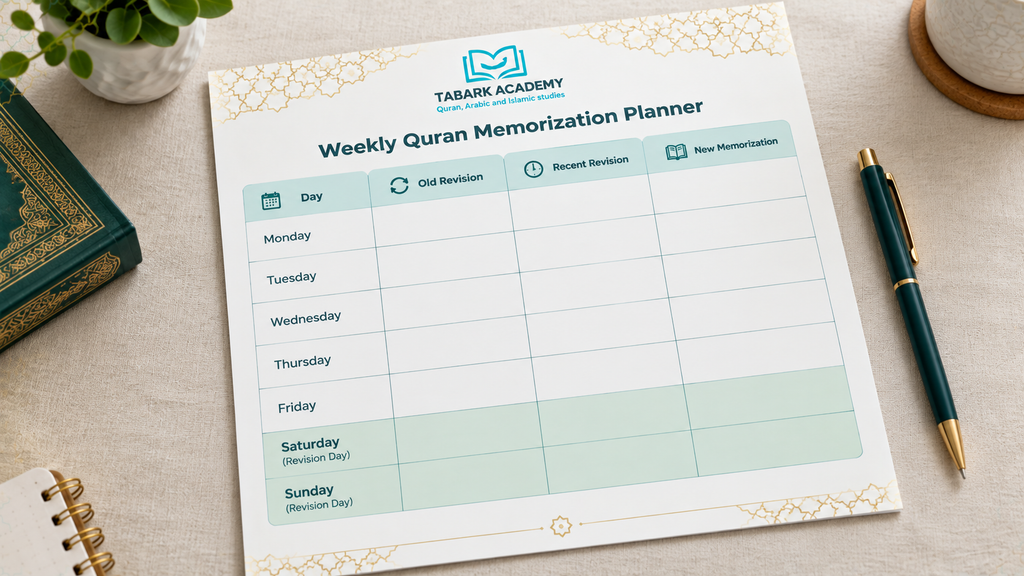
A plan only works when it fits on one page. This is the weekly template used by students on a five-year track, adjustable for both children and adults.
Notice that revision comes first in every session. New memorization is the reward for finishing revision, not the other way round.
Read also: How to Memorize the Quran in 3 Years: Step-by-Step
Sample Weekly Table
The following weekly schedule provides a simple way to organize new memorization and revision throughout your five-year Hifz journey. Use it as a starting point and adjust the portions to suit your age, progress, and daily responsibilities.
| Day | Old revision | Recent revision | New memorization |
| Day 1 | Set portion (½–1 Juz’) | Last 7–10 pages | ½ page |
| Day 2 | Set portion | Last 7–10 pages | ½ page |
| Day 3 | Set portion | Last 7–10 pages | ½ page |
| Day 4 | Set portion | Last 7–10 pages | ½ page |
| Day 5 | Set portion | Last 7–10 pages | ½ page |
| Day 6 | Set portion | Perfect all 2.5 new pages | None |
| Day 7 | Extended revision of weak areas | Recite to teacher | None |
How Do You Adjust This Plan For Young Children?
Reduce the portion, not the consistency. Children aged six to nine do well with three to five lines a day rather than half a page.
Keep the two revision days exactly as they are. A child who memorizes less but revises fully will still finish ahead of one who memorizes more and forgets.
Add meaning early. Children retain verses far better when they understand the story or command behind them, which is why many families pair Hifz with Arabic language lessons.

What Should You Do When You Fall Behind?
Stop adding new pages and spend a full week on revision only. Falling behind is a signal that consolidation has not caught up, not that you need to push harder.
Then restart at half your previous portion for two weeks before returning to normal. The five-year timeline has enough buffer to absorb this twice a year.
The only truly damaging outcome is stopping completely. Continuity beats speed in every long Hifz plan.
Memorize the Quran in 5 Years: 3 Important Tips
Most failed Hifz attempts trace back to the same short list of errors. Each one is easy to prevent and expensive to correct later.
a. Changing Your Mushaf Mid-Journey
Your brain builds a visual map of each page: where a verse sits, where the line breaks, where the page ends. A different print destroys that map instantly.
Buy two identical copies of the same 15-line Uthmani Mushaf at the start, one for home and one for travel.
b. Memorize Before Your Tajweed Is Correct
Every mispronounced letter you memorize becomes a habit you will spend months undoing. Non-Arabic speakers are especially exposed to sounds like ع, ح, ق, and ض.
Correct recitation is the prerequisite, not a later upgrade. Working through Tajweed classes alongside your first Juz’ pays for itself many times over.

c. Ignoring Similar Verses
Keep a dedicated notebook for Mutashabihat. When two passages are nearly identical, write them side by side and circle the difference in red.
Review that notebook weekly. Over five years, it becomes the single most valuable document in your Hifz.
Step Inside Our Virtual Classrooms
See our engaging teaching methods in action! watch real snippets of our live classes and discover how our expert instructors make learning interactive, memorable, and inspiring for every student.
Begin Your Five-Year Hifz Journey With a Teacher Who Keeps You on Track
Tabarak Academy runs one-to-one online Quran classes built for exactly this kind of long-term plan. Your teacher sets your portion, listens to your recitation, and adjusts the pace when school, work, or travel gets in the way.
Our tutors are certified in Tajweed and experienced with non-Arabic speakers, so pronunciation is corrected from the very first session rather than years later. Children, sisters, and working adults each get a schedule that fits their real week.
You can start with a free trial lesson and see how the plan feels before committing to anything. Five years of Hifz begins with one correctly recited page, and that page is easier with someone listening.
Our Quran Memorization / Hifz Courses
- Online Hifz Program
- Juz 30 Memorization Course
- Hifz for Kids Course
- Hifz for Adults Course
- Hifz for Sisters Course
- Short Surah Memorization Course
- Hifz Ijazah Course

Conclusion
Learning how to memorize the Quran in 5 years is less about talent and more about arithmetic and consistency. Half a page on five days a week, with two dedicated revision days, produces 650 pages of capacity against 604 pages of Quran, leaving a realistic buffer for the interruptions every life contains.
The five habits in this guide carry the plan: a fixed daily time, chunking and linking, consistent listening, revision that outweighs new memorization, and weekly recitation to a qualified teacher.
Together, they stop the cycle of memorizing quickly and forgetting just as quickly, which is what ends most Hifz attempts before the second year.
Avoid the three costly mistakes, keep one Mushaf, fix your Tajweed before you build on it, and track your Mutashabihat from day one. Adjust the portion whenever you need to, but protect the continuity at all costs.
Takeaway message: Five years of Hifz is won by the small portion you complete on ordinary days, not by the large portion you attempt on motivated ones.
FAQs
How many pages a day do I need to memorize the Quran in 5 years?
About half a page, or seven to eight lines, on five days each week. That totals 2.5 pages weekly and roughly 130 pages a year, finishing the 604-page Mushaf with a comfortable margin.
Can a child memorize the Quran in 5 years?
Yes, and five years is a well-suited pace for children aged seven and above. Younger children usually memorize three to five lines a day instead of half a page, while keeping the same revision structure.
Is 5 years too slow to memorize the Quran?
No. A slower pace produces stronger retention because each page has time to move into long-term memory. Many students who finish in one or two years lose large portions within months without an intense revision routine.
How much time does a five-year Hifz plan take each day?
Plan for 30 to 45 minutes daily for adults and 15 to 30 minutes for children. Most of that time goes to revision rather than new memorization.
What should I do if I forget a Surah I already memorized?
Return it to your daily revision rotation and recite it every day for two to three weeks until it is stable again. Listening to the same Surah repeatedly between sessions speeds up recovery.
Do I need a teacher, or can I memorize on my own?
A teacher is strongly recommended, especially for non-Arabic speakers. Self-study cannot catch pronunciation errors you are unaware of, and weekly recitation to a listener is the main source of accountability over a five-year plan.




0 Comments