


How To Memorize The Quran In 6 Months? – A Hifz Plan For Kids And Adults
A six-month Quran memorization goal requires more than learning new verses every day. You need a realistic daily routine, a clear revision system, and accurate recitation from the beginning.
This guide explains how to memorize the Quran in 6 months, including the daily page target, a month-by-month roadmap, and a practical schedule for maintaining your Hifz. It also covers how to adjust the plan around school, work, and family responsibilities.
The six-month timeline is an intensive target, not a requirement for every learner. A longer plan can be the right choice when it allows you to preserve what you have memorized and continue learning with confidence.

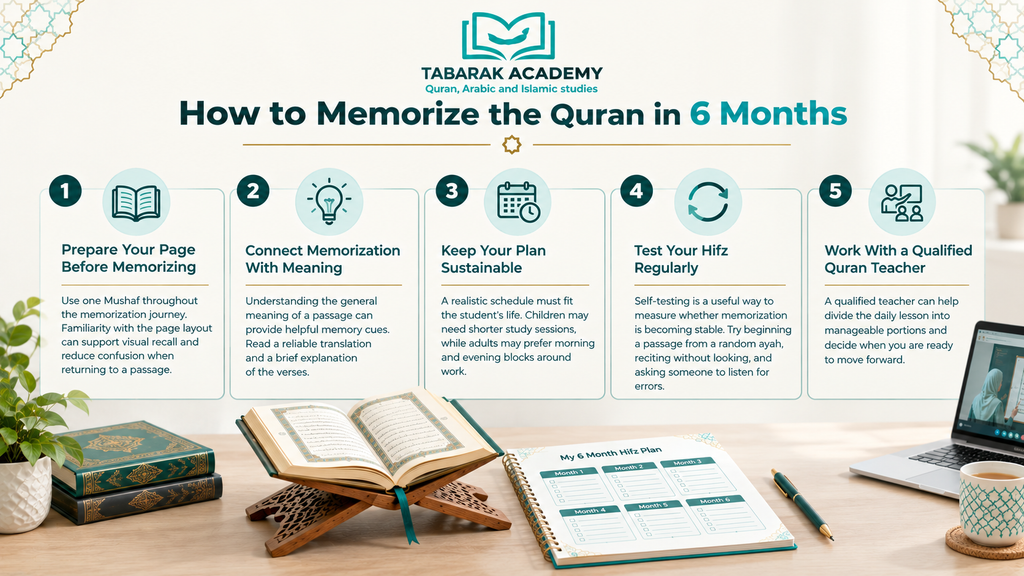
1. Prepare Your Page Before Memorizing
Use one Mushaf throughout the memorization journey. Familiarity with the page layout can support visual recall and reduce confusion when returning to a passage.
Read the new page carefully, listen to an accurate recitation, and identify any Tajweed rules that need attention. If you do not understand the basic pronunciation of a word, correct it before repeating it enough times to memorize.
Then begin with the first ayah and repeat it while looking at the Mushaf until you can recite it without looking. Then learn the next ayah and join it to the first. Continue this process until you can recite the complete page in sequence.
After memorizing, close the Mushaf and test yourself from the beginning. Mark the places where you hesitate, then return to those specific lines instead of repeatedly reading the entire page without identifying the problem.

2. Connect Memorization With Meaning
Understanding the general meaning of a passage can provide helpful memory cues. Read a reliable translation and a brief explanation of the verses, then notice repeated words, themes, and the connection between one ayah and the next.
This does not replace repetition or Tajweed practice. It adds context that can help you remember the order of the verses and understand what you are reciting.
Meaning gives each ayah a clear place in your mind instead of making it feel like a separate group of words. When you understand the message, you can connect the verses through their subject, sequence, and repeated ideas.
Before beginning a new page, identify its main theme and read a short, reliable explanation. You do not need a long tafsir session; a few minutes of focused understanding can make the memorization process more organized and easier to recall.
3. Keep Your Plan Sustainable
A realistic schedule must fit the student’s life. Children may need shorter study sessions and parent-supported routines, while adults may prefer morning and evening blocks around work.
If you miss a day, return to your normal schedule and review what you missed. Avoid doubling the new memorization automatically, since the additional pages can create more revision work later.
When the original six-month target becomes too demanding, extend the timeline. A 12-month or longer plan can still produce meaningful progress and may offer more opportunity to develop accurate, lasting recall.
In addition, it is really important to build flexibility into your routine by keeping one lighter day each week for revision and recovery. This allows you to strengthen difficult passages without feeling pressured to complete the same amount of new memorization every day.
4. Test Your Hifz Regularly
Self-testing is a useful way to measure whether memorization is becoming stable. Try beginning a passage from a random ayah, reciting without looking, and asking someone to listen for errors.
Make self-testing part of your weekly routine rather than waiting until you have memorized a large portion. Short, regular checks help you notice weak verses early and strengthen them before they affect your progress.
You can also record your recitation and compare it with the Mushaf afterward. A teacher’s assessment is particularly helpful for correcting Tajweed and identifying mistakes that you may not notice yourself.
Keep a simple record of the verses that cause hesitation or repeated mistakes. Revisit those passages during your next revision session, giving extra attention to similar verses and difficult transitions between pages.
Step Inside Our Virtual Classrooms
See our engaging teaching methods in action! watch real snippets of our live classes and discover how our expert instructors make learning interactive, memorable, and inspiring for every student.
5. Work With a Qualified Quran Teacher
A qualified teacher can help divide the daily lesson into manageable portions and decide when you are ready to move forward. This prevents you from increasing the number of pages before your previous memorization has become stable.
Your teacher can also organize your Muraja’ah according to your progress. If certain pages contain repeated mistakes, the plan can be adjusted to give those passages more attention before introducing additional material.
The teacher will listen to your recitation, correct pronunciation, and help you decide whether the new lesson is ready. Regular feedback is especially important when learning a large amount of Quran in a short time.
Tabarak Academy provides live, private Quran and Tajweed lessons with Al-Azhar-certified tutors. The Online Quran Classes are available for children and adults, with lesson content adjusted to the learner’s level and schedule.
How to Memorize the Quran in 6 Months: Is It Possible?
Yes. The arithmetic is straightforward, but completing the Quran in six months requires far more than dividing pages across a calendar. The six-month goal is best understood as an intensive memorization target that must be balanced with revision and reliable recitation.
A standard 604-page Mushaf divided by 180 days equals about 3.4 pages per day. This calculation assumes that you maintain your pace throughout the period, so missed days, difficult passages, and time spent revising can make the actual workload higher.
For most children and adults, a longer Hifz timeline may be more practical. The objective is to develop strong, lasting memorization rather than simply finish a page count. A six-month schedule should therefore be treated as a personal plan that can be adjusted as your progress becomes clearer.
Who Is This Plan Suitable For?
The accelerated schedule may suit a student who already reads the Quran fluently, understands basic Tajweed, and can dedicate several focused hours to memorization each day. A learner with previous Hifz experience may also find the pace more manageable.
For children, parents should consider school hours, sleep, homework, and the child’s ability to concentrate. Adults need to account for work, family responsibilities, and the energy available after daily commitments.
If you are still learning Arabic letters, struggling with Makharij, or have very little time for study, start with a foundation course and a more gradual target. Tabarak Academy’s Noorani Qaida and Tajweed Course for Beginners are designed to build accurate Quranic reading before intensive memorization.
Read also: How to Earn an Ijazah in Hafs ‘an ‘Asim Recitation

How to Memorize Quran in 6 Months With a Daily Target
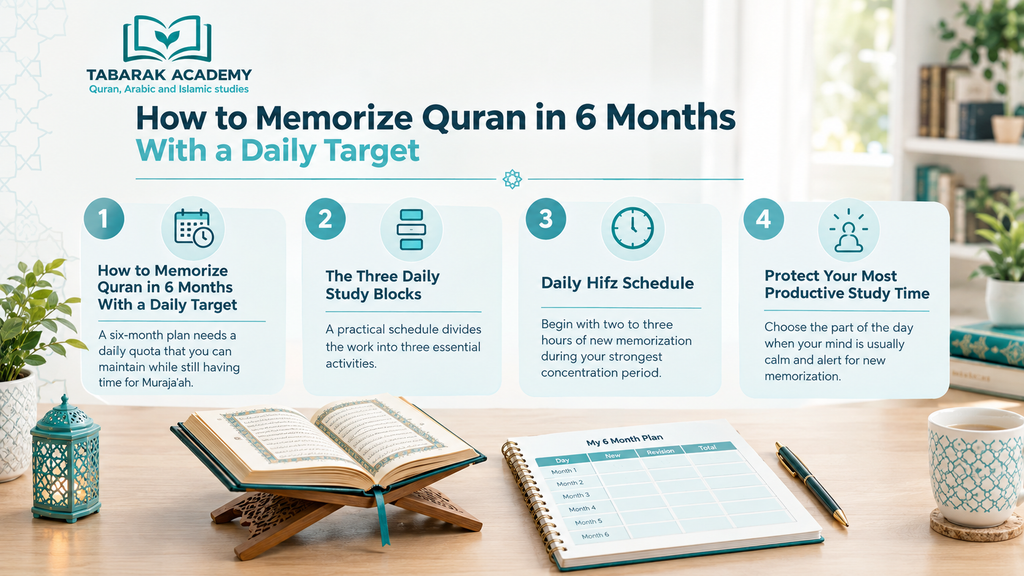
A six-month plan needs a daily quota that you can maintain while still having time for Muraja’ah. The standard calculation provides a useful starting point, but your own pace should be confirmed through practice.
This is an intensive model, not a requirement for every student. If you need more time to correct pronunciation, understand a passage, or repeat a difficult page, reduce the new lesson rather than allowing accuracy to suffer.
The Three Daily Study Blocks
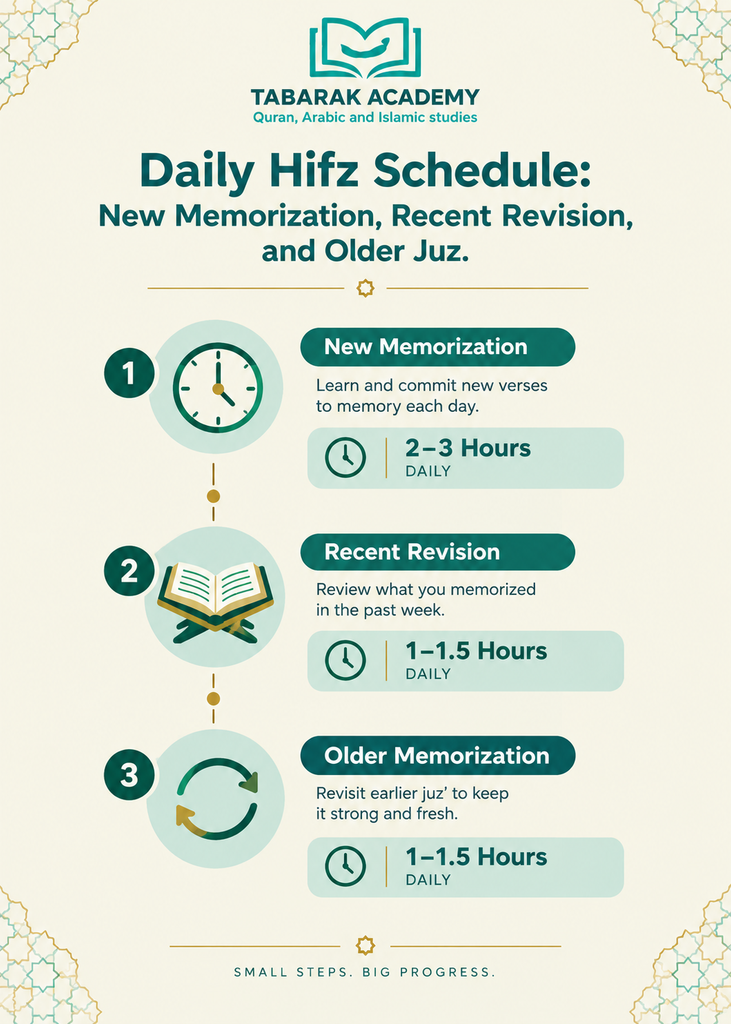
A practical schedule divides the work into three essential activities. The following model can be adapted to your own prayer times and responsibilities.
The three blocks should work together rather than compete with one another. New memorization builds progress, recent revision protects yesterday’s work, and older revision keeps your earlier Juz connected to the rest of your Hifz.
Read also: Is Memorizing the Quran in One Year Possible?
Daily Hifz Schedule
Begin with two to three hours of new memorization during your strongest concentration period. Use this time to read the page, correct Tajweed, repeat each ayah, connect the verses, and recite the complete portion without looking.
Reserve another two to three hours for revision, divided between recent and older memorization. Review yesterday’s lesson and the previous several days first, then recite older Juz according to a rotating schedule; use light listening during breaks or before sleep as additional support.
Protect Your Most Productive Study Time
Choose the part of the day when your mind is usually calm and alert for new memorization. For many students, this may be after Fajr, while others may concentrate better after resting or completing their main responsibilities.
Keep revision for a separate period so that the daily workload feels more manageable. Prepare your Mushaf, notebook, water, and listening materials in advance, and remove unnecessary distractions before beginning each session.
How to Memorise the Quran in 6 Months With a Monthly Roadmap
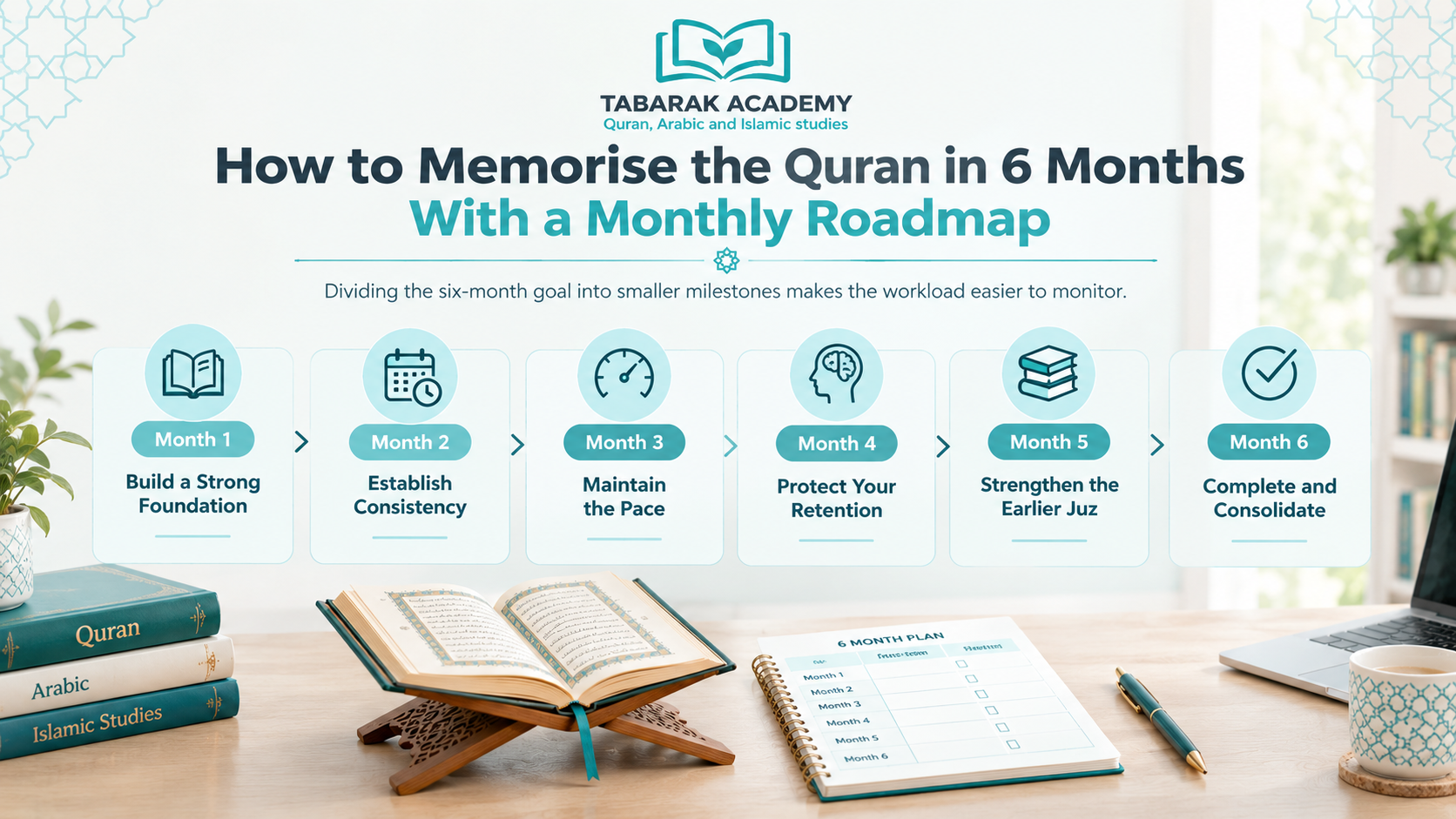
Dividing the six-month goal into smaller milestones makes the workload easier to monitor. The following plan uses approximately five Juz per month as a broad target. Your actual progress may differ depending on page length, revision days, and reading speed.
Month 1: Build a Strong Foundation
Start by establishing your daily routine and correcting any remaining reading or Tajweed problems. Begin with a manageable portion of new memorization and test your ability to maintain the schedule.
If you are a beginner, shorter surahs, like Juz Amma, may help you develop confidence before moving into longer passages. A student who already reads fluently can begin with a sequential Hifz plan after discussing the starting point with a teacher.
Read also : 30 Juz Revision Plan: 7 Tips for One Month

Month 2: Establish Consistency
Increase your memorization only when the previous lessons are stable. Continue reviewing the last seven days and begin a rotating system for older portions.
By this stage, the priority is to make the study routine dependable. Avoid increasing the quota simply because the first few weeks went well.
Month 3: Maintain the Pace
Continue with the planned daily pages and monitor how much time is needed for revision. As your memorized portion grows, older Juz require more attention.
Use your weekly assessment to identify weak passages. A small reduction in new memorization can be useful if it creates enough time to strengthen your earlier work.
Month 4: Protect Your Retention
The middle of the plan is a good time to review your progress honestly. Check whether you can recite previous portions without frequent prompting and whether your daily schedule is sustainable.
If you are falling behind, adjust the target instead of trying to double the next day’s pages. A reliable routine is more useful than an ambitious quota that cannot be maintained.
Read also: Weekend Quran Classes Online for Adults: 2-Day Plan
Month 5: Strengthen the Earlier Juz
Continue learning new material while increasing the attention given to the oldest memorized sections. Practice longer connected recitations so that your Hifz is not limited to isolated pages.
A teacher can help identify similar ayahs and recurring phrases that require extra care. This is also a good time to review the passages you find most difficult.
Month 6: Complete and Consolidate
The final month should balance the remaining new pages with strong revision of the earlier Juz. If the new material is taking longer than expected, allow additional days rather than rushing through it.
Finishing the new memorization is not the end of Hifz. Tathbeet, or consolidation, requires ongoing revision after the six months so that the entire Quran becomes more firmly established in memory.
Read also : Is 100-Day Quran Memorization Possible?
How to Memorize Quran in 6 Months With a Revision Schedule
Revision is the foundation of lasting Hifz. The three-layer approach below helps you organize your daily Muraja’ah without allowing new memorization to replace older lessons.
Layer 1: Review the Most Recent Lessons
Recite today’s new pages and yesterday’s lesson from memory. Continue reviewing the recent portion regularly during the first several days after memorization.
If a page contains repeated mistakes, reduce the new quota until you can recite it accurately. Do not treat a difficult lesson as complete simply because you have read it many times.
Layer 2: Review the Previous Seven to Thirty Days
Set aside a daily period to review the last week of memorization, then gradually include older material from the current month. This helps keep recent lessons connected rather than treating each day as an isolated task.
A weekly review day can be used to recite the week’s pages together. You can also use this day to check whether the daily quota needs to be adjusted.
Layer 3: Review Older Juz
Once a Juz has been memorized, include it in a rotating long-term revision cycle. For example, review one older Juz on some days and more on a weekly review day, depending on your available time.
As the memorized portion grows, the amount of older material will also increase. This is why an intensive six-month plan needs a flexible schedule and continued revision after completion.
Experience Our Interactive Learning
Curious about how we teach? Watch these brief video clips from our recent live sessions to see our structured curriculum, advanced learning platform, and dynamic student-teacher interactions firsthand.
Strengthen Your Hifz With Tabarak Academy’s Quran Classes
Memorizing the Quran in six months requires accurate reading, consistent revision, and guidance from a qualified teacher. Tabarak Academy supports children and adults through private online Quran and Tajweed lessons designed around each learner’s level, pace, and daily responsibilities.
With personalized instruction, students can improve their recitation, correct pronunciation mistakes, and follow a structured memorization and Muraja’ah routine. Flexible lesson times make it easier to continue learning alongside school, work, and family commitments.
Whether you are beginning your Hifz journey or working to strengthen memorized Juz, the right support can help you build steady and lasting progress. Start with an assessment of your current level and discuss a realistic plan with a qualified tutor.
Our Quran Memorization / Hifz Courses
- Online Hifz Program
- Juz 30 Memorization Course
- Hifz for Kids Course
- Hifz for Adults Course
- Hifz for Sisters Course
- Short Surah Memorization Course
- Hifz Ijazah Course
Book your free trial lesson today

Conclusion
Memorizing the Quran in six months is a demanding goal that requires a structured approach to new lessons, daily Muraja’ah, and accurate recitation. The most important step is to begin with a realistic assessment of your reading ability and available time.
A successful Hifz routine does not depend on memorizing the maximum number of pages every day. It depends on maintaining a consistent practice, testing your recall, and giving enough attention to the portions you have already learned.
Takeaway Message: The best way to memorize the Quran in 6 months is to combine a manageable daily quota with regular revision and qualified teacher guidance. If six months is too demanding, extending your plan is a practical way to protect your long-term memorization.
FAQs
Is it possible to memorize the Quran in 6 months?
Yes, it is possible for some students who have strong reading skills, substantial study time, and consistent teacher supervision. The standard 604-page Mushaf requires approximately 3.4 pages of new memorization each day for 180 days, in addition to revision.
How many pages should I memorize per day?
Approximately 3.4 pages daily is the mathematical target for completing 604 pages in six months. However, your practical target should depend on your reading fluency, memorization speed, and ability to retain previous lessons.
Can children memorize the Quran in 6 months?
Some children may be able to follow an intensive Hifz plan, but it depends on their age, reading ability, concentration, and family support. A teacher should assess the child’s level and recommend a schedule that protects school, sleep, and consistent revision.
How many hours a day should I spend memorizing the Quran?
An intensive six-month plan may require several focused hours daily, including new memorization and revision. The total time varies by student, so begin with a realistic trial schedule and adjust it according to your retention and available commitments.
What should I do if I miss a day of memorization?
Return to your routine and review the missed portion before increasing your new quota. Avoid doubling the next day’s lesson automatically, because this can create additional revision pressure and weaken your overall progress.
What is the best way to retain Quran memorization?
Use daily recent revision, regular review of older Juz, and frequent recitation tests. Continue this system after completing the new memorization, since Tathbeet is an ongoing part of maintaining Hifz.
Create a vertical flat-vector infographic titled “Six-Month Quran Memorization Roadmap.” Display six numbered monthly sections arranged in a clear timeline from Month 1 to Month 6, using a Quran icon, calendar icon, and revision icon. Include a simple visual milestone system for the six-month journey, with space for short labels such as Foundation, Consistency, Expansion, Retention, Older Juz, and Consolidation. Use Tabarak Academy’s emerald green #0E5C4A, mint #A8D5C2, warm cream, white, and subtle gold #C9A227. Modern geometric sans-serif typography, flat vector style, generous whitespace, no gradients. Attach the original Tabarak Academy logo at the top. 1000×1400 pixels, professional educational infographic.
Image meta description: Six-month Quran memorization roadmap infographic with monthly milestones and revision planning.
Writing
Create a premium realistic editorial image for an online Quran memorization article. Show a Muslim child and adult learner in separate areas of a bright, modern home study environment, each using a laptop for a private Quran lesson with a qualified teacher. Include a wooden rehal with an open Mushaf, a notebook, and a simple revision planner. Use Tabarak Academy’s brand palette: emerald green #0E5C4A, mint #A8D5C2, cream, white, and subtle gold #C9A227. Natural daylight, warm respectful atmosphere, authentic home setting, realistic photography. Leave generous negative space for article text, no readable Arabic text, no unnecessary objects, no gradients. Add the original Tabarak Academy logo in the upper-left corner. Landscape 1200×800 pixels.
Image meta description: Muslim children and adults studying Quran memorization online with a teacher at home.