


How To Memorize Quran With Tafsir Alongside? – 6 Proven Methods
Can you memorize the Quran while studying its meaning at the same time? Yes—and learning how to memorize the Quran with tafsir alongside can make your memorization more meaningful, organized, and connected to daily life.
Many learners focus heavily on completing a certain number of verses each day, only to realize later that they remember the words but struggle to explain what they mean. A better approach is to combine memorization with a manageable amount of tafsir, reflection, and review.
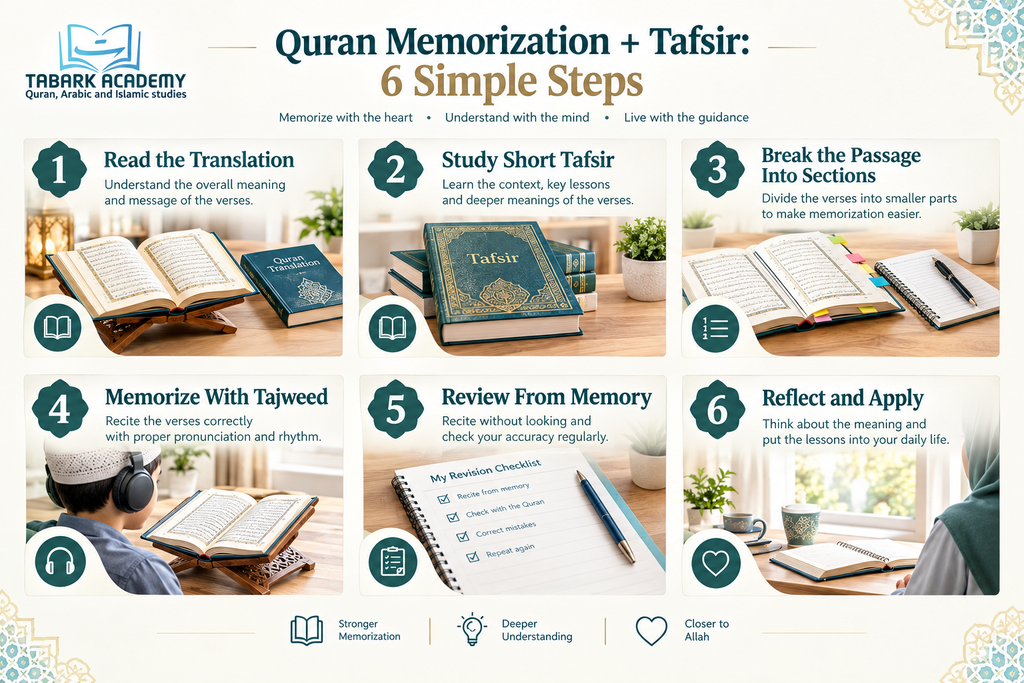
The best way to memorize the Quran with tafsir alongside is to divide your study session into six small stages: read, understand, memorize, recite, review, and reflect.
You do not need to read several pages of detailed commentary before every memorization session. For most beginners, a short and reliable explanation of the verses is enough to understand the general meaning and context.
The Quran itself encourages reflection on its verses. Allah said in Surah Sad 38:29: ‘’ This is˺ a blessed Book which We have revealed to you ˹O Prophet˺ so that they may contemplate its verses, and people of reason may be mindful ’’.
That means the Quran is a blessed Book revealed so that its verses may be contemplated and people may take a reminder from them.
كِتَـٰبٌ أَنزَلْنَـٰهُ إِلَيْكَ مُبَـٰرَكٌۭ لِّيَدَّبَّرُوٓا۟ ءَايَـٰتِهِۦ وَلِيَتَذَكَّرَ أُو۟لُوا۟ ٱلْأَلْبَـٰبِ

1. Read the Translation Before Memorizing
Start with a clear translation of the passage you intend to memorize. Read it slowly and identify the main idea of the verses. Ask simple questions: Who is being addressed? What is happening? Is the passage describing a command, story, warning, promise, or description of Allah’s creation?
This step gives the words a meaningful structure in your mind instead of leaving them as isolated phrases. Reading the translation helps you recognize the connection between each verse and the next.
When you understand the sequence of ideas, the passage becomes easier to follow during memorization. This approach is especially useful for learners who are not fluent in Arabic.
It gives them a meaningful starting point before they begin repeating the Arabic words. So, choose a translation that uses clear language and is suitable for your level of understanding.
Avoid trying to memorize the translation word for word alongside the Arabic text. Instead, focus on understanding the main message and remembering the key ideas. This allows you to concentrate on accurate Quran memorization without feeling overwhelmed.
2. Read a Short, Reliable Tafsir
After reading the translation, consult a concise and trustworthy tafsir. Beginners do not need to study every linguistic, legal, theological, or historical discussion connected to an ayah.
The goal at this stage is to understand the basic meaning, important context, and central lesson. A reliable tafsir can also prevent a common problem: assuming that a personal interpretation is the same as scholarly tafsir.
Besides, a short tafsir can explain unfamiliar words and clarify the relationship between different verses. It may also help you recognize whether a passage discusses worship, guidance, history, or the Hereafter.
This background makes it easier to approach the Arabic text with greater attention. Over time, regular reading can develop your confidence in understanding Quranic messages.
You can keep a small notebook for useful explanations that you discover during your tafsir study. Then write down important meanings, unfamiliar vocabulary, or questions that you want to explore later.
When you review these notes, that can help you remember the main lessons without rereading long explanations. For more complex questions, consult a qualified scholar rather than relying only on personal conclusions.
3. Break the Passage Into Small Sections
Do not feel that you must memorize a complete page before studying its meaning. The correct amount depends on age, reading ability, available time, and previous memorization experience.
For a beginner, three to five verses may be enough for one session. Another learner may comfortably manage half a page or more.
For children, shorter sections can make the process easier to follow. Adults with stronger memorization skills may gradually increase the amount while keeping the tafsir component manageable.
Dividing a passage into smaller sections makes it easier to recognize your daily progress. You can focus on one group of verses without worrying about completing an entire page. This method also leaves enough time for reviewing older memorization and studying the meaning.
A manageable workload helps learners build a steady routine that they can maintain over time. Try to choose sections that form a connected part of the passage whenever possible.
Read also: How to Memorize Quran as an Adult Beginner
4. Memorize After Understanding the Meaning
Once you understand the general meaning, begin memorizing the Arabic text. Read the verses aloud several times while looking at the Mushaf. Then repeat each ayah from memory before connecting it to the next one.
Understanding the message gives you mental landmarks. Instead of remembering only a sequence of sounds, you begin to remember the progression of ideas. This can be especially helpful when two similar verses appear in the same Surah or when a passage contains repeated expressions.
You can listen to a qualified Quran reciter and repeat the passage at a comfortable pace. Pay attention to the pronunciation of each letter, the length of the Madd, and the correct stopping points.
Then recite the verses to the teacher, who can identify mistakes before they become habits. With regular practice, accurate Tajweed can become a natural part of your memorization routine.
Tabarak Academy’s Quran and Tajweed programs use private 1-on-1 instruction to help children and adults develop accurate Quranic reading and apply Tajweed rules directly during recitation.

5. Review the Meaning as You Review the Memorization
Revision should not mean repeating Arabic words mechanically. After reciting the passage from memory, pause briefly and ask yourself what the verses are saying. Can you explain their main message in simple words?
You do not need to reproduce a complete tafsir from memory. The purpose is to keep the meaning connected to the verses you have memorized. This creates a stronger relationship between Hifz, understanding, and Tadabbur.
A useful revision session can include both recitation and a brief review of the passage’s meaning. After completing the Arabic recitation, try to describe the main idea without looking at your notes.
If you cannot remember the explanation, return to the translation or short tafsir for a quick reminder. This keeps your understanding active while you continue strengthening your memorization.
Include meaning-based review alongside your regular Hifz schedule rather than waiting until the end of a Surah. You can ask yourself one question about the passage before moving on to the next section.
For example, consider what guidance the verses offer or how their ideas connect to one another. Small reflection exercises can help maintain your interest and make revision more purposeful.
Read also: Is It Possible To Memorize The Quran Without Knowing Arabic?
6. Connect the Verses to Practical Lessons
After understanding a passage, identify one lesson you can carry into your daily life. For example, if the verses discuss patience, gratitude, repentance, or reliance upon Allah, consider how that message applies to your current behavior.
Also, you can choose one simple lesson from the passage and think about how it relates to your everyday responsibilities. If the verses emphasize patience, consider how you respond to difficulties or disagreements.
If they mention gratitude, reflect on how you appreciate the blessings Allah has given you. These small steps can help transform Quran study into a more meaningful daily practice.
Parents can encourage children to connect what they memorize with positive habits at home. After a lesson, ask the child to share one thing they learned and how they might apply it.
Adults can use the same approach by writing a short reflection after their study session. The aim is to develop a lasting connection with the Quran through understanding, remembrance, and action.
The purpose of learning the Quran is not simply to increase the number of memorized pages. Understanding and acting upon its guidance are important parts of a meaningful relationship with the Quran.
How Much Tafsir Should You Study While Memorizing?
There is no single amount of tafsir that every learner should study. A practical starting point is to spend around 10–20 minutes understanding the meaning and basic explanation of the passage, followed by the main memorization session.
If detailed tafsir causes you to lose focus or prevents you from maintaining your memorization schedule, simplify the process. You can study a concise explanation during the memorization session and return to deeper commentary later.
For serious students of Islamic studies, tafsir can eventually become a structured subject of study in its own right.
For someone primarily working on Hifz, however, the immediate goal is to understand enough of the passage to support memorization and reflection.
Experience Our Interactive Learning
Curious about how we teach? Watch these brief video clips from our recent live sessions to see our structured curriculum, advanced learning platform, and dynamic student-teacher interactions firsthand.
How to Memorize Quran With Tafsir Alongside as a Beginner
Beginners should prioritize consistency rather than quantity. A simple daily routine might took 40- 45 minutes session divided into: 10 minutes reading the Arabic passage and translation. Then take 10-15 minutes to read a concise tafsir and identify the main message.
Another 20- 30 minutes to memorize the selected verses with correct Tajweed. Add 10 minutes to recite the passage without looking and review the meaning. This routine can be shortened for young children and expanded for adults with more available study time.
For children, parents or teachers can benefit from a simpler version of the same method. Instead of giving a child a long tafsir explanation, parents can introduce the basic meaning using age-appropriate language. A short story, question, visual example, or practical lesson can help the child connect the verse to something familiar.
For example, after memorizing verses about gratitude, a parent might ask the child to name three blessings they experienced that day. The objective is to help children build accurate recitation habits while developing a positive and lasting relationship with the Quran.

Should You Memorize First or Study Tafsir First?
You do not necessarily have to choose one. For many learners, the most practical method is to combine both: understand a small passage, memorize it with Tajweed, then review both the words and their meaning.
If detailed tafsir becomes difficult to manage, continue your memorization and return to deeper explanations later. The important point is not to turn the search for perfect understanding into a reason to stop progressing.
A balanced approach allows the learner to build memorization while gradually increasing knowledge. Some students memorize large portions without reviewing their meaning. This may produce memorization progress without the same depth of understanding.
Read also: How To Memorize The Quran With Understanding?
How Quranic Arabic Supports Tafsir and Memorization
Learning Quranic Arabic can make the process even stronger. A learner does not need to become fluent in Arabic before beginning Hifz or tafsir.
However, learning common Quranic vocabulary, root words, basic grammar, and recurring expressions can gradually make verses easier to understand.
When you recognize a word across different Surahs, you begin to see connections that translation alone may not always reveal.
For learners who want to go beyond memorization and develop a stronger understanding of the Quran’s language, structured Quranic Arabic lessons can complement both Hifz and tafsir study.
Tabarak Academy’s Quranic Arabic program covers areas such as Quranic vocabulary, root-word analysis, Nahw, Sarf, and Quranic sentence structures through live instruction.

Step Inside Our Virtual Classrooms
See our engaging teaching methods in action! watch real snippets of our live classes and discover how our expert instructors make learning interactive, memorable, and inspiring for every student.
Improve Your Quran Learning With a Qualified Teacher
A strong Quran routine does not need to be complicated. Your daily plan can combine Hifz, tafsir, Tajweed, revision, and reflection in proportions that fit your level.
For children, this may mean a short memorization lesson followed by a simple explanation. For adults, it may include independent reading of a concise tafsir alongside a private Quran lesson.
If you need help correcting your recitation while memorizing, Tabarak Academy offers structured one-to-one Tajweed and Quran sessions online for children and adults, with qualified tutors and flexible private sessions.
Start building a Quran routine that combines accurate recitation with meaningful understanding, and book your free trial session.
Our Quran Memorization / Hifz Courses
- Online Hifz Program
- Juz 30 Memorization Course
- Hifz for Kids Course
- Hifz for Adults Course
- Hifz for Sisters Course
- Short Surah Memorization Course
- Hifz Ijazah Course

Conclusion
Learning how to memorize the Quran with tafsir alongside does not require studying large volumes of commentary every day.
The most practical approach is to understand a small passage, study a reliable explanation, memorize it carefully with Tajweed, review it regularly, and reflect on its message.
The key takeaway is simple: quality and consistency matter more than rushing through large amounts of memorization without understanding.
Whether you are an adult beginning Hifz or a parent helping a child memorize the Quran, combining memorization with meaning can turn each new passage into more than words to remember. It can become knowledge to understand, reflect upon, and gradually apply.
Read also: How To Memorize The Quran Without A Teacher: 10 Helpful Steps
FAQs
Is it better to memorize the Quran with tafsir?
For many learners, combining memorization with a basic understanding of the meaning is highly beneficial. It helps connect the words to their message and encourages reflection rather than mechanical memorization.
How much tafsir should I read while memorizing the Quran?
Start with a concise and reliable explanation of the verses you are memorizing. You do not need to study detailed commentary during every Hifz session; deeper tafsir can be studied separately as your knowledge develops.
Can children memorize the Quran while learning tafsir?
Yes. Children can learn the basic meaning of the verses using age-appropriate explanations. The explanation should be short, clear, and connected to examples they can understand.
Should I learn Tajweed before memorizing the Quran?
It is best to develop correct recitation while memorizing rather than intentionally memorizing with pronunciation errors and correcting them later. A qualified teacher can help identify and correct mistakes early.
Can I memorize the Quran without understanding Arabic?
Yes. You can memorize the Quran without being fluent in Arabic. However, learning Quranic Arabic gradually can make it easier to understand vocabulary, grammar, and recurring meanings in the verses.
How long should I spend on tafsir each day?
There is no fixed requirement. A beginner may start with around 10–20 minutes of basic explanation before memorization, then adjust the time according to their level, schedule, and memorization goals.