


How To Memorize The Quran With Understanding?
Have you ever memorized a Quranic passage perfectly, only to forget it a few days later because you never understood what you were reciting? Learning the Quran by heart becomes more meaningful and easier to retain when memorization is connected to understanding.
Learning how to memorize the Quran with understanding means combining repetition with meaning, Quranic vocabulary, reflection, correct recitation, and consistent revision.
Instead of treating memorization as simply remembering Arabic words, you build connections between the verses, their meanings, and the message of the surah.
In this guide, you will learn practical methods for memorizing the Quran with understanding, whether you are a beginner, an adult learner, a parent helping a child, or a student working toward Hifz.

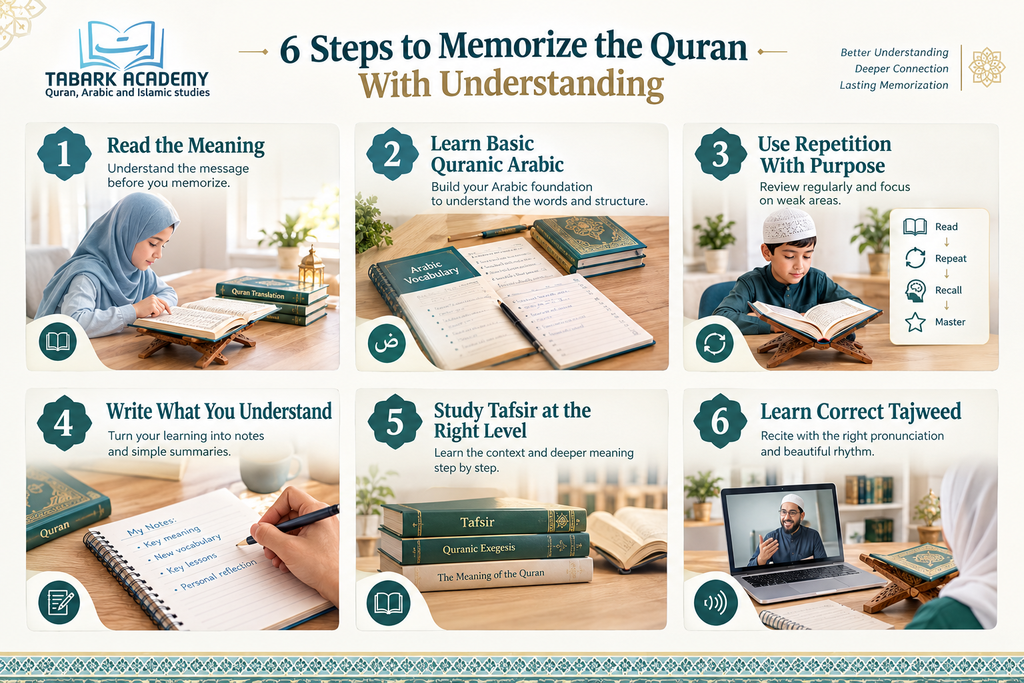
1. Read the Meaning Before You Memorize
Reciting Arabic words without understanding their basic message can make verses harder to connect and recall. Before beginning a new section, read the translation carefully. Try to understand who is being addressed, what is happening, and how the verses connect.
For beginners, memorizing a small number of verses with understanding is often more useful than rushing through a large daily portion without knowing its meaning.
You can also listen to a reliable recitation while following the Arabic text. Resources such as Quran.com provide translations, recitations, word-by-word tools, and Tafsir resources that can support this stage.
A useful routine can combine reading the Arabic passage, reading its translation, and identifying the main idea. Thus, you can listen to the recitation, recite while looking at the Mushaf, and then recite again without looking. This creates several memory connections instead of relying on repetition alone.
When you know what a passage is discussing, individual verses become easier to place within the larger message. You may remember a verse by recalling the idea that comes before it or the lesson that follows it.
2. Learn Basic Quranic Arabic
One of the best ways to memorize the Quran with understanding is to gradually learn the Arabic language of the Quran. You do not need to become fluent in Arabic before starting Hifz.
Learning common Quranic vocabulary, basic grammar, and word patterns can gradually make memorization easier. For example, when you repeatedly recognize the meaning of words appearing throughout different surahs, new verses become less unfamiliar.
You begin to recognize patterns rather than seeing every verse as a completely new sequence of sounds. This is particularly useful for non-Arabic speakers because understanding Arabic can reduce the distance between memorizing the words and understanding the message.
You can begin with a small group of frequently repeated Quranic words rather than trying to learn hundreds of terms at once. As your vocabulary grows, you will start recognizing familiar words when you encounter new verses.
If you want to understand the Quran while improving your Arabic foundation, a structured Quranic Arabic course can help learners build this skill progressively instead of trying to learn vocabulary randomly.

3. Use Repetition With a Purpose
New memorization should never completely replace Muraja’ah. Previously memorized Quran needs regular attention. Repetition is essential for Hifz, but repeating words without paying attention can lead to mechanical memorization.
Instead, divide your repetition into stages. First, look at the Mushaf and recite the passage several times. Then close the Mushaf and test yourself. You can use a simple pattern such as:
- Read and listen carefully.
- Recite while looking.
- Recite from memory.
- Check your mistakes.
- Repeat the difficult section.
- Connect the new passage with the previous one.
The exact number of repetitions does not need to be identical for every learner. Children, adults, beginners, and advanced students have different learning speeds. The goal is accurate recall, not simply reaching a predetermined repetition number.
Purposeful repetition also means paying attention to where you make mistakes instead of repeating the entire passage every time. If one phrase is difficult, isolate it, correct it, and connect it back to the surrounding verses.
You can also vary your practice by listening, reciting aloud, and testing yourself without looking. This makes each repetition an opportunity to strengthen accuracy, recall, and confidence.
4. Write Down What You Understand
Writing can turn passive reading into active learning. After reading the translation or Tafsir, write a few keywords or short notes explaining what you understood from the passage. You do not need to write a long explanation.
For example, your notes might identify the main subject of the passage, a key command or warning, an important event, repeated vocabulary, or the connection between two verses.
Then try to recite the verses while remembering those ideas. This creates an association between the Arabic wording and its meaning, giving your memory more than one pathway for recalling the passage.
Your notes can be as simple as three or four keywords that remind you of the meaning of the passage. For a child, these could be simple words or short sentences; for an adult, they might include vocabulary and key lessons.
The important point is to process the meaning in your own mind rather than simply copying an explanation. This can make the memorization session more active and help you identify what you truly understand.
Read also: How To Memorize The Quran Without A Teacher: 10 Helpful Steps
Experience Our Interactive Learning
Curious about how we teach? Watch these brief video clips from our recent live sessions to see our structured curriculum, advanced learning platform, and dynamic student-teacher interactions firsthand.
5. Study Tafsir at the Right Level
Translation gives you an overview of meaning, while Tafsir can provide additional context and explanation. However, beginners should avoid overwhelming themselves with complicated explanations. Start with a reliable, accessible Tafsir and focus on understanding the main message.
Quran.com, for example, provides access to multiple Tafsir works and learning resources, making it possible to explore the meaning of verses beyond a simple translation.
Understanding the context can also help explain why certain verses follow one another and make difficult passages easier to remember.
The purpose of Tafsir during memorization is to support understanding rather than turn every Hifz session into an extended research lesson. Focus first on the central message, important context, and meanings that directly help you understand the verses.
If a passage contains unfamiliar concepts, take a few extra minutes to study them before returning to memorization. Keeping this balance allows Tafsir to strengthen your Hifz without making the learning process unnecessarily complicated.
6. Learn Correct Tajweed Before Building Bad Habits
Understanding the meaning is important, but accurate pronunciation should develop alongside memorization. A student who repeatedly memorizes an incorrectly pronounced verse may find it difficult to correct the mistake later.
This is why listening to a qualified reciter and receiving feedback from a knowledgeable Quran teacher can be valuable. Tajweed helps learners pay attention to Makharij, letter characteristics, Madd, Ghunnah, Noon and Meem rules, and other aspects of correct Quranic recitation.
For children especially, early correction can prevent small pronunciation mistakes from becoming established habits.
If you are memorizing independently but are unsure whether your pronunciation and Tajweed are correct, regular one-to-one Quran sessions can provide the feedback that self-study cannot always provide.
Correcting an error early is usually easier than trying to change a pronunciation pattern after it has been repeated for weeks or months. A teacher can listen carefully and point out details that may be difficult for a learner to notice independently.
Read also: How To Memorize Quran With Tafsir Alongside? – 6 Proven Methods
How to Memorise Quran With Understanding as a Family
Parents can make Quran memorization more effective by helping children connect their lessons with meaning rather than turning every session into a test. Ask simple questions about the passage. What is the verse talking about? Who is being mentioned? What lesson does the child remember?
For younger children, pictures, stories, repetition, listening activities, and short explanations can make the learning experience more engaging.
Adults can use a similar principle but adapt it to their goals. A busy adult may benefit from shorter daily sessions, audio revision during suitable parts of the day, and a teacher who provides accountability.
An online Quran program for a kid can make this easier by giving a regular lesson schedule, qualified feedback, and a clear learning path instead of leaving the learner to organize everything alone.

Build a Quran Memorization Routine With the Right Support
The best way to memorize the Quran with understanding is not based on one magic technique. It is a combination of meaningful study, correct recitation, repetition, Arabic learning, writing, and consistent revision.
For children and adults, individual needs can vary considerably. Some learners need help with Arabic pronunciation, while others need stronger revision habits or more explanation of the verses they are memorizing.
Tabarak Academy provides online Quran, Tajweed, memorization, and Arabic learning for learners of different ages and levels. Its one-to-one lessons can be adapted to the student’s current ability, learning pace, and goals.
Read also: Is It Possible To Memorize The Quran Without Knowing Arabic?
Step Inside Our Virtual Classrooms
See our engaging teaching methods in action! watch real snippets of our live classes and discover how our expert instructors make learning interactive, memorable, and inspiring for every student.
Start Your Quran Learning Journey With Personalized Support
If you want to memorize the Quran while developing stronger recitation and understanding, start with a structured learning plan that matches your current level.
A qualified tutor can listen to your recitation, identify pronunciation and Tajweed issues, help organize your memorization and revision, and explain difficult parts of the lesson.
Tabarak Academy offers private online Quran and Tajweed classes, as well as Arabic and Quranic Arabic programs, helping learners build their Quran journey through consistent guidance.
Book your free trial lesson and see the difference
Our Quran Memorization / Hifz Courses
- Online Hifz Program
- Juz 30 Memorization Course
- Hifz for Kids Course
- Hifz for Adults Course
- Hifz for Sisters Course
- Short Surah Memorization Course
- Hifz Ijazah Course

Conclusion
Learning how to memorize the Quran with understanding requires more than repeating verses until they can be recalled. The strongest approach combines understanding the meaning, learning useful Quranic Arabic, listening and reciting accurately, using repetition intelligently, writing key ideas, and maintaining regular revision.
The main takeaway is simply: memorize with meaning, recite with accuracy, and revise consistently.
Whether you are helping a child begin Hifz or working toward your own memorization goal as an adult, progress does not have to be rushed. A consistent routine supported by qualified instruction can make the journey more organized, sustainable, and meaningful.
FAQs
What is the best way to memorize Quran with understanding?
Start by reading the translation and understanding the main message before memorizing. Then combine listening, accurate recitation, repetition, Quranic vocabulary, and regular revision.
Should I understand the Quran before memorizing it?
Understanding the basic meaning before memorization can make verses easier to connect and recall. You do not need complete knowledge of Arabic or Tafsir before starting Hifz.
Can I memorize the Quran without knowing Arabic?
Yes. Many non-Arabic speakers memorize the Quran successfully. However, learning Quranic Arabic gradually can improve understanding and help you recognize recurring vocabulary and grammatical patterns.
How much Quran should I memorize each day?
There is no single amount that works for everyone. A small, consistent portion that you can accurately memorize and revise is generally more sustainable than a large amount that you cannot retain.
How can children memorize Quran with understanding?
Children can benefit from short lessons, repetition, simple explanations, listening practice, visual materials, and age-appropriate questions about the meaning of the verses.
Why is revision important after memorizing the Quran?
Regular revision strengthens recall and helps prevent previously memorized passages from being forgotten. Hifz should therefore include a consistent Muraja’ah routine alongside new memorization.