


Is It Possible To Memorize The Quran Without Knowing Arabic?
Can you memorize the Quran if you cannot understand Arabic? Yes, it is possible to memorize the Quran without knowing Arabic. Many Muslims begin Hifz while Arabic is still unfamiliar to them.
You do not need to become fluent in Arabic before starting. What you need first is the ability to read the Arabic script correctly, pronounce the Quranic letters accurately, follow basic Tajweed, and build a consistent memorization and revision routine.
In this guide, you will learn whether it is possible to memorize the Quran without knowing Arabic, how Arabic knowledge can help Hifz, what a non-Arabic speaker actually needs to learn, and how children and adults in Canada can begin with a practical step-by-step approach.
What You Will Learn
- You can memorize the Quran without speaking or understanding Arabic fluently.
- Correct Arabic reading and Tajweed are more important prerequisites than conversational Arabic.
- Understanding the meaning through a reliable translation can make memorization easier.
- Consistent repetition, listening, revision, and teacher correction are essential for long-term Hifz.
- Learning Quranic Arabic alongside memorization can deepen understanding without delaying your Hifz journey.
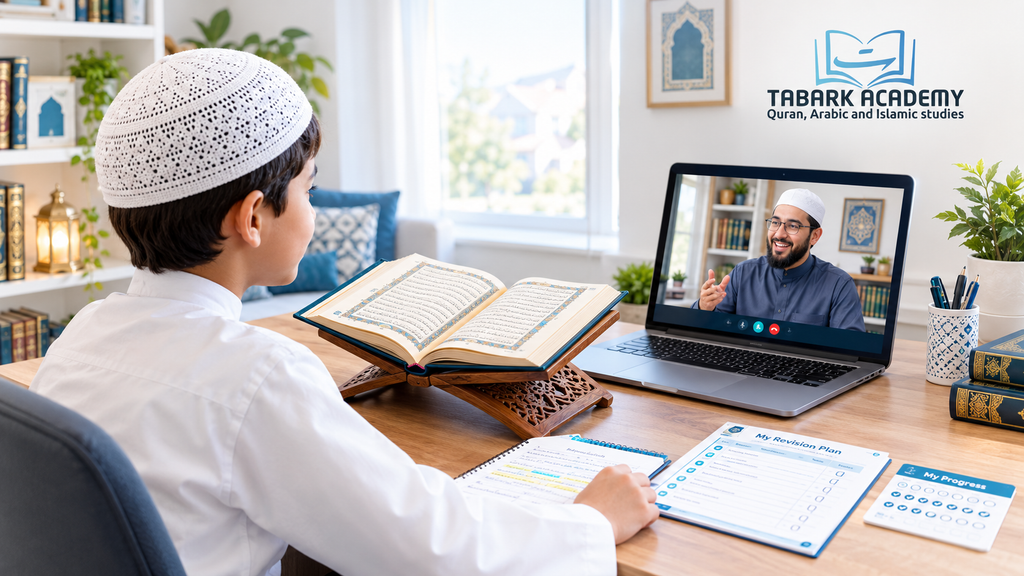
Is It Possible to Memorize the Quran Without Knowing Arabic?
Yes, you can memorize the Quran without knowing Arabic. You do not need conversational Arabic or complete knowledge of Arabic grammar before beginning Hifz.
The key distinction is between memorizing the Arabic Quran and understanding every word of it. A learner can accurately memorize the sounds and sequence of verses while gradually developing an understanding of their meanings.
For a beginner, the priority should be reading the Arabic script accurately. This includes recognizing letters, understanding vowel marks, and producing the correct sounds.
What Arabic Knowledge Actually Helps With Hifz?
Knowing Arabic can make memorization easier because meaning gives your memory additional cues. When you understand the subject of a verse, its vocabulary and sentence structure can help you remember what comes next.
However, Arabic fluency is not a requirement for starting. A learner can use a reliable English translation or brief Tafsir explanation to understand the general meaning of each passage while continuing to develop Quranic Arabic.
The Quran itself describes its revelation as an Arabic Quran, emphasizing the importance of its original Arabic form.
This means a non-Arabic speaker should aim to learn how to read and recite the Arabic Quran correctly, even if full Arabic language study comes later.
Is It Better to Learn Arabic Before Hifz?
Not necessarily. For some students, learning Arabic alongside Hifz is more practical than postponing memorization until they become fluent. A beginner can learn common Quranic vocabulary gradually while memorizing short Surahs.
This approach prevents a common problem: spending years preparing to begin instead of actually beginning.
For families, this can be particularly useful when children or adults have limited study time because of school, work, and family responsibilities.
How to Memorize the Quran Without Knowing Arabic
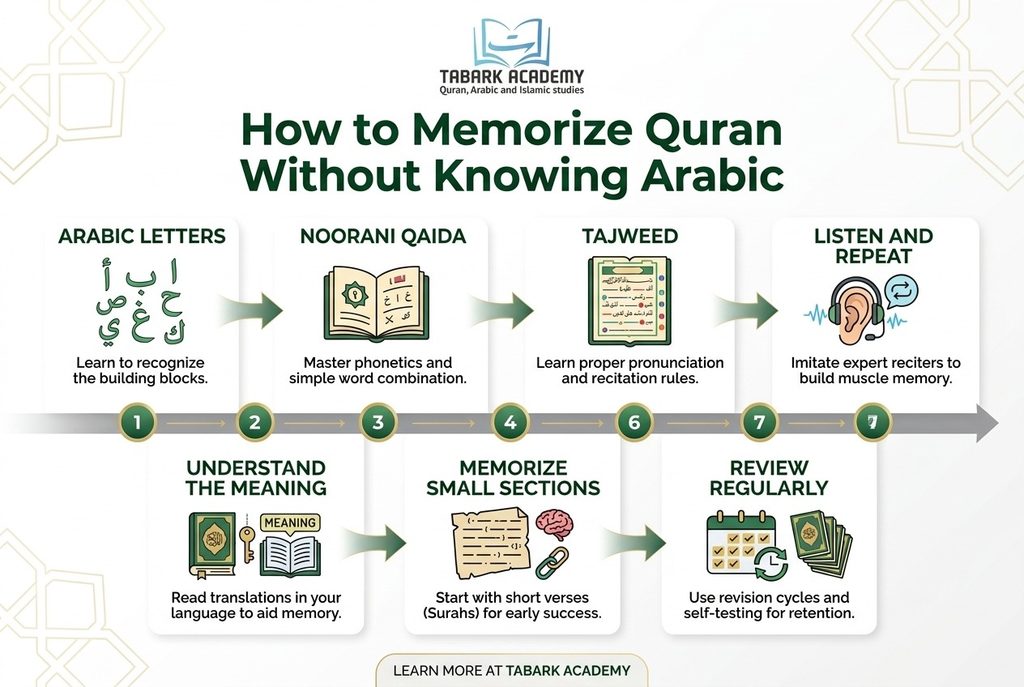
The most effective approach is to separate the skills into manageable stages. You do not need to master everything at once.
1. Learn to Read Arabic Correctly
Before serious memorization begins, make sure you can recognize Arabic letters and read connected Quranic words.
A beginner who struggles with letters, Harakat, Sukoon, Shaddah, or letter connections may memorize incorrect pronunciation. These errors can become difficult to correct later. A structured beginner program such as Noorani Qaida can provide a useful foundation.
2. Learn Basic Tajweed From the Beginning
Tajweed should not be treated as something you study only after completing Hifz. Start with practical areas such as Makharij, Ghunnah, Qalqalah, Madd, Noon Sakinah, Meem Sakinah, and basic Waqf.
The goal is not to memorize a long list of theoretical definitions. The goal is to apply correct pronunciation while reciting and memorizing. This is one reason guided Quran lessons can be valuable.
Tabarak Academy’s Quran and Tajweed curriculum takes learners from Arabic letter recognition toward Quranic reading while applying foundational Tajweed in live recitation practice.
3. Start With Short Surahs
A non-Arabic speaker should not feel pressured to begin with long passages. Short Surahs from Juz Amma provide manageable memorization units and allow learners to experience progress quickly.
Surahs such as Al-Ikhlas, Al-Falaq, An-Nas, and Al-Kawthar can provide useful early milestones.
For children, short memorization targets can also make lessons easier to manage around school schedules.
4. Listen Before and During Memorization
Listening to accurate Quran recitation gives your brain a reliable sound model. Choose a clear reciter and listen to the same passage repeatedly. Then recite along with the recording before trying to recite independently.
A simple routine that includes listening, reading, repeating, reciting from memory, correcting, and reviewing can help you while memorizaion.
This approach is especially useful when the language is unfamiliar because the learner becomes familiar with the rhythm and pronunciation before attempting independent recall.
5. Understand the General Meaning
You do not need to understand every Arabic grammatical detail before memorizing a verse. However, knowing what a passage generally means can provide another memory cue.
Read a trustworthy English translation before or after your memorization session and identify the main message of the verses.
Translations are useful for understanding, but they should not be treated as replacements for the Arabic Quran. Egypt’s Dar Al-Ifta explains that translations convey the meanings of the Quran rather than becoming the Quran itself.
6. Memorize Small Sections
Avoid trying to memorize an entire page in one sitting if the language is unfamiliar. Instead, divide the passage into one or two verses or manageable lines.
Repeat each section until you can recite it without looking, then connect it to the next section. For children, even shorter portions may be appropriate depending on age and concentration.
Read also: How To Memorize The Quran Without A Teacher: 10 Helpful Steps
Experience Our Interactive Learning
Curious about how we teach? Watch these brief video clips from our recent live sessions to see our structured curriculum, advanced learning platform, and dynamic student-teacher interactions firsthand.
Can Children Memorize Quran Without Knowing Arabic?
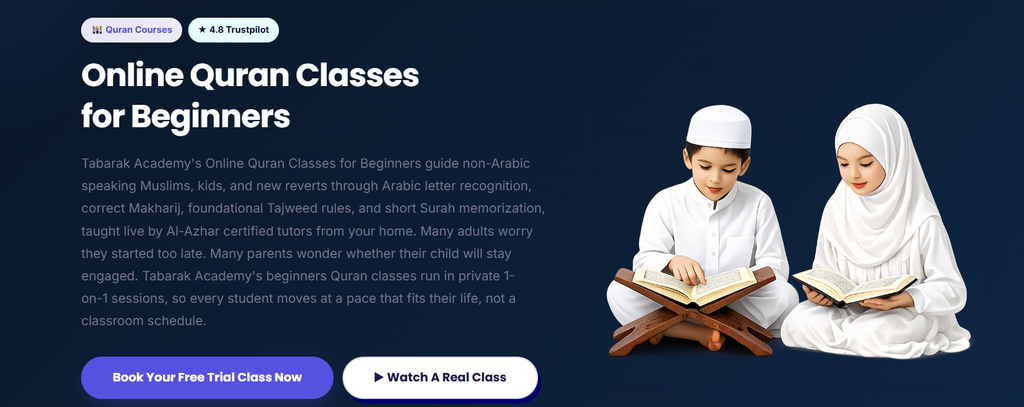
Yes. Children can memorize Quran without knowing Arabic, provided they receive age-appropriate instruction and consistent correction. For a child, Quran learning may happen alongside English or French as the primary language at home and school. This does not prevent Hifz.
What matters is building the child’s Quranic reading ability gradually. A practical children’s routine might combine, learning Arabic letters and learning Noorani Qaida, exploring Tajweed basics, and memorizing short Surahs. In addition, daily repetition and regular teacher assessment
Parents should also avoid comparing a child’s memorization speed with another student’s. Some children memorize quickly but need more revision, while others progress slowly and retain very well.
The goal should be accurate and sustainable memorization, not simply completing a certain number of pages.
Tabarak Academy provides private online Quran classes for children and beginners, with lessons structured around the learner’s level and individual needs.
Can Adults Memorize Quran Without Knowing Arabic?
Yes. Adults can begin Hifz without being fluent in Arabic. Adult learners often worry that they are too old or that their unfamiliarity with Arabic will make memorization impossible. In reality, the bigger challenge is usually maintaining a realistic routine around work and family responsibilities.
An adult beginner can start with 20–30 minutes of focused practice and increase the amount gradually as the routine becomes established.
Private instruction can also help adults avoid wasting time repeating pronunciation mistakes. Tabarak Academy offers one-to-one Quran classes for adults covering Quran reading, Tajweed, Hifz, and Tafsir.
Read also: How To Memorize The Quran With Understanding?
Do You Need to Learn Arabic to Become a Hafiz?
No. Arabic fluency is not a prerequisite for becoming a Hafiz. A student needs to be able to read the Quran accurately and memorize its Arabic text.
Learning Arabic can make the process richer because vocabulary and meaning can support recall, but complete language mastery can develop alongside Hifz.
In fact, many learners can begin with a small set of Quranic vocabulary rather than attempting to study all of Arabic at once. Focus first on words and expressions that appear repeatedly in the Surahs you are memorizing. Over time, you will naturally recognize more vocabulary.
What Should You Learn First?
For a non-Arabic speaker, prioritize:
- Arabic letters and their sounds.
- Harakat and other basic reading signs.
- Makharij and correct pronunciation.
- Foundational Tajweed.
- Short Quranic vocabulary.
- General meanings of memorized verses.
- Regular revision.
Advanced Arabic grammar, conversational Arabic, and writing skills can be developed separately according to your long-term goals.
If understanding Quranic Arabic is one of your goals, Tabarak Academy also offers Quranic Arabic classes covering vocabulary, grammar, root analysis, and Quranic sentence structures.
Step Inside Our Virtual Classrooms
See our engaging teaching methods in action! watch real snippets of our live classes and discover how our expert instructors make learning interactive, memorable, and inspiring for every student.
Start Learning Quran With Tabarak Academy
Self-study resources can help with repetition, but they cannot fully replace personalized feedback. A qualified teacher can hear whether a letter is being pronounced correctly, identify Tajweed mistakes, monitor memorization accuracy, and adjust the lesson when a student is struggling.
This is especially important for non-Arabic speakers because some Arabic sounds may not exist in their first language. For beginners, the learning path can start with the Arabic alphabet before moving toward Quranic reading and memorization.
Tabarak Academy offers private online Arabic and Noorani Qaida lessons for children and adults, with flexible scheduling and instruction designed for non-Arabic speakers.
Our Quran Memorization / Hifz Courses
- Online Hifz Program
- Juz 30 Memorization Course
- Hifz for Kids Course
- Hifz for Adults Course
- Hifz for Sisters Course
- Short Surah Memorization Course
- Hifz Ijazah Course

Conclusion
So, is it possible to memorize the Quran without knowing Arabic? Yes. You do not need to speak Arabic fluently before beginning Hifz.
You need to learn how to read the Arabic Quran correctly, establish accurate pronunciation, apply foundational Tajweed, memorize manageable portions, understand the general meaning through reliable resources, and review consistently.
Learning Arabic remains highly valuable. It can deepen comprehension and give you additional memory cues, but it does not have to stand between you and your first memorized Surah.
The main takeaway: do not wait for perfect Arabic before beginning Quran memorization. Start with correct Quran reading and Tajweed, build a consistent Hifz routine, and allow your Quranic Arabic to grow alongside your memorization.
Read also: How To Memorize Quran With Tafsir Alongside? – 6 Proven Methods
FAQs
Is it possible to memorise the Quran without knowing Arabic?
Yes. It is possible to memorise the Quran without knowing Arabic fluently. You should first learn to read the Arabic script correctly and pronounce the Quranic letters accurately, then build memorization and revision gradually.
Can I become a Hafiz if I do not understand Arabic?
Yes. Understanding Arabic can make memorization easier, but it is not a prerequisite. You can use a reliable translation to understand the general meaning while memorizing the original Arabic text.
Should I learn Arabic before memorizing the Quran?
No. You can learn Arabic alongside Hifz rather than waiting until you become fluent. Start with Quranic reading, Tajweed, and useful vocabulary, then develop your Arabic gradually.
Can children in Canada memorize Quran without speaking Arabic?
Yes. Children can memorize the Quran even when English or French is their main language. A structured routine, age-appropriate lessons, repetition, and regular teacher correction can support steady progress.
Is Tajweed necessary when memorizing Quran?
Learning foundational Tajweed is highly important because memorization should be based on correct recitation. A teacher can help identify pronunciation and articulation mistakes before they become established habits.
Is it better to memorize Quran with a teacher?
For most beginners, regular teacher guidance is extremely beneficial. A qualified teacher can listen to your recitation, correct pronunciation, monitor memorization, and adapt the pace to your needs.