

How To Memorize The Quran Without A Teacher: 10 Helpful Steps
Can you really memorize the Quran without a teacher? Yes, it is possible to begin a personal Hifz journey independently, especially when access to a local Quran teacher is difficult. However, memorization and accurate recitation are two different goals, and knowing how to balance both is essential.
For children and adults, online resources, recorded recitations, digital Mushafs, and structured revision plans can make independent Quran memorization more accessible than ever.
The key is not simply repeating verses, but following a consistent method that combines preparation, repetition, connection between verses, and regular Muraja’ah.
This guide explains how to memorise the Quran without a teacher, which techniques work best, how to use online resources correctly, and when professional Tajweed correction can make your memorization stronger.
1. Choose One Mushaf and One Reciter
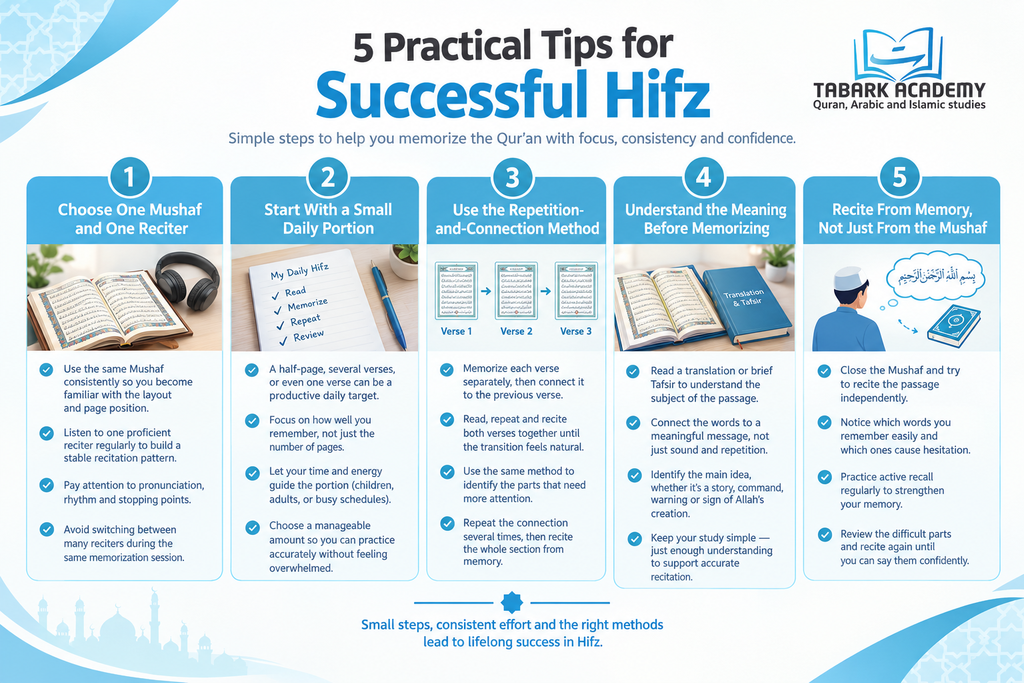
Consistency in your learning materials can make memorization more organized and less confusing. When you use the same Mushaf, you become familiar with the position of each verse and the overall appearance of the page.
This familiarity can help you remember where a passage begins and how the verses follow one another. Over time, the Mushaf becomes a familiar visual guide during your Hifz journey.
Start by using the same physical Mushaf consistently. Keeping the same page layout helps your visual memory associate verses with their location on the page.
Listening to one reciter regularly can also help you develop a stable recitation pattern. Choose one proficient Quran reciter and listen to the passage before memorizing it. Pay attention to the pronunciation of each word, the rhythm of the verses, and the places where the reciter stops.
Try listening to a short passage several times before attempting to memorize it. Once you feel comfortable with the sound of the passage, begin reciting it yourself while following the same Mushaf.
For beginners, it is better to avoid switching between many reciters during the same memorization session.
2. Start With a Small Daily Portion
One of the biggest mistakes in Hifz is trying to memorize too much too quickly. A half-page, several verses, or even one verse can be a productive daily target if the memorization becomes strong. A realistic daily target helps you build a memorization routine that you can maintain over time.
Instead of measuring success by the number of pages you finish, focus on how well you remember the verses after your session. If one verse requires extra practice, give it the attention it needs before moving forward. Consistent progress, even when it is slow, can lead to stronger long-term Hifz.
Your available time and energy should guide the amount you memorize each day. For children, the daily amount should match their concentration span. Adults can gradually increase the portion when their retention becomes stable.
A student with a busy schedule may benefit from a few verses in the morning and a short review in the evening. Children may need shorter sessions with breaks, while adults can choose a regular time that fits their responsibilities.
The important thing is to choose a portion that allows you to practice accurately without feeling overwhelmed. Your goal should be retention, not speed. A smaller portion that you can recite confidently tomorrow is more useful than several pages that disappear from memory after a few days.
3. Use the Repetition-and-Connection Method
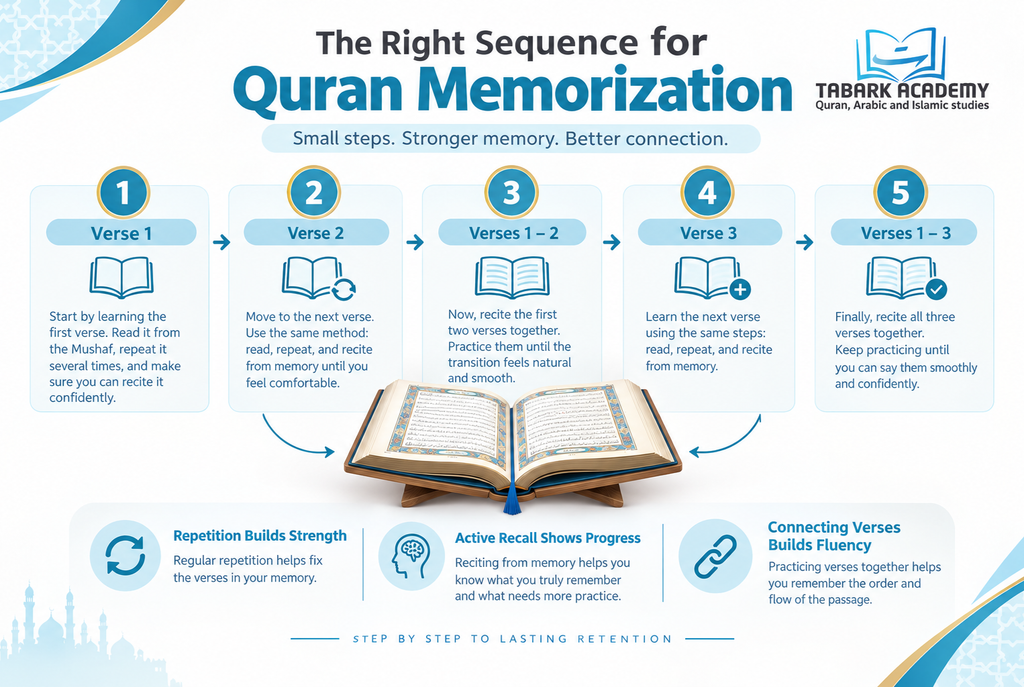
A practical independent method is to memorize each verse separately and then connect it to the previous verse. The repetition-and-connection method gives each verse a clear place in your memorization process.
After learning a verse, make sure you can recite it confidently before adding the next one. Then practice both verses together until the transition feels natural. This gradual approach helps you remember the order of the passage instead of learning separate verses that are difficult to connect.
Read the first verse repeatedly while looking at the Mushaf. Then close the Mushaf and recite it from memory several times. Repeat the same process with the second verse, then recite the first and second verses together. Start the third verse, repeat it, read it aloud, and recite it from memory. Then recite all three verses together and continue this pattern.
You can also use this method to identify the parts of a passage that need more attention. If you remember each verse separately but struggle when joining them, return to the last few words of the first verse and the beginning of the next.
Repeat the connection several times, then recite the entire section without looking. With regular practice, these transitions can become easier and your recitation more fluent. This method reduces the risk of remembering individual verses while forgetting how they connect to one another.
4. Understand the Meaning Before Memorizing
Reading the meaning of the Quran before memorization can make the verses easier to follow and remember. A translation or brief Tafsir can help you recognize the subject of the passage and understand how the ideas develop.
When you know what the verses are discussing, you can connect the words to a meaningful message rather than relying only on sound and repetition. This makes the memorization process more purposeful.
Understanding the general meaning of a passage can also create additional memory connections. Before beginning a new section, read a reliable brief Tafsir or translation and identify the main idea. Take a few minutes to identify the main message of the section you plan to memorize.
Then notice whether the verses describe a story, a command, a warning, or a sign of Allah’s creation. You can also divide a longer passage according to changes in meaning, which may help you remember the sequence. Keep your study simple and focus on understanding enough to support accurate and confident recitation.
5. Recite From Memory, Not Just From the Mushaf
Active recall should be part of every memorization session because it shows whether the words have been stored in your memory. After reading and repeating a passage, close the Mushaf and try to recite it independently. Notice which words you remember easily and which ones cause hesitation.
This process helps you identify what needs more practice before you consider the portion complete. Listening and reading are useful preparation tools, but active recall is what tests whether the passage is actually memorized.
After repeating a verse, close the Mushaf and recite it aloud. When you make a mistake during recitation, use it as an opportunity to strengthen your memorization. Look at the correct wording, repeat the difficult part, and then recite the verse again without looking.
Avoid immediately checking the Mushaf after every word, as this can make you dependent on visual prompts. Regular practice without assistance gradually builds confidence and improves your ability to recall the passage during prayer or revision.
Do not judge your memorization by how familiar the page looks. Judge it by whether you can reproduce the words accurately without seeing them.
Read also: Is It Possible To Memorize The Quran Without Knowing Arabic?
6. Build Muraja’ah Into Every Day
Muraja’ah is essential because memorized verses need regular attention to remain strong. A student may successfully memorize a new page but struggle to recall it after several days without revision. Reviewing older portions helps protect what you have already learned while making room for new memorization.
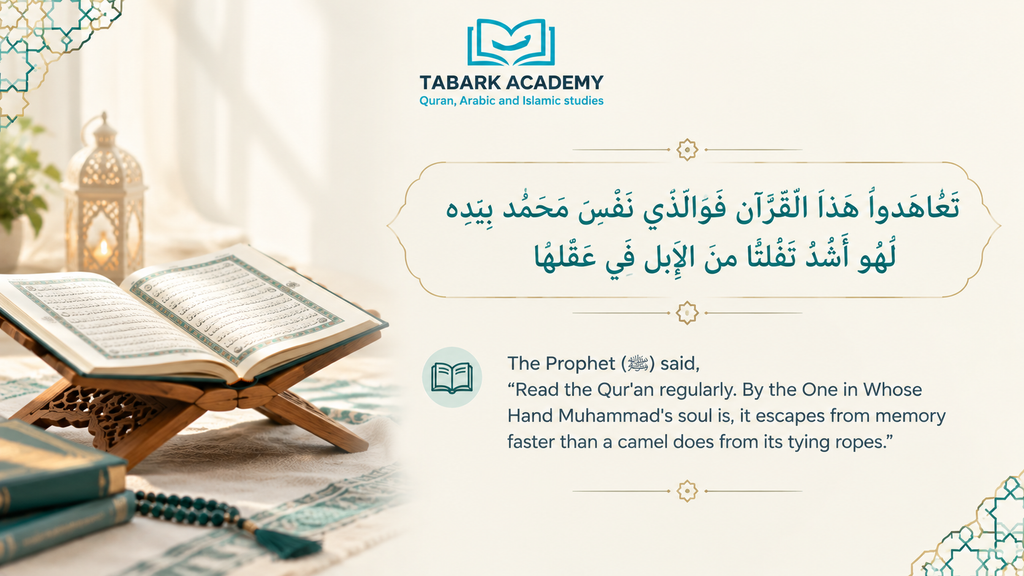
The Prophet ﷺ emphasized repeatedly maintaining the Quran because memorized verses can be forgotten if they are not continually reviewed. The Prophet (ﷺ) said, “Read the Qur’an regularly. By the One in Whose Hand Muhammad’s soul is, it escapes from memory faster than a camel does from its tying ropes.” [Al-Bukhari and Muslim].
“تعاهدوا هذا القرآن فوالذي نفس محمد بيده لهو أشد تفلتًا من الإبل في عقلها”
A simple routine can divide your session into three parts. Old revision, which you previously memorized; new memorization that includes today’s selected verses; and connection review that reciting today’s new material together with nearby previous material.
By giving revision a fixed place in your daily schedule, you can develop a more balanced and sustainable Hifz routine. Memorization does not finish when you learn a new page. Revision is part of Hifz itself. As your memorized portion grows, gradually increase the amount of old Quran you review.
A useful way to organize your revision is to begin with previously memorized passages before studying new verses. After learning the new portion, recite it together with the verses that came before it.
7. Use Prayer as a Memorization Tool
Reciting recently memorized verses in prayer can provide meaningful practice outside your regular study session. It allows you to recall the words without looking at the Mushaf and helps you become more comfortable with the passage during worship.
Choose portions that you can recite accurately, and continue reviewing them outside prayer so that mistakes do not become repeated habits. This practical way helps you to strengthen recently memorized verses is to recite them during prayers when appropriate.
This moves the verses from a study environment into regular worship and gives you another opportunity to retrieve them without looking at the Mushaf.
Parents can support their children’s memorization by creating simple opportunities for recitation at home. A child might recite the day’s verses to a parent after Maghrib or before bedtime, depending on the family’s routine.
Encourage the child to recite calmly and praise consistent effort rather than focusing only on the number of verses learned. A supportive environment can help children associate Quran memorization with confidence and love for the Quran.
Experience Our Interactive Learning
Curious about how we teach? Watch these brief video clips from our recent live sessions to see our structured curriculum, advanced learning platform, and dynamic student-teacher interactions firsthand.
8. Use Online Resources Wisely
Online Quran resources can make independent memorization easier by giving students access to recitations, translations, and revision tools. You can listen to a passage while following the Mushaf, repeat it at a comfortable pace, and return to the same recording whenever you need additional practice.
These resources are especially useful for students who want to maintain a routine at home. However, listening should always be followed by active recitation. When learning independently, YouTube and Quran apps can help with repeated listening, but they should support—not replace—careful recitation practice.
When choosing online learning materials, look for reliable Quran recordings and resources that present the Arabic text accurately. Use the same recording consistently when possible, and compare your recitation with a qualified teacher when you are unsure about pronunciation or Tajweed.
Use recordings to hear the correct pronunciation, then practice independently and compare your recitation against a reliable source. For Tajweed-sensitive passages, however, a recording cannot tell you exactly what you are doing incorrectly.
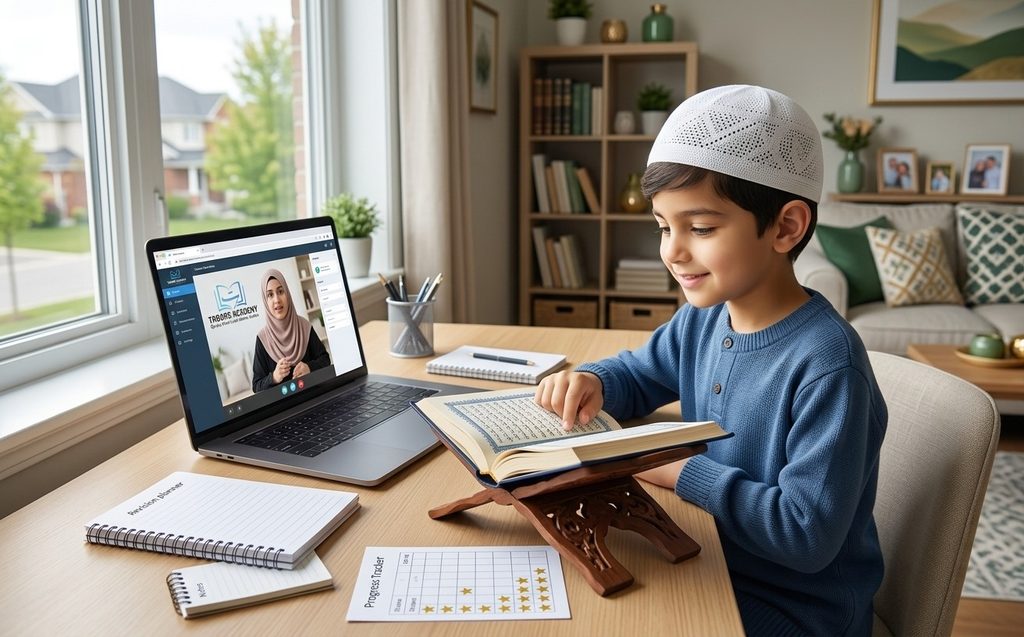
This is where online one-to-one Quran instruction can be particularly useful. Tabarak Academy, for example, offers live Quran classes covering recitation, Tajweed, Hifz, and Quranic learning for children and adults.

9. Know What You Can and Cannot Correct Alone
Independent memorization gives you control over your daily practice, but accurate recitation requires more than remembering the words. Some Tajweed mistakes are difficult to recognize without someone listening carefully to your pronunciation.
A student may repeat the same incorrect sound or madd length many times without realizing it. Regular feedback from a qualified Quran teacher can help you correct these issues before they become established habits.
You can independently control many parts of your memorization routine, such as repetition, scheduling, listening, page familiarity, and revision. Pronunciation is different. Errors in any Tajweed rule can become habits when learners repeatedly practice them without feedback.
When a teacher points out an error, practice the correction slowly and apply it during your next revision. This approach allows you to benefit from self-directed learning while maintaining the accuracy of your Quran recitation.
For this reason, the strongest approach is often a hybrid model that includes memorizing and revising independently every day while periodically reciting to a qualified Quran teacher for correction.
Tabarak Academy’s Tajweed courses use live one-to-one instruction so tutors can identify and correct individual recitation errors during actual Quran reading.

Read also: How To Memorize Quran With Tafsir Alongside? – 6 Proven Methods
10. Adapt Your Method to Your Age and Lifestyle
Your memorization routine should fit your age, responsibilities, and ability to concentrate. Children often benefit from short lessons, frequent repetition, and encouragement when they complete a small goal.
On the other hand, Adults may prefer longer sessions that include translation, reflection, and independent revision. By choosing a method that matches your needs, you can make Quran memorization a regular part of your life rather than a task that feels difficult to maintain.
There is no single memorization method that works identically for everyone. A flexible schedule can help students continue Hifz during busy periods. If you have limited time on weekdays, set aside a short session for new memorization and use weekends for longer revision.
Families can also coordinate their routines so that children have a consistent time for lessons and practice. The goal is to build a dependable habit that supports steady progress while allowing enough time for work, school, worship, and family responsibilities.
Tabarak Academy offers flexible Quran instruction and private sessions without requiring travel to a local mosque or learning center for different ages and levels.
How to Memorize Quran Without a Teacher Online
If you are searching for how to memorize quran without a teacher online, create a simple digital routine that includes listening to one recitation, reading the passage from your Mushaf, repeating it aloud, testing yourself without looking, and recording your progress.
However, online self-study should not mean learning completely without human feedback. A live teacher can listen to your recitation and identify mistakes that an app or recording may not detect.
For learners who cannot attend a physical Quran school, private online Hifz can provide the missing element of correction while preserving the flexibility of independent practice. Tabarak Academy’s Online Hifz Program combines personalized memorization plans, systematic Muraja’ah, and Tajweed accuracy with qualified tutors.
What Is the Best Way to Memorize Quran Without a Teacher?
The best way to memorize Quran without a teacher is to combine small daily portions, repeated listening, active recall, verse-to-verse connection, and a structured revision schedule.
Do not measure progress only by the number of pages memorized. Measure it by how accurately you can recite the passage the next day, one week later, and several weeks later.
Most importantly, do not let the absence of a local teacher become a reason to stop learning. Begin with what you can do safely and accurately, then seek qualified correction whenever possible.
A Simple Daily Hifz Schedule
A consistent daily routine can make Quran memorization easier, more organized, and more effective. That’s why a simple Hifz schedule helps you balance new memorization with regular revision and accurate recitation.
The following schedule provides a practical starting point that can be adapted to your individual needs.
| Stage | Suggested Practice |
| Preparation | Listen to the passage and read it from the Mushaf |
| New Hifz | Memorize a small, manageable portion |
| Active Recall | Recite without looking |
| Connection | Join the new verses together |
| Recent Review | Recite yesterday’s memorization |
| Long-Term Review | Revisit older portions regularly |
By following a clear sequence of preparation, active recall, and review, you can build steady progress while strengthening your connection with the Quran. This structure can be adjusted according to your age, available time, and current memorization level.
Read also: How To Memorize The Quran With Understanding?
Step Inside Our Virtual Classrooms
See our engaging teaching methods in action! watch real snippets of our live classes and discover how our expert instructors make learning interactive, memorable, and inspiring for every student.
Strengthen Your Quran Memorization With Qualified Online Support
You can continue building your Hifz independently while receiving the expert guidance you need to recite correctly.
Tabarak Academy offers private online Quran, Hifz, and Tajweed classes for children and adults, helping learners improve pronunciation, strengthen memorization, maintain consistent revision, and stay accountable to their goals.
With live one-to-one instruction, a qualified tutor can listen to your recitation, identify Tajweed or pronunciation mistakes, and guide you through a personalized learning plan. If you also want to understand the Arabic of the verses you memorize, adding online Arabic lessons can help you build a deeper connection with the Quran.
Start your Quran learning journey with a free trial at Tabarak Academy
Our Quran Memorization / Hifz Courses
- Online Hifz Program
- Juz 30 Memorization Course
- Hifz for Kids Course
- Hifz for Adults Course
- Hifz for Sisters Course
- Short Surah Memorization Course
- Hifz Ijazah Course

Conclusion
Learning how to memorize the Quran without a teacher is possible when the learner follows a disciplined system rather than relying on repetition alone.
Choose one Mushaf, listen carefully, memorize manageable portions, connect the verses, test yourself without looking, and make Muraja’ah a permanent part of your routine. Most importantly, remember that memorization and accurate Quranic recitation are connected but distinct skills.
The key takeaway: you do not need to wait for perfect circumstances to begin Hifz. Start with a realistic amount, remain consistent, and seek qualified Tajweed correction whenever possible.
For Canadian families who need flexible support, online one-to-one Quran and Hifz classes can bridge the gap between independent practice and professional guidance.
FAQs
Can I memorize the Quran by myself without a teacher?
Yes. You can begin memorizing independently using a consistent Mushaf, reliable recitation, repetition, active recall, and daily revision. However, a qualified teacher is highly beneficial for checking pronunciation and Tajweed.
What is the best way to memorize Quran without a teacher?
A strong method is to memorize a small portion, repeat each verse, recite it from memory, connect consecutive verses, and review old memorization every day. Consistency is more important than memorizing a large amount quickly.
How long does it take to memorize the Quran without a teacher?
There is no fixed timeframe. It depends on your daily memorization amount, retention, revision schedule, previous Quranic reading ability, and available time. A slower but sustainable plan can be more effective than an intensive schedule that cannot be maintained.
Can children memorize Quran without a teacher?
Yes. Children can practice memorization at home, especially with parental support and audio recitation. However, regular teacher feedback is valuable for correcting pronunciation and Tajweed before mistakes become established habits.
Can I memorize Quran online without attending a physical class?
Yes. You can use online recordings and digital resources for self-study, while live online Quran classes provide direct teacher feedback. Private online Hifz programs can be especially useful for families who cannot access a qualified local teacher.