


Online Quran Learning for Kids – Real Benefits Every Parent Should Know
Online Quran learning is the practice of teaching children to read, understand, and memorize the Quran through live, structured lessons delivered over the internet, most often through video-calling platforms such as Zoom.
Instead of driving to a local mosque or Islamic center, families now connect with a qualified tutor from home, at a time that actually fits their schedule.
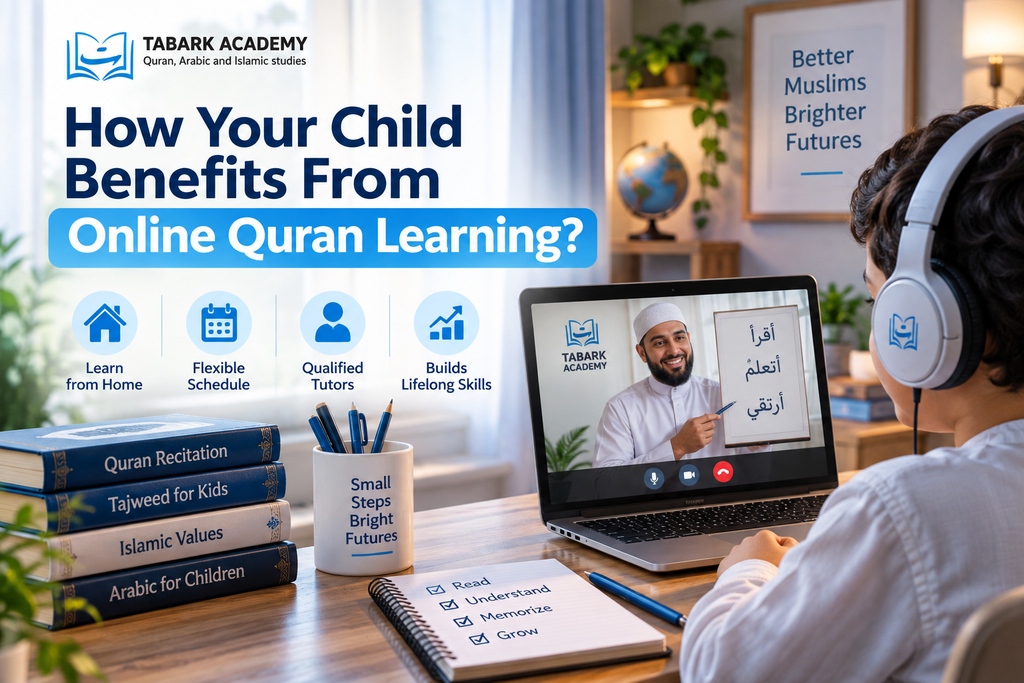
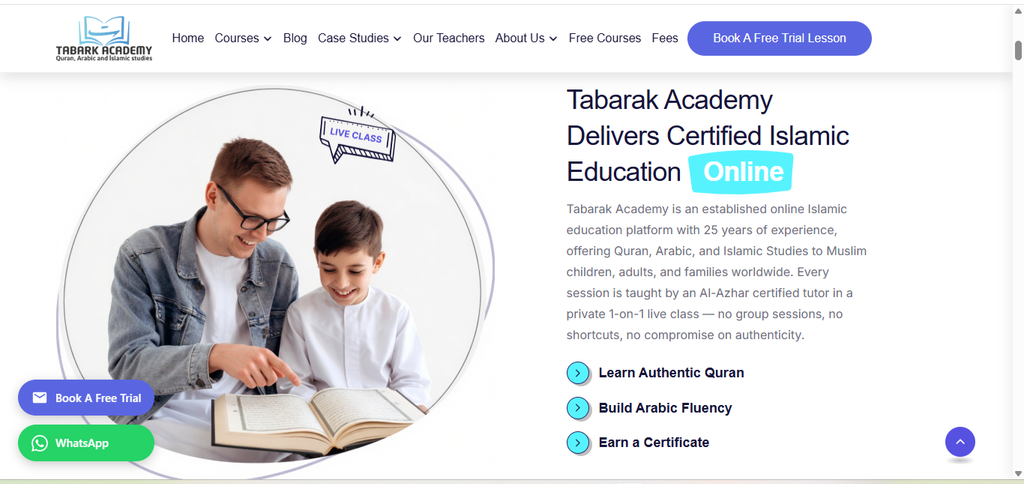
This shift is exactly why so many parents ask How Your Child Benefits From Online Quran Learning? before choosing a program for their family. Academies such as Tabarak Academy have built their entire teaching model around answering that question – with certified teachers, structured curriculums, and lesson formats designed specifically for children.
For parents, this means they can look beyond convenience and consider whether the learning environment actually supports their child’s progress, comfort, and individual needs.
This article walks through the real, practical benefits online learning offers a child – not just convenience, but measurable gains in memorization, Arabic pronunciation, confidence, and safety.
Take Away – What You Will Learn
- The core benefits online Quran learning offers children compared to in-person classes.
- Why one-on-one attention from a qualified teacher speeds up memorization and correction.
- Practical, teacher-tested strategies to keep a child focused during online lessons.
- What the Quran and an authentic Hadith say about the value of learning and teaching the Quran.
- How to choose a safe, structured, and effective online Quran program for your child.
How Your Child Benefits From Online Quran Learning
Online Quran learning benefits a child by giving them direct, one-on-one access to a qualified teacher, in a flexible and safe environment, without the time and travel that in-person classes usually require.
Rather than sitting in a crowded class where attention is divided among many students, a child learning online works closely with one teacher who can adapt the pace, correct pronunciation immediately, and track memorization step by step.
This individual approach is particularly valuable because children do not all learn Quran reading or memorization at the same speed. One child may need additional practice with Arabic letters and Makharij, while another may read confidently but struggle to retain newly memorized verses.
In an individual lesson, the teacher can spend more time on exactly what that child needs rather than following a fixed pace designed for an entire group.
For many families, especially those living outside Muslim-majority countries or in areas without a nearby Quran teacher, online learning is not just convenient – it is often the only realistic way for a child to receive structured Quran education from a qualified instructor.
Platforms such as Tabarak Academy were built specifically to close that gap, connecting children with certified teachers regardless of where the family lives.
Understanding How Your Child Benefits From Online Quran Learning? therefore requires looking at more than location or scheduling.
The real value comes from combining accessibility with qualified teaching, individual correction, parental involvement, and a learning structure that can adapt as the child progresses.
Why Do Children Lose Focus During Online Quran Classes?
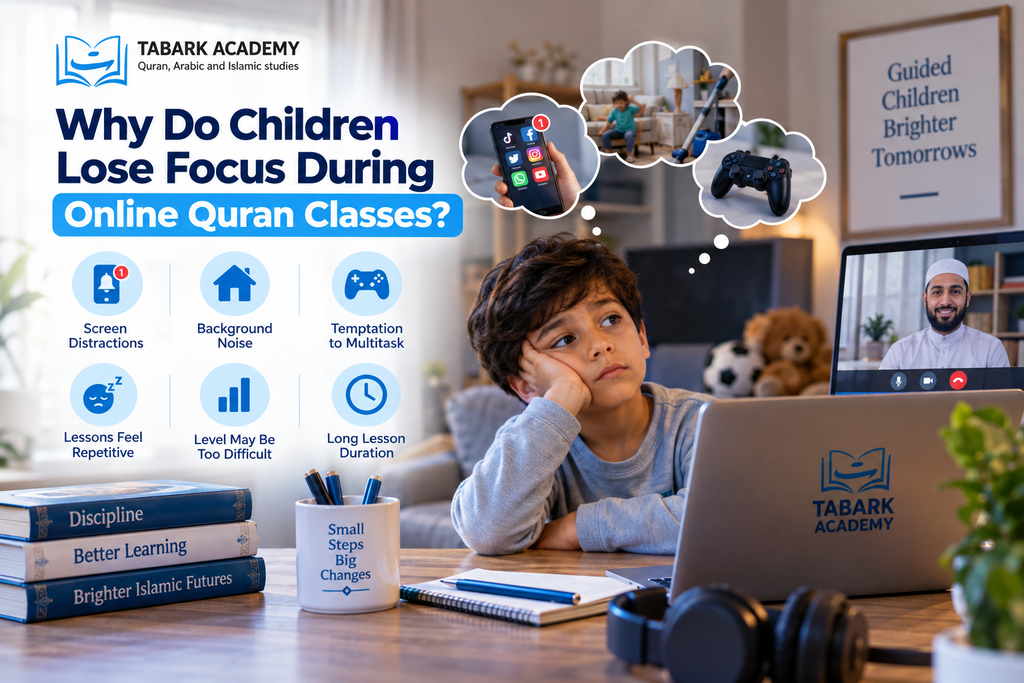
Children naturally have short attention spans, and online learning adds distractions that are unique to a screen – notifications, background noise at home, or the temptation to multitask. A lesson that feels repetitive, or one that is pitched above a child’s current level, will also cause motivation to drop quickly.
The child’s age, lesson duration, environment, and relationship with the teacher can all affect concentration. A younger learner who is expected to sit through a long lesson may become restless even when the teaching itself is good. Similarly, a child who constantly encounters material that feels too difficult may gradually associate Quran lessons with frustration rather than progress.
Understanding these causes is the first step toward solving them, which is why practical engagement strategies are covered later in this article, alongside the core benefits below. With an age-appropriate lesson length, an engaging teacher, and a quiet learning environment, many of these distractions can be reduced considerably.
Core Benefits of Online Quran Learning for Kids
Once the right teacher and structure are in place, online Quran learning offers several concrete advantages over traditional in-person classes. Below are the benefits that matter most for a child’s memorization, confidence, and safety.
These benefits can also reinforce one another. For example, one-on-one attention makes correction faster, while flexible scheduling makes consistent attendance easier.
Greater parental oversight can then help parents understand what needs to be reviewed between lessons. Together, these elements can create a more organized learning experience for both the child and the family.
1. Personalized One-on-One Attention
One on one classes make sure that students receive the special attention that they need. When compared to group classes in physical schools, this proves to be a significant advantage. Some Quran learners can often find it challenging to ask questions in a class full of students.
An online Quran teacher can devote all their attention to an individual student. This helps the child in learning the Quran effectively.
The teacher can notice small pronunciation mistakes immediately instead of waiting until several students have finished reciting. If a particular Arabic letter, Tajweed rule, or verse is difficult, the lesson can pause there and provide additional repetition until the child becomes more comfortable.
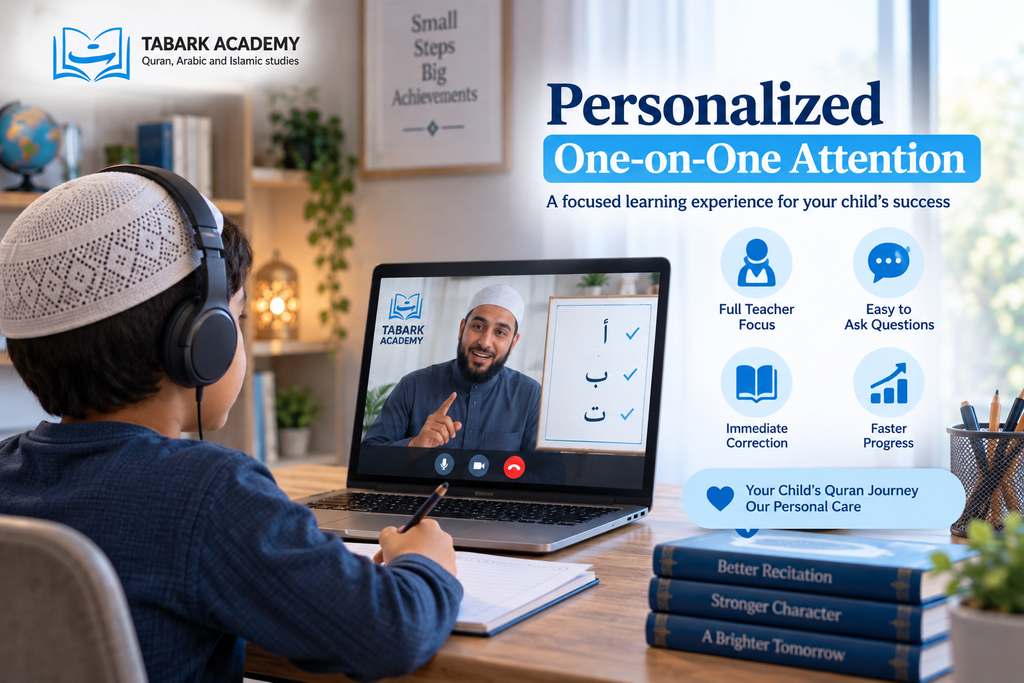
This individual pacing means a child is never rushed past a verse before they have actually memorized it, and shy children who would normally stay quiet in a group setting are far more willing to ask questions or repeat a mistake until they get it right.
It also gives teachers a clearer understanding of the child’s strengths and weaknesses from one lesson to the next.
2. Access to Qualified Teachers
Most of the qualified Quran teachers do not visit the homes of students but teach at a Quran academy or masjid. Thus, when you opt for a Quran online class for your kid, you make sure that your child gets to learn from the best of the best.
You get access to qualified, professional and expert Quran teachers online that are dedicated for making Quran learning easy for kids and adults.
Online learning removes geographical restrictions from the search for a suitable Quran teacher. Parents are no longer limited to whoever happens to teach in the nearest mosque or Islamic center. This can be especially helpful when a child needs a teacher experienced with beginners, Tajweed, memorization, or a particular age group.
This matters most for correct Tajweed, since a teacher’s own recitation – and the way they correct a child’s letters – directly shapes how accurately that child will recite the Quran for the rest of their life. Programs such as Tabarak Academy’s Quran course for kids are built around certified teachers for exactly this reason.
3. Easy to Monitor
When kids learn online, parents can easily monitor the progress and make sure that their child is comfortable with the teacher and their teaching methodology. Also, online learning of the Quran is the safest option for kids as it has been observed that teachers can get violent in offline classes.
Especially in the subcontinent, things like beating with a stick, blurting out harsh words and pulling of ears is pretty common. When the learning is online, there is no question of teachers abusing the kids.
Online lessons give parents greater visibility into how their child is being taught. They can observe the teacher’s tone, see how mistakes are corrected, and understand whether the child feels comfortable participating in the lesson.
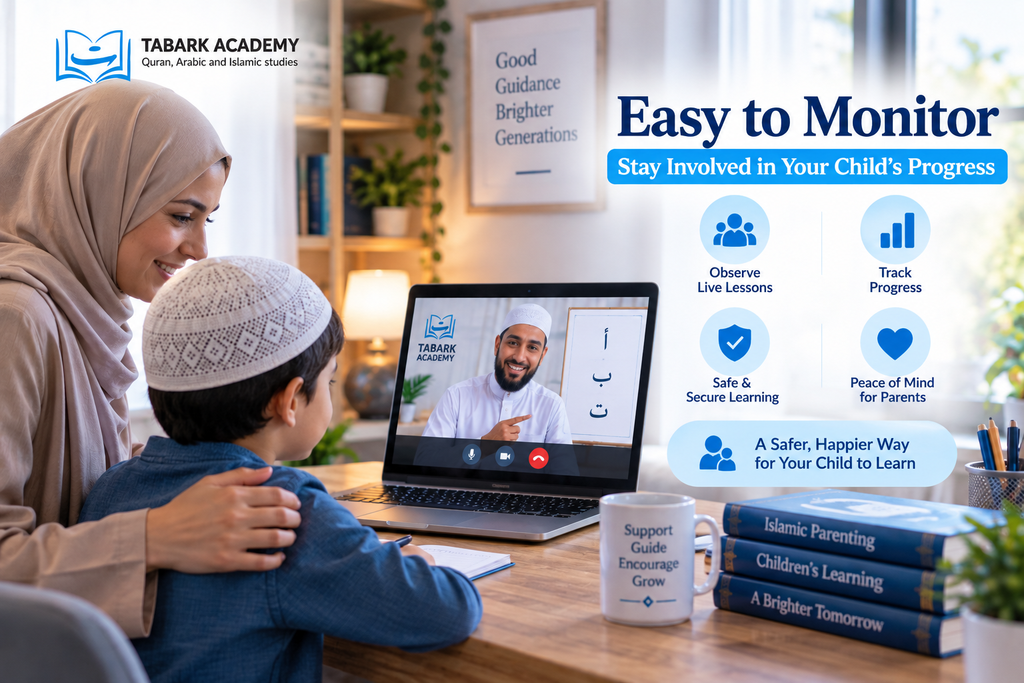
Sitting nearby during a lesson, or reviewing a recorded session afterward, lets a parent step in immediately if something feels wrong – a level of oversight that simply is not possible when a child is dropped off at a physical class.
This involvement can also help parents know exactly what their child should review before the next session.
4. Interactive and Entertaining
Kids benefit from the creative use of technology when it comes to learning the Quran online. They get access to videos that showcase the Quranic stories of Prophets and kids also get to participate in quizzes and games that promote their learning further.
Online learning allows teachers to vary the format of a lesson rather than relying exclusively on reading and repetition. Younger learners, in particular, may respond better when short recitation activities are combined with visual explanations, questions, stories, or simple challenges.
Digital whiteboards, colourful slides, and short recitation clips turn what could feel like a chore into something a child looks forward to – which is exactly why gamified rewards and story-based lessons appear again in the engagement strategies further down in this article.
The purpose of these tools is not to replace Quran recitation itself, but to support attention and understanding. Used carefully, technology can make it easier for a child to remain engaged while still keeping the Quran at the center of the lesson.
5. Flexible Scheduling That Fits Your Family
Online Quran learning also gives families full control over timing. Parents can book a lesson around school, prayer times, or a child’s natural energy levels, instead of adjusting the whole family’s day around a fixed class at a physical center.
This flexibility can also improve consistency. When lessons are easier to fit into the family’s existing routine, children are less likely to miss classes because of transportation difficulties or clashes with other commitments. Parents can also choose a time when their child is alert rather than tired after a long school day.
This flexibility is one reason Tabarak Academy’s Zoom Quran classes have grown popular with busy households, and why sessions can just as easily be arranged through dedicated online Quran classes for sisters when a family prefers a female teacher for their daughters.
6. Stronger Arabic Pronunciation and Language Skills
Repeated listening and correction during recitation naturally strengthens a child’s Arabic pronunciation, even in homes where Arabic is not spoken day to day. Correct articulation points (makharij) are trained gradually, session after session, which is why consistency matters more than the length of any single class.
A teacher can also help the child distinguish between Arabic sounds that may initially seem similar. Through repetition, listening, and immediate correction, the child’s ear gradually becomes more sensitive to correct pronunciation, while the tongue becomes more comfortable producing unfamiliar sounds.
These improvements can support Quran reading as a whole. When individual letters and vowels become easier to pronounce, the child can devote more attention to fluency, Tajweed, memorization, and eventually understanding rather than struggling with every word.
7. A Safer, More Purposeful Use of Screen Time
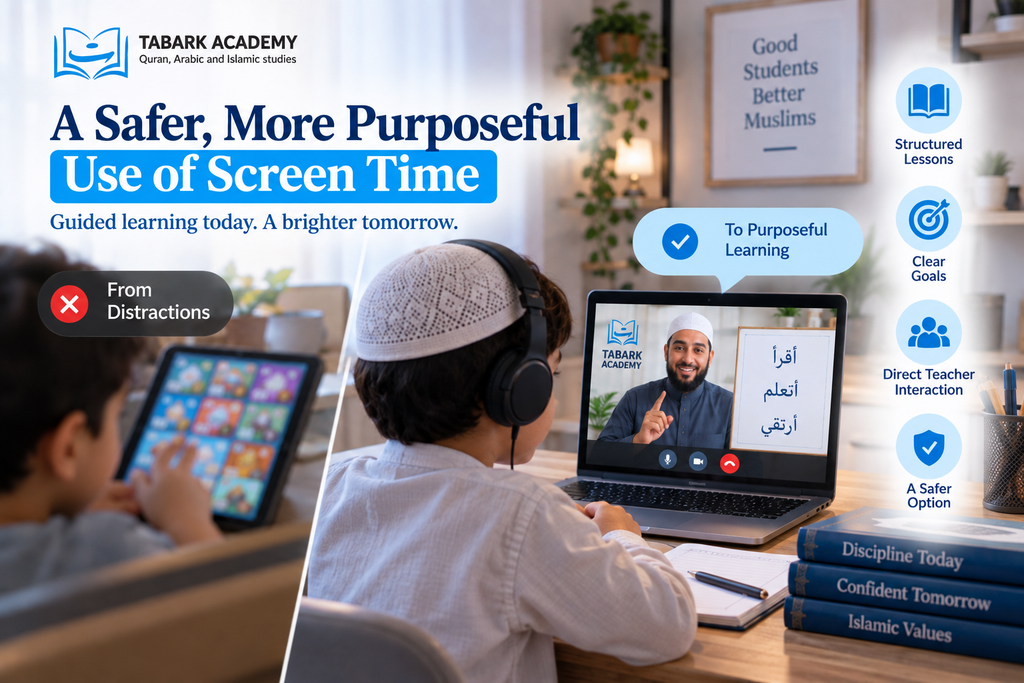
Structured online Quran lessons give children a healthy, guided reason to use a tablet or laptop, rather than defaulting to unsupervised apps or social media. Many parents view this as a quiet but meaningful additional benefit of choosing a live Quran class over simply handing a child a device.
Instead of treating all screen time in the same way, parents can distinguish between passive entertainment and purposeful digital learning. A live Quran lesson has a clear start and finish, direct interaction with a teacher, and specific learning goals.
The device therefore becomes a tool for recitation, memorization, listening, and teacher interaction rather than merely entertainment. Parents can reinforce this distinction by closing unrelated applications and using the device only for the class during lesson time.
The table below summarizes how a one-on-one online class compares to a typical group class.
| Aspect | Group Class | One-on-One Online Class |
| Teacher’s attention | Divided among many students | Fully focused on one child |
| Pace of lessons | Set for the average student | Adjusted to the child’s own speed |
| Correcting mistakes | Often delayed or overlooked | Corrected immediately, verse by verse |
| Parental oversight | Limited once dropped off | Easy to sit in or review the session |
| Scheduling | Fixed class times | Flexible, booked around family life |
Watch Our Classes in Action
Curious about how this actually looks in practice? Watching a real lesson can help parents understand how the teacher interacts with a child, how corrections are delivered, and how the curriculum moves from explanation to practical recitation.
This short clip from a recent live session shows the structured curriculum, the learning platform, and real student-teacher interaction: Watch the video here.

What Does the Quran and Sunnah Say About Learning the Quran?
Islam places clear emphasis on learning and teaching the Quran, and this is stated directly in both the Quran and authentic Hadith—not simply as a general cultural value, but as an important part of Islamic learning and practice.
Muslims are encouraged to read the Quran, reflect on its guidance, improve their recitation, and pass Quranic knowledge on to others.
For parents, these teachings provide a deeper reason for helping children establish a relationship with the Quran from an early age. Reading, memorization, correct recitation, Tajweed, and age-appropriate understanding can all become gradual parts of the child’s upbringing rather than something introduced only when they are older.
Starting with small, manageable lessons can also help children develop familiarity with Quran learning without making it feel overwhelming.
The goal does not need to be rapid memorization or perfect recitation from the beginning. A more sustainable approach is to help the child build consistent Quran habits over time, combining regular reading with listening, revision, understanding, and gentle correction.
As these habits become part of everyday family life, children can gradually develop greater confidence in their recitation and a stronger connection with the Quran.
Experience Our Interactive Learning
Curious about how we teach? Watch these brief video clips from our recent live sessions to see our structured curriculum, advanced learning platform, and dynamic student-teacher interactions firsthand.
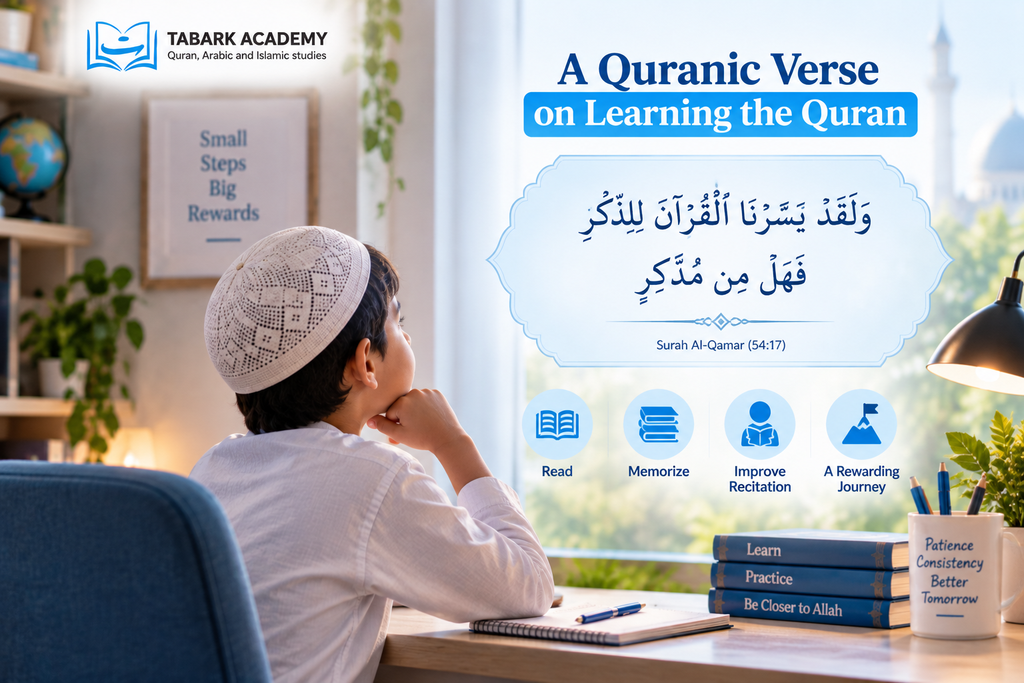
A Quranic Verse on Learning the Quran
Learning the Quran is a rewarding journey that requires patience, consistency, and trust in Allah. Whether you are beginning to read, memorizing new verses, or improving your recitation with Tajweed, every step you take brings you closer to the words of Allah.
Allah says:
وَلَقَدْ يَسَّرْنَا الْقُرْآنَ لِلذِّكْرِ فَهَلْ مِن مُّدَّكِرٍ
“And We have certainly made the Quran easy to remember. So is there anyone who will be mindful?”
This verse is repeated four times within Surah Al-Qamar, emphasizing that Allah has made memorizing and understanding the Quran genuinely achievable – for adults and children alike – when the right method and consistency are used.
For a child, that process may begin with listening to a single ayah, repeating short words, or learning a few Arabic letters. Small and consistent steps can gradually develop into confident reading and memorization as the child becomes more familiar with the Quran.
A Hadith on Learning and Teaching the Quran
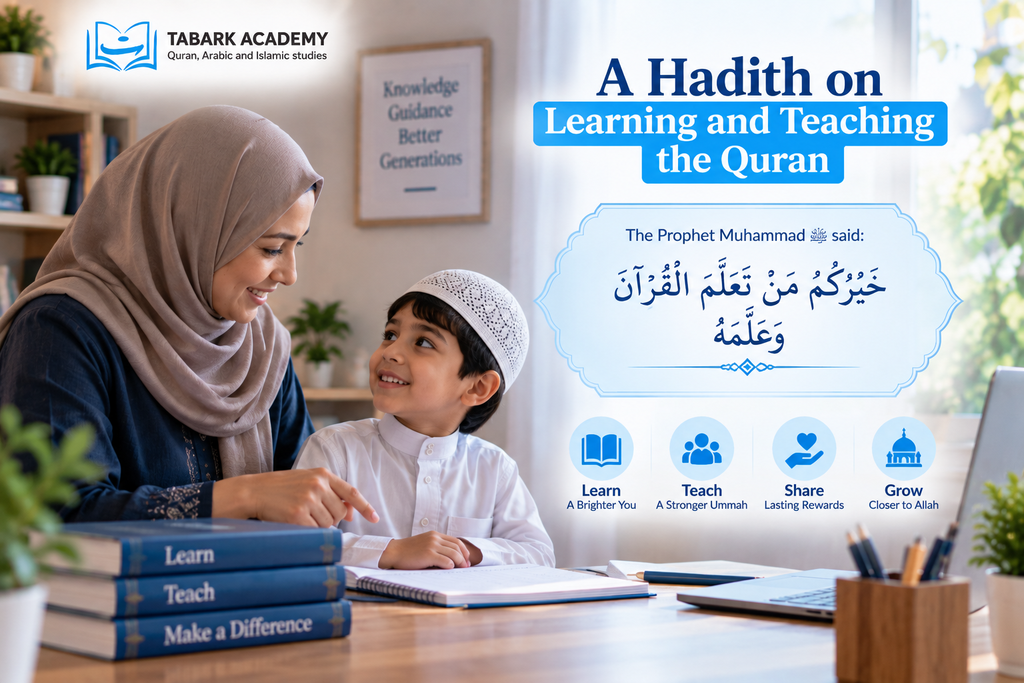
The Quran is the word of Allah and a source of guidance, mercy, and wisdom for all believers. Learning it is a noble journey that brings spiritual growth, while teaching it allows its light and guidance to reach others.
Islam encourages Muslims to dedicate themselves to understanding the Quran and sharing its knowledge with sincerity and humility.
The Prophet Muhammad ﷺ said:
خَيْرُكُمْ مَنْ تَعَلَّمَ الْقُرْآنَ وَعَلَّمَهُ
“The best among you are those who learn the Quran and teach it.”
This Hadith is one of the most frequently cited motivations for parents who want their children to grow up connected to the Quran, and it applies just as much to learning through a live online class as it does to learning in person.
Parents can support this learning even when they are not qualified Quran teachers themselves. Creating a consistent routine, encouraging practice, listening to the child’s progress, and choosing suitable instruction are all practical ways to make Quran learning a regular part of family life.
How to Keep Your Child Engaged in Online Quran Classes
Even the best teacher and online learning platform will have limited impact if a child feels bored, distracted, or reluctant to participate. Engagement is therefore an important part of understanding How Your Child Benefits From Online Quran Learning? because many of the advantages of online education depend on the child attending consistently, interacting with the teacher, and practicing what they learn between lessons.
Keeping children engaged does not mean that every Quran class needs to feel like entertainment. The goal is to create an environment where the child feels comfortable, understands what is expected, and can see their own progress.
The strategies below are commonly used in online Quran learning and can also be reinforced by parents at home.
1. Choose the Right Teacher and Format
The teacher is one of the biggest factors affecting your child’s engagement. A good Quran teacher for children needs more than knowledge of recitation, Tajweed, or memorization.
They should also know how to explain mistakes patiently, adjust their language to the child’s age, recognize when concentration begins to fall, and change the pace of the lesson when necessary.
The right teacher should make the child feel comfortable asking questions and attempting difficult words without being afraid of mistakes.
Look for an academy such as Tabarak Academy that offers certified teachers experienced specifically with children, and consider starting with a free trial lesson to see whether the teacher’s personality, teaching style, and lesson format suit your child before committing.
2. Keep Sessions Short and Age-Appropriate
Younger children usually benefit from shorter lessons because their ability to maintain concentration is still developing.
For children between four and seven years old, a session of around fifteen to twenty minutes may be more manageable, while older children may be comfortable with lessons of around thirty minutes depending on their attention span and learning level.
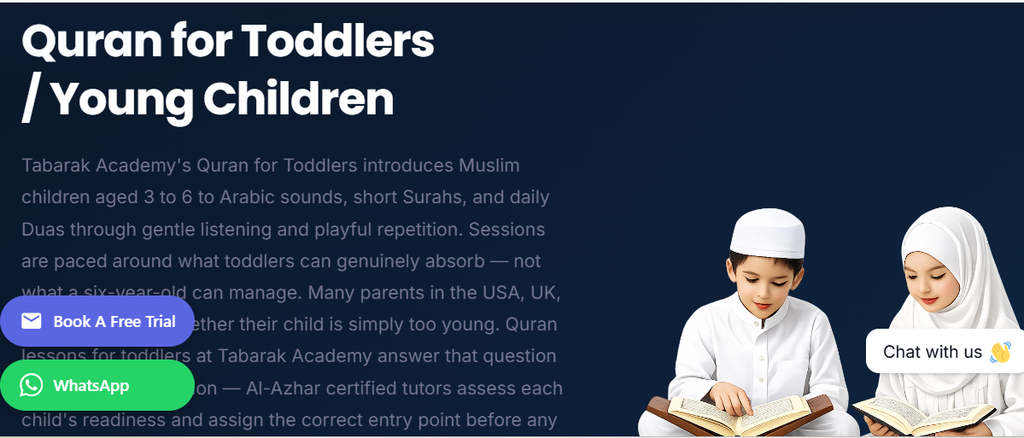
Programs created specifically for very young learners, such as a Quran course for toddlers, can take these shorter attention spans into account from the beginning.
Short, consistent sessions can often be more productive than long, irregular ones because they reduce mental fatigue and make Quran learning easier to fit naturally into the child’s routine.
3. Create a Distraction-Free Learning Space
Set up a quiet, clean corner that your child can associate specifically with Quran learning. Remove distracting toys, turn off the television, silence unnecessary device notifications, and make sure the computer or tablet is being used only for the lesson while the class is taking place.
The learning area does not need to be a separate study room. A familiar desk or quiet corner can work well as long as interruptions are minimized. Prepare the Mushaf, notebook, headphones, pencils, and other learning materials before class so valuable lesson time is not lost searching for them.
4. Build a Consistent Routine
Children often respond well to predictability. Scheduling Quran lessons at approximately the same time on learning days can help your child understand that Quran study is a normal and expected part of the routine rather than an activity that appears unexpectedly.
You might schedule lessons after a meal, after a prayer, or at another time when your child is normally alert and relaxed. A regular schedule also makes home revision easier because the child gradually becomes accustomed to Quran practice happening at a familiar point in the day.
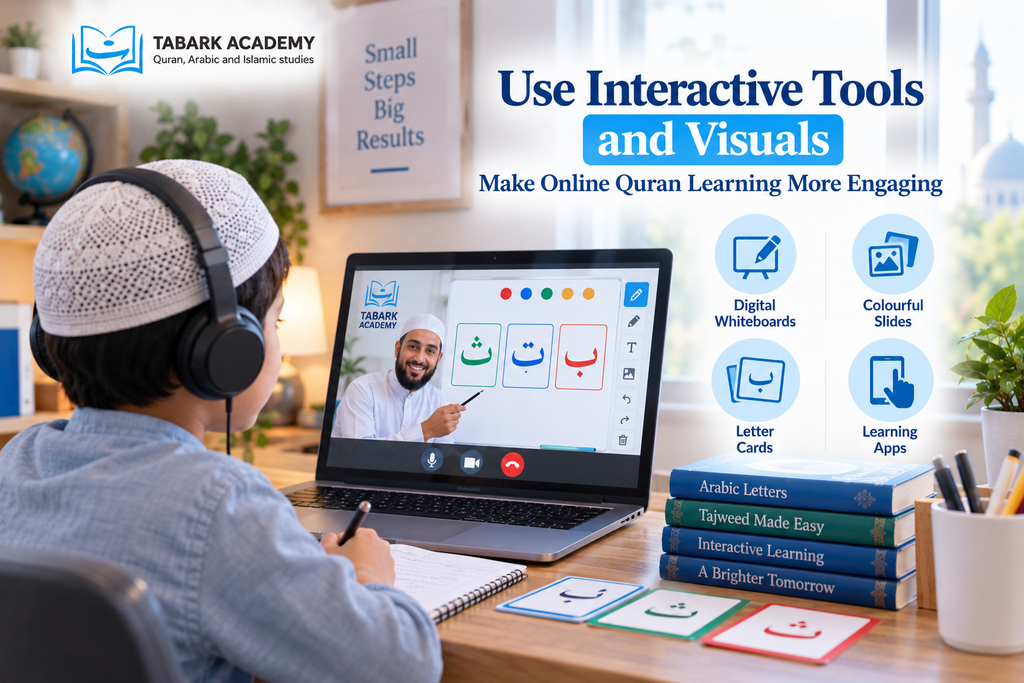
5. Use Interactive Tools and Visuals
Digital whiteboards, colourful slides, letter cards, and appropriate Quran learning apps can make online lessons more interactive. Visual aids are particularly useful for children because they provide something concrete to focus on while the teacher explains a letter, word, Tajweed rule, or concept.
For beginners, a teacher might highlight similar Arabic letters, separate words into smaller parts, or demonstrate visually how letters connect. Older children learning Tajweed may benefit from seeing particular rules highlighted while they recite.
These tools should support the learning objective rather than become distractions themselves.
6. Use Games and Small Rewards
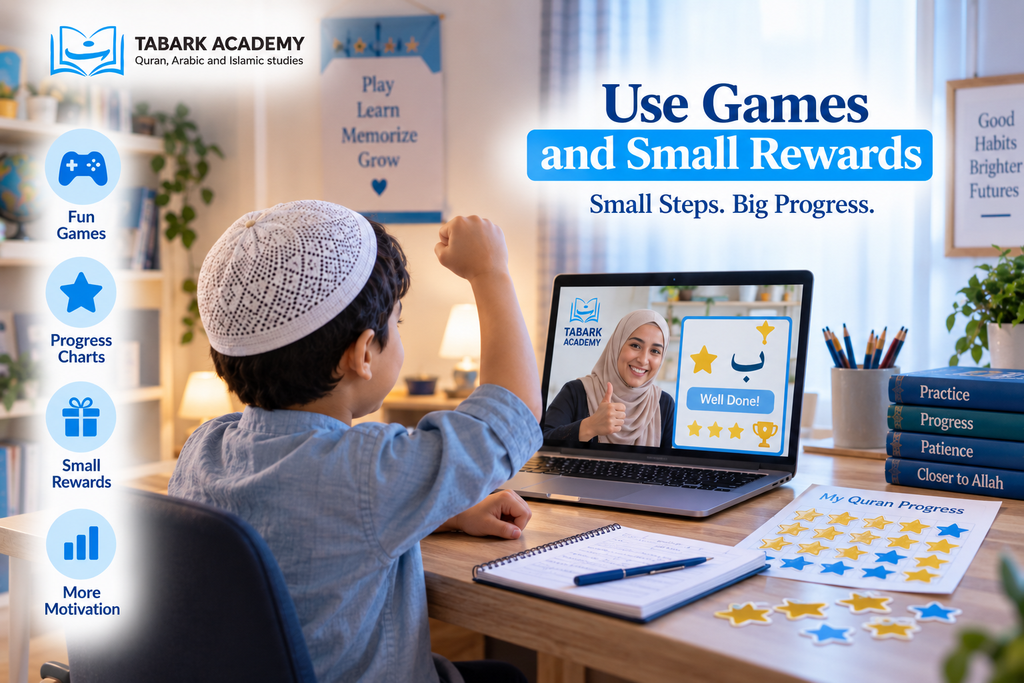
Simple games can make repetition and memorization more enjoyable, particularly for younger learners. A digital star chart, for example, might allow a child to earn a star for completing a memorization target, correcting a difficult letter, reviewing a previous Surah, or remaining focused throughout the lesson.
Rewards do not need to be expensive or offered after every class. A favourite activity, extra playtime, or another small privilege can be enough.
The purpose is to make progress visible and give younger children a simple goal to work toward while their internal motivation for Quran learning continues to develop.
7. Connect Verses to Stories and Values
Children naturally respond to stories, so connecting Quran learning with age-appropriate meanings and lessons can make memorization much more engaging.
When introducing a new Surah or passage, explain its general message in simple language and, where appropriate and reliably known, discuss the relevant context or lessons connected with it.
This helps Quran learning become more meaningful than simply repeating unfamiliar sounds. Parents can reinforce these lessons outside class by discussing Quranic values such as gratitude, patience, kindness, honesty, and reliance on Allah in situations the child can understand.
8. Praise Effort, Not Just Results
Celebrate small improvements instead of waiting for perfect recitation. Praise your child for concentrating, repeating a difficult word, remembering a previous correction, completing revision, or continuing to try when an ayah feels challenging.
This is particularly important during Tajweed and pronunciation correction. Children need mistakes to be corrected, but constant criticism without recognizing progress can make them nervous about reading aloud.
Combining correction with encouragement helps the child understand that improvement develops gradually through practice and patience.
9. Take Movement Breaks
Younger children may find it difficult to remain seated and focused for an extended period, even when they enjoy the lesson. A short movement break can help a restless child reset before returning to recitation or memorization.
A quick stretch, standing for a moment, or a few simple movements may be enough. Keep these breaks short and purposeful so that they refresh concentration without completely shifting the child’s attention away from Quran learning.
10. Track Progress Together
Work with the teacher to establish small, achievable learning goals that your child can understand. Depending on their level, this might mean learning five new Arabic letters, correcting a particular Makhraj, memorizing a short passage, or revising previously memorized Surahs.
Track these achievements using a simple chart or progress sheet so your child can see how far they have come. Clear milestones are one reason structured programs such as an online Hifz academy can be useful.
They also make parent-teacher communication more meaningful because parents can see what has been completed and what should be practiced next.
Read also: Quran Hifz Classes for Sisters – Everything You Need to Start Memorizing Today
11. Stay Patient and Positive
Every child learns at a different pace, and Quran learning is rarely perfectly linear. One child may memorize quickly but require additional pronunciation practice, while another may have strong Tajweed but need more repetition before new verses remain secure in memory.
Avoid showing frustration when your child forgets something they previously knew or struggles with a letter that seemed easy during an earlier lesson.
Patient repetition, consistent encouragement, and cooperation between parents and teachers help children understand that mistakes are a normal part of learning and that steady improvement matters more than immediate perfection.
A Simple Repetition Method for Memorizing the Quran
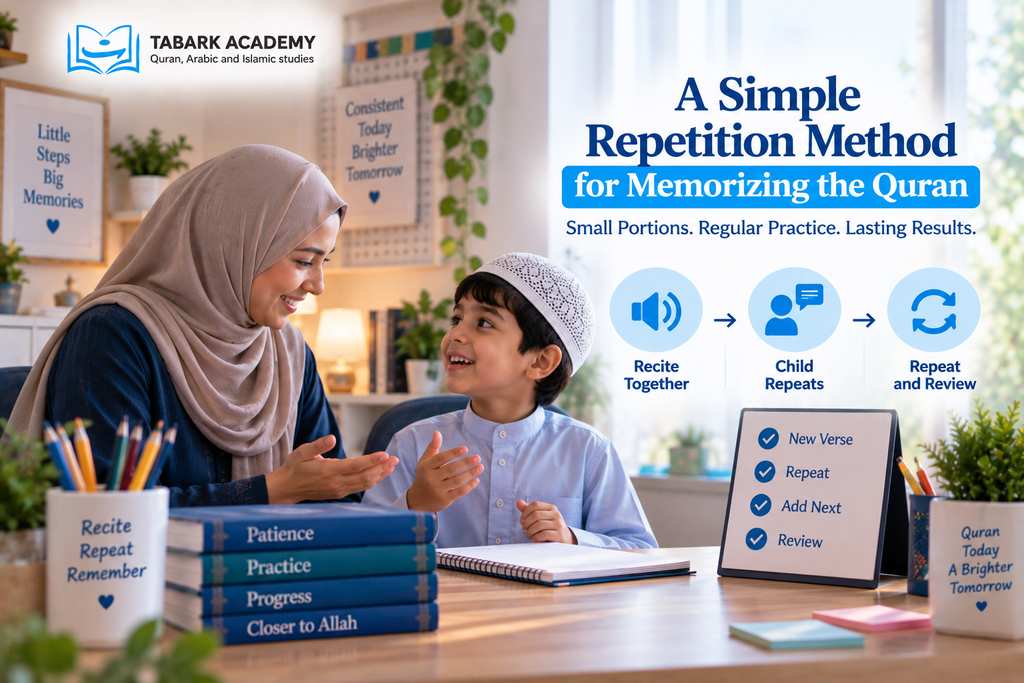
Repetition-based memorization is one of the most effective and widely used methods for helping children memorize the Quran, and it is simple enough for a parent to reinforce at home between lessons.
The key is to work with small portions rather than expecting a child to memorize an entire passage at once. Each new verse should become reasonably secure before another verse is added, while previously memorized material continues to be reviewed.
- Recite the first verse aloud several times in front of the child, then have the child repeat it until it is memorized correctly and firmly retained.
- Memorize the second verse using the same method, repeating it more than once.
- Recite both verses together three times, then move on to the next verse using the same cycle.
This cycle – memorize, repeat, combine – builds a chain of verses the child can recall confidently, rather than isolated lines that are quickly forgotten.
Parents can also ask the child to recite previously memorized verses before beginning new material. This keeps revision connected to new memorization and makes it easier to identify weak sections before they are forgotten.
Practical Tips for Helping Your Child Memorize Quran at Home
Alongside live lessons, a few simple habits at home can make a noticeable difference in how quickly and confidently a child memorizes the Quran. The aim is not to turn the home into another formal classroom or place unnecessary pressure on the child, but rather to create frequent, positive contact with the verses currently being studied.
Short periods of listening, repeating an ayah together, reviewing previously memorized Surahs, or reciting during a familiar part of the daily routine can reinforce what the teacher has already introduced.
Consistency is usually more valuable than occasional long revision sessions. Even a few focused minutes each day can help strengthen recall, improve pronunciation, and prevent previously memorized verses from becoming weak.
Parents can also encourage children by listening attentively, celebrating small improvements, and noting difficult words or ayahs that need to be reviewed with the teacher.
In this way, home practice complements the live Quran lesson rather than replacing it, giving the child regular opportunities to strengthen memorization in a relaxed and supportive environment.
- Encourage your child consistently and offer a small reward when a section of memorization is completed.
- Create friendly memorization competitions between siblings to build motivation and a healthy sense of competition.
- Be a good role model – children naturally imitate parents who read and review the Quran themselves.
- Play recordings of the verses your child is memorizing frequently at home, which reinforces retention and speeds up recall.
- Time lessons when your child is alert, not after a long school day.
- Keep the learning space quiet and free from noise or distractions.
- Give your child their own personal copy of the Quran (mushaf) to memorize from, and avoid changing it, since familiarity with the same page layout supports faster recall.
- Consider starting before school age if your child responds well to early learning, since some children are able to memorize very quickly at this stage.
These habits work best when they complement the child’s lessons rather than overwhelm them with additional work. A few focused minutes of review can often be more manageable than asking the child to complete another long study session after class.
If you would rather have expert guidance instead of managing memorization alone, this guide to memorizing the Quran by yourself is a useful starting point, and many families choose to pair independent home practice with a live, structured online Hifz program for faster and more consistent progress.
Adults working on their own memorization alongside their children can also find a suitable path through the best online Hifz program or a dedicated Quran course for adults.
Watch More of Our Live Sessions
To see how these engagement strategies look in a real, ongoing class, watch this additional clip from one of our live sessions: watch the second video here.
Observing an actual lesson can give parents a clearer idea of how correction, repetition, encouragement, and teacher-student interaction work together during online Quran learning.
Step Inside Our Virtual Classrooms
See our engaging teaching methods in action! watch real snippets of our live classes and discover how our expert instructors make learning interactive, memorable, and inspiring for every student.
Start Your Quran Learning Journey Today
Whether you want your child to learn Quran reading, improve their Tajweed through a Tajweed with Quran course for kids, or memorize the Quran with proper guidance, Tabarak Academy provides personalized online classes with qualified teachers.
The right program can adapt to where your child is now rather than expecting every learner to begin at exactly the same point. A beginner may focus on letters and basic reading, while another child may need Tajweed correction or a structured memorization plan.
Join Tabarak Academy today for structured online lessons with qualified tutors, customized to fit your goals. Families can choose a learning path according to the child’s age, current Quran level, and whether the main goal is reading, Tajweed, or memorization.

| Start Your Quran Learning JourneyJoin Tabarak Academy today for structured online lessons with qualified tutors, customized to fit your goals.Book Your Free Trial Lesson |
Our Quran Courses
- Online Quran Classes
- Online Quran Classes for Beginners
- Online Quran Classes for Kids
- Online Quran Classes for Adults
- Online Quran Classes for Men
- Online Quran Classes for Sisters
- Quran Reading Course
- Quran Recitation Course
- Online Ijazah Course
- Online Qirat Course
- Quran for Toddlers / Young Children
- Weekend Quran Classes
- Intensive Quran Course
- Al-Azhar Quran Course
- Zoom Quran Classes
- Noor Al-Bayan Course
Conclusion
Online Quran learning benefits a child in ways that go well beyond convenience: focused one-on-one attention, access to qualified and certified teachers, easier parental oversight, and interactive tools that keep lessons engaging rather than tedious.
Flexible scheduling can make consistent Quran education easier to maintain, while immediate teacher correction helps children improve pronunciation and memorization progressively.
Paired with a consistent routine, a distraction-free space, and simple repetition-based memorization at home, a child can progress steadily and confidently through the Quran.
Parents also remain closely involved in the process, allowing them to understand what their child is learning and reinforce those skills between lessons.
As the Hadith cited earlier reminds us, learning and teaching the Quran carries real, lasting value – and choosing the right online program, such as Tabarak Academy, is one of the most practical ways for a busy family to give their child that foundation.
Ultimately, understanding How Your Child Benefits From Online Quran Learning? means looking at the complete learning experience: the quality of the teacher, individual attention, consistent practice, parental involvement, age-appropriate teaching, and a structure that allows the child to progress without unnecessary pressure.
FAQs
Is online Quran learning effective for young children?
Yes, online Quran learning is effective for young children when lessons are kept short, interactive, and taught by a teacher experienced with kids. One-on-one correction and a consistent routine can make the learning process easier to sustain, particularly when parents reinforce what was taught between lessons.
A dedicated toddlers’ course can also provide a format built specifically around a young child’s attention span and early learning needs.
What age can a child start learning Quran online?
Many programs, including a Quran course for toddlers, accept children as young as three or four for basic listening and repetition. At this stage, the focus can remain simple and age-appropriate rather than expecting a young child to manage long formal lessons.
Formal memorization programs, such as a Hifz course for kids, typically begin once a child can recognize basic Arabic letters, usually around age five or six.
How long should an online Quran class be for a child?
Fifteen to twenty minutes suits many children aged four to seven, while thirty minutes is generally appropriate for older children. Short, consistent sessions prevent burnout and keep a child looking forward to the next lesson.
However, lesson length should also reflect the individual child’s concentration and progress. Some children can remain engaged for longer, while others benefit from shorter lessons or brief breaks.
Is a one-on-one online class better than a group class for kids?
A one-on-one class generally allows more individualized attention for children, since the teacher’s full attention goes to a single student, mistakes can be corrected immediately, and the pace matches the child’s own ability rather than an average class pace.
Group classes can still provide valuable social interaction and shared learning, but individual lessons are particularly useful when a child needs focused pronunciation correction, personalized memorization targets, or extra help with specific Quran reading skills.
Does the Quran or Sunnah encourage parents to teach their children the Quran?
Yes. The Hadith “The best among you are those who learn the Quran and teach it” (Sahih al-Bukhari 5027) is widely cited in discussions about the virtue of learning and teaching the Quran.
Parents can support their children’s Quran education through direct teaching when qualified, arranging suitable instruction, encouraging regular practice, and creating a home environment in which Quran reading and memorization are valued.
Are online Quran classes safe for children?
Online classes let parents sit nearby or review a session afterward, offering direct visibility into the child’s learning experience. Parents can observe how the teacher communicates, how corrections are delivered, and whether their child feels comfortable during the lesson.
Choosing a reputable academy with clear teaching standards and qualified instructors, such as Tabarak Academy, can add further structure and accountability. Parents can also contact the academy or learn more about Tabarak Academy before enrolling their child.