


10 Benefits of Tajweed: Why Reading Quran with Tajweed Matters
Reading the Quran with proper Tajweed is one of the most valuable skills a Muslim can develop. Tajweed is the set of rules that governs the correct pronunciation of Arabic letters, their articulation points (makharij), their characteristics (sifat), and the way letters interact with one another during continuous recitation.
Learning these rules helps Muslims approach Quran recitation with greater accuracy, care, and confidence.
The benefits of tajweed go far beyond correct pronunciation. Tajweed can help protect the words of the Quran from recitation errors, encourage slower and more thoughtful reading, strengthen memorization, improve familiarity with Arabic sounds, and help the reciter develop a deeper connection with the words of Allah.
For beginners in particular, learning Tajweed gradually can turn Quran reading from a difficult decoding process into a more natural and structured act of worship.
Instead of trying to correct many mistakes at once, learners can develop their recitation step by step, beginning with individual letters and progressing toward complete verses and longer passages.
In this article, we’ll explore the benefits of reading Quran with tajweed, look at what the Quran and authentic Sunnah say about careful recitation, and explain how you can start learning Tajweed the right way, whether you’re a beginner, a parent looking for classes for your child, or a sister seeking a female-only learning environment.

What You Will Learn
• What Tajweed means and why it matters for every reciter of the Quran
• The specific spiritual, linguistic, and practical benefits of learning tajweed
• What the Quran and authentic hadith teach about reciting with tajweed
• How to begin learning tajweed correctly, step by step
• Where you can start structured, guided tajweed lessons online
10 Benefits of Tajweed and Reading the Quran with Tajweed
Reading the Quran correctly is about more than pronouncing Arabic words clearly. The way each letter is articulated, how long certain sounds are held, and where the reciter pauses all contribute to preserving the Quranic recitation and reading the words of Allah with greater care and attention.
This is where Tajweed becomes essential. Learning its principles can improve accuracy, build confidence in recitation, support reflection, and help Muslims develop a more consistent relationship with the Quran.
Before exploring the benefits of tajweed and the benefits of reading Quran with tajweed, it is important to understand what Tajweed actually means and what it is designed to achieve.
What Is Tajweed?
Tajweed is the science of reciting the Quran correctly, giving every Arabic letter its rightful articulation point and characteristics while following the pauses and rules transmitted from the Prophet ﷺ through an unbroken chain of reciters.
The word “tajweed” literally means “to make better” or “to improve,” and that is exactly its purpose: to protect the tongue from mistakes (lahn) that could distort the meaning of the Quran.
Allah commanded the Prophet ﷺ directly to recite the Quran in this measured, deliberate way:
وَرَتِّلِ الْقُرْآنَ تَرْتِيلًا
“And recite the Qur’an with measured recitation.”
Scholars have explained that “tarteel” in this verse refers precisely to tajweed — reciting with correct articulation and awareness of the proper stopping points.
Understanding this foundation makes it easier to appreciate why the benefits of tajweed are so significant for every reciter of the Quran.
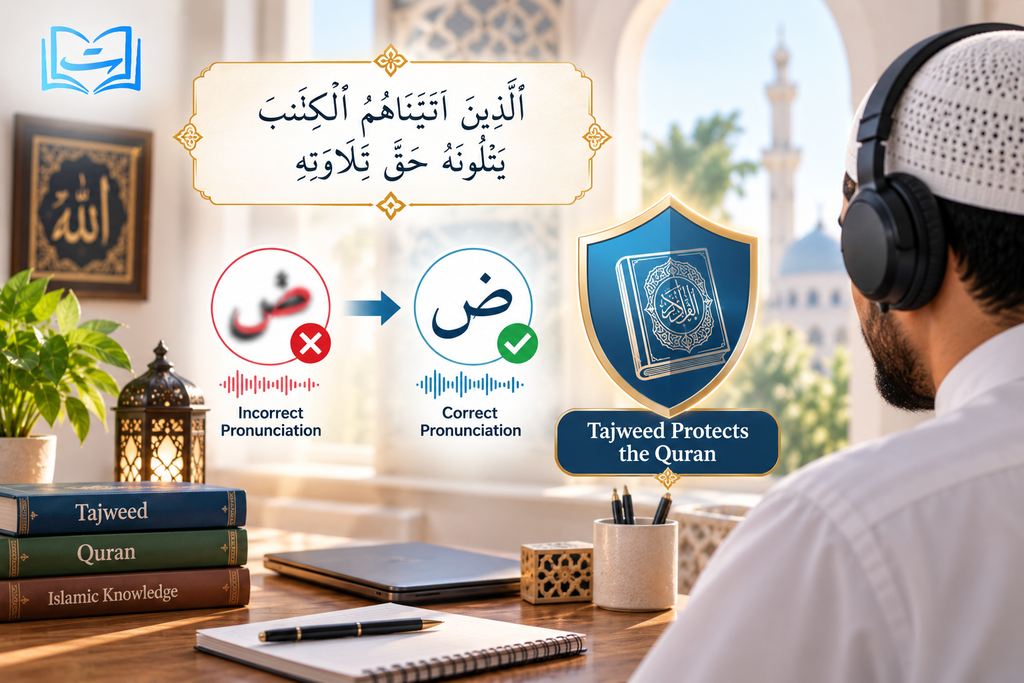
1. Tajweed Protects the Quran from Mispronunciation and Distortion
One of the greatest benefits of tajweed is that it safeguards the wording of the Quran from errors in pronunciation. Arabic is a precise language, and changing the articulation of a letter, shortening or lengthening a sound incorrectly, or confusing similar letters can sometimes change the word being recited and potentially affect its meaning.
Tajweed gives the learner a practical system for avoiding these mistakes. Instead of relying only on how a word appears on the page, students learn where each letter originates, how it should sound, how long particular vowels should be held, and what happens when certain letters meet during connected recitation.
This is especially important with Arabic letters that may initially sound similar to non-native speakers. Learning to distinguish letters through their correct articulation points and characteristics gradually trains both the tongue and ear.
With consistent practice, the learner becomes better able to hear an incorrect sound and correct it before it develops into a permanent habit.
Tajweed rules therefore exist specifically to prevent this kind of lahn, or recitation error, from creeping into Quran reading. Allah says:
الَّذِينَ آتَيْنَاهُمُ الْكِتَابَ يَتْلُونَهُ حَقَّ تِلَاوَتِهِ
“Those to whom We have given the Book recite it as it should be recited.”
Learning the correct articulation points (makharij al-huruf) is one of the foundations of accurate Quran reading. Beginners can explore these articulation points in greater detail in our guide to the seventeen articulation points of Arabic letters.
Structured courses such as Qaida with Tajweed are designed specifically to build this foundation from the earliest stages of Quran reading. Developing accurate pronunciation early can be much easier than memorizing words incorrectly and attempting to correct established habits later.

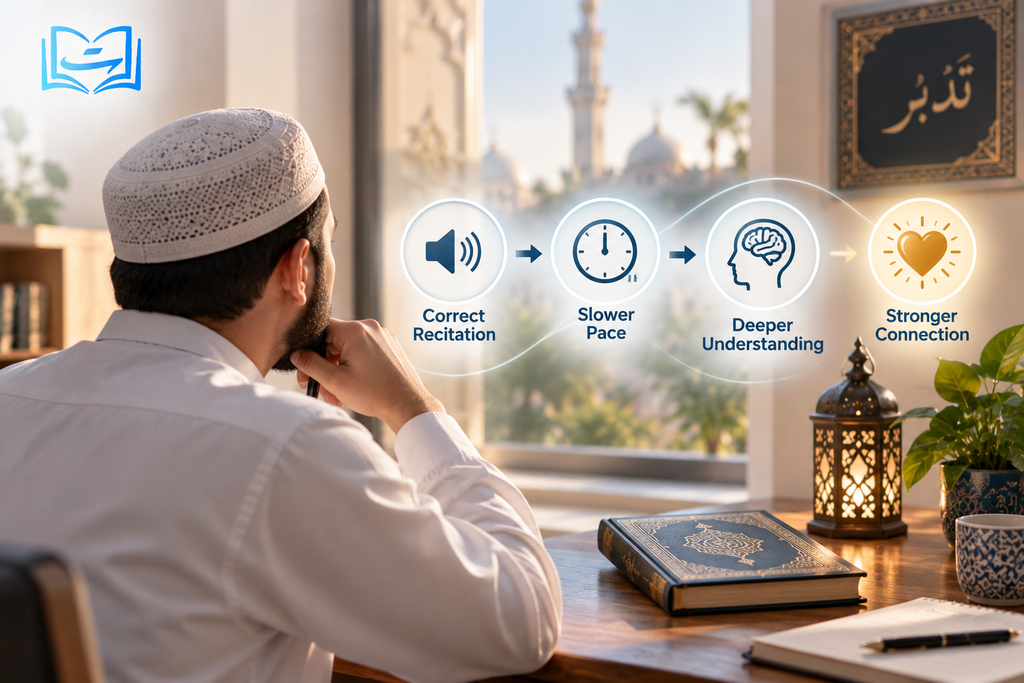
2. Tajweed Deepens Understanding and Reflection (Tadabbur) of the Quran
Another of the important benefits of reading the Quran with tajweed is that correct, unhurried recitation naturally encourages the reader to slow down.
Instead of moving quickly through verses simply to complete a certain number of pages, Tajweed asks the reciter to pay attention to letters, elongations, stops, pauses, and transitions between words.
That slower pace can create valuable space for reflection. Once a learner becomes increasingly comfortable with pronunciation, attention can begin shifting from the mechanics of producing each sound toward the meanings of the verses themselves.
This does not mean that Tajweed automatically produces tadabbur. Understanding the Quran also requires learning its meanings, context, vocabulary, and explanation.
However, careful recitation can support reflection by preventing the Quran from becoming something the reader simply rushes through without pausing to consider what is being recited.
Allah says:
كَذَٰلِكَ لِنُثَبِّتَ بِهِ فُؤَادَكَ وَرَتَّلْنَاهُ تَرْتِيلًا
“…thus [We revealed it] that We may strengthen your heart with it, and We have recited it thoroughly.”
Students studying through guided programs such as the Online Tajweed Classes at Tabarak Academy can work on pronunciation and practical rule application under direct guidance.
As the mechanics of recitation become more familiar, students can devote more attention to following the meaning and reflecting on the verses they read.
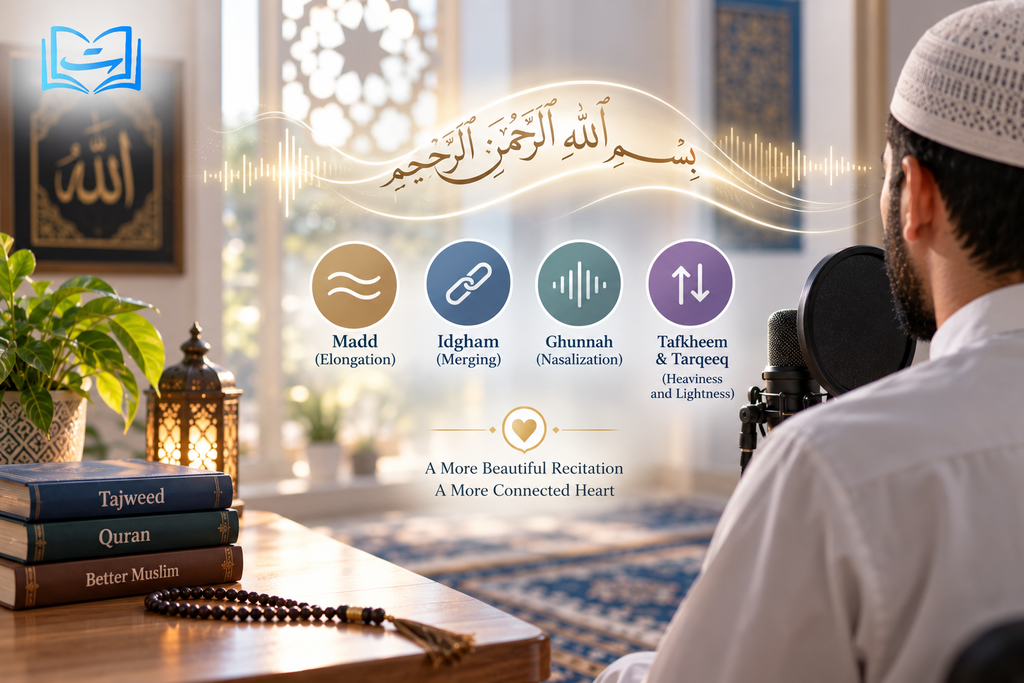
3. Tajweed Beautifies the Recitation and Captivates the Heart
At its linguistic core, Tajweed carries the meaning of improving or making something excellent, and one of the most noticeable benefits of tajweed is the clarity and beauty it brings to Quran recitation.
Rules such as madd (elongation), idgham (merging), ghunnah (nasalization), and tafkheem and tarqeeq (heaviness and lightness) are not random additions to the recitation. They regulate how Quranic Arabic is pronounced and help give each letter and sound its proper quality.
When these rules are applied correctly, recitation can become clearer, smoother, and more pleasant to hear. Rather than forcing an artificial melody onto the Quran, the reciter learns to preserve the natural qualities of its letters and words while beautifying the voice appropriately.
The Prophet ﷺ encouraged Muslims to beautify their voices when reciting the Quran:
زَيِّنُوا الْقُرْآنَ بِأَصْوَاتِكُمْ
“Beautify the Quran with your voices.”
Sunan Abi Dawud 1468
If you’d like to hear how Tajweed sounds when applied in practical recitation, this short Tajweed video demonstrates practical application in an easy-to-follow format.
4. Tajweed Strengthens Arabic Language Skills
Learning Tajweed can also strengthen a learner’s familiarity with Arabic sounds and pronunciation. Students repeatedly practice individual letters, short and long vowels, letter characteristics, connected speech, and the differences between sounds that may initially appear very similar.
For non-Arabic speakers, this can be particularly valuable. A student who once struggled to distinguish letters such as ح and ه, س and ص, or ت and ط gradually learns that these sounds originate from different articulation points and possess different characteristics.
Many Tajweed topics also intersect with Arabic phonetics and reading conventions. Rules involving hamzat al-wasl and hamzat al-qat’, for example, help learners understand how words behave when beginning or continuing recitation.
Likewise, studying idgham, izhar, vowels, sukoon, and shaddah strengthens awareness of how Arabic letters interact in connected speech.

Tajweed itself is not a substitute for studying Arabic vocabulary or grammar, but the pronunciation foundation it provides can make further Arabic study easier.
For learners who want to strengthen this connection through direct recitation practice rather than theory alone, the Tajweed Amali Practice course focuses specifically on applied Tajweed and practical correction.
Read also: Is Arabic A Difficult Language To Learn?
5. Tajweed Helps You Follow the Sunnah of the Prophet ﷺ
The Quran was not transmitted to the Muslim community as written text alone. The Prophet Muhammad ﷺ recited it, and the Companions learned the Quran through listening, reciting, memorizing, and receiving correction.
This oral dimension remains central to Tajweed education today. A student may understand the written definition of a makhraj or Tajweed rule but still pronounce it incorrectly because subtle differences in articulation are often easier to recognize by hearing them and receiving immediate correction.
That is why Tajweed has traditionally been taught through talaqqi — direct learning from a teacher. The student recites, the teacher listens carefully, and errors are corrected before they become established habits.
Following Tajweed rules today therefore connects the learner with a long tradition of Quran teaching based on listening and correction. Books, videos, charts, and apps can all be useful learning aids, but they are strongest when combined with guided recitation.
This is also the model followed in one-on-one guided lessons such as Tabarak Academy’s live Online Tajweed Classes, where students can recite directly to a tutor and receive correction during the lesson.

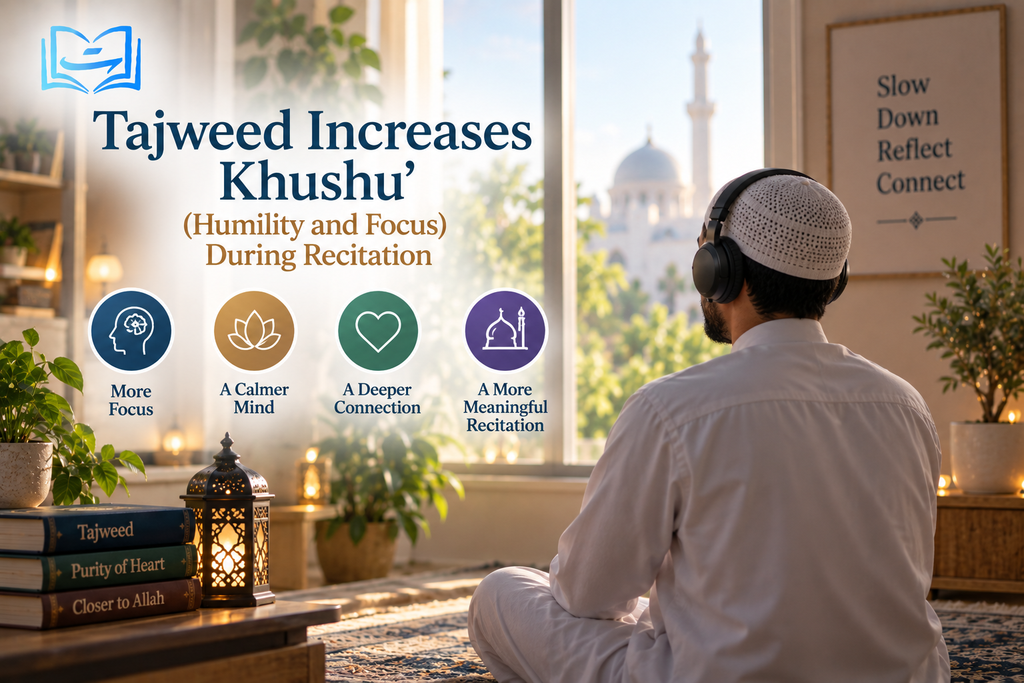
6. Tajweed Increases Khushu’ (Humility and Focus) During Recitation
One of the spiritual benefits of reading the Quran with tajweed is the way careful recitation can encourage greater focus. When the reader deliberately gives each letter its right, observes elongations, respects stopping points, and avoids rushing, recitation becomes a more attentive activity.
Rushing can make it easy for the tongue to continue while the mind becomes distracted. Tajweed encourages a more deliberate pace, requiring the reciter to remain conscious of what is being read and how it is being pronounced.
For some learners, this can support khushu’ — humility, attentiveness, and focused presence — during Quran reading and Salah. Instead of thinking primarily about reaching the end of a page or Surah, the reciter can concentrate on reading each passage carefully and respectfully.
The environment also matters. Choosing a quiet time, reducing distractions, putting away unnecessary devices, and dedicating a consistent period to Quran reading can complement Tajweed practice and make focused recitation easier.
Over time, the combination of accurate pronunciation, measured pacing, understanding, and regular practice can help Quran reading feel less like a task to finish and more like a meaningful period of worship and reflection.
7. Tajweed Makes Memorization (Hifz) Easier and More Accurate
Tajweed and Hifz are closely connected because memorization is not simply about remembering written words. A memorizer is also storing the sound, rhythm, pronunciation, and sequence of the verses.
When a verse is repeatedly memorized with an incorrect pronunciation, that incorrect version can become deeply embedded in memory. The student may later know the verse confidently but still need significant correction because the tongue has become accustomed to reproducing the same error.
Learning Tajweed from the beginning helps reduce this problem. Correct pronunciation becomes part of the memorized verse itself. Repeatedly hearing and producing the same accurate sounds also develops what learners often describe as “muscle memory” for recitation.
This is particularly useful for children. Young learners can develop pronunciation habits quickly, so teaching them correct articulation, vowels, elongations, and basic Tajweed alongside memorization can establish a much stronger foundation for future Quran study.
Programs designed specifically for younger learners, such as Tajweed for Kids, can help children learn these skills progressively rather than waiting until after they have memorized large portions of the Quran to begin correcting their recitation.
Read Also: How Long Does It Take To Memorize One Page Of Quran?

Experience Our Interactive Learning
Curious about how we teach? Watch these brief video clips from our recent live sessions to see our structured curriculum, advanced learning platform, and dynamic student-teacher interactions firsthand.
8. Tajweed Helps Students Approach Authentic Qira’at Correctly
Tajweed also provides an important foundation for students who later study the authentic qira’at, or canonical modes of Quran recitation.
The qira’at are not simply different accents or personal styles of reading. They are transmitted recitation traditions with established chains and specific rules governing pronunciation, vowels, elongations, and other aspects of recitation.
For that reason, a learner should not treat every unfamiliar pronunciation heard online or elsewhere as an error, nor should they imitate a different reading without understanding its transmission and rules.
A solid foundation in Tajweed helps students understand that Quran recitation is based on transmitted knowledge rather than personal preference.
At more advanced stages, qualified teachers can explain how Tajweed rules operate within a particular riwayah and how recognized readings differ from mistakes or unsupported variations.
This is a more advanced benefit of Tajweed study and demonstrates why Quran recitation education can continue far beyond mastering beginner rules. Sisters who want structured instruction with a learning environment designed for women can also explore Online Tajweed Classes for Ladies.

9. Tajweed Supports Rewarded, Careful Recitation
Reciting the Quran is an act of worship, and learning to recite it accurately is a meaningful part of a Muslim’s relationship with the Book of Allah. One of the encouraging aspects of learning Tajweed is that difficulty at the beginning should not discourage the learner.
The Prophet ﷺ described the reward of the proficient reciter as well as the reward of the person who struggles while continuing to recite:
الْمَاهِرُ بِالْقُرْآنِ مَعَ السَّفَرَةِ الْكِرَامِ الْبَرَرَةِ، وَالَّذِي يَقْرَأُ الْقُرْآنَ وَيَتَتَعْتَعُ فِيهِ وَهُوَ عَلَيْهِ شَاقٌّ لَهُ أَجْرَانِ
“The one who is proficient in reciting the Qur’an is with the noble, righteous scribes (angels), and the one who recites the Qur’an and stumbles over it, finding it difficult, will have a double reward.”
Sahih al-Bukhari 5027
This hadith is especially encouraging for beginners. A learner may struggle to produce a difficult letter, repeatedly forget a Tajweed rule, or need several attempts before reading a verse smoothly. That difficulty does not mean the learning process has failed.
Instead of comparing their recitation with someone who has studied for years, beginners can focus on consistent improvement: correcting one letter, mastering one rule, or reading a short passage more accurately than they could the previous week.
The journey itself can therefore become an ongoing act of worship, effort, and learning.

Read also: Parenting Styles In Islam – How Each One Affects Your Child?
10. Tajweed Nurtures Spiritual Peace and Emotional Well-Being
Many Muslims experience Quran recitation as a source of calm, comfort, and spiritual reassurance. Tajweed can support this experience because it encourages the reciter to slow down, concentrate on each word, regulate the pace of reading, and give the Quran undivided attention.
Instead of racing through several pages, the reader may spend more time on a smaller passage, repeating difficult verses, listening carefully to their pronunciation, and reflecting on the meaning. This slower approach can make Quran reading feel more deliberate and restorative.
The benefit is not merely the pleasant sound of recitation. Tajweed helps establish a structured relationship with the Quran in which listening, reading, correction, repetition, and reflection can become part of a regular routine.
For sisters in particular, having access to a comfortable learning environment can make maintaining that routine easier. Programs and guidance such as Online Quran Classes for Sisters can help women explore learning options that fit their level, schedule, and preference for female instruction.

Taken together, these benefits of tajweed show why Tajweed should not be viewed merely as a collection of technical rules. Its purpose is ultimately to help Muslims approach Quran recitation with greater accuracy, attention, consistency, and respect.
What Is the Ruling on Learning Tajweed?
The ruling on Tajweed is often explained by distinguishing between studying the detailed theoretical science of Tajweed and reciting the Quran correctly in practice.
Learning every technical definition, classification, and advanced detail of Tajweed is commonly discussed as a communal responsibility (fard kifayah) because the Muslim community needs qualified people who preserve, teach, and transmit the science of Quran recitation.
At the individual level, the priority is avoiding clear pronunciation mistakes when reciting, particularly mistakes that alter letters or words. This is why beginners should not feel that they must memorize an entire Tajweed textbook before they can begin reading the Quran.
The practical path is gradual. A student can begin by correcting the articulation of Arabic letters, distinguishing similar sounds, learning short vowels and basic reading signs, and then adding Tajweed rules progressively.
This distinction is important: you are not expected to master every advanced rule immediately, but learning to pronounce the Quran correctly should remain an important goal for every reciter.
Understanding the benefits of tajweed is important, but experiencing the real benefits of reading Quran with tajweed requires regular practice, correct guidance, and a clear learning method. Tajweed is an applied skill, so learners should combine theoretical study with listening, recitation, repetition, and direct correction.
Beginners do not need to learn every Tajweed rule at once. A more effective approach is to strengthen the foundations first and then move gradually toward complete Quran recitation.
This means learning Arabic letters and their correct articulation points, becoming familiar with short vowels and reading signs, and then applying Tajweed rules directly while reciting Quranic ayahs.

1. Start With a Strong Foundation Like Noorani Qaida
Tajweed like Noraani Qaida that learners are taught prior to teaching them Quran. However, a tutor is essential because they can help the students in learning the holy book in the best manner.
A foundational Qaida can help beginners become familiar with Arabic letters, connected forms, Fatha, Kasra, Damma, Sukoon, Shaddah, Tanween, and other essential reading patterns before they attempt longer Quranic passages.
This foundation is particularly useful for learners who cannot yet read Arabic confidently or who learned previously but still struggle with basic pronunciation.
Students can build these foundational skills progressively through Qaida with Tajweed, combining basic Quran reading with an introduction to correct Tajweed application.

2. Learn Tajweed With a Qualified Tutor
Learning the written definition of a Tajweed rule is different from being able to apply that rule correctly while reciting. A learner may understand where a letter should originate but still produce it incorrectly without realizing it. This is why listening and direct correction are particularly important.
A qualified tutor can listen for mistakes in Makharij, Sifat, Madd, Ghunnah, Tafkheem, Tarqeeq, stopping, and other aspects of recitation. More importantly, the tutor can identify recurring mistakes and help the learner correct them before they become established habits.
These days, you can come across multiple online Quran academies that teach students the right way of learning the Quran. You can master the Quran with Tajweed with the help of these academies.
Online learning can be particularly convenient for students who cannot easily access a qualified teacher locally. Live lessons allow students to recite directly to a tutor, receive immediate feedback, repeat difficult sounds, and follow a structured learning plan according to their current level.
Students looking for this type of direct guidance can explore Online Tajweed Classes at Tabarak Academy.
3. Use Tajweed Books Alongside Your Lessons
One great way to learn the rules of Tajweed is to discover great books that are written on Tajweed and then accompany the teachings of your tutor with the learnings from your book.
A reliable Tajweed book can serve as a useful reference between lessons. Students can return to explanations of rules such as Noon Sakinah and Tanween, Meem Sakinah, Madd, Qalqalah, Ghunnah, Tafkheem, Tarqeeq, and Waqf whenever they need additional revision.
Books, however, work best as a supplement rather than a replacement for direct recitation. Tajweed involves subtle sounds and articulation that written explanations alone cannot always communicate.
Study the rule in your book, listen to how it is pronounced, apply it to Quranic examples, and then recite those examples to your tutor for correction.

4. Listen Carefully to Correct Quran Recitation
You can also learn the Tajweed rules by listening to the recitation of Quran by your elders or experts.
Careful listening helps train the ear before the tongue. When learners regularly hear accurate Quran recitation, they become more familiar with the correct length of Madd, the sound of Ghunnah, the difference between heavy and light letters, appropriate stopping points, and the natural flow of Quranic Arabic.
Instead of listening passively, choose a short passage and follow along carefully. Listen to one ayah, pause the recording, and repeat it aloud. Pay attention to difficult letters and compare your pronunciation with what you hear.
Repeating the same passage several times can be more useful for Tajweed practice than listening to a large amount of recitation without actively imitating it.
5. Practice With a Tajweed Mushaf
One efficient method to learning the Quran with Tajweed is by using Tajweed Mushaf. Special copies of Quran are available that contain the signs and symbols of Tajweed.
A Tajweed Mushaf can make it easier for learners to recognize rules while they are actually reading rather than trying to remember every rule from theory. Depending on the edition, visual markings or colors may help identify places where particular Tajweed rules should be applied.
However, learners should gradually understand what the markings mean rather than depending entirely on colors. The goal is to recognize the rule, understand why it occurs, and eventually apply it naturally during recitation.
Choose a clear and readable Mushaf and, when possible, continue using the same copy during regular practice. Familiarity with its layout can also make daily recitation and revision more comfortable.

6. Practice Every Tajweed Rule With Real Quranic Ayahs
The most important method that needs to be paid consideration to is practice. The significance of practice cannot be overestimated when it comes learning Tajweed rules. You need to practice the rules that you learn by applying them to the ayahs of Quran.
This is where theoretical Tajweed becomes practical Tajweed. Knowing that a particular word contains Ikhfa, Idgham, Qalqalah, or Madd is only the first stage. You should be able to recognize the rule while reading and produce it correctly without interrupting the natural flow of recitation.
Rather than studying many rules at once, choose one rule and find several Quranic examples where it appears. Recite those examples repeatedly until the application becomes easier, then move on to another rule while continuing to review what you previously learned.
7. Recite Out Loud Instead of Practicing Silently
Tajweed is concerned with sound, so regular practice should include audible recitation. Reading silently may help with recognizing words, but it cannot fully reveal whether a letter is leaving from the correct makhraj or whether a Madd, Ghunnah, or heavy letter is being pronounced properly.
Reciting aloud allows you to hear your own voice and gives your tutor something concrete to assess. Start slowly and prioritize accuracy before speed. Fluency can develop gradually once correct pronunciation becomes more natural.
8. Record Your Recitation and Listen Back
Recording yourself is another useful addition to teacher-led practice. Choose a short Surah or several ayahs, record yourself reciting them, and then listen back carefully.
You may notice rushed vowels, unclear letters, inconsistent elongations, or stopping mistakes that were difficult to recognize while you were actively reciting.
Compare your recording with a reliable recitation and write down the specific areas you want to ask your tutor about.
9. Build a Simple Daily Tajweed Routine
Consistency is more valuable than studying Tajweed intensely once and then leaving it for several days. A simple daily routine can include a few minutes of pronunciation practice, listening to a short passage, reciting it slowly, repeating difficult words, and reviewing one previously learned rule.
Even a short but focused session gives your tongue repeated practice. As the weeks pass, Makharij, elongations, Ghunnah, and other rules can begin to feel increasingly natural rather than requiring conscious thought every time they appear.
10. Get Regular Correction Instead of Practicing Mistakes
Independent practice is valuable, but unnoticed errors can become permanent habits. Regular recitation to a qualified tutor ensures mistakes are caught early and corrected before they become established.
The best approach therefore combines all of these methods: build your foundation with Qaida, study with a qualified teacher, use reliable Tajweed books for revision, listen carefully to skilled reciters, follow a clear Tajweed Mushaf, practice rules using real Quranic ayahs, recite aloud, record yourself, and receive regular correction.
With consistent application, Tajweed gradually moves from something you have to consciously remember into something you naturally apply while reading. This is where many of the practical benefits of tajweed become increasingly noticeable in your accuracy, confidence, fluency, and overall Quran recitation.
This short Tajweed clip also provides a helpful visual introduction to foundational Tajweed practice for beginners.

Step Inside Our Virtual Classrooms
See our engaging teaching methods in action! watch real snippets of our live classes and discover how our expert instructors make learning interactive, memorable, and inspiring for every student.
How to Start Learning Tajweed the Right Way
Start Your Quran Learning Journey Today
Whether you want to learn Quran reading, improve your Tajweed, or memorize the Quran with guidance, Tabarak Academy provides personalized online learning options with qualified tutors.
A structured learning path can be particularly useful if you already know how to read Arabic but are unsure whether your Makharij, Madd, Ghunnah, stopping, or other Tajweed rules are being applied correctly.
Instead of practicing the same mistakes repeatedly, direct feedback helps you understand exactly what needs correction.
Children can build correct pronunciation habits from an early stage, while adults can begin at their existing level without needing to restart unnecessarily. Learners can then progress at a pace appropriate to their ability and schedule.

| Start Your Quran Learning JourneyJoin Tabarak Academy today for structured online lessons with qualified tutors, customized to fit your goals.Book Your Free Trial Lesson |
Our Quran Courses
- Online Quran Classes
- Online Quran Classes for Beginners
- Online Quran Classes for Kids
- Online Quran Classes for Adults
- Online Quran Classes for Men
- Online Quran Classes for Sisters
- Quran Reading Course
- Quran Recitation Course
- Online Ijazah Course
- Online Qirat Course
- Quran for Toddlers / Young Children
- Weekend Quran Classes
- Intensive Quran Course
- Al-Azhar Quran Course
- Zoom Quran Classes
Conclusion
The benefits of tajweed extend across nearly every part of a Muslim’s experience with Quran recitation. Tajweed protects pronunciation, reduces the risk of recitation errors, encourages thoughtful reading, beautifies the voice, strengthens familiarity with Arabic sounds, supports memorization, and preserves the disciplined oral tradition through which Quran recitation has been taught for generations.
At the same time, the benefits of reading Quran with tajweed are not limited to learners who have already reached an advanced level. A beginner struggling with individual Arabic letters can benefit from Tajweed just as much as an experienced reciter refining subtle rules. What changes is simply the level of detail being studied.
The most effective approach is therefore gradual and consistent. Begin with accurate letters and Makharij, strengthen the foundations of Arabic reading, learn Tajweed rules progressively, apply them directly to Quranic verses, listen to reliable recitation, and seek correction from a qualified teacher whenever possible.
Whether you are just starting with the Arabic alphabet or refining advanced recitation skills, learning Tajweed can remain a lifelong and rewarding pursuit.
Every corrected letter, carefully practiced verse, and improved recitation brings the learner another step toward reading the Quran with the accuracy, care, and respect its words deserve.
Frequently Asked Questions
What is the main benefit of tajweed?
The main benefit of Tajweed is protecting Quran recitation from pronunciation errors by helping the reader give Arabic letters their correct articulation, characteristics, and pronunciation.
Beyond accuracy, Tajweed can also support clearer recitation, stronger memorization, greater focus, and a more deliberate relationship with the Quran.
Is learning tajweed obligatory?
The detailed theoretical study of Tajweed is commonly distinguished from the responsibility to recite the Quran correctly. Learners should particularly work to avoid clear pronunciation errors that alter letters or words, while advanced theoretical rules can be studied progressively rather than mastered all at once.
Can adults learn tajweed, or is it only for children?
Adults can absolutely learn Tajweed. Many students begin after years of reading the Quran and discover that targeted correction helps them improve errors they had previously overlooked.
can start from their actual level, whether that means learning Makharij from the beginning or refining more advanced Tajweed rules.
How long does it take to learn tajweed?
There is no single timeline that applies to every learner. Progress depends on previous Arabic reading ability, pronunciation, practice frequency, lesson consistency, and the level of Tajweed the student wants to achieve.
Regular practice with qualified correction generally produces better progress than occasional intensive study.
Do I need to know Arabic before learning tajweed?
You do not need to understand or speak Arabic fluently before beginning Tajweed. However, you do need to develop the ability to recognize and pronounce Arabic letters and basic reading signs.
Beginners can therefore start with foundational Arabic reading and pronunciation before gradually adding Tajweed rules.