


A Weekly Hifz Plan For Beginners
A weekly hifz plan for beginners is not about pushing through as many verses as possible each session. It’s about building a structured rhythm where memorization, review, and rest each carry a defined role.
Most beginners plateau or quit within weeks because they treat every day the same. A clear weekly structure solves this. Each day carries a specific function, and together the seven days form a system that produces steady, lasting progress.
This guide gives you a seven-day framework drawn from established hifz methodology, the foundational rules that protect everything you memorize.
What A Weekly Hifz Plan For Beginners Actually Looks Like
Opening a Mushaf daily and reciting a few verses is not a plan; it is a habit without structure. A real weekly hifz plan for beginners assigns each day a distinct purpose so that new memorization, short-term review, and long-term revision all receive dedicated time.
Most beginners collapse the three functions into one daily session. The result is a growing body of verses memorized incompletely, reviewed inconsistently, and forgotten faster than they were acquired.
The following seven steps built around a half-page daily memorization target with progressive layered review. Adjust your daily quantity up or down based on your current recitation fluency, but hold the structure itself constant.

1. Dedicate Saturday To Fresh Memorization Only
Begin your week with new material. Memorize a quarter to half page, repeating each verse ten to fifteen times before moving forward. Recite aloud, not silently; your tongue and ears must register the verse together.
Before adding anything new, spend one minute reciting the last two or three verses from your previous week. This single bridge prevents the weekly gap from becoming a memory wall between sessions.
Keep Saturday’s session to thirty or forty minutes maximum. Overloading your opening day creates a fatigue that carries into the rest of the week.
Check How Do Students Progress Through Quran Recitation Course Curriculum?

2. Connect Sunday’s Session To Saturday’s Verses
Begin Sunday by reciting Saturday’s material entirely from memory without opening the Mushaf. Only after confirming Saturday is solid should you proceed to Sunday’s new half-page.
This back-linking method is neurologically critical. Memory stores verses in sequence. Reciting Saturday into Sunday makes both sessions continuous in your memory rather than two isolated events that may drift apart.
For those aiming to accelerate their progress, this connection technique is among the most consistently recommended methods in how to memorize Quran fast.

3. Expand Monday’s Review To Cover Three Days
Monday introduces cumulative review. Before adding any new memorization, recite Saturday, Sunday, and Monday’s material in sequence as a single continuous block.
This session is intentionally more demanding than the previous two. That difficulty is productive; it forces your memory to retrieve material under mild pressure, which is precisely how long-term retention is built.
If Monday’s review reveals gaps in earlier days, close them before advancing. A complete but slow week always outperforms a fast but hollow one.
Experience Our Interactive Learning
Curious about how we teach? Watch these brief video clips from our recent live sessions to see our structured curriculum, advanced learning platform, and dynamic student-teacher interactions firsthand.
Start Your Quran Learning Journey
Join Tabark Academy today for structured online lessons with qualified tutors, customized to fit your goals.
Book Your Free Trial Lesson4. Consolidate Tuesday With A Continuous Recitation Run
Recite everything memorized from Saturday through Monday as one uninterrupted block before adding new material. This full run is more demanding than reviewing in separate pieces and better mirrors how you will use this memorization during prayer.
After the full recitation, add Tuesday’s new half-page and link it to Monday’s final verse. By this point, the connection habit should feel natural rather than deliberate.
Forgetting at this stage is expected. Understanding why do I forget what I memorize of the Quran helps distinguish normal memory consolidation from weak memorization that needs more repetition before you advance.
Explore Why Sisters Choose Hifz for Sisters at Tabarak Academy

5. Reinforce Wednesday Through A Full-Week Assessment
Recite everything from Saturday through Tuesday without stopping. Mark any verse where you hesitate or stumble. Complete the full run first; then return only to flagged sections.
After closing those gaps, add Wednesday’s new material last. By mid-week, new verses settle faster because your review habit has already primed the relevant memory circuits.
A best revision schedule for hifz consistently recommends a mid-week assessment exactly like this one, because catching errors on Wednesday costs far less time than correcting them after they compound.

6. Reserve Thursday For Pure Revision Only
No new memorization on Thursday. This is the rule most beginners break; it is also the rule that most directly determines whether the week’s memorization sticks.
Recite the full week’s material twice. The first pass identifies weak sections; the second confirms they have been addressed. Track which passages needed work, and carry that information forward to the following week.
This session maps directly to the weekly consolidation slot described in a daily murajaah plan for hifz students, where the end of the week is always reserved for intensive revision rather than new acquisition.
Discover What does the Online Hifz Program cover?

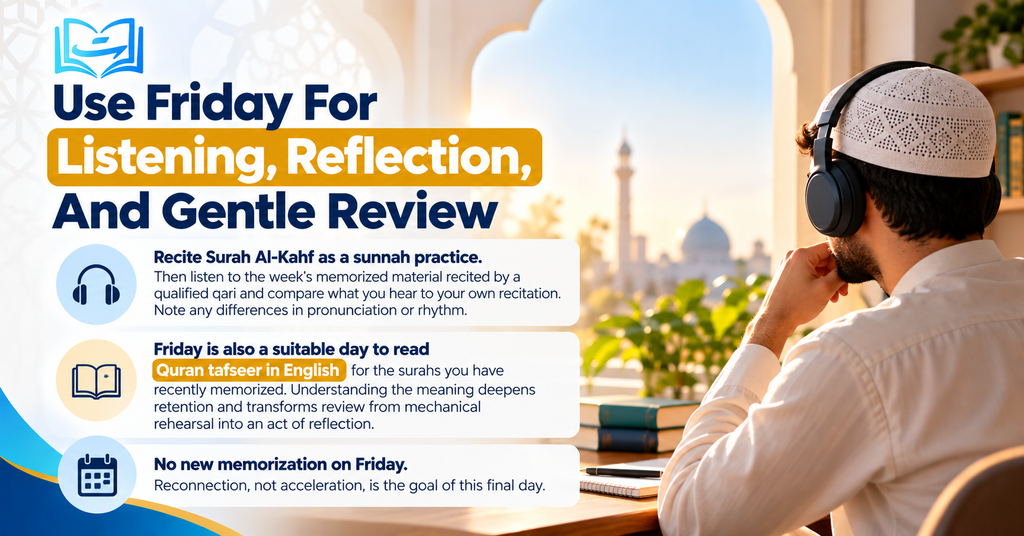
7. Use Friday For Listening, Reflection, And Gentle Review
Recite Surah Al-Kahf as a sunnah practice. Then listen to the week’s memorized material recited by a qualified qari and compare what you hear to your own recitation. Note any differences in pronunciation or rhythm.
Friday is also a suitable day to read Quran tafseer in English for the surahs you have recently memorized. Understanding the meaning deepens retention and transforms review from mechanical rehearsal into an act of reflection.
No new memorization on Friday. Reconnection, not acceleration, is the goal of this final day.
Three Rules That Every Beginner Must Anchor Their Hifz Week Around
A seven-day schedule is only as effective as the habits surrounding it. These three rules address the foundational conditions that make or break a weekly hifz plan for beginners, regardless of your location, schedule, or starting level.
Each rule here reflects a mistake that, left uncorrected, undermines the weekly structure no matter how consistently you follow it day by day.
A. Choose One Mushaf And Never Switch It
Your visual memory is active during recitation whether you are aware of it or not. Every session, your brain logs where a verse sits on the page, which line it occupies, and what text surrounds it on either side.
Switching between Mushaf editions resets this visual map entirely. Commit to one printed copy of the Madinah Mushaf from day one. Even a digital version should replicate the exact same page layout to preserve this visual encoding.
Learn with qualified tutors who specialise in Quran for Toddlers / Young Children.

B. Fix Tajweed Before Memorizing, Not After
Memorizing a verse with a tajweed error costs you double the time to correct later. The incorrect version embeds itself in memory, and rewiring a flawed phoneme from established recitation is significantly harder than learning it correctly from the start.
Spend your first week or two reviewing tajweed rules for beginners before pushing your memorization volume.
The benefits of tajweed extend beyond correct pronunciation; tajweed’s rhythmic structure also functions as a memory framework that makes verses easier to hold and harder to confuse with adjacent material.
C. Build Both Short-Term And Long-Term Review Into Every Week
Short-term review covers the last seven days. Long-term review covers material memorized in previous weeks and months. Both are essential; most beginners neglect the second one almost entirely.
A practical starting ratio for beginners is sixty percent of review time dedicated to recent material and forty percent to older pages.
As your total memorized quantity grows, shift gradually toward more long-term revision. Explore the strategies to revise memorized Quran to find revision approaches that match your schedule and learning style without creating burnout.
Step Inside Our Virtual Classrooms
See our engaging teaching methods in action! watch real snippets of our live classes and discover how our expert instructors make learning interactive, memorable, and inspiring for every student.
Start Your Quran Learning Journey
Join Tabark Academy today for structured online lessons with qualified tutors, customized to fit your goals.
Book Your Free Trial LessonBegin Your Weekly Hifz Journey With Qualified Guidance Today
A weekly plan works best when a qualified teacher checks your recitation and holds you accountable at regular intervals.
Tabarak Academy‘s instructors guide beginners through every stage, from the first half-page to the final juz, with structured weekly sessions, tajweed correction, and personalized feedback that keeps your memorization clean from day one.
Our Courses:
- Online Quran & Arabic Classes | Foundation
- Online Quran Memorization Course
- Recitation Of Quran with Tajweed Course
- Hifz for Kids Course
- Hifz Ijazah Course
- Hifz for Adults Course
- Noor Al-Bayan Course
- Quran Recitation Course
- Weekend Quran Classes
Book your free trial class now

Conclusion
A weekly hifz plan for beginners works because it removes the daily question of what to do. When Saturday means new memorization, Thursday means revision only, and Friday means listening and reflection, your week becomes a system rather than a collection of separate, disconnected decisions.
The seven steps outlined here are not arbitrary. Each day’s role supports the day before it and prepares the day after. New memorization, progressive review, cumulative recitation, pure consolidation, and reflective listening build on each other in a sequence that mirrors how long-term memory is actually formed, not how most people imagine it works.
Start with the weekly structure, add Arabic vocabulary alongside it progressively, and you will find that over months, recitation gives way to comprehension; and comprehension is what makes memorization genuinely last.
Frequently Asked Questions
How Many Verses Should A Beginner Memorize Per Day?
Most hifz teachers recommend between five and ten short verses, or approximately a quarter to half page, per day.
This amount allows proper review the following morning and prevents the accumulation of poorly-fixed material that stalls progress later.
Do I Need A Teacher To Follow This Weekly Hifz Plan?
You can use this structure independently, but a qualified teacher is strongly recommended for at least bi-weekly recitation checks.
Errors in tajweed or pronunciation that go uncorrected embed themselves in memory and become increasingly difficult to fix as your memorized volume grows.
What Should I Do If I Miss A Day In My Hifz Week?
Do not skip review time to compensate for missed memorization. Return to your last confirmed section, verify it is solid, and continue from that point.
Adding extra new material after a break typically weakens retention across your existing memorization rather than recovering lost ground.
How Does Learning Arabic Help With Quran Memorization?
Arabic creates a second memory pathway alongside the phonetic one. When you understand a verse’s meaning, your brain stores it as both sound and meaning simultaneously.
That dual encoding makes the verse significantly harder to forget and easier to retrieve during recitation, especially under pressure.
How Long Will It Take To Complete The Quran With This Plan?
At a half-page per day with six memorization days and one revision day per week, you memorize approximately three pages weekly.
At this consistent pace, completing all 604 pages of the Madinah Mushaf takes approximately three and a half to four years, depending on your review schedule.
Is This Plan Suitable For Adults Who Are Starting Later In Life?
Yes. The structure suits learners of any age. Adults typically bring stronger focus and motivation than younger students, which compensates for differences in raw memorization speed.
The review-heavy design of this plan is particularly well-suited to adult beginners, as consistent reinforcement matters more at any age than the pace of initial acquisition.