


The Best Method To Memorize Quran
Millions of Muslims begin their Hifz journey with full resolve – and a fraction of them reach the end. The gap between starting and finishing almost always comes down to method, not willpower.
The best method to memorize Quran is not a single trick. It is a structured system built from proven techniques that work together, each one reinforcing the next.
This article lays out ten practical, actionable methods — rooted in classical Islamic scholarship and real-world memorization experience — so your Hifz is not just fast but solid enough to carry with you for life.

1. Anchor Your Intention Before You Memorize Is Your Best Method To Memorize Quran
Purpose is not a soft introduction to Hifz — it is a functional prerequisite. The classical scholars were consistent on this point: a student memorizing for social recognition, family pressure, or personal prestige finds the Quran slipping faster than they can add new material.
A student memorizing sincerely for Allah’s sake finds ease that no memorization technique alone can produce.
Renew your intention at the start of every session — not once at the beginning of your journey, but every single time you open the Mushaf.
Islamic scholarship has consistently tied Hifz to moral character, and the important reasons why morals are important in Islamic life explain precisely why a hafiz is expected to embody the Quran, not merely store it.
The Prophet ﷺ demonstrated what it looks like to live the Quran rather than simply recite it. Reflecting on what can we learn from the life of prophet Muhammad gives your own relationship with the Quran a firmer foundation before you begin.
2. Choose One Mushaf And Never Look Back
The choice of Mushaf is one of the most consequential and most overlooked decisions in the entire Hifz process.
When you memorize consistently from a single print edition, your brain builds a precise visual map of each page — where a verse begins, how a word breaks across a line, what sits at the bottom of the page. Switch editions mid-Hifz, and that map collapses.

The Medina Mushaf in the Hafs narration is the most widely used standard for Hifz worldwide, and its page-aligned layout — each page beginning and ending at a verse boundary — makes it particularly suited to structured memorization.
Buy a clean, legible copy, keep it dedicated to Hifz, and resist the temptation to switch to phone screens. Digital layouts shift with font size settings, and the visual memory you build becomes unreliable.
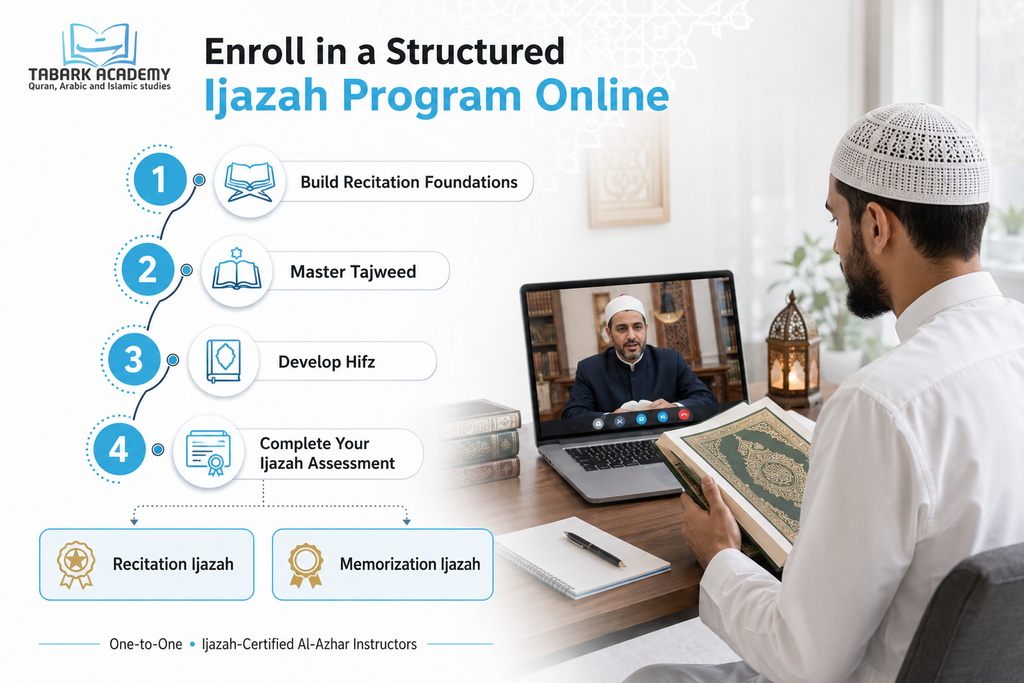
Enroll in a structured Ijazah Program Online at Tabarak Academy
3. Break Your Daily Memorization Portion Into Small Segments
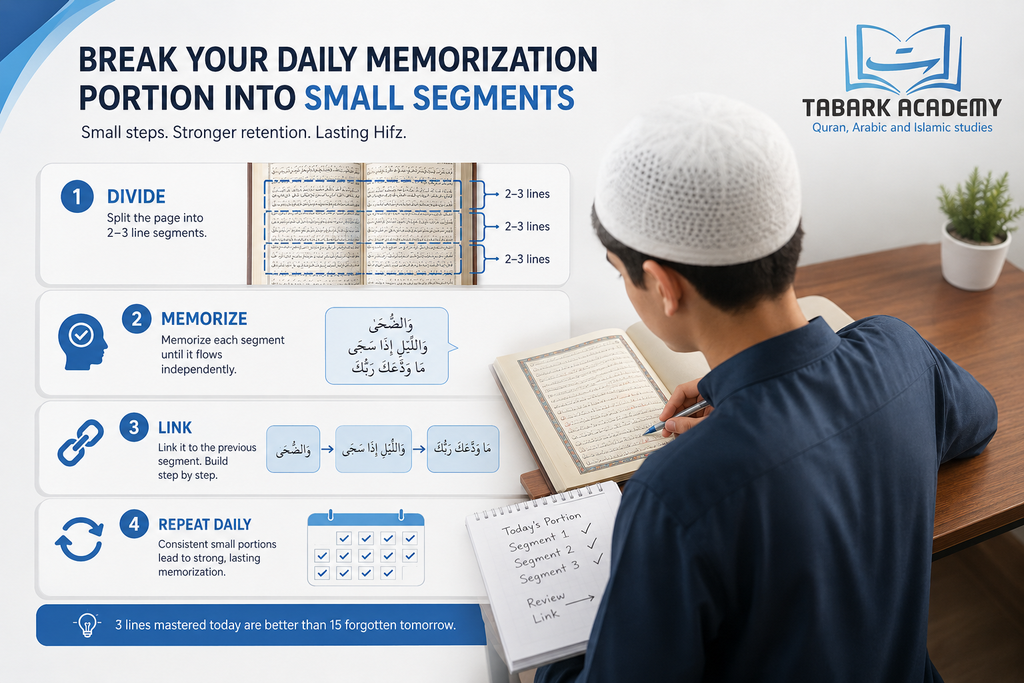
A standard Mushaf page contains roughly 15 lines. Attempting all 15 in one sitting is the fastest route to forgetting all 15 by evening.
The top method to memorize Quran that works: divide the page into segments of two to three lines, memorize each segment until it flows independently, then link it to the segment before it.
Only when the combined portion runs smoothly do you add the next. This cumulative linking mirrors the brain’s memory consolidation process — small, repeated exposures build durable recall far more reliably than extended single sessions.
A student who finishes three lines well every day will outpace one who attempts a full page and retains nothing. Quantity is not the metric; mastery is.
Enroll in Tabarak Academy’s Juz 30 Memorization Course Today
4. Listen To Your New Portion Before You Memorize
Before memorizing a single word of a new portion, listen to it being recited by a skilled reciter at least five to ten times. This step is not preparation — it is part of the memorization itself.
Pre-listening plants correct pronunciation in your ear before your tongue develops the wrong habit, and it creates an emotional connection to the sound of the verse that makes retention significantly faster.
Choose one reciter and stay with them for each memorization block. Mixing multiple reciters during a single session fragments your audio memory. The types of Qirat in the Quran represent different but equally authentic recitation traditions — knowing which school your teacher follows helps you build a consistent ear and brings coherence to your daily practice.
Begin your journey in Tabarak Academy’s Online Qirat Course with a free trial

5. Prove Each Portion Is Solid Before Moving On
A consistent error in Hifz: students measure progress by how much new material they have covered rather than how securely they hold what they have already memorized. Covering two pages with shaky retention is not progress. Holding five lines solidly is.
The practical test used in traditional Hifz circles: recite your new portion from memory, at normal pace, without hesitation — three consecutive times — before adding anything new.
This test is strict. It is also what separates memorization that lasts for decades from memorization that requires constant re-learning.
Read also:How To Memorize Quran By Yourself At Home?
Experience Our Interactive Learning
Curious about how we teach? Watch these brief video clips from our recent live sessions to see our structured curriculum, advanced learning platform, and dynamic student-teacher interactions firsthand.
6. Use Deliberate Repetition Not Mindless Repetition
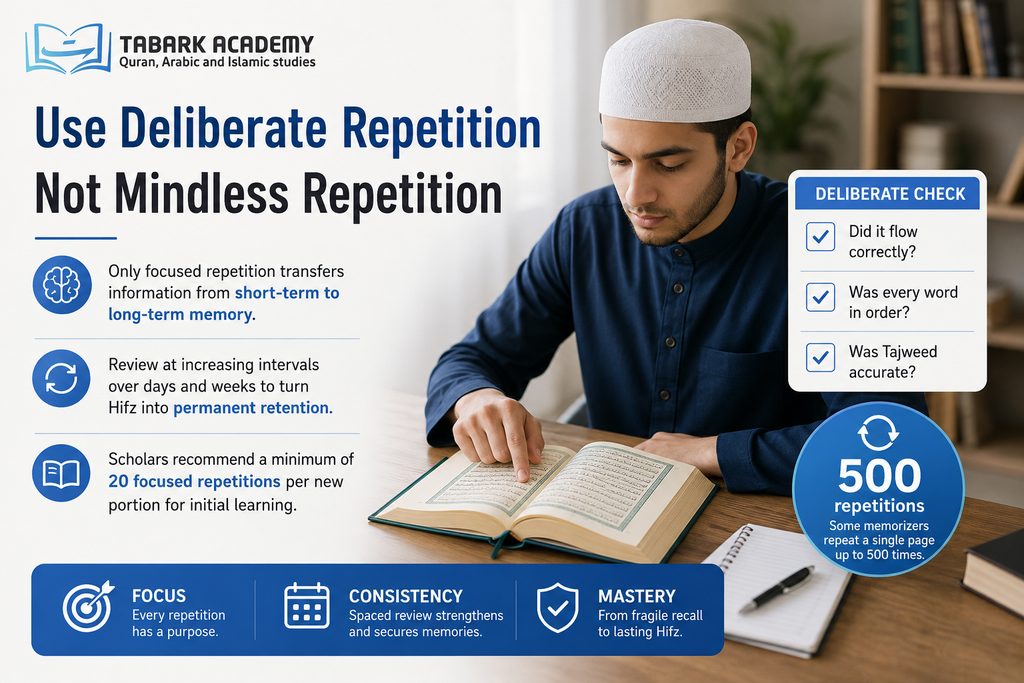
There is a real difference between repeating a verse 20 times while your attention drifts and repeating it 20 times with focused verification. Only the second kind transfers information from short-term to long-term memory.
Deliberate repetition means each pass is a conscious check: “Did that flow correctly? Was every word in order?” Scholars of memorization recommend a minimum of 20 focused repetitions per new portion for initial learning.
Beyond that, spaced repetition — reviewing the same portion at gradually increasing intervals over days and weeks — is what moves Hifz from fragile recall into permanent retention.
The memorizers of Mauritania, known for some of the most solid Hifz in the modern world, sometimes repeat a single page up to 500 times before moving forward. The principle, if not the number, deserves serious attention.
7. Give Review More Time Than New Memorization
A reliable ratio for sustainable Hifz: for every one part new memorization, spend two to three parts reviewing what you have already learned.
This is the discipline most students resist, because adding new material feels like progress while reviewing old material feels static. In practice, the reverse is true.
Students who skip review to keep adding new pages frequently discover — sometimes years later — that their early surahs have deteriorated beyond recognition.
The classical standard is clear: every memorized portion should be recited in full at least once per week. Students who hold this weekly cycle retain their Hifz with a consistency that no volume of new memorization alone can produce.
Book your FREE trial class Today

8. Memorize With A Qualified Teacher
This is the most important structural decision in the entire Hifz journey. You cannot hear your own pronunciation errors objectively. You cannot hold yourself to the same standard of accountability a teacher provides.
And you cannot receive Ijazah — the chain of transmission connecting every recitation back to the Prophet ﷺ — without learning from a teacher who already holds one.
A qualified teacher corrects Tajweed errors before they calcify into permanent habits, monitors your pace to ensure review keeps up with new memorization, and provides the external discipline that sustains progress through difficult periods.
If you are thinking ahead to formal certification, understanding how to get ijazah and what that pathway requires makes clear why the teacher-student relationship is its irreplaceable core.

9. Recite From Memory In Every Prayer It Is Free Review Time
The five daily prayers are a memorization tool that most students leave unused. Rather than defaulting to familiar short surahs after every salah, make a deliberate habit of cycling through your memorized material.
Use Fajr and Dhuhr for recently memorized portions where errors are most likely to surface under the slight pressure of formal recitation. Reserve Asr, Maghrib, and Isha for older memorization that needs reinforcement.
Tahajjud is especially powerful here: a 20-to-30-minute Qiyam ul-Layl session recited from memory functions as a focused, high-quality review with built-in devotional weight.
Every prayer filled with memorized material is a review session that requires no additional time from your schedule.

10. Flag Similar Verses Early For Extra Attention
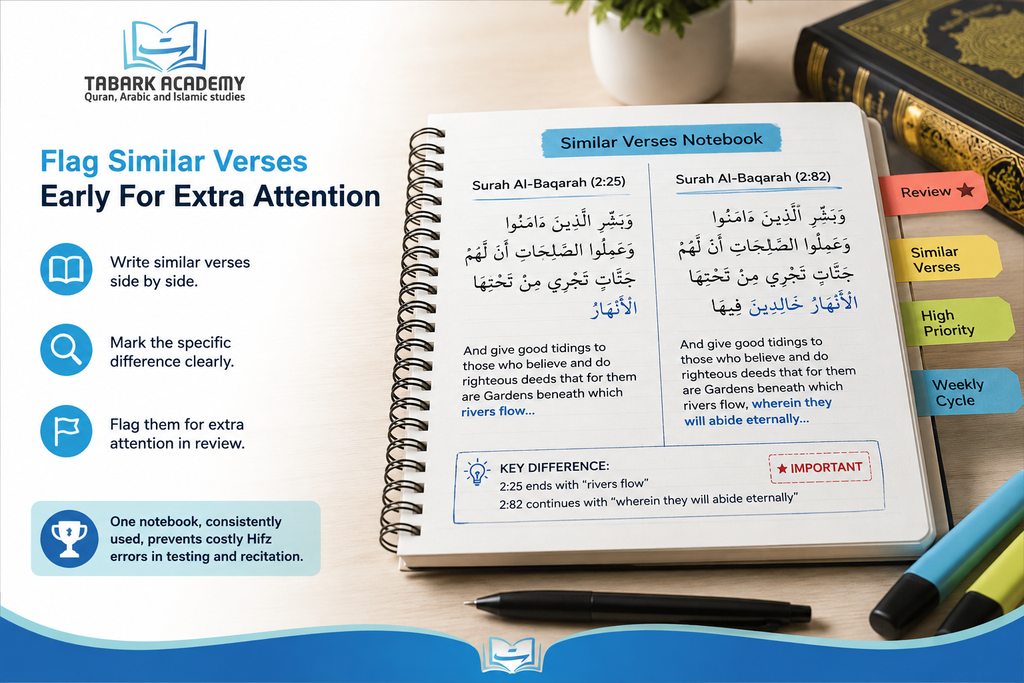
The Quran contains many pairs and groups of mutashabihat — verses with nearly identical wording but different endings. These are the single most common source of Hifz errors in testing and recitation, and they demand deliberate attention beyond regular review.
An effective system used by experienced huffaz: keep a notebook dedicated entirely to similar verses. When you encounter a resembling pair during memorization, write both versions side by side, mark the specific difference clearly, and flag them for extra attention in your weekly cycle.
One notebook, consistently used, prevents a disproportionate share of recitation errors that would otherwise surface at the worst possible moment.
Read also: How to Maintain Consistency in Quran Memorization
Why Does Arabic Language Understanding Give Your Memorization An Edge?
Hifz and Arabic comprehension are often pursued separately, but the evidence — from educational research and from the experience of successful memorizers — consistently shows they strengthen each other.
Understanding what you are memorizing, even at a foundational level, transforms the process from phonetic storage into meaningful recall.
Meaningful material is dramatically harder to forget than a sequence of unfamiliar sounds. A verse you understand anchors to existing knowledge in your memory; a verse you cannot parse has nothing to attach to.
Read also:How much does it take to memorize quran
A. Arabic Unlocks What Repetition Alone Cannot
Arabic has specific features that challenge learners early on — 3 reasons why Arabic is difficult covers exactly what those are — but even a working knowledge of the 500 most frequently used Quranic root words covers roughly 75–80% of all Quranic vocabulary by frequency. Students who build this foundation before or alongside their Hifz move faster and retain more securely than those memorizing purely by sound.
Exploring the facts about the Arabic language reveals how its root-based structure and morphological regularity make Quranic Arabic — once understood — one of the most retention-friendly language systems in the world.
The architecture of the language supports memory rather than working against it.
Read also: Black Magic in Islam: Protection, Symptoms & Quranic Cure
B. The Language Work for You, Not Against You
The importance of the Arabic language extends well beyond religious practice: it gives you direct access to what the Quran actually says, in the precision its words were chosen for — something no translation can fully replicate, and something that makes every memorized verse feel grounded rather than abstract.
Students who want a structured pathway into Quranic Arabic can learn Arabic language through courses designed specifically to connect language learning with Quranic comprehension — a combination that serves both pursuits simultaneously.
What consistently surprises students is that Hifz itself becomes a language teacher. The memorization process naturally helps students improve your language skills with Quran — the repetition embedded in Hifz reinforces vocabulary, grammar patterns, and root recognition with a consistency that classroom study alone rarely achieves.
Step Inside Our Virtual Classrooms
See our engaging teaching methods in action! watch real snippets of our live classes and discover how our expert instructors make learning interactive, memorable, and inspiring for every student.
Tabarak Academy Where Hifz Becomes a Structured, Supported Journey
Memorizing the Quran alone is possible. Memorizing it accurately, sustainably, and with the kind of certification that connects you to an unbroken chain of transmission almost always requires proper guidance.
Tabarak Academy offers structured, teacher-led online Hifz programs where every student works with a certified instructor who holds Ijazah in Quranic recitation. Sessions are live, personal, and scheduled around each student’s timezone and availability.
Students receive regular Tajweed correction, progressive memorization targets, and formal review assessments — so what is memorized is retained, not merely covered.
The methodology is classical: teacher-to-student transmission, the same model that has produced huffaz for fourteen centuries. The delivery is modern: fully online, flexible, and accessible from anywhere in the world.
Students who complete Tabarak’s structured program retain their memorization at rates that self-study approaches consistently cannot match — because accountability and structure are built into every session, not left to willpower alone.
Book your FREE trial class Today

Our Quran Memorization / Hifz Courses
- Online Hifz Program
- Juz 30 Memorization
- Hifz for Kids
- Hifz for Adults
- Hifz for Sisters
- Short Surah Memorization Course
- Hifz Ijazah Course
Conclusion
The best method to memorise Quran is not a single technique — it is a complete system. Fix your intention, choose one Mushaf, listen before you memorize, break your daily portion into manageable segments, prove retention before moving forward, repeat with focus, use your prayers as review, prioritize review over new memorization, learn with a qualified teacher, and flag similar verses before they become a problem.
Each method on its own helps. All ten together produce Hifz that actually lasts. Start with the method that addresses your current weakness. Apply it consistently this week.
Layer the next one in as the first becomes a habit. The Quran has always rewarded steady, sincere effort over bursts of enthusiasm — and a structured approach is what turns that intention into a complete, lifelong Hifz.
Frequently Asked Questions
What is the single best method to memorize Quran for a complete beginner?
For beginners, the most effective starting point combines listening with segmented memorization. Listen to your target portion at least five times before attempting it, then memorize in two-to-three-line segments, mastering each before linking them together. Starting from Juz’ Amma builds early confidence through shorter surahs before the longer chapters of the Quran.
How long does it realistically take to memorize the full Quran?
A student memorizing one page daily with consistent review typically completes the Quran in 18 months to two years. Full-time students covering more per day can finish in under a year.
Timeline matters far less than retention quality — solid memorization of half the Quran is worth more than shaky memorization of all of it.
Can you memorize the Quran without a teacher?
Some students do, but the outcome is rarely satisfactory. Without external correction, Tajweed errors go undetected and become permanently embedded in the recitation.
A qualified teacher also provides the accountability structure that most self-study efforts eventually lack. For anyone serious about accuracy — and especially for those pursuing Ijazah — learning with a teacher is not optional.
Is Tajweed really necessary for Hifz?
Yes. Tajweed governs how the Quran is recited as it was revealed — memorizing without it means memorizing with errors that carry religious weight. The right time to establish correct Tajweed is before memorization begins, not after years of ingrained habit have made correction far more difficult.
What is the best time of day to memorize the Quran?
The period after Fajr prayer is the consistent recommendation from scholars across centuries, and it holds up practically: the mind is clear, the day’s distractions have not yet accumulated, and the post-dawn hours carry a specific baraka that benefits spiritual work.
Evening sessions serve review of previously memorized material better than new memorization.
How do I stop forgetting what I have already memorized?
Through systematic weekly review. Most forgetting is not a memory failure — it is a structure failure. Divide your entire memorized portion into equal review slots across the week and recite each slot from memory at least once, regardless of whether you are adding new material that day.
Students who maintain this cycle retain their Hifz with a consistency that no memorization technique alone can replicate.