


How To Strengthen Shaky Quran Memorization? 9 Proven Strategies
When asked how to strengthen shaky Quran memorization, it is not a sign of failure; it is a sign your current system needs a clear adjustment.
Thousands of Muslims in the USA, UK, Canada, Australia, Germany, Malaysia, the UAE, Bahrain, Egypt, and across the Gulf reach this exact point.
The problem is rarely about memory capacity. Students who struggle to strengthen shaky Quran memorisation typically rely on inconsistent review structures.
They recite too quickly when studying alone, or use a single method that cannot sustain long-term retention. The nine strategies below combine classical Islamic methodology with evidence-based learning principles.
They address every common structural weakness, from wrong repetition patterns to memorizing text whose meaning remains completely unknown.
1. Reduce Your New Memorization And Multiply Your Repetitions To Know How To Strengthen Shaky Quran Memorization
When memorization feels unstable, the instinct is to work harder and add more. That instinct causes greater damage than the original problem. New material competes with older material for consolidation in your working memory.
Cut your new daily memorization to half a page or fewer verses per session. Pour that saved time into repeating existing passages twenty or more times each.
Scholars consistently recommend this ratio; it feels slower at first but produces dramatically deeper retention. This is the foundation of the best way to strengthen shaky Quran memorization: less new content, far more focused review.
To understand why forgetting happens in the first place, why do I forget what I memorize of the Quran explains the root causes and the precise fixes for each one.
Find What Do Students Achieve in the Short Surah Memorization Course?

2. Stick To One Mushaf So Your Brain Builds A Reliable Visual Map
Your brain stores Quranic text partly as a visual image. It remembers where a verse falls on the page, how the line breaks, and where the page ends. Switching between different mushaf editions, phone apps, or printed copies disrupts that visual map completely.
Choose one physical mushaf, preferably a Hafs edition used in standard hifz programs, and commit to it throughout your entire memorization journey. Keep the same font, page layout, and line structure across every single session without exception.
This is one of the strongest strengthen shaky Quran memorization tips in this guide, requiring zero extra time. It is a single decision that compounds its value every day you apply it consistently.

3. Work With A Certified Sheikh Or Qualified Online Instructor Every Week
Self-correction has a real ceiling. Every dedicated student develops blind spots; they recite the same error repeatedly, fully convinced they are reciting correctly. Only an external ear catches what the internal ear has normalized over months of solo practice.
Working with a qualified instructor at least once a week changes the entire trajectory of shaky memorization. The teacher hears errors you cannot hear yourself, identifies tajweed mistakes corrupting whole passages, and holds you to a standard you cannot maintain alone.
Prioritize instructors with ijazah certified Quran teachers credentials. That verified chain of transmission back to the Prophet, peace be upon him, is both a spiritual assurance and a quality guarantee for the correction you receive.
Tabarak Academy connects students across the USA, UK, Canada, Australia, Germany, Malaysia, UAE, and the Gulf with ijazah-certified instructors for live, one-on-one weekly sessions.

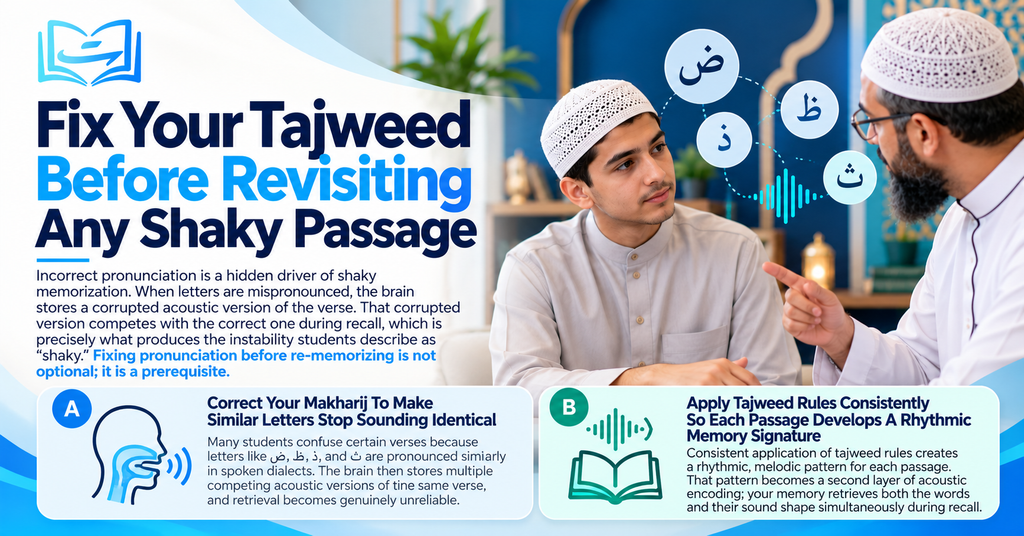
4. Fix Your Tajweed Before Revisiting Any Shaky Passage
Incorrect pronunciation is a hidden driver of shaky memorization. When letters are mispronounced, the brain stores a corrupted acoustic version of the verse.
That corrupted version competes with the correct one during recall, which is precisely what produces the instability students describe as “shaky.” Fixing pronunciation before re-memorizing is not optional; it is a prerequisite.
Understanding what is tajweed and why each rule exists gives you the foundation to correct errors at their source, rather than applying surface-level patches that never fully hold.
A. Correct Your Makharij To Make Similar Letters Stop Sounding Identical
Many students confuse certain verses because letters like ض, ظ, ذ, and ث are pronounced similarly in spoken dialects. The brain then stores multiple competing acoustic versions of the same verse, and retrieval becomes genuinely unreliable.
Studying the makharij of the Arabic letters gives you precise articulation points for every letter causing confusion. Once your brain receives one consistent acoustic signal per letter, competing versions disappear and memorization stabilizes noticeably.
B. Apply Tajweed Rules Consistently So Each Passage Develops A Rhythmic Memory Signature
Consistent application of tajweed rules creates a rhythmic, melodic pattern for each passage. That pattern becomes a second layer of acoustic encoding; your memory retrieves both the words and their sound shape simultaneously during recall.
Students who correctly apply tajweed rules for beginners often find that previously shaky passages suddenly feel anchored. The rules are not just about correct recitation; they function as memorization technology built directly into the Quran’s structure.
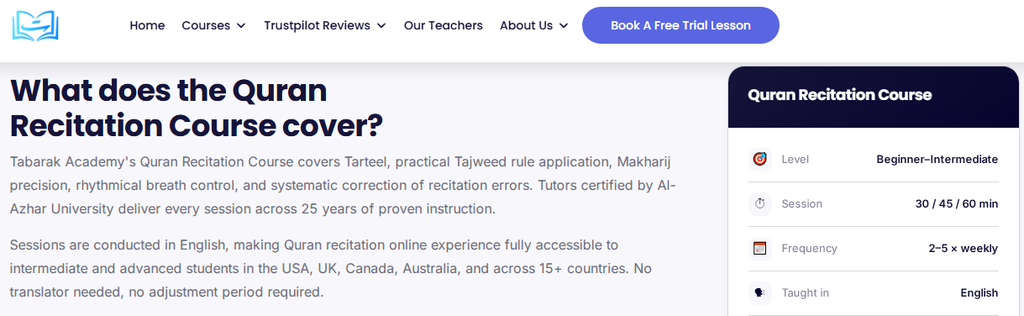
Check What does the Quran Recitation Course cover?
5. Recite Your Memorized Sections In Every Sunnah And Nafl Prayer
The most powerful consolidation tool available to every Muslim student is already built into the five daily prayers. Reciting memorized verses during sunnah prayers, tahajjud, and nafl salah forces active retrieval in a focused, distraction-free environment. Each retrieval act strengthens the neural pathway for that specific passage.
Scholars throughout Islamic history have identified prayer as the primary vehicle for fixing shaky memorization, and contemporary learning research confirms that tested retrieval is far more effective than passive repetition.
Assign specific juz or surah sections to specific prayers throughout the week. This turns salah into a systematic revision engine rather than a collection of familiar short surahs.
For a complete consistency framework, stay consistent with Quran memorization outlines exactly how to build and sustain this habit.
Experience Our Interactive Learning
Curious about how we teach? Watch these brief video clips from our recent live sessions to see our structured curriculum, advanced learning platform, and dynamic student-teacher interactions firsthand.
Start Your Quran Learning Journey
Join Tabark Academy today for structured online lessons with qualified tutors, customized to fit your goals.
Book Your Free Trial Lesson6. Learn Quranic Arabic To Give Every Verse A Meaning Anchor In Your Mind
This is the most overlooked yet most powerful long-term solution for shaky Quran memorization. Understanding what you recite creates two independent memory pathways simultaneously: one acoustic and one semantic.
Both must fail at the same time for forgetting to occur. Without Arabic, only the acoustic path exists. One review gap breaks it entirely.
The importance of the Arabic language is why classical scholars never separated Arabic study from memorization, and why Arabic opens entirely new directions of deep Quranic understanding.
A. Study Arabic Root Words To Stop Confusing Verses That Look Or Sound Similar
The Quran frequently uses the same three-letter root across multiple grammatical forms. Students without Arabic knowledge treat each form as a separate memory task. Students who know the root see one connected family of meaning instead.
A focused Learn Arabic Language program built around Quranic vocabulary eliminates this confusion systematically. Within weeks, students report that previously shaky passages stabilize because the words now make grammatical sense, not just acoustic sense.

B. Read A Short Tafsir Before Each Session To Build Meaning-Based Memory Anchors
Scholars have always recommended reading the tafsir of a passage before memorizing it. Understanding the context, the occasion of revelation, and the precise meaning of each word creates narrative scaffolding in the mind.
That scaffolding prevents verses from disappearing during review gaps. For accessible daily-use options, tafsir books for beginners lists commentaries that balance scholarly depth with practical usability alongside regular hifz sessions.
C. Start A Quranic Arabic Course That Unlocks The Deeper Meaning Behind Every Ayah
For English-speaking students in the USA, UK, or Malaysia, the fastest path to experiencing how Arabic transforms your Quran relationship is a structured Quranic Arabic course.
The moment a student reads a verse and understands its meaning in real time, they stop memorizing sounds and start memorizing ideas; and ideas are far harder to forget.
Tabarak Academy provides dedicated Quranic Arabic courses from beginner to advanced grammar levels. Every lesson explains how each grammatical structure reinforces the meaning, turning Arabic study into a direct and practical hifz tool.
The Academy serves students across the Gulf, Egypt, Malaysia, and Western countries with fully flexible scheduling.
Start Quranic Arabic Classes With a Free Trial Now

7. Write Down Every Verse That Consistently Slips By Hand To Activate Motor Memory
Writing activates a different memory channel from recitation. When you write a verse, your hand traces each letter, your eye tracks the line, and your brain processes the shapes through a motor-visual loop that vocal repetition alone cannot reach.
Keep a dedicated notebook specifically for your weakest verses. Write each one at least five times per session, then cover the page and write it again from memory without looking.
This is especially effective for consecutive verses with similar endings, which cause the majority of mid-passage confusion. This practical strengthen shaky Quran memorization tip requires only a notebook and ten minutes daily.
Its impact is disproportionate to its time cost, particularly for students whose weak passages cluster around phrases with nearly identical closings or repeated grammatical structures.
Read also: How To Memorize Quran With Tafsir Alongside? – 6 Proven Methods
8. Record Your Recitation And Listen Back To Catch Errors You Miss During Live Recitation
Most students recite too quickly when reviewing alone, and the brain fills in gaps automatically, creating a false sense of correct recall. Recording eliminates that illusion immediately and completely.
Use your phone to record a complete recitation of any passage you consider memorized. Play it back while following along in your mushaf. Every error that was invisible during live recitation becomes obvious during playback.
Students who adopt this practice typically discover two to five errors per page they were completely unaware of.
Fix each error the same day before the next session. For broader development beyond error correction, improve Quran recitation covers the full range of techniques that lift recitation quality and simultaneously deepen memorization stability.
Explore Why Families Choose Tabarak Academy for Hifz Online

9. Build A Murajaah Schedule That Systematically Protects Every Juz You Currently Hold
New memorization without a systematic murajaah plan is the primary mechanism that converts strong hifz into shaky hifz over time. Every juz that goes unreviewed for more than two weeks begins fading, and the longer the gap, the more effort it takes to restore it.
A sustainable murajaah schedule divides all existing memorization into daily portions and rotates through them on a fixed cycle. Reviewing one juz per day, for example, means twenty juz of memorization receive a full pass every twenty days.
A daily murajaah plan for hifz students helps you calibrate this rotation based on your current total memorization.
The murajaah schedule is the primary prevention mechanism for shaky Quran memorization. Students who maintain consistent murajaah rarely develop the deep instability that requires months of remediation.
The daily hifz revision guide gives you a ready-to-use template to start this week without delay.
Step Inside Our Virtual Classrooms
See our engaging teaching methods in action! watch real snippets of our live classes and discover how our expert instructors make learning interactive, memorable, and inspiring for every student.
Start Your Quran Learning Journey
Join Tabark Academy today for structured online lessons with qualified tutors, customized to fit your goals.
Book Your Free Trial LessonStart Strengthening Your Quran Memorization With Tabarak Academy Today
Shaky memorization has a clear solution; it begins with the right system and a qualified teacher working alongside you every step of the way.
At Tabarak Academy, ijazah-certified instructors combine classical hifz methodology with personalized, structured guidance to rebuild your memorization on a foundation that genuinely holds.
Whether you are in New York, London, Toronto, Sydney, Dubai, Kuala Lumpur, or Cairo, sessions happen live and one-on-one, tailored precisely to your weak passages, your realistic timeline, and your daily schedule.
Register today and take the first concrete step toward confident, stable Quran recitation.
Our Courses:
- Hifz for Kids Course
- Hifz Course for Sisters
- Hifz for Adults Course
- Hifz Ijazah Course
- Recitation Of Quran With Tajweed Course
- Advanced Tajweed Course
- Amali (Practical) Tajweed Course
- Tajweed Course for Kids
Start your Quran hifz journey today and take the next step toward reading and memorizing the Quran with confidence.

Conclusion
Shaky Quran memorization is a solvable problem when approached with the right structure, not simply more effort. The nine strategies in this guide address every common structural weakness: wrong repetition patterns, inconsistent review cycles, compromised tajweed pronunciation, absence of teacher accountability, and memorizing text without understanding a single word of its meaning.
The most transformative long-term shift is learning Quranic Arabic. When a student understands each verse they recite, the meaning itself becomes a second independent memory anchor alongside the acoustic one.
The Quran then opens dimensions of understanding that memorization by sound alone can never reach. Linguistic precision, theological depth, and contextual richness all become accessible in ways that profoundly strengthen both comprehension and retention simultaneously.
Arabic learning is not an addition to your hifz journey; it is a multiplier that changes the entire experience of engaging with the Quran. Start with two or three strategies this week.
Build the daily habit first, then layer in further strategies as each one becomes automatic. Consistent application over weeks and months is what converts shaky hifz into the firm, confident recitation that carries a student through decades of prayer and scholarship.
Frequently Asked Questions
How Long Does It Take To Fix Shaky Quran Memorization?
Most students see measurable improvement in unstable passages within two to four weeks of applying a structured daily review system.
Full stabilization of a complete juz typically takes one to three months, depending on how long the weakness has persisted and how consistently the daily routine is maintained.
What Is The Best Way To Strengthen Shaky Quran Memorization For Adults?
The best way to strengthen shaky Quran memorization for adults combines a fixed daily review routine with weekly teacher feedback sessions.
Adults benefit particularly from the recording method, handwritten verse practice, and integrating memorized sections into their existing prayer schedule, which requires no additional time commitment.
Does Learning Quranic Arabic Really Help Fix Shaky Memorization?
Learning Quranic Arabic is one of the most effective long-term solutions for unstable memorization. Understanding verse meaning creates a semantic memory anchor alongside the acoustic one.
Both anchors must fail simultaneously for forgetting to occur, which makes meaning-grounded memorization significantly more stable than sound-only memorization.
How Many Times Should I Repeat A Shaky Verse Before Moving Forward?
Repeat a shaky verse until you can recite it correctly from memory at least ten consecutive times without looking. Many scholars recommend twenty repetitions for new material and higher counts for passages that have repeatedly slipped.
Should I Pause New Memorization Until My Shaky Passages Are Fully Stabilized?
Yes. Temporarily pausing new memorization and focusing entirely on stabilizing existing passages produces faster overall results.
Students who continue adding new material while managing shaky sections typically find both the new and old memorization deteriorating together, which deepens the overall problem.
What Role Does Murajaah Play In How To Strengthen Shaky Quran Memorization?
Murajaah is the systematic revision of previously memorized Quran, and it is the primary prevention mechanism against shaky memorization. Human memory naturally decays without regular retrieval.