


The Hadith About Forgetting The Quran Explained Through 8 Essential Insights Every Muslim Needs
The hadith about forgetting the Quran explained through Islamic scholarship does not deliver a single blanket warning; it presents a nuanced, graduated set of teachings that separate negligence from human limitation.
Most people who have heard about this topic cannot name which narrations are authentic, which scholars considered weak, or exactly when forgetting crosses from excusable to blameworthy.
Woven throughout is an insight rarely addressed in English-language content on this topic: understanding Quranic Arabic does not just deepen your comprehension.
It actively protects your memorization from fading and opens entirely new directions for engaging with Allah’s words. This article addresses these questions clearly in 8 points.

1. Quranic Memory Follows The Law Of Consistent Maintenance
The following hadith carries no threat of punishment. Ibn Umar reported the Prophet saying: “The keeper of the Quran is like the owner of a tethered camel. If he tends to it; he keeps it; if he lets it go; it strays.” (Bukhari and Muslim)
It describes a behavioral law: what is consistently tended stays; what is left unattended drifts away. Scholars across the four madhabs cited this narration when establishing murajaah as a religious obligation for those who have memorized the Quran.
The Arabic word “mu’aqqala” (tethered) carries a nuanced image of active binding.
Understanding it gives the metaphor a depth that the English word “tethered” cannot fully convey, which is one reason Arabic comprehension adds motivational clarity to revision practice.
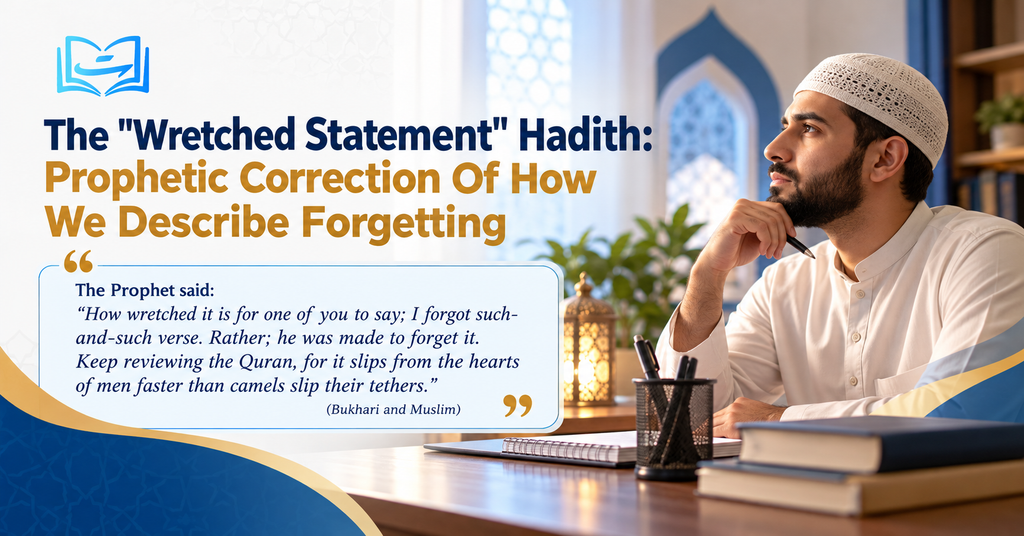
2. The “Wretched Statement” Hadith About Prophetic Correction Of How We Describe Forgetting
This hadith offers important guidance on how Muslims should speak about forgetting the Quran. The Prophet said: “How wretched it is for one of you to say; I forgot such-and-such verse. Rather; he was made to forget it. Keep reviewing the Quran, for it slips from the hearts of men faster than camels slip their tethers.” (Bukhari and Muslim)
This narration teaches that the language of self-assessment matters in Islamic ethics. “I forgot” (nasitu) implies a neutral accident; “I was made to forget” (nussitu) acknowledges that the forgetting was connected to one’s own neglect of review.
For memorizers struggling with repeated lapses, the practical guidance in this hadith points directly to structured revision. Resources like Stop Forgetting the Quran translate this Prophetic emphasis into actionable murajaah methods.
Experience Our Interactive Learning
Curious about how we teach? Watch these brief video clips from our recent live sessions to see our structured curriculum, advanced learning platform, and dynamic student-teacher interactions firsthand.
Start Your Quran Learning Journey
Join Tabark Academy today for structured online lessons with qualified tutors, customized to fit your goals.
Book Your Free Trial Lesson3. The Anas Ibn Malik Narration About Forgetting After Receiving The Quran Is Among The Grave Sins
Anas ibn Malik reported the Prophet saying that among the greatest sins a person could bring on the Day of Resurrection is a surah or verse he received and then forgot.
This was narrated by Abu Dawud and has supporting chains that some scholars authenticated. Scholars who accepted this narration applied it specifically to memorizers who had the time and capacity to maintain their memorization but chose to abandon it.
It does not apply to those who forget despite genuine and sustained effort. Those who have experienced significant forgetting after a period of absence from their Quran will find that return and re-memorization is not only possible but spiritually encouraged.
How To Re-Memorize The Quran After Forgetting It provides a structured framework for those restarting their hifz journey.
Begin Hifz for Adults With a Free Trial Now

4. The Uthman Ibn Abi Al-As Narration About Shaytan As A Recognized Cause Of Involuntary Forgetting
Uthman ibn Abi al-As complained to the Prophet that something was causing him to forget the Quran and lose his concentration during prayer. The Prophet placed his hand on his chest and said: “O Shaytan; leave the chest of Uthman.” (Sahih Muslim)
This narration establishes a distinct category of forgetting: involuntary disruption caused by spiritual interference rather than personal neglect.
It absolves the sincere memorizer who loses access to verses despite consistent effort and genuine commitment to revision.
This hadith also explains why spiritual practices, including adhkar before study and du’a for protection and focus, are treated as integral parts of a sound hifz practice rather than optional additions.
5. The “Ajdhama” Narration Is A Famous Warning That Scholars Did Not Authenticate
A widely circulated narration warns that whoever memorizes the Quran and then forgets it will meet Allah “ajdhama,” meaning afflicted or severed. Imam al-Bukhari, al-Tirmidhi, and Sheikh al-Albani each classified this hadith as severely weak or fabricated.
This narration has caused real harm. Sincere memorizers in countries across the West have abandoned their hifz after encountering this unverified threat.
If the fear of this hadith has affected you, the guidance at Feel Like Giving Up Hifz addresses this emotional weight directly.
The Islamic scholarly tradition has rigorous tools for evaluating narrations. Applying a fabricated hadith to create religious obligation is itself considered an error in traditional Islamic learning; only authenticated narrations carry binding weight.
Discover What does the Quran Reading Course cover?
6. The Scholars’ Complete Framework For When Forgetting The Quran Is Blameworthy
Scholarly opinion on forgetting the Quran is graduated and precise. Neither blanket condemnation nor blanket acquittal reflects the classical consensus. The ruling turns entirely on two factors: capability and deliberate choice.
Reading the original Arabic-language fiqh texts on this topic changes the conclusions significantly.
Every major ruling is grounded in classical Arabic sources, which is why Arabic literacy opens layers of the scholarly discussion that English summaries routinely omit.
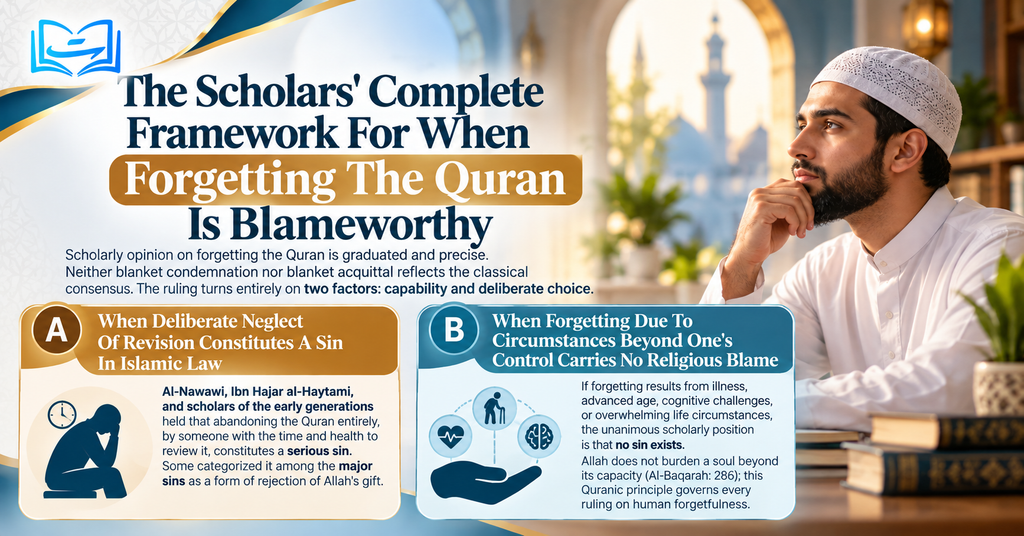
A. When Deliberate Neglect Of Revision Constitutes A Sin In Islamic Law
Al-Nawawi, Ibn Hajar al-Haytami, and scholars of the early generations held that abandoning the Quran entirely, by someone with the time and health to review it, constitutes a serious sin.
Some categorized it among the major sins as a form of rejection of Allah’s gift.
The operative phrase is “capable of reviewing it”. The ruling applies to the person who has the time, cognitive ability, and physical health to maintain their memorization but actively chooses not to over an extended period.
B. When Forgetting Due To Circumstances Beyond One’s Control Carries No Religious Blame
If forgetting results from illness, advanced age, cognitive challenges, or overwhelming life circumstances, the unanimous scholarly position is that no sin exists.
Allah does not burden a soul beyond its capacity (Al-Baqarah: 286); this Quranic principle governs every ruling on human forgetfulness.
Memorizers asking Why Do I Forget What I Memorize Of The Quran due to health conditions or unavoidable pressures should draw reassurance from this position rather than distress from an unverified narration.
Explore What does the Quran Course for Toddlers / Young Children cover?

7. How Arabic Literacy Directly Reduces Quranic Forgetting For Long-Term Memorizers
This connection rarely appears in English content on the hadith about forgetting Quran explained, yet practitioners observe it consistently.
Students who understand Quranic Arabic forget far less than those who memorize phonetically. Meaning is the most powerful anchor in long-term memory.
Tabarak Academy instructors working with students from the USA, Germany, Bahrain, Malaysia, and Egypt have observed this pattern repeatedly.
When a student connects each word to its root and meaning, murajaah becomes active reading rather than sound repetition, and retention improves significantly across all age groups and learning backgrounds.
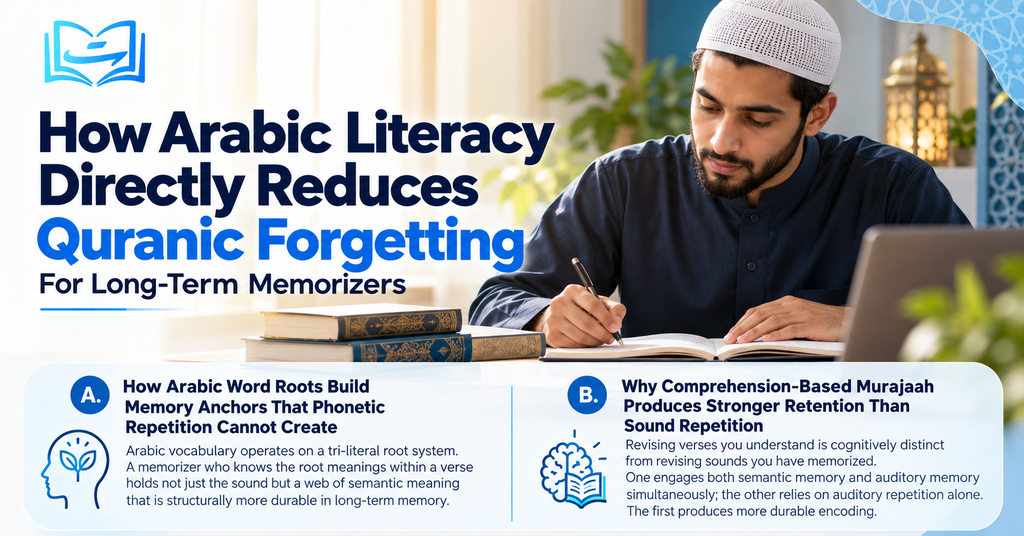
A. How Arabic Word Roots Build Memory Anchors That Phonetic Repetition Cannot Create
Arabic vocabulary operates on a tri-literal root system. A memorizer who knows the root meanings within a verse holds not just the sound but a web of semantic meaning that is structurally more durable in long-term memory.
The question If I Learn Arabic, Will I Understand The Quran is one that many convert and non-Arab Muslim students ask.
The honest answer is: yes; and the retention benefit alone makes Arabic study one of the highest-value investments a memorizer can make.
Even foundational Quranic Arabic study through Quranic Arabic for Beginners opens root-level understanding that makes the effect on memorization retention noticeable within weeks of connecting words to meanings.
B. Why Comprehension-Based Murajaah Produces Stronger Retention Than Sound Repetition
Revising verses you understand is cognitively distinct from revising sounds you have memorized. One engages both semantic memory and auditory memory simultaneously; the other relies on auditory repetition alone. The first produces more durable encoding.
Students who integrate meaning into their revision through tools like Quran Tafseer in English consistently report that familiar passages feel more stable and that unfamiliar passages are easier to acquire on first exposure.
Meet Tabarak Academy’s Qualified Quran Instructors

8. Prophetic Prescriptions That Address The Root Causes Of Quranic Forgetting
The hadiths on forgetting the Quran are not only warnings; they are prescriptions. The camel analogy carries a specific instruction: check the tether daily. The following steps emerge directly from the Prophetic guidance on retention and revision.
Students returning to their memorization after a significant gap should know that re-entry is encouraged and achievable. How to Regain Hifz After Years Away outlines a compassionate, structured approach grounded in both scholarly precedent and practical experience.
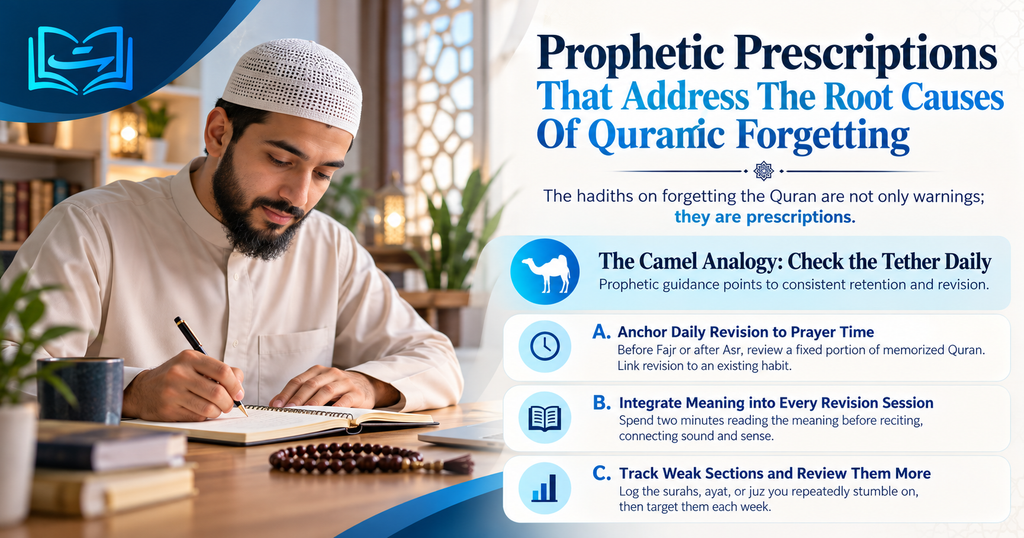
A. Anchor Your Daily Revision To An Existing Prayer Time
Attach murajaah to one of the five daily prayers. Before Fajr or after Asr, review a fixed portion of your memorized Quran. Anchoring a new behavior to an existing daily habit produces consistency automatically rather than depending on daily willpower.
A structured Daily Murajaah Plan For Hifz Students built around salah times is among the most effective practical systems for preventing the forgetting the authentic hadiths warn against.
B. Integrate Meaning Into Every Revision Session, Not Just New Memorization
Spend two minutes before each revision session reading the meaning of what you will revisit. Connecting the meaning to each verse before reciting it gives your brain a dual memory hook: sound and sense together.
Arabic readers do this automatically, since meaning lives in every word they hear. For others, a structured What Is Tafsir guide builds that same semantic layer, giving each verse a firmer anchor in long-term memory.
C. Track Your Weak Sections And Target Them With Extra Review Cycles
Not all memorized material holds equally; some verses slip far more than others during murajaah. Keep a brief log of which surahs, ayat, or juz you stumble on consistently, so you know exactly where to direct your energy each week.
Add one focused extra revision cycle to your weakest sections before your standard general review. A structured Best Revision Schedule for Hifz helps you allocate targeted review time scientifically, so weak sections receive the extra exposure these hadiths implicitly demand.
Start Your Quran Learning Journey
Join Tabark Academy today for structured online lessons with qualified tutors, customized to fit your goals.
Book Your Free Trial LessonBegin Your Quranic Arabic And Hifz Journey With Tabarak Academy Today
Tabarak Academy offers live, certified online courses in Hifz, Quranic Arabic, Tajweed, Tafseer, and Islamic Studies, designed for learners of all levels across the USA, UK, Canada, Australia, UAE, Germany, Malaysia, Bahrain, Egypt, and the Gulf.
When you understand the Arabic of the Quran, verses stop being sounds to hold and become meanings you cannot forget. That cognitive shift is exactly what Tabarak Academy‘s programs are built to give every student.
Our Courses:
- Online Ijazah Course
- Quranic Arabic Classes
- Tafseer Al Quran Course
- Hifz for Kids Course
- Hifz Course for Sisters
- Advanced Tajweed Course
- Hifz Ijazah Course
- Online Hifz Program
- Quran Recitation Course
Book a Free One Day Trial Now for the Hifz Ijazah Course at Tabarak Academy and meet your authorized Sheikh.

Conclusion
The eight insights above show that the hadith about forgetting the Quran explained across authentic narrations are not threats; they are a Prophetic framework for protecting what you have memorized.
From the tethered camel metaphor to the scholars’ three-category classification, these narrations clarify where moral responsibility begins and where genuine circumstance provides valid excuse.
The practical prescription is consistent: daily murajaah anchored to prayer times, meaning-aware revision, and targeted attention on weak sections.
These are not modern study techniques invented by productivity writers; they reflect exactly what the Prophet, peace be upon him, taught his Companions through both word and demonstrated practice.
Arabic literacy transforms every piece of this. The hadith about forgetting the Quran explained through the lens of actual Arabic comprehension carries far more weight than any translation conveys.
When you understand the language of the Quran, each verse becomes a meaning-anchored memory rather than a sound alone, and the language itself becomes the most durable protection against forgetting.
Frequently Asked Questions
Is It A Sin To Forget The Quran After Memorizing It?
Forgetting the Quran is not automatically sinful; classical scholars distinguish carefully between forgetting caused by unavoidable life circumstances and forgetting caused by deliberate neglect.
Only the second carries moral liability, based on the hadith and scholarly consensus from al-Nawawi onward.
What Does The Tethered Camel Hadith About The Quran Mean?
The hadith compares the Quran to a tethered camel: leave it unattended and it escapes. The message is that regular murajaah is not optional; without consistent daily revision, even well-memorized verses will slip from the heart faster than most students expect.
How Does Arabic Help Prevent Forgetting The Quran?
Understanding Arabic connects sound to meaning in memory, giving each verse two retention anchors instead of one. This dual encoding, phonetic and semantic, makes memorized verses significantly more resistant to forgetting over months and years of study.
What Is The Weak Hadith About Forgetting The Quran?
The narration using the word “ajdhama,” which describes severe physical consequences for a person who forgets the Quran, is classified as weak by hadith scholars. It should not be cited as evidence, used in teaching, or relied upon to generate fear around this topic.
How Often Should I Revise The Quran According To The Prophetic Guidance?
The Prophet, peace be upon him, warned that the Quran escapes the heart faster than camels escape ropes, and urged Muslims to review their memorization with great regularity. Most scholars consider daily murajaah of at least a meaningful portion of memorized text to be the practical minimum.
What Should I Do If I Have Forgotten Large Portions Of The Quran?
Begin immediately with whatever you still retain and rebuild gradually using a structured schedule.
Scholars classify forgetting without deliberate neglect as excusable; there is no reason to delay, and returning to the Quran is always praiseworthy regardless of how much time has passed since you last reviewed.