

Is It A Sin To Forget The Quran After Memorizing It?
Verses that once flowed without effort begin to fade, and the question rises: is it a sin to forget the Quran after memorizing it?
The answer is not a fixed verdict. Islamic scholarship draws a careful line between forgetting caused by deliberate neglect and forgetting caused by genuine circumstances. That single distinction changes everything, spiritually and practically.
This article covers the points every hafiz and hifz student needs to understand, wherever in the world they are, and however far they currently feel from their memorization.
What you will learn in this article:
- The precise conditions under which forgetting becomes blameworthy.
- Why the widely-cited hadith about forgetting is not authenticated.
- What the authentic prophetic guidance actually prescribes.
- How valid excuses change the ruling entirely.
- A clear, practical direction forward from wherever you currently stand.
Discover What Sisters Learn in Tabarak Academy’s Quran Program

Is It A Sin To Forget The Quran After Memorizing It; The Ruling Scholars Actually Hold
Scholars across all major schools of thought begin from one foundational principle: the ruling on forgetting the Quran depends entirely on the cause. No blanket verdict covering every case exists in classical Islamic jurisprudence.
This framework guards against two opposing errors; dismissing neglect as unimportant on one side, and burdening sincere students with guilt they do not deserve on the other.
1. Forgetting Through Deliberate Neglect Is Considered Blameworthy
When a hafiz stops reviewing the Quran with no valid excuse, and forgetting follows as a direct consequence, scholars identify this as a serious failure.
Imam al-Nawawi, Ibn Hajar al-Asqalani, and al-Suyuti all pointed to deliberate abandonment of the memorized Quran as blameworthy.
The principle is consistent: accepting the Quran into the chest is a form of custodianship. Allowing that trust to dissolve through preventable inaction reflects a failure of responsibility.
Some scholars, including al-Bulqini and al-Zarkashi, placed willful neglect among the major sins, though they qualified this ruling to deliberate, avoidable carelessness, not forgetting that happens despite genuine effort.
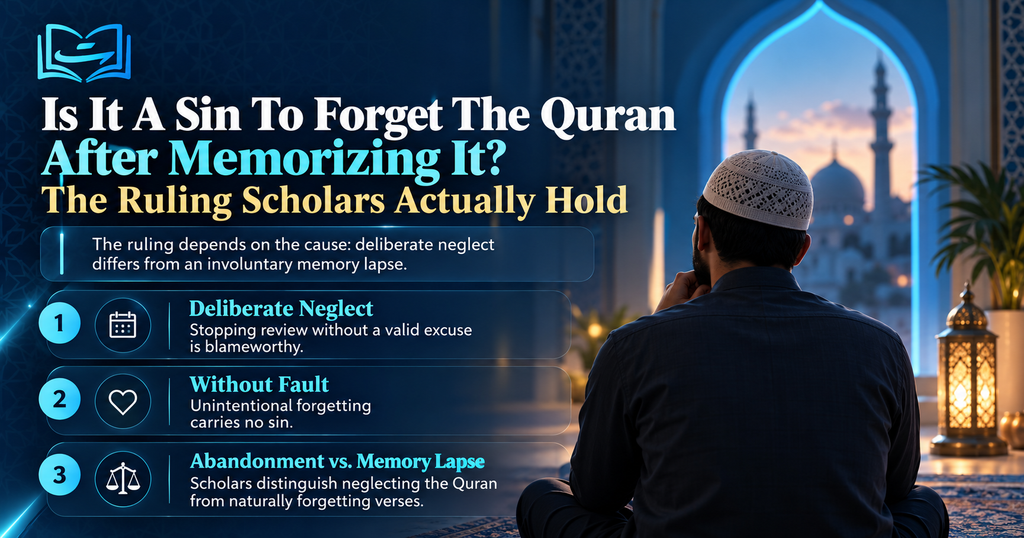
2. Forgetting Without Any Fault Carries No Sin At All
Shaykh Ibn Baz was asked directly about forgetting memorized verses. His answer was clear: no sin. Forgetting is a natural human reality; even the Prophet (peace be upon him) was reminded of verses he had temporarily forgotten, as confirmed in both Bukhari and Muslim.
Forgetting due to illness, overwhelming obligations, weak memory, or circumstances that make daily revision impossible falls entirely outside the realm of blame. Allah does not charge a soul beyond its capacity.
For students working through Psychological Barriers To Quran Memorization during difficult seasons of life, this ruling is a clear permission to return, not evidence of an existing sin.
Read also: Best Revision Schedule for Hifz – The Complete Muraja’ah System
3. The Line Scholars Draw Is Between Abandonment And Natural Memory Lapse
Classical scholars, including Ibn Uyaynah, noted that “forgetting” in Quranic and hadith texts often carries the meaning of abandoning rather than losing memory. This linguistic reality transforms the entire discussion.
When Surah Taha (20:126) says:
“and so today you are forgotten”
وَكَذَٰلِكَ ٱلۡيَوۡمَ تُنسَىٰ
It addresses those who abandoned guidance and practice, not those who experienced natural forgetfulness. The condemned state is deliberate turning away, not cognitive failure.
A student who tried sincerely but still forgot stands in a completely different position from one who simply stopped. The ruling and the remedy differ for each.
Experience Our Interactive Learning
Curious about how we teach? Watch these brief video clips from our recent live sessions to see our structured curriculum, advanced learning platform, and dynamic student-teacher interactions firsthand.
Start Your Quran Learning Journey
Join Tabark Academy today for structured online lessons with qualified tutors, customized to fit your goals.
Book Your Free Trial LessonThe Widely-Cited Hadith About Forgetting The Quran Is Not Authenticated
A narration reportedly states that whoever memorizes the Quran and then forgets it will meet Allah in a maimed state (ajdham). It appears in Abu Dawud and al-Tirmidhi and is frequently cited in popular discussions about this topic.
The majority of hadith scholars, including Imam al-Albani, Shaykh al-Arnaout, and al-Tirmidhi himself, classified this narration as weak (daif). A weak hadith cannot support a severe legal ruling under the established principles of usul al-fiqh.
Shaykh al-Qaradawi observed that accepting this narration at face value would logically discourage all memorization, since even brief forgetting could carry extreme consequences, directly contradicting the full body of authentic texts encouraging hifz.

The Authentic Prophetic Guidance Is About Maintenance, Not A Verdict
The hadith that carries proper legal weight is agreed upon in both Bukhari and Muslim: “Keep reviewing the Quran, for it slips away faster than a camel released from its tether.” This is the benchmark text in this discussion.
The comparison is precise. A tied camel stays close; an untethered one walks away. Quranic memorization follows the same pattern, fading steadily without consistent review.
This authentic text issues a practical instruction, not a punishment. It tells the hafiz to maintain the bond consistently. Understanding this reframes the question from “am I sinful?” to “what do I do next?”.
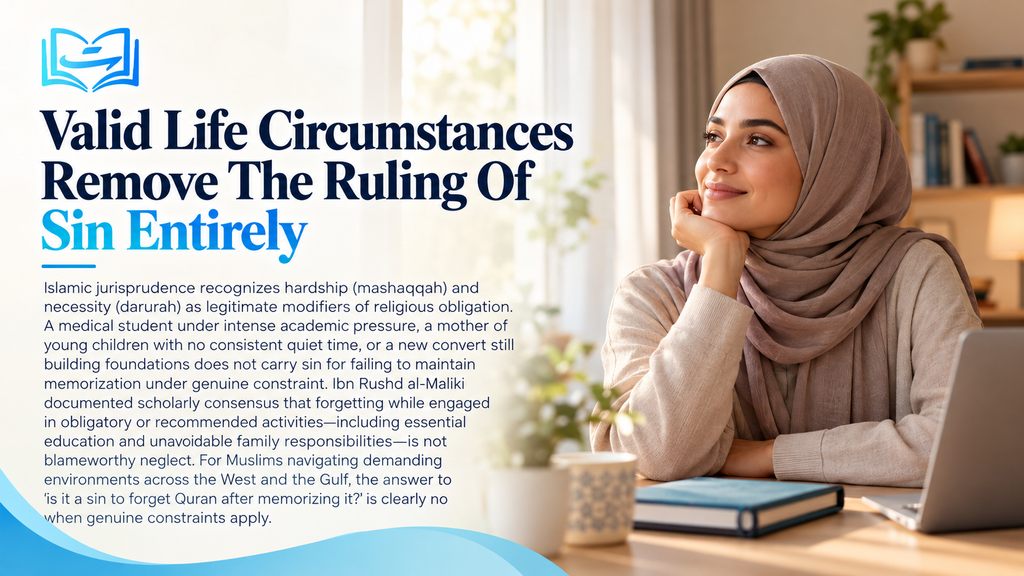
Why Families Choose Tabarak Academy for Juz Amma Memorization Course
Valid Life Circumstances Remove The Ruling Of Sin Entirely
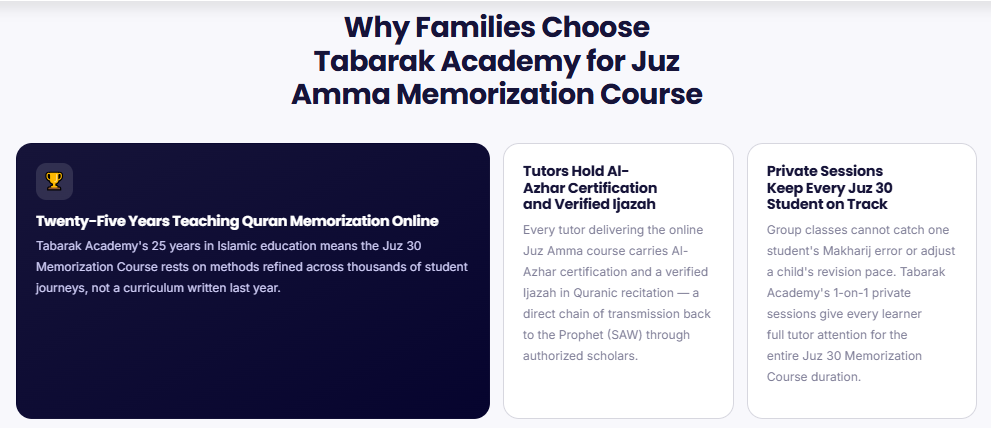
Islamic jurisprudence recognizes hardship (mashaqqah) and necessity (darurah) as legitimate modifiers of religious obligation.
A medical student under intense academic pressure, a mother of young children with no consistent quiet time, a new convert still building foundations; none of these individuals carry sin for failing to maintain memorization under genuine constraint.
Ibn Rushd al-Maliki documented scholarly consensus that forgetting while engaged in obligatory or recommended activities, including essential education and unavoidable family responsibilities, does not constitute blameworthy neglect.
For Muslims navigating demanding environments across the West and the Gulf, this ruling is directly relevant. The question [is it a sin to forget Quran after memorizing it] often comes from someone in exactly these circumstances, and for them the answer is clearly no.
The Quran Is Uniquely Prone To Fading Without Regular Review
The Prophet compared the Quran to a tied camel for a precise reason. Its structure, with clusters of nearly identical verses distributed across different surahs, makes it unusually vulnerable to confusion and blending without ongoing review.
No other form of religious knowledge was described with such emphasis on active, ongoing maintenance. Learning Arabic deepens comprehension of the Quran’s meanings, which significantly strengthens long-term retention and makes forgetting far less likely.
Why Do I Forget What I Memorize Of The Quran examines the cognitive and spiritual dimensions of this challenge in practical detail.
Recognizing why Quranic memorization fades differently from other knowledge clarifies why scholars treated daily revision as near-obligatory for every hafiz, not an optional habit.
Check What does the Online Qirat Course cover?

Returning To Forgotten Memorization Is Always The Right And Rewarded Path
Regardless of how forgetting happened, Islamic scholarship is unanimous on one point: returning to the Quran is praiseworthy, rewarded, and available to every Muslim at any point. No period of distance closes this door permanently.
Experienced Quran teachers note an important practical reality: a student who once memorized and then forgot benefits from neural pathways already formed. Re-memorization is substantially faster than the initial learning process.
This matters for the student who feels the gap is too wide to bridge. How to Regain Hifz After Years Away speaks directly to that feeling. The distance is always recoverable.
1. Repent Sincerely First If Neglect Was Genuine
Scholars who identify deliberate neglect as blameworthy also prescribe the remedy clearly: sincere repentance (tawbah).
Acknowledging the neglect honestly, resolving genuinely to change, and beginning a structured review; that sequence is the prescribed path forward.
Tawbah here is a beginning, not a burden. It removes the spiritual weight that can make returning to the Quran feel blocked. How To Restart Hifz After A Long Break provides realistic, practical steps for this exact starting point.
Returning to the Quran after distance, with genuine intention, carries its own reward. The duration of the gap does not erase the merit of the return.
2. Build A Revision Schedule Around Your Real Available Time
The most common reason hafiz continues losing memorization after resolving to maintain it is an unrealistic plan. A two-hour daily schedule designed for a full-time student will collapse within weeks for a working professional.
Effective plans are built around actual available time. Best Revision Schedule for Hifz demonstrates how to structure reviews for students, working professionals, and parents at different stages of life.
Teacher accountability significantly accelerates retention. Students who recite regularly to a qualified teacher maintain memorization at substantially higher rates.
Daily Hifz Revision Guide complements teacher-led sessions with self-directed daily techniques.
3. Re-Memorize Gradually; Never Rush The Recovery Process
The most common mistake after significant forgetting is attempting to recover everything rapidly. This approach consistently leads to exhaustion and abandonment, the territory documented in Hifz Burnout a Full Guide.
Experienced teachers advise gradual re-memorization: one page daily for a focused student, or half a page for someone managing competing demands. Sustained, consistent progress always outperforms frantic short-term effort.
The goal is permanent, durable retention, not a rapid completion number. Gradual re-memorization also allows deeper engagement with meaning, which strengthens long-term recall considerably.
Step Inside Our Virtual Classrooms
See our engaging teaching methods in action! watch real snippets of our live classes and discover how our expert instructors make learning interactive, memorable, and inspiring for every student.
Start Your Quran Learning Journey
Join Tabark Academy today for structured online lessons with qualified tutors, customized to fit your goals.
Book Your Free Trial LessonBegin Your Journey With Tabarak Academy
Tabarak Academy connects students in every timezone with qualified, ijazah-certified instructors who provide structured, personalized guidance for every level.
From students taking their first steps to advanced hafiz working toward their Ijazah in the Quran, every learner receives a clear program built around their actual goals.
Whether your goal is maintaining existing memorization, recovering what was lost, or starting completely fresh, Tabarak Academy’s live online programs serve students across the USA, UK, UAE, Malaysia, Germany, Egypt, Bahrain, and beyond.
Our Courses:
- Hifz Course for Sisters
- Tajweed Course for Kids
- Hifz Ijazah Course
- Hifz for Kids Course
- Hifz for Adults Course
- Online Hifz Program
- Quran Recitation Course
- Weekend Quran Classes
- Zoom Quran Classes

Conclusion
The question of whether it is a sin to forget the Quran after memorizing it has a clear, scholar-backed answer: sin applies only when forgetting comes from deliberate abandonment, not from unavoidable life pressure.
Ibn Baz, al-Nawawi, and the consensus of classical jurists all confirm this distinction. What every hafidh carries forward is the obligation to protect what remains and return to what was lost.
The cause of forgetting decides the ruling; the response to forgetting decides the outcome. Repentance, structured review, and a realistic schedule are the three tools every returning student needs.
Whether you memorized it in Cairo, Kuala Lumpur, or Birmingham, the path back to the Quran is always open. Understanding Arabic deeply accelerates that return, because comprehension turns review from mechanical repetition into genuine engagement with the text, and engaged review holds far longer.
Frequently Asked Questions
Is It A Sin To Forget The Quran After Memorizing It If You Were Busy?
No, forgetting the Quran due to genuine unavoidable busyness carries no sin. Scholars distinguish between willful neglect and forced circumstances.
A medical student, a new parent, or someone facing illness is not sinful for memory loss caused by legitimate obligations beyond their control.
What Is The Islamic Ruling On Someone Who Forgets Surah Al-Fatiha?
Al-Fatiha is the only portion of the Quran whose memorization is obligatory for every Muslim, because prayer is invalid without it. Forgetting any other surah or juz carries a separate ruling.
A person who forgets al-Fatiha through neglect is sinful; one who loses it through illness or cognitive decline bears no blame.
How Quickly Does Quran Memorization Fade Without Review?
Classical scholars noted that Quran memorization fades faster than any other memorized text if review stops. The Prophet (peace be upon him) compared it to a tied camel, meaning it requires constant attention.
Most huffadh report noticeable fading within two to four weeks of stopped revision.
Can Someone Who Forgot Most Of Their Hifz Return To Full Memorization?
Yes, and scholars explicitly encourage it. The prophetic reward for the one who struggles with recitation because it has grown difficult is double.
Former huffadh who rebuild their memorization after a gap often find the second memorization more stable, because the neural pathways are already formed from prior work.
Is The Hadith “Whoever Forgets A Surah Has It Cut Off” Authentic?
No. The hadith using the word “ajdham” to describe a person who forgets Quranic memorization is classified as daif (weak) by al-Albani, Shuaib al-Arnaout, and other hadith scholars.
It cannot be used to establish a ruling of serious sin. The authentic narrations on this topic concern maintenance and review, not permanent condemnation for forgetting.