

Say “qaf” and then “kaf” out loud. To most English speakers, both come out sounding like the letter “k” – yet in Arabic, mixing them up changes the meaning of a word entirely.
Understanding the difference between qaf and kaf pronunciation is one of the first real tajweed challenges a new reciter runs into, because the two letters sit almost in the same spot on the tongue and still sound completely different.
This guide walks through exactly where قِ (qaf) and كِ (kaf) are produced, why one is heavy and voiced while the other is light and breathy, and how to train your tongue and ear to tell them apart with confidence.
At Tabarak Academy, this is one of the most common corrections teachers make in live tajweed sessions, so the tips here reflect what actually helps students fix it.
What you’ll learn in this article:
- Exactly where qaf and kaf are each produced inside the mouth.
- Why qaf and kaf sound different despite their near-identical position.
- A simple physical test to tell the two letters apart every time.
- How each letter behaves with harakat (vowel marks) and sukoon.
- Real practice words and Qur’anic examples to build the sound into memory.
What Is The Difference Between Qaf And Kaf Pronunciation?
The difference between qaf and kaf pronunciation comes down to two things: tongue depth and voice.
Qaf (ق) is produced by pressing the very back of the tongue against the soft palate, with a heavy, voiced sound. Kaf (ك) is produced slightly further forward, against the hard palate, with a lighter, unvoiced, breathier sound.
Both letters stop the airflow completely for a brief instant before releasing it — what tajweed calls a shadid quality — so the two can feel deceptively similar to a beginner.
The real distinction is not where the tongue lands but how much weight and voicing goes into the letter once it gets there, which is exactly what the next two sections break down letter by letter.
Learners who are just starting to recognize the Arabic alphabet often benefit from reviewing the letter shapes and points of articulation together — Tabarak Academy’s Arabic Alphabet Learning Course covers both side by side before moving into full recitation.
How to Pronounce Qaf (ق) Correctly?
Qaf belongs to a small group of Arabic letters produced at the very back of the mouth, closer to the throat than any other letter on the tongue. Getting this letter right starts with placing the tongue correctly, then adding the right amount of weight and voice.
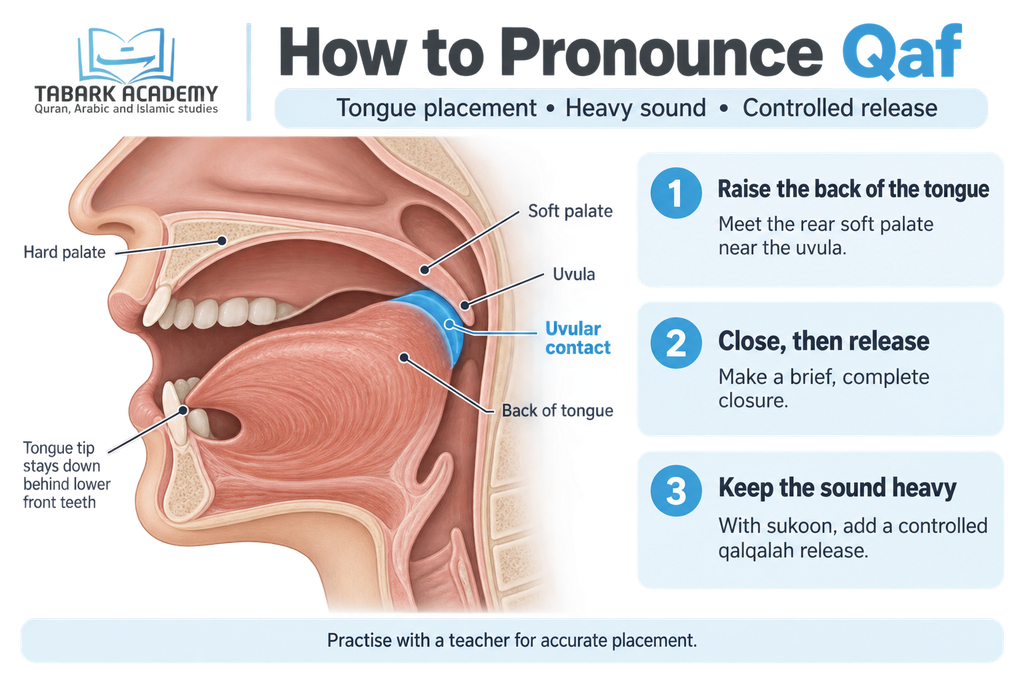
1. Tongue Position for Qaf
To produce qaf, raise the very root of your tongue until it presses against the soft palate — the fleshy part at the back of the roof of your mouth, close to the uvula. Hold a full, momentary closure there before releasing the sound.
This point sits almost as far back as the throat letters ghain and kha’, which is why qaf can feel like it is coming from the throat rather than the mouth when you first practice it.
2. The Sound and Feel of Qaf
Qaf is one of only seven letters in the entire Arabic alphabet classified as heavy (mufakhkham), and it is also voiced, meaning your vocal folds vibrate as you say it. That combination gives qaf its full, deep, almost “thumping” quality compared to any English sound.
Qaf is also one of the five qalqalah letters (remembered by the phrase qutb jad: ق ط ب ج د). When qaf carries a sukoon, especially at the end of a word, it produces a small, controlled echo instead of a flat stop — a detail that becomes important once you start reading connected Qur’anic text.
Experience Our Interactive Learning
Curious about how we teach? Watch these brief video clips from our recent live sessions to see our structured curriculum, advanced learning platform, and dynamic student-teacher interactions firsthand.
How to Pronounce Kaf (ك) Correctly?
Kaf sits only a few millimeters forward of qaf, but that small shift in position — combined with a completely different sifah profile — is what makes the two letters sound so distinct once you know what to listen for.
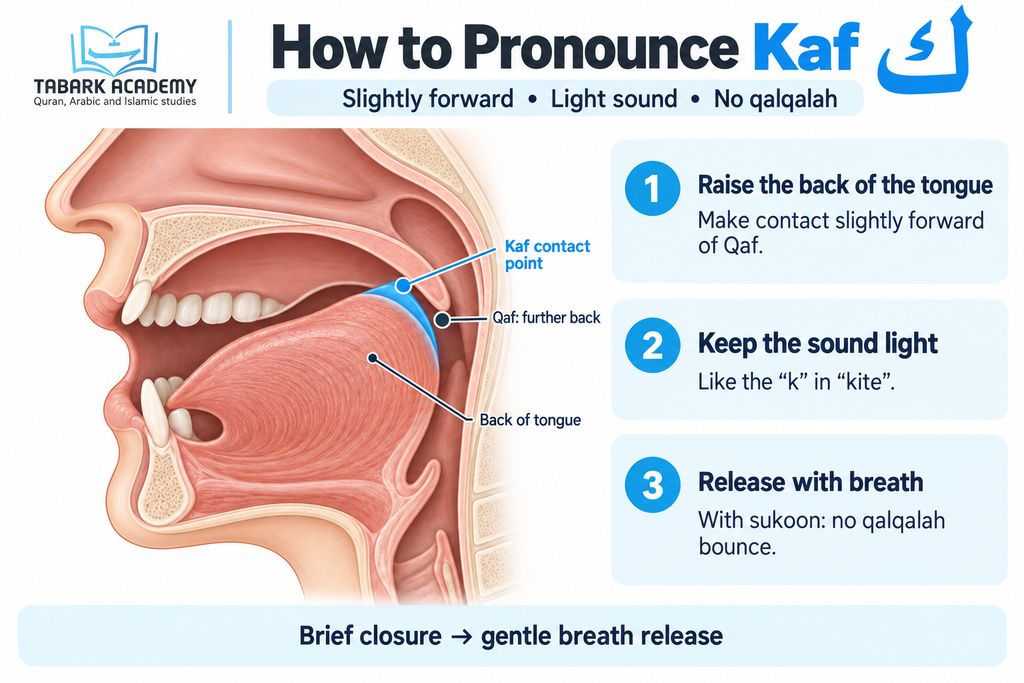
1. Tongue Position for Kaf
For kaf, the back of the tongue touches the hard palate rather than the soft palate — slightly forward and higher than the qaf point. The closure is still complete, but the contact is against a firmer part of the roof of the mouth.
If you say qaf and freeze your tongue in place, then say kaf, you should feel the point of contact move forward and the pressure lighten noticeably.
2. The Sound and Feel of Kaf
Kaf is light (muraqqaq) and unvoiced, produced mostly with breath rather than vocal vibration. This is the letter that actually resembles the English “k” in “kite,” which is exactly why English-speaking learners tend to default to it even when a word calls for qaf.
Unlike qaf, kaf is not one of the qalqalah letters. When it carries a sukoon, it is read as a plain, silent stop with no bounce or echo.
If you’re building your recitation from the very beginning, Tabarak Academy’s Arabic Course for Beginners pairs each new letter with guided listening practice like this, so the qaf-kaf distinction gets corrected early rather than becoming a habit to unlearn later.
Read Also: How to Pronounce the Two Arabic Haa Letters (ه & ح)
Qaf And Kaf Side By Side: A Quick Comparison
Once you can produce each letter on its own, the fastest way to lock in the difference is to compare them directly, feature by feature.
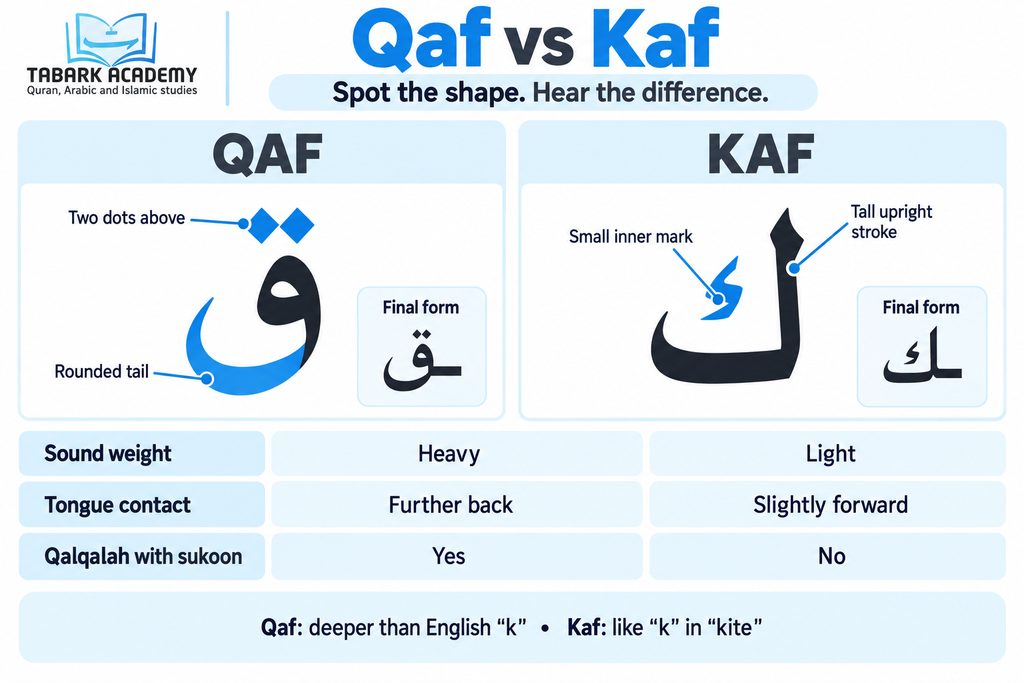
| Feature | Qaf (ق) | Kaf (ك) |
| Point of articulation | Back of tongue → soft palate | Back of tongue → hard palate (slightly forward) |
| Weight | Heavy (mufakhkham) | Light (muraqqaq) |
| Voicing | Voiced | Unvoiced |
| Qalqalah on sukoon | Yes | No |
| Closest English sound | Deeper than English “k” | Close to English “k” in “kite” |
Visually, the two letters are also easy to separate: qaf carries two dots above its final and isolated forms with a rounded tail, while kaf has a small squiggle above it that disappears in its medial and initial forms.
If reading and writing the letters accurately alongside their pronunciation would help, the Learn Arabic Writing Course covers letter shapes in every position.
Read also: Why Is Arabic Known as the Language of the Dhad?
Qaf And Kaf With Harakat And Sukoon
Harakat (vowel marks) change the vowel sound that follows a letter, but they never change the letter’s weight or voicing — a detail beginners frequently get wrong.
A. Fathah, Kasrah, and Dammah on Qaf and Kaf
With fathah, قَ sounds like “qa” and كَ sounds like “ka.” With kasrah, قِ sounds like “qi” and كِ sounds like “ki.” With dammah, قُ sounds like “qu” and كُ sounds like “ku.” In every case, qaf should stay heavy and kaf should stay light — a kasrah (which is itself a light vowel) does not soften qaf’s heaviness the way learners sometimes assume.
B. Sukoon and Qalqalah
When qaf ends a syllable with sukoon, as in حَقْ (haq), tajweed calls for a light echoing bounce rather than a flat cutoff. Kaf never does this: a word like أَكْ ends in a plain, silent stop.
You can hear both letters together in Surah Al-Fatihah: الْمُسْتَقِيمَ (al-mustaqeem, “the straight,” 1:6) carries qaf, and إِيَّاكَ (iyyaka, “You alone,” 1:5) ends in kaf — a useful pair to compare back to back.
Recitation at this level of detail is exactly what the Classical Arabic Course is built to develop, moving from individual letters into full ayahs with correct tajweed.
Common Mistakes Learners Make With Qaf and Kaf
Most errors with these two letters come from relying on the ear alone instead of training the tongue’s position first.
- Substituting the English “k” for qaf, which drops both its heaviness and its voicing.
- Softening qaf’s weight when it carries a kasrah, since a “light” vowel does not make the letter itself light.
- Reading kaf’s sukoon as if it needed a qalqalah bounce, which only applies to qaf, jeem, ba, ta, and dal.
A simple two-step self-check catches most of these: first, lock your tongue in the qaf position and confirm it feels pressed against the soft palate, not the hard palate; second, say the letter and check whether your voice is vibrating (qaf) or mostly breath (kaf).
Running through both checks before moving on to a new word is a habit worth building early.
Read also: How to Pronounce Dhad (ض): A Step-by-Step Guide
Practice Words And Qur’anic Examples
Once the position and sifat feel natural in isolation, practicing full words trains your tongue to make the switch quickly in real recitation.
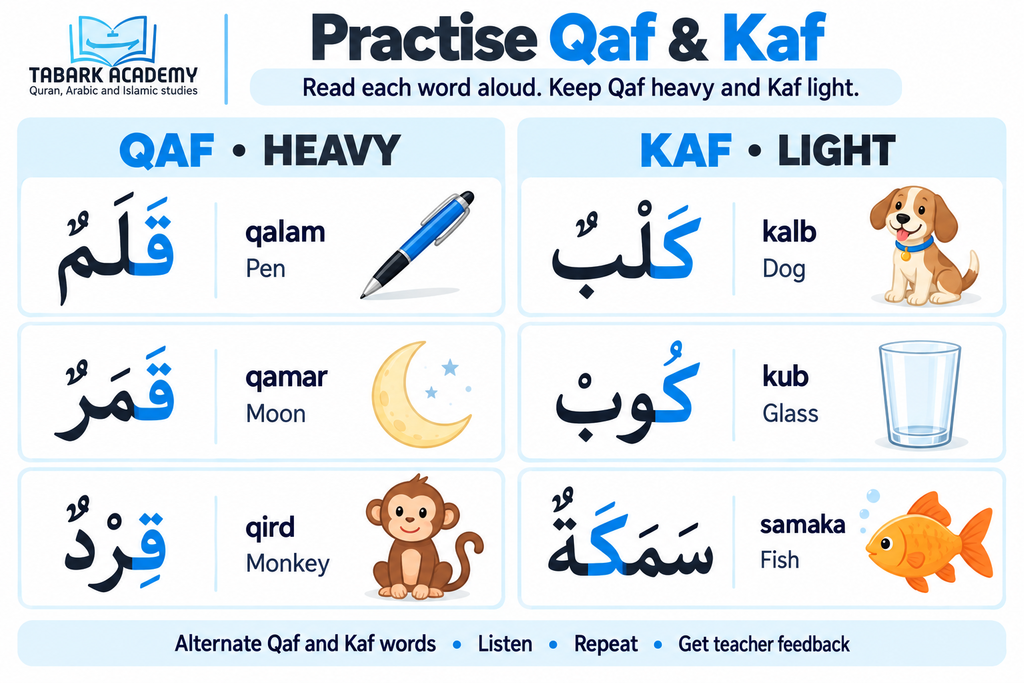
1. Words With Qaf
قَلَمٌ (qalam, “pen”), قَمَرٌ (qamar, “moon”), and قِرْدٌ (qird, “monkey”) are good starting words — each keeps qaf in a different vowel position so you can check that the heaviness holds throughout.
2. Words With Kaf
كَلْبٌ (kalb, “dog”), كُوبْ (kub, “glass”), and سَمَكَةٌ (samaka, “fish”) let you compare kaf in initial, isolated, and medial positions.
Reading these pairs aloud back to back, rather than on separate days, is what actually builds the distinction into muscle memory.
A teacher listening in real time can catch a mispronounced qaf or kaf far faster than self-practice alone — which is the exact feedback loop Tabarak Academy’s Online Arabic Classes are structured around.
Read Also: 23 Interesting Facts About The Arabic Language
Step Inside Our Virtual Classrooms
See our engaging teaching methods in action! watch real snippets of our live classes and discover how our expert instructors make learning interactive, memorable, and inspiring for every student.
Start Correcting Your Qaf and Kaf Pronunciation Today
Reading about the difference between qaf and kaf pronunciation only goes so far — the fastest way to fix it permanently is live correction from a qualified tajweed teacher who can hear exactly where your tongue is landing.
Tabarak Academy’s live, one-on-one classes are built around this kind of direct feedback, taking you letter by letter until qaf, kaf, and every other makhraj feel natural rather than memorized.
Our Arabic Language Courses
- Online Arabic Classes
- Arabic Course for Beginners
- Arabic Alphabet Learning Course
- Online Arabic Classes for Kids
- Arabic Classes for Adults
- Arabic Grammar Course
- Intermediate Arabic Course
- Arabic Speaking Course
- Arabic Reading Course
- Learn Arabic Writing Course
- Classical Arabic Course
- Modern Standard Arabic (MSA) Course
- Advanced Arabic Course
- Intensive Arabic Course
- Madinah Arabic Course
- Egyptian Arabic Course

Conclusion
The difference between qaf and kaf pronunciation is small in distance but large in effect: qaf is heavy, voiced, and carries qalqalah on sukoon; kaf is light, unvoiced, and never bounces.
Both are produced at the back of the tongue, only a few millimeters apart, which is exactly why English speakers tend to blur them into one sound.
Once you separate the two by position first and voicing second, the distinction becomes automatic rather than something you have to think through mid-recitation.
With consistent practice — and a teacher who can confirm your tongue placement is correct — qaf and kaf stop being one of the harder letters in the Arabic alphabet and become two of the clearest.

Frequently Asked Questions
Here are quick answers to the questions learners ask most often about qaf and kaf pronunciation, based on the corrections teachers give most frequently in live tajweed classes.
1. What is the main difference between qaf and kaf pronunciation?
Qaf is heavy and voiced, produced against the soft palate at the very back of the tongue. Kaf is light and unvoiced, produced slightly forward against the hard palate. The gap in position is small, but the difference in weight and voicing is clear once trained.
2. Why do qaf and kaf sound the same in English but not in Arabic?
English only has one “k” sound, which naturally maps onto kaf’s lighter quality. Arabic treats qaf as a separate, heavier, voiced letter, so English speakers have to build a new sound rather than reuse an existing one.
3. How can I practice qaf and kaf pronunciation at home?
Practice minimal pairs like قَلَمٌ and كَلْبٌ back to back, checking tongue position first and voicing second. Recording yourself and comparing to a native reciter, or getting live feedback from a teacher, speeds up the correction significantly.
4. Is qaf pronounced like a G or a K?
Qaf is closer to a deep, heavy “k” than a “g,” though its voicing gives it more depth than the English “k.” It should never be softened into a plain English “k” sound, which is actually closer to kaf.
5. Does kaf ever have qalqalah?
No. Qalqalah applies only to five letters — ق ط ب ج د — and kaf is not one of them. A sakin kaf is always read as a plain, silent stop.




0 Comments