
The difference between tafsir and ta’wil is an important topic in the sciences of the Quran (ʿUlum al-Quran). Although both terms relate to understanding the Book of Allah, scholars have used them in different ways throughout Islamic history.
Tafsir explains the direct meanings of Quranic words and verses, while ta’wil may refer to deeper interpretations supported by evidence or the outcome a verse points to.
In this guide, you will explore their linguistic roots, Quranic usage, scholarly opinions, and a simple example from Surah Al-Fajr to understand the difference more clearly.

What You Will Learn
- The linguistic and technical meanings of tafsir (تفسير) and ta’wil (تأويل).
- How the Quran uses each word, with verified verses and references.
- The seven best-known scholarly opinions on how tafsir and ta’wil differ.
- A practical example showing the tafsir and the ta’wil of the same verse.
- Common misunderstandings about ta’wil and how to avoid them.
Difference Between Tafsir and Tawil
The difference between tafsir and tawil, according to most later scholars, is that tafsir explains the apparent and direct meaning of Quranic words using Arabic language, authentic narrations, and the occasions of revelation. Ta’wil refers either to a deeper meaning derived through scholarly reasoning, or to the actual reality that a statement leads to.
Early Muslim scholars often used tafsir and ta’wil as synonyms. Imam al-Tabari (d. 310 AH), for example, named his famous commentary Jamiʿ al-Bayan ʿan Ta’wil Ay al-Quran and used the word ta’wil to mean tafsir throughout the book. This historical shift in usage explains why definitionsس of the two terms vary.

What Is Tafsir in Islam?
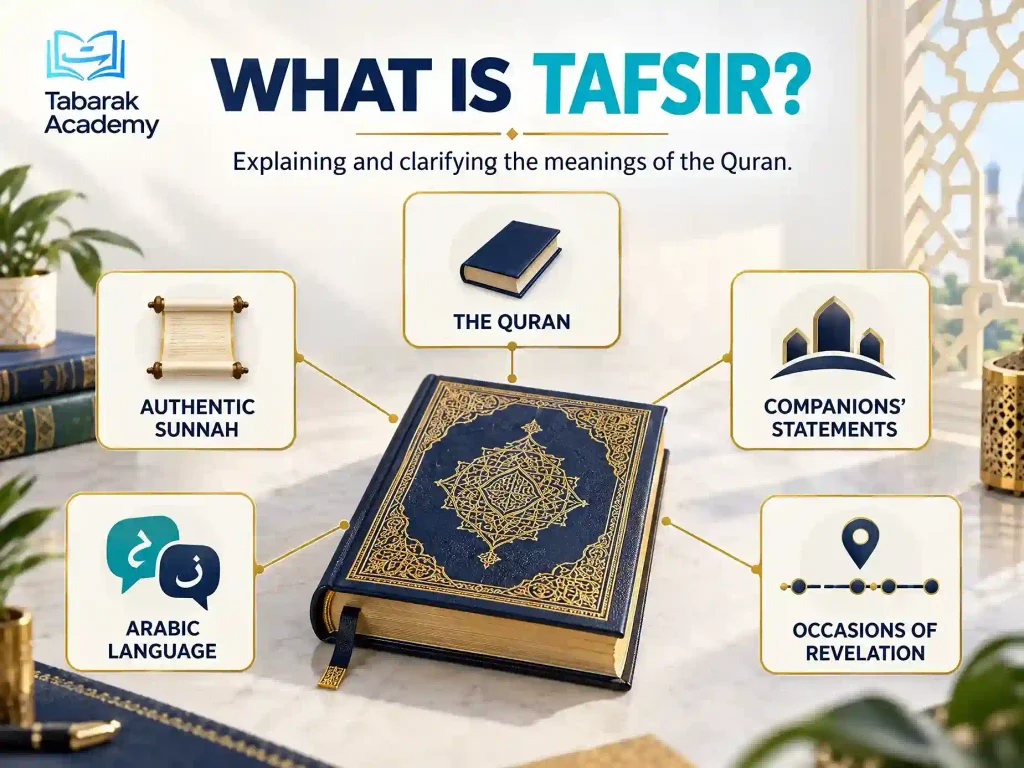
Tafsir (تفسير) is the Islamic science of explaining and clarifying the meanings of the Quran, including its words, verses, rulings, and intended messages. It helps readers understand what Allah teaches in each verse and how its meanings relate to the broader context of the Quran.
A mufassir (Quran commentator) relies on several essential sources, including the Quran itself, the authentic Sunnah of Prophet Muhammad ﷺ, the statements of the Companions, Arabic grammar and vocabulary, and knowledge of asbab al-nuzul (the occasions of revelation).
These sources help ensure that Quranic explanations are accurate, well-supported, and consistent with Islamic teachings.
How the Quran Uses the Word Tafsir
The word tafsir appears only once in the Quran, in Surah Al-Furqan. In this verse, Allah tells Prophet Muhammad ﷺ that whatever argument the disbelievers bring, Allah answers it with the truth and with the best explanation.
وَلَا يَأْتُونَكَ بِمَثَلٍ إِلَّا جِئْنَاكَ بِالْحَقِّ وَأَحْسَنَ تَفْسِيرًا
“And they do not come to you with an example [i.e., argument] except that We bring you the truth and the best explanation.”
The Main Sources of Tafsir
Scholars of tafsir follow a specific order of sources when explaining Quranic verses to ensure accurate understanding and avoid misinterpretation.
They begin with the most authoritative Islamic references and then move to other supporting sources. The main sources of tafsir, arranged according to their reliability, include:
- The Quran explaining the Quran: one verse clarifies another.
- The authentic Sunnah: the Prophet ﷺ explained the Quran in word and action.
- The Companions: they witnessed revelation and knew its context.
- The Arabic language: the Quran was revealed in clear Arabic.
Learners who want to recite verses accurately before studying their meanings can join the Quran recitation course at Tabarak Academy.

What Is Ta’wil in Islam?
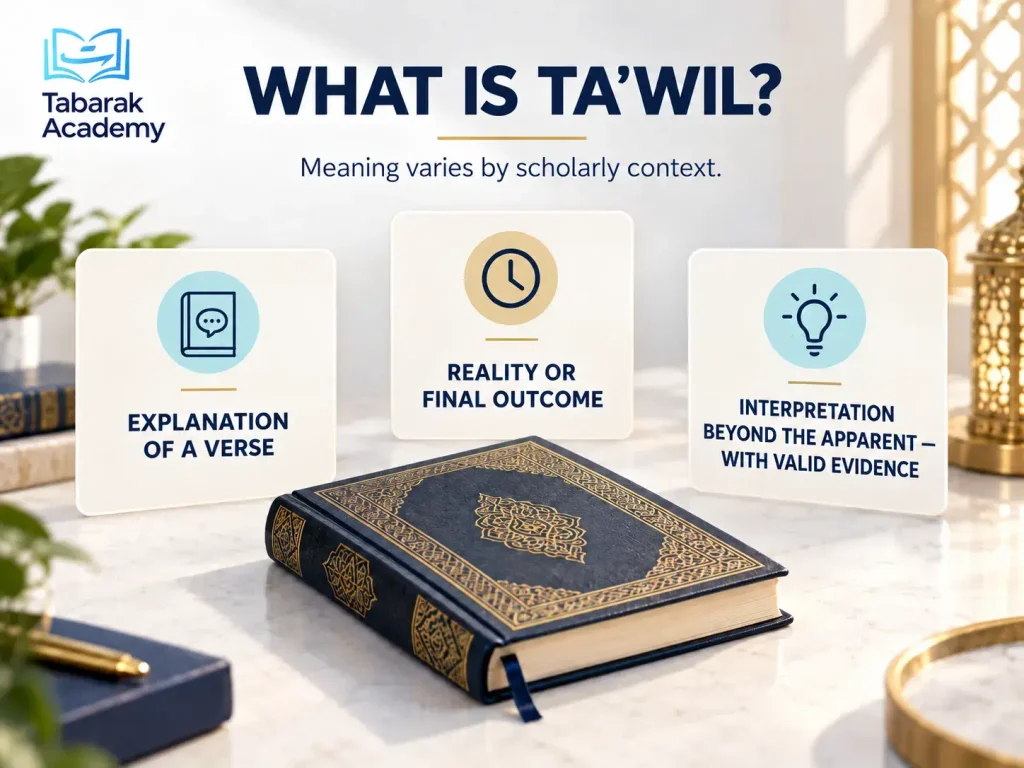
Ta’wil (تأويل) is an important Quranic and scholarly term that carries several meanings depending on the historical period and field of study. It may refer to explaining the meaning of a verse, revealing the reality or final outcome that a statement points to, or interpreting a word beyond its apparent meaning based on valid Islamic evidence.
Scholars have used the term in different ways, making it important to understand its context when studying Quranic interpretation. This distinction helps students appreciate the different approaches scholars have taken to understanding the meanings and messages of the Quran.
How the Quran Uses the Word Ta’wil
Unlike tafsir, the word ta’wil appears many times in the Quran. In most places, Quranic ta’wil refers to the real outcome or fulfillment of something, such as a dream coming true or the occurrence of what Allah has promised. Surah Yusuf gives a clear example.
وَرَفَعَ أَبَوَيْهِ عَلَى الْعَرْشِ وَخَرُّوا لَهُ سُجَّدًا ۖ وَقَالَ يَا أَبَتِ هَٰذَا تَأْوِيلُ رُؤْيَايَ مِن قَبْلُ قَدْ جَعَلَهَا رَبِّي حَقًّا ۖ وَقَدْ أَحْسَنَ بِي إِذْ أَخْرَجَنِي مِنَ السِّجْنِ وَجَاءَ بِكُم مِّنَ الْبَدْوِ مِن بَعْدِ أَن نَّزَغَ الشَّيْطَانُ بَيْنِي وَبَيْنَ إِخْوَتِي ۚ إِنَّ رَبِّي لَطِيفٌ لِّمَا يَشَاءُ ۚ إِنَّهُ هُوَ الْعَلِيمُ الْحَكِيمُ
“And he raised his parents upon the throne, and they bowed to him in prostration. And he said, ‘O my father, this is the explanation of my vision of before. My Lord has made it reality. And He was certainly good to me when He took me out of prison and brought you [here] from bedouin life after Satan had induced [estrangement] between me and my brothers. Indeed, my Lord is Subtle in what He wills. Indeed, it is He who is the Knowing, the Wise.’”
Ta’wil in the Language of Later Scholars
Among later scholars of usul al-fiqh (Islamic legal theory) and theology, ta’wil came to refer to interpreting a word away from its stronger, apparent meaning (al-zahir al-rajih) toward another possible but less apparent meaning (al-ihtimal al-marjuh), based on supporting evidence.
This approach requires clear and valid proof from Islamic sources or linguistic context. Without such evidence, scholars reject this type of reinterpretation because it may lead to incorrect or unsupported understandings of the Quran..
Step Inside Our Virtual Classrooms
See our engaging teaching methods in action! watch real snippets of our live classes and discover how our expert instructors make learning interactive, memorable, and inspiring for every student.
Deepen Your Knowledge with Islamic Studies
Join Tabarak Academy for structured, interactive Islamic studies lessons designed for all ages and taught by expert tutors.
Book Your Free Trial LessonScholars’ Opinions on the Difference Between Tafsir and Tawil
Scholars of ʿUlum al-Quran (Quranic sciences) have held different views on the definitions of tafsir and ta’wil, with no single definition accepted by everyone.
Their opinions generally fall into two main groups: those who consider the two terms synonymous and use them interchangeably, and those who distinguish between them according to their meanings, purposes, and methods of Quranic interpretation.
Understanding these two approaches makes it easier to follow classical discussions and recognize how scholars have used both terms in their works.
1. Tafsir and Ta’wil Are Synonyms
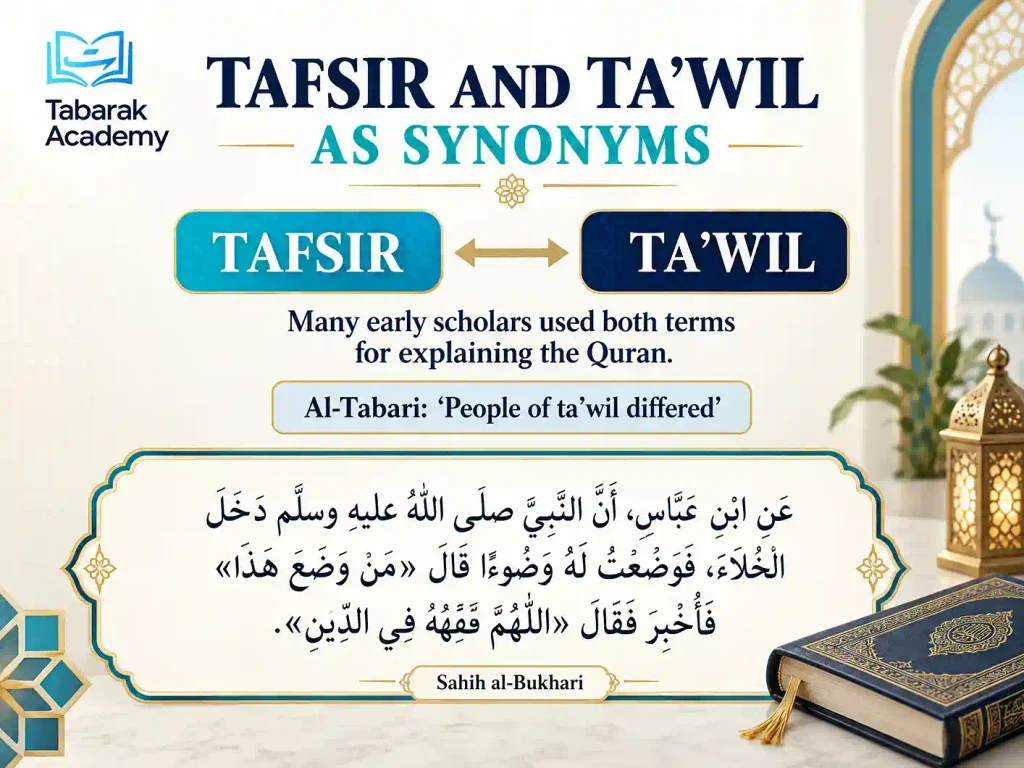
Many early scholars used tafsir and ta’wil interchangeably to mean explaining the Quran. This usage appears in al-Tabari’s commentary, where the phrase “people of ta’wil differed” refers to scholars disagreeing about a verse’s meaning.
The same usage appears in the Prophet’s supplication for Ibn ʿAbbas, asking Allah to teach him ta’wil, meaning Quranic interpretation. The core supplication is also recorded in Sahih al-Bukhari:
عَنِ ابْنِ عَبَّاسٍ، أَنَّ النَّبِيَّ صلى الله عليه وسلم دَخَلَ الْخَلاَءَ، فَوَضَعْتُ لَهُ وَضُوءًا قَالَ ” مَنْ وَضَعَ هَذَا ”. فَأُخْبِرَ فَقَالَ ” اللَّهُمَّ فَقِّهْهُ فِي الدِّينِ ”.
“Once the Prophet (ﷺ) entered a lavatory and I placed water for his ablution. He asked, ‘Who placed it?’ He was informed accordingly and so he said, ‘O Allah! Make him (Ibn ʿAbbas) a learned scholar in religion (Islam).’”
2. Tafsir Is More General Than Ta’wil
Some scholars viewed tafsir as broader in meaning than ta’wil. According to this perspective, tafsir includes the general explanation of Quranic words and verses, while ta’wil involves selecting a possible meaning beyond the immediate or apparent meaning based on valid evidence.
In other words, ta’wil is considered a specific form of tafsir, but tafsir is not always ta’wil. This distinction highlights the different approaches scholars have used to explain and understand the meanings of the Quran.
3. Tafsir Relates to Riwayah and Ta’wil to Dirayah
Another well-known scholarly view connects tafsir with transmission (riwayah) and ta’wil with understanding (dirayah). Tafsir focuses on meanings reported in the Quran, authentic Sunnah, and statements of early scholars.
Ta’wil, on the other hand, involves the understanding and conclusions that qualified scholars reach through knowledge, reflection, and reasoning. Both approaches aim to explain the meanings of the Quran using reliable foundations.
4. Al-Maturidi’s View Based on Certainty
Imam Abu Mansur al-Maturidi distinguished between tafsir and ta’wil based on the level of certainty involved. He viewed tafsir as stating definitively that Allah intended a particular meaning, which requires decisive evidence.
Ta’wil, however, involves preferring one possible interpretation over others without claiming absolute certainty about Allah’s intended meaning. This distinction highlights the importance of scholarly caution when interpreting Quranic verses.
5. Al-Baghawi’s View Based on Context
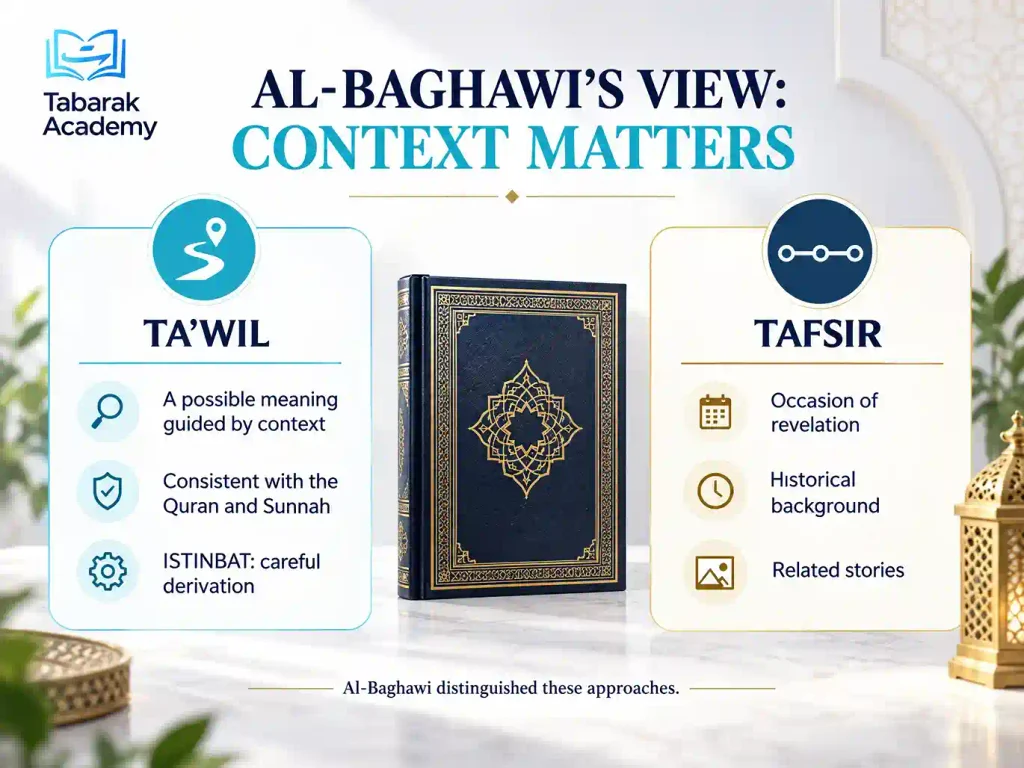
Imam al-Baghawi explained ta’wil as directing a Quranic verse toward a possible meaning that agrees with its surrounding context and does not contradict the Quran or Sunnah. This process involves istinbat (deriving meanings through careful reasoning).
In contrast, he associated tafsir more closely with explaining the occasion of revelation, historical background, and stories related to a verse.
6. Tafsir for Clear Verses and Ta’wil for Ambiguous Verses
Another scholarly view links tafsir with the muhkamat, the clear and decisive verses, and ta’wil with the mutashabihat, verses that carry more than one possible meaning. This view draws on Surah Al-Imran, which mentions the ta’wil of ambiguous verses directly.
هُوَ الَّذِي أَنزَلَ عَلَيْكَ الْكِتَابَ مِنْهُ آيَاتٌ مُّحْكَمَاتٌ هُنَّ أُمُّ الْكِتَابِ وَأُخَرُ مُتَشَابِهَاتٌ ۖ فَأَمَّا الَّذِينَ فِي قُلُوبِهِمْ زَيْغٌ فَيَتَّبِعُونَ مَا تَشَابَهَ مِنْهُ ابْتِغَاءَ الْفِتْنَةِ وَابْتِغَاءَ تَأْوِيلِهِ ۗ وَمَا يَعْلَمُ تَأْوِيلَهُ إِلَّا اللَّهُ ۗ وَالرَّاسِخُونَ فِي الْعِلْمِ يَقُولُونَ آمَنَّا بِهِ كُلٌّ مِّنْ عِندِ رَبِّنَا ۗ وَمَا يَذَّكَّرُ إِلَّا أُولُو الْأَلْبَابِ
“It is He who has sent down to you, [O Muhammad], the Book; in it are verses [that are] precise – they are the foundation of the Book – and others unspecific. As for those in whose hearts is deviation [from truth], they will follow that of it which is unspecific, seeking discord and seeking an interpretation [suitable to them]. And no one knows its [true] interpretation except Allah. But those firm in knowledge say, ‘We believe in it. All [of it] is from our Lord.’ And no one will be reminded except those of understanding.”
7. Apparent Meaning Versus Indicated Meaning
Many later scholars described tafsir as explaining meanings understood from the wording itself, and ta’wil as explaining meanings understood through subtle indication (ishara).
Al-Alusi highlighted this view in the introduction to his commentary Ruh al-Maʿani, and it became widely known among later scholars.
Busy professionals and parents can explore online Quran classes for adults to build regular study habits around their schedules.
Why Arabic Language Matters for Tafsir and Ta’wil
Both tafsir and ta’wil depend on Classical Arabic. Scholars required Quran commentators to master Arabic grammar (nahw), morphology (sarf), rhetoric (balagha), and vocabulary, because a single word can carry several meanings that change how a verse is understood.
Al-Raghib al-Isfahani noted that some Quranic words are used in a general sense at times and a specific sense at others, such as kufr (disbelief) and iman (faith). Other words share several meanings, like wajada. Recognizing these layers is part of a scholar’s careful work in ta’wil.
Students who already know the basic rules can build accuracy through practical Tajweed (Amali) lessons, where Tajweed rules are applied while reciting real passages of the Quran under a teacher’s supervision.

How Qira’at Relate to Tafsir
Qira’at are the authentic, mass-transmitted methods of reciting the Quran, preserved and passed down through generations of qualified scholars.
Classical Quran commentators often referred to qira’at when explaining verses because recognized variant readings can reveal additional aspects of meaning, clarify linguistic details, and enrich the understanding of a verse without changing the revealed text.
Students interested in exploring this field can learn more about the ten recognized readings, their rules, and the scholars who transmitted them through the Quran Qira’at course, which provides a structured introduction to this important branch of Quranic studies.

Common Misunderstandings About Ta’wil
Understanding ta’wil requires avoiding some common misconceptions about Quranic interpretation. Scholars have established clear guidelines to distinguish valid interpretation from unsupported personal opinions. Here are some important points to keep in mind:
- Ta’wil is not personal interpretation: It must be supported by valid evidence, agree with the Arabic language, and not contradict the Quran, authentic Sunnah, or scholarly consensus.
- Ta’wil does not always mean changing the apparent meaning: In the Quran, the term often refers to the fulfillment or reality of something, such as a dream coming true.
- Personal opinions require knowledge: Scholars warned against blameworthy interpretation (al-tafsir bi al-ra’y al-madhmum) based on guesswork or personal assumptions.
- Beginners should build a strong foundation: New Muslims can start by developing their Quran reading skills before moving on to advanced topics such as tafsir and ta’wil.
Experience Our Interactive Learning
Curious about how we teach? Watch these brief video clips from our recent live sessions to see our structured curriculum, advanced learning platform, and dynamic student-teacher interactions firsthand.
Deepen Your Knowledge with Islamic Studies
Join Tabarak Academy for structured, interactive Islamic studies lessons designed for all ages and taught by expert tutors.
Book Your Free Trial LessonDeepen Your Understanding of Islam with Tabarak Academy
Understanding the difference between tafsir and ta’wil is a sign of a growing relationship with the Quran. The next step is learning to read, recite, and reflect on Allah’s words with the help of qualified tutors who can answer your questions.
Tabarak Academy offers structured online Quran, Tajweed, and Qira’at lessons for children, adults, and new Muslims, customized to each learner’s level and goals. Start your learning journey today by booking a free trial lesson, and let every verse you read become clearer and closer to your heart.

Our Islamic Studies Courses
- Online Islamic Studies Classes
- Islamic Studies for Beginners
- Islamic Studies Classes for Kids
- Islamic Studies for Adults
- Islamic Studies for Ladies
- Islamic Studies for New Muslims
- Tafseer Al Quran Course
- Quranic Sciences (Uloom Al Quran) Course
- 5 Pillars of Islam for Kids
- Islamic Summer Camp
Conclusion
The difference between tafsir and ta’wil depends largely on how scholars have used these terms throughout Islamic history. Early scholars, such as al-Tabari, often treated them as synonyms, while later scholars distinguished tafsir as explaining the apparent meanings of Quranic verses and ta’wil as exploring possible deeper meanings or the reality behind a statement.
In the Quran, tafsir appears once to mean clear explanation, while ta’wil appears in several verses, often referring to fulfillment or reality. Both approaches require knowledge of Arabic, authentic Sunnah, and reliable evidence.
Ultimately, studying these sciences helps Muslims understand the Quran more deeply, reflect on its teachings, and avoid unsupported interpretations. May Allah grant us all a sound understanding of His Book.
Frequently Asked Questions About Tafsir and Ta’wil
What is the simple difference between tafsir and tawil?
Tafsir explains the clear, apparent meaning of Quranic words, while ta’wil refers to a deeper meaning supported by evidence or to the real outcome of a statement. Many later scholars summarize it this way: tafsir relates to transmission, and ta’wil relates to understanding.
Are tafsir and ta’wil the same thing?
Tafsir and ta’wil were often used as the same thing by early scholars, including Imam al-Tabari. Later scholars distinguished between them, so whether they are identical depends on which scholarly usage is being followed.
How many times does the word tafsir appear in the Quran?
The word tafsir appears only once in the Quran, in Surah Al-Furqan 25:33, where it means the best and clearest explanation. The word ta’wil, by comparison, appears many times across several surahs.
Is ta’wil allowed in Islam?
Ta’wil is accepted by scholars when it is supported by valid evidence, agrees with the Arabic language, and does not contradict the Quran, authentic Sunnah, or scholarly consensus. Ta’wil based only on personal desire or guesswork is rejected.
Who was called the Interpreter of the Quran?
ʿAbdullah ibn ʿAbbas, the cousin of Prophet Muhammad ﷺ, was known as Tarjuman al-Quran, the Interpreter of the Quran. The Prophet ﷺ supplicated for him to gain deep understanding of the religion.
Which famous tafsir book uses the word ta’wil in its title?
Jamiʿ al-Bayan ʿan Ta’wil Ay al-Quran by Imam al-Tabari uses ta’wil in its title. Al-Tabari used ta’wil to mean tafsir, reflecting the early usage of the two terms as synonyms.



0 Comments