
Learning how to memorize Quranic vocabulary is an important step toward understanding the Quran. Knowing the meanings of words makes recitation in prayer more meaningful and helps Muslims connect with the verses they read.
Many children and adults struggle to remember Quranic words, especially when they have different meanings depending on the context. However, learning Quranic vocabulary does not require memorizing hundreds of words at once. A simple plan based on understanding, repetition, and regular practice can make the process easier.
In this guide, you will discover practical memorization methods, a simple daily routine, tips for teaching children, and common mistakes to avoid.
1. Start With the Most Frequent Quranic Words
The best way to memorize Quranic vocabulary at the beginning is to focus on high-frequency words. A relatively small group of words and roots appears again and again throughout the Quran, so learning them first gives you the fastest improvement in understanding.
Start with common words such as Allah (Allah), Rabb (Lord, Sustainer), Yawm (day), Ard (earth), Sama’ (sky), Rahmah (mercy), ‘Ilm (knowledge), Qala (he said), and Amanu (they believed). You will meet these words in almost every page of the Mushaf.
Aim for three to five new words per day. Each time you recite, try to spot the words you have learned. This repeated exposure naturally strengthens your memory without extra study time.
2. Learn Each Word Within the Context of Its Verse
Learning a Quranic word inside its verse is more effective than memorizing it alone because the surrounding context helps explain its meaning and gives your memory a clear connection to the word.
Instead of simply repeating a translation, read the entire verse, understand its message, and notice how the word is used. This approach helps you remember both the vocabulary and its meaning while improving your understanding of Quranic verses.
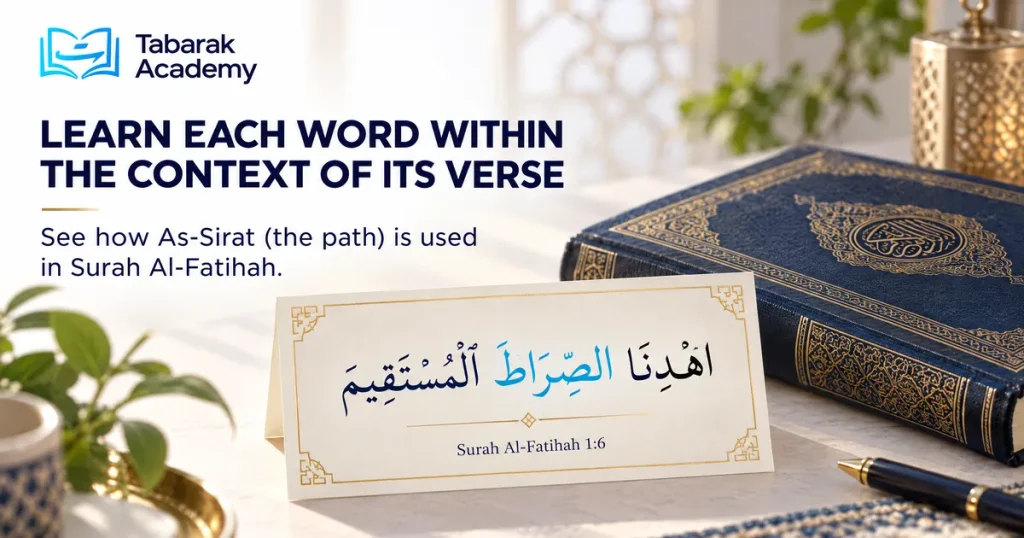
For example, when you learn the word As-Sirat (the path), study it in Surah Al-Fatihah, where Allah says:
اهْدِنَا الصِّرَاطَ الْمُسْتَقِيمَ
“Guide us to the straight path.”
If you are just beginning, this guide on how to learn the Quran when you converted late in life explains how to build a steady, realistic learning path.
3. Break Words Down to Their Arabic Roots
Most Arabic words are built on a three-letter root (Jidhr), and words that share the same root usually have a related core meaning. Learning these roots is one of the most effective ways to memorize Quranic vocabulary tips, because understanding one root can help you recognize and remember several related words at once.
For example, the root ك-ت-ب (K-T-B) is connected to writing and includes words such as Kitab (book), Kataba (he wrote), and Maktub (written). When you recognize this pattern, you can understand unfamiliar words more easily instead of memorizing each one separately.
This method also helps you notice connections between Quranic words and gradually build a stronger Arabic vocabulary.
| Root | Core Meaning | Related Quranic Words |
|---|---|---|
| ع – ل – م | Knowledge | عِلْم (‘Ilm), عَلِيم (‘Aleem), يَعْلَمُونَ (Ya’lamoon) |
| ر – ح – م | Mercy | رَحْمَة (Rahmah), الرَّحْمَٰن (Ar-Rahman), الرَّحِيم (Ar-Raheem) |
| ك – ت – ب | Writing | كِتَاب (Kitab), كُتِبَ (Kutiba), كَاتِب (Katib) |
| ه – د – ي | Guidance | هُدًى (Huda), اهْدِنَا (Ihdina), الْمُهْتَدِينَ (Al-Muhtadeen) |
Step Inside Our Virtual Classrooms
See our engaging teaching methods in action! watch real snippets of our live classes and discover how our expert instructors make learning interactive, memorable, and inspiring for every student.
Start Your Quran Learning Journey
Join Tabark Academy today for structured online lessons with qualified tutors, customized to fit your goals.
Book Your Free Trial Lesson4. Create Flashcards for Quranic Words
Flashcards are cards with a Quranic word on one side and its meaning on the other. They work well for kids and beginners because they encourage active recall, which means trying to remember the answer before seeing it. You can use paper cards or a digital app such as Anki.
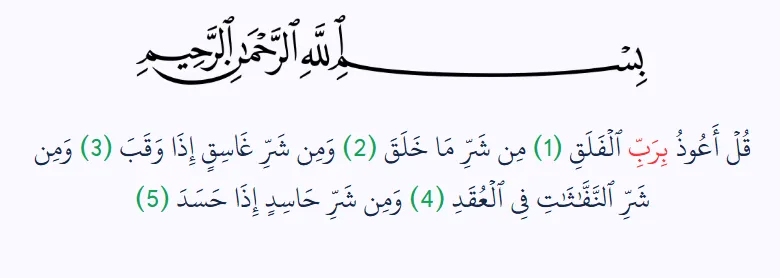
On the back of each card, write the meaning, the Surah where the word appears, and a short phrase from the verse. Here is an example set from Surah Al-Falaq, a short Surah many children already know:
| Quranic Word | Meaning |
|---|---|
| الْفَلَق (Al-Falaq) | Daybreak |
| غَاسِق (Ghasiq) | Night when it becomes dark |
| النَّفَّاثَات (An-Naffathat) | Those who blow on knots |
| حَاسِد (Hasid) | One who envies |
5. Group Quranic Words by Theme
Grouping Quranic vocabulary by topic helps your brain build connections between related words, making them easier to understand and recall later. Instead of memorizing random words, focus on one theme at a time, such as words related to worship, Paradise, the Prophets, nature, or the Day of Judgment.
For example, when studying worship, you can learn words like Salah (prayer), Dua (supplication), Sujud (prostration), and Iman (faith) together.
Before moving to a new topic, review the previous group to strengthen your memory and make it easier to recognize these words when you encounter them in different surahs.
- Names of Allah: Ar-Rahman, Ar-Raheem, Al-Ghafoor (the Most Forgiving), Al-‘Aleem (the All-Knowing), Al-Hakeem (the All-Wise).
- Worship: Salah (prayer), Zakah (obligatory charity), Siyam (fasting), Du’a (supplication).
- The Hereafter: Qiyamah (Resurrection), Hisab (reckoning), Mizan (the scale), Jannah (Paradise).
- Character: Sabr (patience), Shukr (gratitude), Ihsan (excellence), Taqwa (God-consciousness).
6. Review Words Using Spaced Repetition
Spaced repetition is a review method in which you revisit information at increasing intervals, such as one day, three days, one week, and one month. It is one of the most reliable ways to move Quranic words from short-term memory into long-term memory.
| When to Review | What to Do |
|---|---|
| Day 1 | Learn new words and understand their meanings |
| Day 2 | Review yesterday’s words |
| After 3 days | Test yourself on the meanings |
| After 1 week | Review all words from the week |
| After 2 weeks | Check how many words you still remember |
| After 1 month | Do a complete review |
The Prophet ﷺ encouraged Muslims to keep revisiting the Quran regularly, because what is not reviewed slips away from memory:
تَعَاهَدُوا هَذَا الْقُرْآنَ فَوَالَّذِي نَفْسُ مُحَمَّدٍ بِيَدِهِ لَهُوَ أَشَدُّ تَفَلُّتًا مِنَ الإِبِلِ فِي عُقُلِهَا
“Keep refreshing your knowledge of the Qur’an, for I swear by Him in Whose Hand is the life of Muhammad that it is more liable to escape than camels which are hobbled.”
Read also: 9 Signs Of How To Know If Your Hifz Is Strong
7. Listen to Quran Recitation While Following the Text
Listening to a skilled reciter while following the Mushaf links each word’s written form to its sound. This helps you recognize vocabulary instantly during your own recitation and in congregational prayer.
Choose a short Surah, listen to it several times during the week, and underline the words whose meanings you already know. Then look up the new words in a reliable Tafsir. Pairing this with Tajweed lessons for beginners ensures you also pronounce each word correctly as you learn its meaning.
Learn Quran reading, meaning, and recitation with qualified female teachers in a comfortable, supportive online environment.
Explore Quran Classes for Sisters

8. Link Words to Stories and Images
Visual and story-based learning makes Quranic vocabulary easier to remember, especially for children. When a word is tied to a picture or a story from the Quran, the mind stores it as a memorable scene rather than an abstract term.
- An-Nahl (the bee): link it to a picture of a bee and a honeycomb.
- Al-Fajr (the dawn): link it to an image of sunrise at the start of the day.
- Al-Mizan (the scale): link it to a balance scale representing justice.
- Al-Feel (the elephant): link it to the story of the Companions of the Elephant in Surah Al-Feel.
Parents can retell Quranic stories in simple language and pause to explain key words. This turns vocabulary lessons into an engaging activity and helps children understand meanings instead of memorizing them mechanically.
If you have forgotten parts of what you once memorized, this article on how long it takes to re-memorize a Juz offers a realistic revision plan.

9. Use New Words in Prayer and Daily Recitation
The best way to keep Quranic vocabulary fresh in your memory is to use it regularly in worship. After learning the vocabulary of a Surah, try reciting it in your voluntary prayers while consciously recalling the meaning of each word.
This practice turns memorized vocabulary into active understanding during Salah and helps strengthen your connection with the Quran. Regular recitation and revision also make it easier to recognize words without having to translate each one mentally.
Joining a guided learning program, such as an applied Tajweed practice course, provides consistent opportunities to read, repeat, and understand Quranic verses while improving your recitation.

10. Test Yourself and Teach Others
Testing yourself is an effective way to discover which Quranic words you truly remember and which ones need more revision. Instead of simply rereading your vocabulary list, try recalling meanings without looking at the answers.
This helps strengthen memory and makes it easier to recognize words when reading the Quran. Simple activities work well for both kids and adults:
- Matching game: connect each Quranic word with its correct meaning.
- Multiple choice: read a word and choose the right meaning from three options.
- Daily challenge: pick five words and recall their meanings without looking.
- Family quiz: compete with family members on the meanings of Quranic words.
Self-assessment is just as valuable for memorization. These methods to test your own Hifz can be adapted to check your vocabulary progress as well.
Daily Routine to Memorize Quranic Vocabulary
A focused session of 15 to 20 minutes a day is enough to make steady progress in learning Quranic vocabulary, as long as you follow a consistent routine. You do not need to memorize a large number of words in one sitting.
Instead, divide your time between learning new vocabulary, reviewing previously studied words, and practicing their meanings in Quranic verses. Here is a simple daily routine for beginners:
| Time | Activity |
|---|---|
| 5 minutes | Review previously learned words |
| 5 minutes | Learn 3 to 5 new words |
| 5 minutes | Read the verses where the new words appear |
| 5 minutes | Test yourself using flashcards |
If your weekdays are busy with work or school, you can dedicate longer sessions on your days off. Joining weekend Quran classes is a practical way to keep your learning consistent without disrupting your weekly schedule.

Memorize Quranic Vocabulary Tips for Kids
Children learn Quranic vocabulary best through short, interactive, and enjoyable lessons. Using pictures, simple explanations, educational games, and regular repetition helps them understand new words and remember their meanings. Here are some practical tips to make learning easier and more enjoyable:
- Start with simple words from short Surahs your child already recites, such as Al-Ikhlas, Al-Falaq, and An-Nas.
- Use pictures and flashcards so each word is linked to a clear image.
- Keep sessions short, around 10 to 15 minutes depending on the child’s age.
- Turn review into games like matching and simple quizzes.
- Praise effort regularly so your child associates the Quran with joy, not pressure.
Children who learn word meanings alongside memorization often build a deeper connection with what they recite. A dedicated Quran memorization program for kids can combine Hifz with age-appropriate explanation of the verses.

Reliable Books and Tools for Learning Quranic Vocabulary
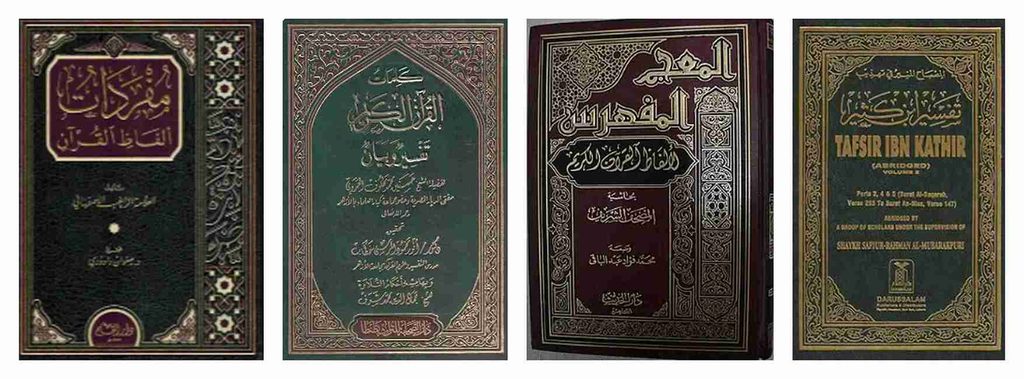
Choosing reliable references is important for understanding Quranic vocabulary accurately, as some words carry specific meanings that may change depending on their context in the verses. The following well-established resources can help you learn and explore Quranic vocabulary:
- Mufradat Alfadh al-Quran by Ar-Raghib al-Asfahani: a classical dictionary explaining the meanings of Quranic words.
- Kalimat al-Quran: Tafsir wa Bayan by Sheikh Hasanayn Muhammad Makhluf: a concise explanation of difficult Quranic words, suitable for beginners.
- Al-Mu’jam al-Mufahras li-Alfadh al-Quran by Muhammad Fu’ad Abd al-Baqi: an index showing where each word appears in the Quran.
- Trusted Tafsir books such as Tafsir Ibn Kathir and Tafsir As-Sa’di, for understanding words within their verses.
Read also: Is Adult Memorization Slower Than Childhood Memorization?
Experience Our Interactive Learning
Curious about how we teach? Watch these brief video clips from our recent live sessions to see our structured curriculum, advanced learning platform, and dynamic student-teacher interactions firsthand.
Start Your Quran Learning Journey
Join Tabark Academy today for structured online lessons with qualified tutors, customized to fit your goals.
Book Your Free Trial LessonLearn Quranic Vocabulary With Qualified Teachers at Tabarak Academy
Self-study is a great start, but a qualified teacher helps you learn faster, correct mistakes early, and understand the meanings of verses accurately. Tabarak Academy offers structured online Quran, Tajweed, and Hifz courses for kids, sisters, and adults, with flexible schedules and lessons tailored to your level and goals.
You can get started with a free trial lesson and choose the learning path that suits your needs.

Our Quran Courses
- Online Quran Classes
- Online Quran Classes for Beginners
- Online Quran Classes for Kids
- Online Quran Classes for Adults
- Online Quran Classes for Men
- Online Quran Classes for Sisters
- Quran Reading Course
- Quran Recitation Course
Conclusion
Knowing how to memorize Quranic vocabulary can transform the way you read, understand, and connect with the Quran. By starting with frequently used words, studying them in context, using flashcards, and practicing spaced repetition, you can gradually build a stronger vocabulary and remember meanings more effectively.
Applying new words during prayer and Quran recitation also helps reinforce what you have learned.
The key to success is consistency rather than memorizing long lists in a short time. Try learning a few words each day, reviewing previously learned vocabulary, and using new words when reading and reflecting on Quranic verses.
Remember, the goal is not simply to memorize words but to understand the speech of Allah, reflect on its meanings, and apply its teachings in your daily life.
Frequently Asked Questions About Memorizing Quranic Vocabulary
How do I start learning Quranic vocabulary?
Start with short Surahs you already know. Write down unfamiliar words, look up their meanings in a reliable Tafsir, and record each word with its verse. Review daily so the meanings become familiar during recitation.
How to memorise Quranic vocabulary faster?
To memorise Quranic vocabulary faster, focus on high-frequency words and Arabic roots first. Combine flashcards with spaced repetition and recite the verses containing those words in prayer.
How many Quranic words should I memorize per day?
Beginners can start with three to five Quranic words per day. Learners with stronger Arabic can increase the number gradually. Retaining words through review matters more than the daily count.
Does learning Quranic vocabulary help with Quran memorization?
Yes, understanding word meanings makes Quran memorization easier because verses become a connected message. However, Hifz still requires regular repetition, recitation to a teacher, and revision.
Can kids learn Quranic vocabulary?
Yes, children can learn Quranic vocabulary effectively using picture cards, short stories, and games. Begin with words from short Surahs they already recite and keep sessions brief and positive.




0 Comments