

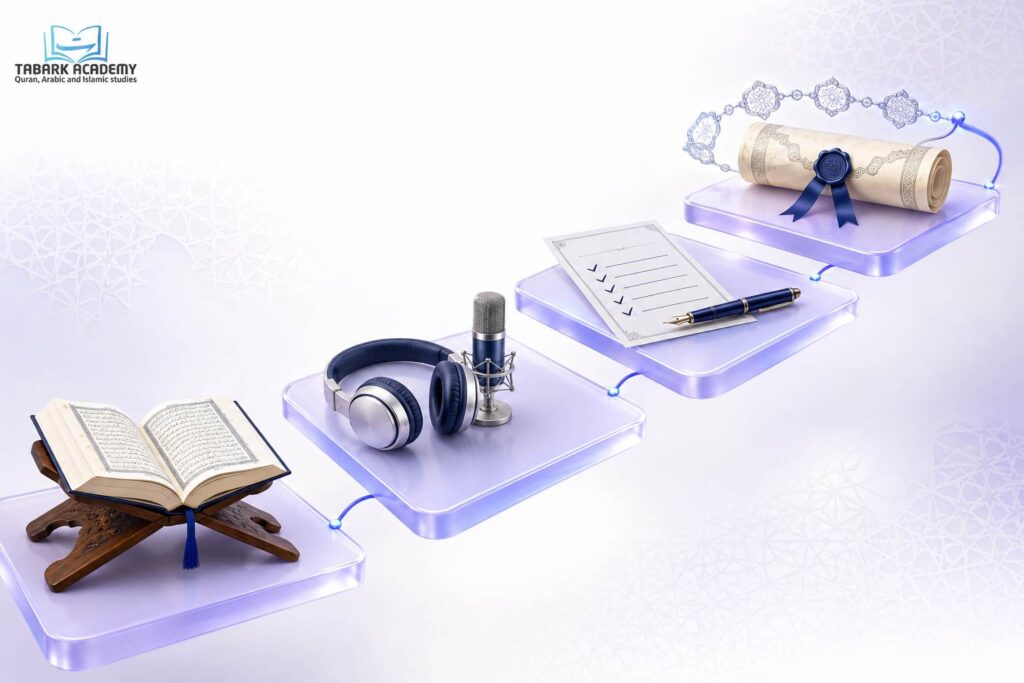
How To Get Ijazah In The Quran – A Complete Guide
Every year, thousands of students memorize or recite the Quran to a level they believe qualifies them to teach it, only to discover that completing a Quran course and receiving an Ijazah are not the same thing.
If you are asking how to get Ijazah in the Quran, you are asking about a formal system of authorization within the Islamic scholarly tradition. An Ijazah is granted by a qualified Sheikh who has received authorization through a Sanad, or chain of transmission, connecting teachers and reciters across generations.
Receiving an Ijazah therefore involves more than finishing a curriculum or demonstrating general fluency. The student must reach the recitation standard required by the Sheikh, complete the prescribed study and assessment process, and demonstrate mastery of the particular Qira’ah or Riwayah in which authorization is being sought.
The exact requirements can vary according to the type of Ijazah, the Riwayah being studied, and the methodology of the Sheikh. The steps below explain the core process and the standards a student may be expected to meet before receiving an Ijazah.
1. Build Precise and Reliable Memorization of the Entire Quran
For an Ijazah that requires complete Hifz, memorizing the Quran means more than reaching Surah An-Nas once. The student needs sufficiently strong retention to recite the entire Quran accurately from memory, from Surah Al-Fatihah to Surah An-Nas.
A qualified Sheikh will pay attention not only to obvious forgotten verses but also to smaller weaknesses such as hesitation, omitted words, accidental additions, incorrect endings, and confusion between similar passages.
This is why students preparing for Ijazah usually need intensive Muraja’ah alongside new memorization. The goal is to reach a point where the Quran can be recalled consistently rather than depending on short-term memory.
Before beginning the final Khatmah, the student should be able to move between Surahs and passages with confidence and recover quickly when tested on similar verses.
2. Master the Essential Tajweed Rules Behind Accurate Quran Recitation
Correct recitation requires the student to understand the rules governing how Quranic letters, words, and verses should be pronounced.
This includes a thorough understanding of Makharij and Sifaat, Noon Sakinah and Tanween, Meem Sakinah, Madd, Qalqalah, Tafkhim and Tarqiq, as well as Waqf and Ibtida’ and the other Tajweed principles required for accurate recitation.
The objective is not simply to memorize definitions. A student preparing for Ijazah should understand why a particular rule applies and be able to recognize it while reading the Quran.
This theoretical foundation becomes particularly important when the student is expected to identify mistakes, explain corrections, or eventually transmit what they have learned to others.
3. Apply Tajweed Consistently During Live Recitation With a Qualified Teacher
Knowing Tajweed rules on paper does not automatically produce accurate recitation. The student must train until those rules are applied naturally and consistently while reciting.
This requires direct correction from a qualified teacher who can hear errors the student may not recognize independently. Particular attention is given to Makharij, Sifaat, vowel lengths, Ghunnah, Qalqalah, Tafkhim and Tarqiq, and correct stopping and starting.
The goal is consistency. Applying a rule correctly in one Surah but repeatedly missing it elsewhere shows that the rule has not yet become firmly established in the student’s recitation.
Regular supervised practice also prevents repeated pronunciation mistakes from becoming habits that are much harder to correct later in the Ijazah journey.
4. Study and Memorize the Tajweed Matn Required by Your Sheikh
Depending on the Sheikh and the type of authorization being pursued, the student may be expected to study or memorize a recognized classical Tajweed text (Matn).
One well-known example is Al-Muqaddimah Al-Jazariyyah (المقدمة الجزرية) by Imam Ibn al-Jazari. A teacher may use this or another recognized text according to their teaching methodology and the student’s level.
Studying a Matn gives structure to Tajweed knowledge. Instead of knowing individual rules in isolation, the student develops a systematic understanding of the principles governing Quranic recitation.
The exact text and level of memorization required should therefore be confirmed with the Sheikh rather than assumed to be identical for every Ijazah program.
5. Recite a Complete Quran Khatmah to the Sheikh for Direct Verification
One of the central stages of the Ijazah process is completing a full Khatmah under the direct supervision of the Sheikh.
The student recites the Quran according to the requirements of the Ijazah being pursued, while the Sheikh listens closely and corrects errors throughout the recitation. This allows the teacher to assess the student’s performance across the entire Quran rather than judging their ability from a few selected Surahs.
The Sheikh may stop the student to correct pronunciation, Tajweed application, memorization mistakes, or rules specific to the Riwayah being studied. Those corrections must be understood and applied when similar cases appear later.
This stage may take considerable time because the objective is not simply to finish the Khatmah. It is to demonstrate a reliable standard of recitation across the Quran.
6. Pass the Sheikh’s Final Assessment of Hifz, Tajweed, and Riwayah
Completing the Khatmah does not necessarily mean the Ijazah is automatically granted. The Sheikh must be satisfied that the student has reached the required level of accuracy and consistency.
The final evaluation may assess the strength of the student’s Hifz, practical Tajweed, pronunciation, stopping and starting, and mastery of the particular Qira’ah or Riwayah in which authorization is being sought.
The Sheikh may also revisit passages where the student previously made mistakes or test similar verses to make sure earlier weaknesses have been corrected.
There is no need to assume that every Sheikh uses an identical final examination. Assessment methods can differ, but the underlying purpose is the same: the teacher must be confident in the student’s ability before attaching that student’s name to the chain of transmission.
7. Receive Your Ijazah With the Specific Riwayah and Documented Sanad
Once the Sheikh is satisfied that all required standards have been met, the student may receive the Ijazah.
The authorization should identify what the student has been authorized in rather than functioning as a generic Quran completion certificate. For example, it may specify the particular Riwayah in which the student’s recitation was verified.
The accompanying Sanad records the chain of transmission through which that authorization was received, connecting the student to their Sheikh and through preceding teachers in the chain.
This is what distinguishes an Ijazah from an ordinary course certificate: it represents authorization within a transmitted scholarly chain rather than simply proof that a student attended or completed a course.
Experience Our Interactive Learning
Curious about how we teach? Watch these brief video clips from our recent live sessions to see our structured curriculum, advanced learning platform, and dynamic student-teacher interactions firsthand.
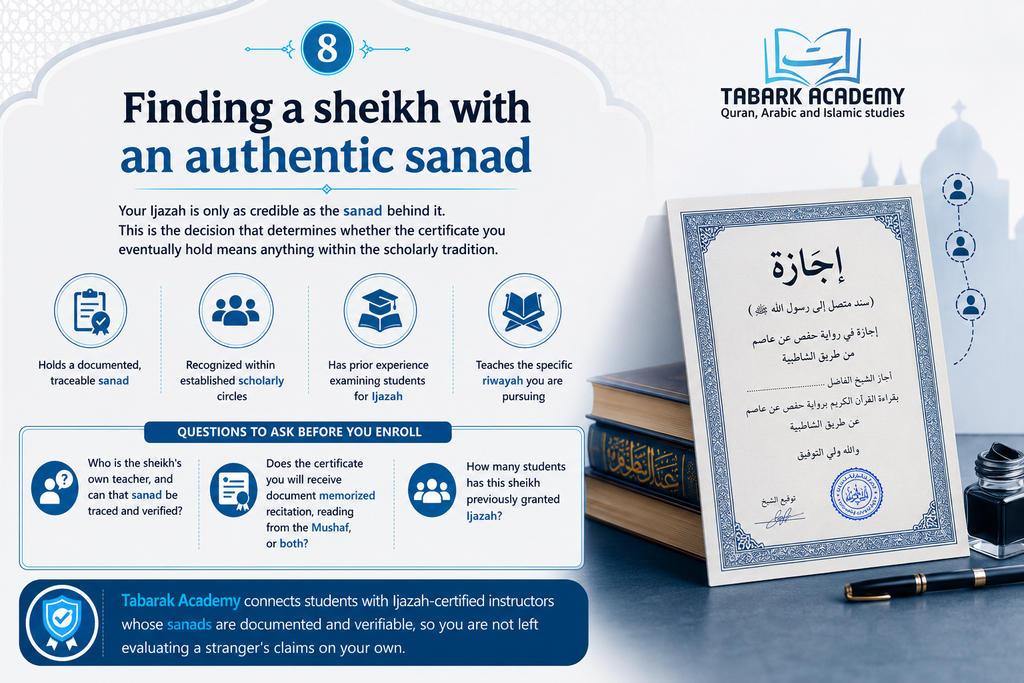
8. Choose a Qualified Ijazah Sheikh With a Verified and Traceable Sanad
Finding the right Sheikh should happen before investing months in the Ijazah process because the credibility of the authorization depends heavily on the qualification and Sanad of the person granting it.
A qualified Ijazah Sheikh should hold their own documented and traceable Sanad, have strong mastery of the recitation they teach, and be qualified to grant authorization in the specific Qira’ah or Riwayah the student wants to pursue.
It is also useful to look for a teacher with experience preparing and assessing Ijazah students. A strong reciter is not automatically an experienced Mujiz, just as being authorized in one Riwayah does not necessarily mean a teacher can grant authorization in every other Riwayah.
Students searching independently should therefore verify the Sheikh’s credentials before beginning. Ask who granted their Ijazah, which Riwayah they are authorized to teach, whether their Sanad can be documented, and what requirements they expect you to complete before authorization.
Doing this at the beginning protects the student from spending significant time preparing for a certificate whose chain or authorization cannot later be clearly verified.
Read also:Complete Path to a Certified Quran Sanad & Ijazah
Questions to Ask Before Choosing an Ijazah Sheikh or Academy
Before committing to an Ijazah program, verify exactly who will teach and authorize you, what their Sanad covers, and what type of Ijazah you will receive. A reputable Sheikh or academy should be able to answer these questions clearly before you enroll.
Ask:
- Who granted the Sheikh their own Ijazah? Ask about the Sheikh’s teacher and whether their Sanad can be documented and traced through the chain of transmission.
- Which Qira’ah or Riwayah is the Sheikh authorized to teach? Make sure their authorization covers the specific recitation you intend to study rather than assuming every Ijazah teacher teaches every Riwayah.
- What type of recitation will your Ijazah certify? Confirm whether you will complete the Quran from memory, by reading from the Mushaf, or according to another defined method required for that authorization.
- What must you complete before the Ijazah is granted? Ask about the Khatmah, Tajweed standard, memorization requirements, assessments, and any Tajweed texts or additional study the Sheikh expects.
- How much experience does the Sheikh have granting Ijazah? Ask how many students they have previously examined and authorized and how the assessment process normally works.
- What information will appear on the final Ijazah and Sanad? You should understand what Riwayah or authorization the document records and how the chain of transmission will be documented.
These questions help you distinguish a structured Ijazah program from a course that simply provides a completion certificate.

.What a Quran Ijazah Certifies and Authorizes You to Transmit
A Quran Ijazah is a formal authorization from a qualified Sheikh confirming that a student has recited the Quran to the required standard, with correct Tajweed and according to a specific Riwayah. The teacher who grants this authorization is known as the Mujeez.
Unlike a standard course certificate, an Ijazah represents scholarly authorization to transmit a particular recitation. It is connected to a documented line of teachers through whom that recitation has been preserved and passed down.
How Your Sanad Connects Your Ijazah Through a Chain of Quran Teachers
The Sanad is the documented chain of transmission accompanying the Ijazah. It connects the student to their Sheikh, then through successive teachers and reciters in the chain back through the established tradition of Quranic transmission.
The Sanad is therefore a central part of what gives an Ijazah its scholarly significance. It documents from whom the student received the recitation and through which chain it was transmitted, rather than simply recording that a Quran course was completed.
High vs Low Sanad – Does the Length of the Chain Affect Your Ijazah?
A high Sanad (uluw al-isnad) contains fewer transmitters between the student and earlier authorities in the chain, while a lower Sanad contains more.
The difference concerns the length and scholarly distinction of the chain, not automatically the validity of the Ijazah. A longer chain does not make an Ijazah invalid simply because it contains more transmitters; what matters is that the chain and authorization are properly established.
For students pursuing Ijazah, the priority should therefore be finding a qualified Sheikh with a documented and verifiable Sanad rather than choosing a teacher solely because their chain is shorter.
Read also: Understanding Ijazah vs. Sanad in Quranic Studies
Ijazah From the Mushaf vs Memorization – What Each One Certifies
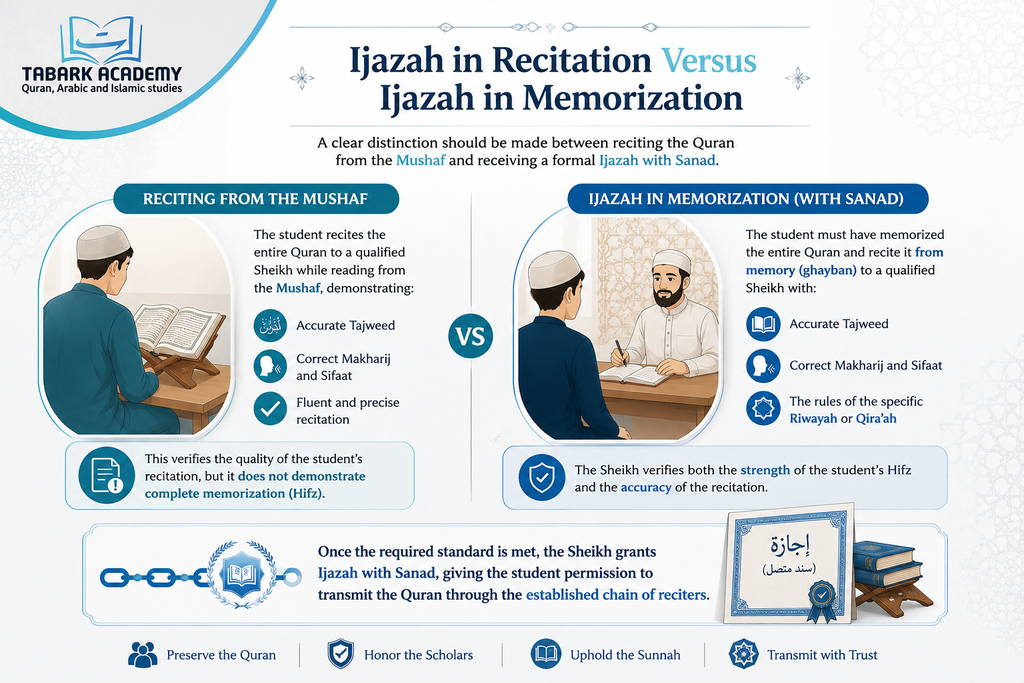
A student may recite the entire Quran to a Sheikh while reading from the Mushaf, demonstrating accurate pronunciation and correct application of Tajweed. However, this should be distinguished from a Sanad-bearing Ijazah based on complete Quran memorization.
For the latter, the student memorizes the entire Quran and recites it from memory (ghayban) to a qualified Sheikh while demonstrating accurate Tajweed, Makharij, Sifaat, and the rules of the specific Riwayah or Qira’ah being studied.
The Sheikh verifies both the strength of the student’s Hifz and the accuracy of their recitation before granting authorization to transmit that recitation through the established Sanad.
Do You Need to Memorize the Whole Quran for Ijazah?
Yes. For a Sanad-bearing Quran Ijazah, the student is required to memorize the entire Quran and recite it accurately from memory to a qualified Sheikh.
A student may also complete a supervised Khatmah by reading from the Mushaf and receive correction in Tajweed, Makharij, and Waqf and Ibtida’. This may lead to a Shahadah or certificate of proficiency, but it should be distinguished from an Ijazah based on complete Hifz and recitation from memory.
Before enrolling, confirm whether the program grants a documented Sanad-bearing Ijazah or a certificate for completing the Quran from the Mushaf.

Complete a Full Quran Khatmah Under Your Sheikh’s Direct Supervision
Once your sheikh accepts you into Ijazah preparation, the khatmah begins — a systematic recitation of the entire Quran, section by section, under direct correction.
Receive Direct Correction Until Your Quran Recitation Is Consistently Accurate
Your sheikh stops you at every misapplied rule, mispronounced letter, or incorrect Waqf, and requires you to repeat the section until it is correct. This is not discouragement; it is the mechanism that has protected the accuracy of Quranic transmission for over 1,400 years.
The Prophet ﷺ said, as recorded in Sahih al-Bukhari (4937): “The one who is proficient in the recitation of the Quran will be with the honourable and obedient scribes, and the one who recites the Quran and finds it difficult to recite, doing his best to recite it in the best way possible, will have a double reward.
” Both the fluent reciter and the striving student are honored — but Ijazah itself is granted only once genuine proficiency is demonstrated.
How Long Does The Khatmah Take?
For students entering with strong existing Tajweed, the recitation phase typically runs 6 to 18 months. Students starting from an intermediate level, or pursuing full Hifz-based Ijazah, should expect a longer path — often 2 to 3 years in total.
The single biggest factor in this timeline is not reading speed. It is how consistently Tajweed rules were internalized before the khatmah began — inconsistent Tajweed is what causes a session to be repeated, not slow recitation.
Preparing with a structured, personalized course shortens this phase considerably. Learning at your own pace, from home, with a tutor focused only on your recitation, removes the two things that slow most independent learners down: inconsistent correction and infrequent practice.
The final evaluation and receiving your certificate
After the khatmah is complete, your sheikh conducts a final, comprehensive oral evaluation before issuing your Ijazah.
The sheikh evaluates correct makharij for every letter, consistent application of Tajweed rules without prompting, proper Waqf and Ibtida, accurate Ghunnah and Madd durations, and the complete absence of lahn jali — major recitation errors. Passing this evaluation is what triggers issuance of the certificate.
Your finished Ijazah documents your name, the riwayah you were certified in, and the full sanad connecting you back through your sheikh’s teachers to the Prophet ﷺ. From that point, you hold the right to teach that recitation and, in time, to grant Ijazah to your own students.
Common Mistakes That Can Delay Your Quran Ijazah
Students can spend months longer than necessary preparing for Ijazah, not because they lack ability, but because they begin the process with weaknesses that should have been addressed earlier.
Since an Ijazah requires consistent recitation rather than occasional accuracy, small recurring problems can repeatedly interrupt the Khatmah and delay the Sheikh’s final approval.
1. Starting the Ijazah Khatmah Before Your Tajweed Is Consistent
Understanding Tajweed rules theoretically is not the same as applying them automatically while reciting. If you still need to stop and think about Madd, Ghunnah, Qalqalah, Makharij, or Waqf and Ibtida’, you may not yet be ready for the final Ijazah Khatmah.
During the Khatmah, recurring Tajweed mistakes force the Sheikh to stop, correct, and sometimes repeat passages with you. Correcting these weaknesses before beginning the full recitation can make the Ijazah process significantly smoother.
2. Beginning With Weak Hifz and Unstable Quran Revision
For an Ijazah that requires recitation from memory, completing Hifz once is not enough. Your memorization must be strong enough to withstand continuous testing across the Quran.
Frequent hesitation, forgotten words, incorrect endings, and confusion between similar verses are signs that more Muraja’ah may be needed before the final Khatmah.
A better approach is to strengthen weak Surahs and Mutashabihat first, then begin the supervised recitation when your recall is reliable across both recently memorized and older portions.
3. Repeating Recitation Mistakes Without Correcting Their Root Cause
One correction should improve more than one verse. If your Sheikh repeatedly corrects the same Makharij, Madd, Ghunnah, or stopping mistake in different places, the underlying rule has probably not been fully mastered.
Simply repeating the corrected verse may solve the immediate mistake without fixing the pattern behind it.
Keep track of recurring corrections and practice them separately between lessons. This turns each correction into a permanent improvement instead of allowing the same mistake to consume time in future sessions.
4. Choosing an Ijazah Sheikh Without Verifying Their Sanad
Starting with the wrong teacher can create a much bigger problem than slow progress. Before enrolling, verify that the Sheikh holds a documented Sanad and is authorized in the particular Qira’ah or Riwayah you intend to study.
You should also understand who granted the Sheikh their own Ijazah and what authorization they are qualified to pass on.
Doing this verification before beginning protects you from completing months of study only to discover that the certificate or chain cannot be properly documented.
5. Not Confirming What Type of Ijazah or Certificate You Are Pursuing
Another mistake is assuming that every Quran completion program leads to the same qualification.
Before starting, clarify exactly what the Sheikh expects you to complete and what the final document will certify. Ask whether the program involves recitation from memory, reading from the Mushaf, a particular Riwayah, and a documented Sanad.
This prevents you from preparing for one standard while your teacher is assessing you according to another, and ensures you understand exactly what authorization you are working toward.
6. Treating the Khatmah as a Race Instead of a Verification Process
Trying to finish the Quran as quickly as possible can work against the purpose of an Ijazah. The supervised Khatmah exists so the Sheikh can verify your accuracy throughout the Quran, not simply record that you reached the final Surah.
If a passage needs to be repeated, corrected, or reviewed, slowing down is part of the process.
The most effective goal is therefore not to finish the Khatmah quickly, but to reach a level where corrections become increasingly rare as you progress. That consistency is what ultimately prepares you for the Sheikh’s final evaluation.
Step Inside Our Virtual Classrooms
See our engaging teaching methods in action! watch real snippets of our live classes and discover how our expert instructors make learning interactive, memorable, and inspiring for every student.
Start your Ijazah path with Tabarak Academy
Getting Ijazah in the Quran is not a matter of finishing a course — it is a matter of finding the right sheikh, building genuine Tajweed mastery, and completing a structured, supervised recitation.
Tabarak Academy pairs you with Ijazah-certified instructors whose sanads are documented and verifiable, through one-on-one online sessions built around your current level and schedule.
Whether you are starting Tajweed from zero, refining recurring recitation mistakes, or ready to begin your khatmah, your learning path is personalized rather than generic.
Have a closer look on our real life sessions:
Warsh Recitation | Advanced Tajweed Lesson
Build accurate pronunciation, strengthen your Tajweed, and progress toward confident
Our Quran Courses
- Online Quran Classes
- Online Quran Classes for Beginners
- Online Quran Classes for Kids
- Online Quran Classes for Adults
- Online Quran Classes for Men
- Online Quran Classes for Sisters
- Quran Reading Course
- Quran Recitation Course
- Online Ijazah Course
- Online Qirat Course
- Quran for Toddlers / Young Children
- Weekend Quran Classes
- Intensive Quran Course
- Al-Azhar Quran Course
- Zoom Quran Classes
- Noor Al-Bayan Course
Start Your Online Tajweed Classe

Conclusion
Getting Ijazah in the Quran means mastering Tajweed until it is automatic, reciting the full Quran under a sheikh whose sanad is genuinely verified, and passing a rigorous final evaluation. Along the way, know that scholars themselves differ on whether memorization is required for a true sanad-bearing Ijazah — so confirm exactly what your sheikh is certifying before you begin.
The reward for this process is not a certificate on a wall. It is a documented place within the same chain of transmission that has carried the Quran, unchanged, since the Prophet ﷺ. Whichever riwayah or path you choose, that chain is what makes an Ijazah worth pursuing in the first place.
Frequently asked questions
How long does it take to get Ijazah in the Quran?
Most dedicated students need 1 to 3 years, depending on their starting Tajweed level and whether they pursue recitation-based or memorization-based Ijazah. Students entering with strong Tajweed foundations often finish in 12 to 18 months.
Do I need to memorize the entire Quran to get Ijazah?
Yes, if you are seeking a true sanad-bearing Ijazah — the license that authorizes you to transmit the Quran through the chain of reciters. This requires reciting the entire Quran from memory to your sheikh.
What varies between programs is not whether memorization is required for this type of Ijazah, but what each program actually offers: some grant only a Shahadah (certificate) for fluent, error-free reading from the Mushaf, which is a different and lesser qualification.
Confirm directly with your sheikh which certificate — a sanad-bearing Ijazah or a Shahadah — you will actually receive.
Can I get a valid Ijazah online?
Yes, provided the sheikh granting it holds a documented, verifiable sanad. Scholarship recognizes transmission through direct, live recitation regardless of physical location, which is why online one-on-one sessions can produce a fully valid Ijazah.
What is the difference between a high sanad and a low sanad?
Both are equally valid. A high sanad simply has fewer generations of teachers between the student and the Prophet ﷺ, which scholars regard as an honor, not a measure of correctness.
What Tajweed level do I need before starting Ijazah preparation?
Your application of Tajweed rules must be consistent and automatic, not something you consciously think through letter by letter. This includes Noon Sakinah, Meem Sakinah, Madd, Waqf, Qalqalah, and the rules governing Lam and Ra.
Is a certificate from reading the Mushaf the same as a true Ijazah?
Not according to every scholar. Some contemporary scholars, including Sheikh Ayman Suwaid, distinguish between a shahadah for reading from the Mushaf and a true Ijazah with a documented sanad, which they hold requires memorized recitation. Ask your sheikh which certificate you will actually receive.