

How Many Lines Of Quran Should I Memorize Per Day?
You open the mushaf with real intention, memorize half a page, and feel unstoppable. Three weeks later, you’re re-reading the same page for the fourth time and wondering whether you’ve moved at all. Almost every hifz student meets that wall.
The question of how many lines of Quran should I memorize per day is really a question about pacing — how much new material you can add without your review load collapsing on top of you. Get the number right, and hifz becomes a quiet daily habit. Get it wrong, and it becomes a cycle of restarting.
This guide gives you a direct answer, a full table of daily lines matched to completion timelines, level-by-level targets for children and adults, and a structured 1,000-day plan built around one page a day.
The numbers here are based on the standard 15-line Madani mushaf and on how memorization is actually taught in supervised halaqat — not on best-case theory.

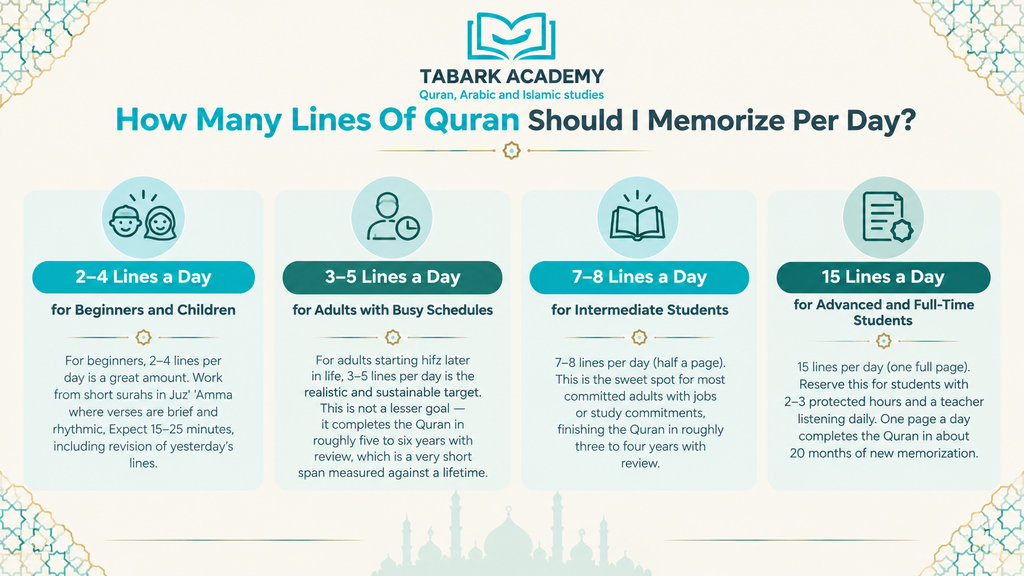
2–4 Lines a Day for Beginners and Children
For beginners, 2–4 lines per day is a great amount. Work from short surahs in Juz’ ‘Amma where verses are brief and rhythmic. Expect 15–25 minutes, including revision of yesterday’s lines.
The goal in month one is attendance, not volume. A student who shows up daily at three lines will overtake one who does ten lines twice a week. For young children, they absorb through repetition and listening, so play the day’s lines aloud during breakfast and car rides.
It helps to know what those three lines actually cost you in effort. Listen to the portion recited correctly five to ten times before you attempt it, then recite each line aloud about twenty times, then chain line one to line two before adding line three.
Beginners who skip the listening stage almost always memorize the mistake along with the verse.
The most common beginner error is starting from Surah Al-Baqarah because it comes first in the mushaf. Its verses are long, its themes are legal and detailed, and the page density is unforgiving for a new memorizer.
Consistency and enjoyment matter as well, far more than speed here — which is exactly how Quran memorization classes for kids are structured, with short, playful sessions and a fixed teacher.

7–8 Lines a Day for Intermediate Students
7–8 lines per day (half a page). This is the sweet spot for most committed adults with jobs or study commitments, finishing the Quran in roughly three to four years with review.
Split it: memorize the first four lines in the morning, the second four after ‘Asr, and join them before sleeping.
Expect a plateau somewhere between the fifth and eighth juz. This is where mutashabihat — near-identical verses that appear in several surahs. During this time, you have to begin to collide and pull your recitation onto the wrong track mid-page.
The fix is not more repetitions but marking each pair in your mushaf and memorizing the small difference between them deliberately. Structure your week rather than your day alone.
Five days of new half-pages followed by one consolidation day where you add nothing new keeps your recent material stable and gives your memory a place to settle. Half a page of new material realistically costs 25–35 minutes; the consolidation day usually costs the same, which is why students who skip it fall behind faster than students who take it.
15 Lines a Day for Advanced and Full-Time Students
15 lines per day (one full page). Reserve this for students with 2–3 protected hours and a teacher listening daily. One page a day completes the Quran in about 20 months of new memorization.
Anything beyond two pages a day is generally unsustainable outside intensive residential programs. Do the review arithmetic before you commit to this pace.
By the twentieth juz you are carrying 400 memorized pages, and a standard manzil rotation asks you to cycle through all of them roughly every seven to ten days — that is 40 to 55 pages of old material recited every single day, on top of your new page and your recent-week review. The new page is the smallest part of an advanced session, not the largest.
Plan your disruptions instead of reacting to them. Travel, exam periods, illness, and the shifted schedule of Ramadan will interrupt a page-a-day rhythm at some point, and the students who survive them are the ones who drop to a quarter page and keep the daily slot alive rather than pausing entirely. Stopping for two weeks costs far more than three weeks of reduced output.
3–5 Lines a Day for Adults with Busy Schedules
For adults starting hifz later in life, 3–5 lines per day is the realistic and sustainable target. This is not a lesser goal — it completes the Quran in roughly five to six years with review, which is a very short span measured against a lifetime.
Adult memory works differently from a child’s. You retain less through pure repetition and far more through understanding, structure, and association, so reading the tafsir of your portion before memorizing it is not optional for you the way it might be for a nine-year-old.
Anchor the session to something that already happens every day. The minutes immediately after Fajr, the gap before your commute, or the quarter hour after ‘Isha are stable slots; “sometime in the evening” is not a slot and will be the first thing your day deletes.
Accept that some weeks will produce two lines a day rather than five. An adult schedule has genuine emergencies in it, and a plan that assumes otherwise breaks within a month. Reduce the portion, protect the streak, and let the pace recover on its own.
Read also: How to Start Memorizing the Quran as an Adult
How Many Lines of Quran Should I Memorize Per Day?
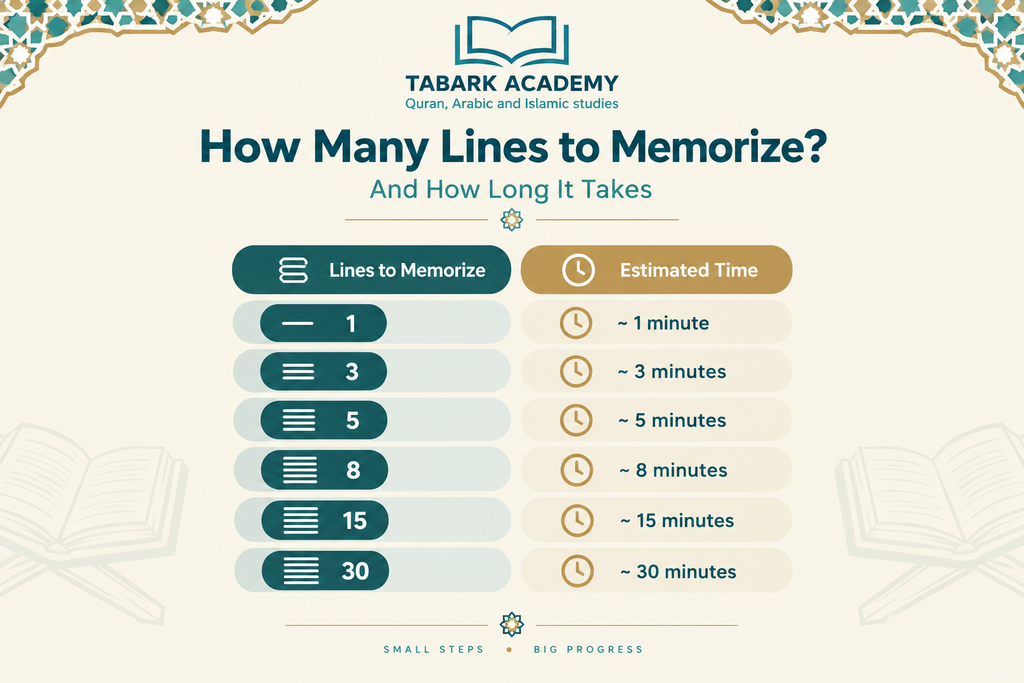
Most learners should memorize 3 to 8 lines of Quran per day — roughly a quarter page to half a page. Beginners start at 2–3 lines, consistent students settle around 7–8 lines (half a page), and advanced or full-time students handle 15 lines (one full page) daily.
Why the 15-Line Mushaf Is the Reference Point
The standard Madani mushaf has 604 pages with 15 lines on each page — about 9,060 lines in total. Every page begins and ends with a complete verse, which is why huffaz are advised to memorize from this print.
It also keeps the math clean: 20 pages equals one juz (except Juz’ ‘Amma), so a page-based target maps directly onto juz milestones.
Daily Lines and How Long the Whole Quran Takes
This table covers new memorization only. Add review days and the real timeline stretches by roughly 40–65%, which the 1,000-day plan below accounts for.
| Lines per day | Portion | Time to finish (new hifz) |
| 1 line | — | ~24 years, 10 months |
| 2 lines | — | ~12 years, 5 months |
| 3 lines | ⅕ page | ~8 years, 3 months |
| 5 lines | ⅓ page | ~5 years |
| 7–8 lines | ½ page | ~3 years, 3 months |
| 10 lines | ⅔ page | ~2 years, 6 months |
| 15 lines | 1 page | ~1 year, 8 months |
| 20 lines | 1⅓ pages | ~1 year, 3 months |
| 30 lines | 2 pages | ~10 months |
What Decides Your Daily Line Target
Two students can sit for the same thirty minutes and produce very different results. The number of lines you should take is set by four practical factors, not by ambition.
1. Reading Fluency and Tajweed Affect Your Daily Lines
If you still decode letters slowly, memorization will always feel heavy. Fluent, rule-correct recitation is what turns a line from a puzzle into a phrase you can absorb in a few repetitions.
There is a simple way to test yourself. Open a page you have never memorized and read it aloud at a normal pace; if you stumble, restart, or hesitate more than three or four times per line, your reading is still consuming the attention that memorization needs.
Spend six to eight weeks on fluency and Noorani Qaida foundations first, and the lines you struggled with will start arriving in half the repetitions.
Students who fix their recitation first — through structured online Tajweed classes — routinely double their daily line count within a couple of months without adding study time.
2. Available Focus Time Sets Your Memorisation Pace
Be honest about the minutes you truly protect each day. Ten focused minutes after Fajr beats an hour you keep postponing until midnight.
As a rough guide: 15–20 minutes supports 3–5 lines, 30–45 minutes supports half a page, and 90+ minutes is what a full page with review actually requires.
The consistency of the slot matters more than its length. Two separate fifteen-minute sessions at fixed times outperform one unpredictable forty-minute block, because the second sitting acts as a natural review of the first while the material is still fresh.
Read also: How Many Verses Should I Memorize A Day?
3. Review Load Limits: How Much New Quran You Add
This is the factor most people underestimate. Reviewing recent pages (sabqi) and older juz (manzil) typically takes two to three times longer than the new portion.
That means your daily lines aren’t limited by how fast you memorize — they’re limited by how much you can still hold. When review starts slipping, cut new lines in half before you lose ground.
4. Understanding the Meaning Helps Verses Stick
Reading the tafsir of your daily portion and grasping the Arabic sentence structure makes verses stick as meaning rather than sound.
Students following Arabic language courses alongside hifz consistently report faster retention.

Experience Our Interactive Learning
Curious about how we teach? Watch these brief video clips from our recent live sessions to see our structured curriculum, advanced learning platform, and dynamic student-teacher interactions firsthand.
The 1,000-Day Hifz Plan: One Page a Day With Review Built In
If you want a complete, ready-made schedule, this is the most widely used structure among traditional halaqat. It assumes one page (15 lines) daily and inserts review at fixed milestones.
The memorization cycle can include:
- Memorize one page per day for five days
- Day six is a full review of those five pages
- After each completed juz, take 4 review days
- After 5 juz → 10 review days
- After 10 juz → 15 review days
- After 15 juz → 25 review days
- After 20 juz → 30 review days
- After 25 juz → 35 review days
- After the full 30 juz → 45 days of comprehensive review
This will result in approximately 1,000 days, or two years and nine months, to a memorized and reviewed Quran. You keep full freedom over which juz to start with, and over your time and place of study.
The one non-negotiable is a teacher who listens to you daily. That’s the entire premise of Tabarak Academy’s Hifz Program — a fixed schedule, a certified teacher, and tracked review milestones so you never guess where you stand.

Why Every Line Counts: The Reward Behind the Numbers
The Prophet ﷺ said: “Whoever recites a letter from Allah’s Book, then he receives the reward from it, and the reward of ten times the like of it.
I do not say that Alif Lam Mim is a letter, but Alif is a letter, Lam is a letter, and Mim is a letter.” (Sunan at-Tirmidhi 2910)
“ مَنْ قَرَأَ حَرْفًا مِنْ كِتَابِ اللَّهِ فَلَهُ بِهِ حَسَنَةٌ وَالْحَسَنَةُ بِعَشْرِ أَمْثَالِهَا لاَ أَقُولُ الم حَرْفٌ وَلَكِنْ أَلِفٌ حَرْفٌ وَلاَمٌ حَرْفٌ وَمِيمٌ حَرْفٌ ”
Consider what that means mechanically. Bismillāhir-Raḥmānir-Raḥīm contains 19 letters — 190 rewards from the basmalah alone. Now multiply that by the dozens of repetitions a single line takes to memorize.
A three-line daily portion, repeated twenty times, generates reward on a scale that no calculator captures. And Allah says: “And We have certainly made the Quran easy for remembrance, so is there any who will remember?” (Al-Qamar 54:17)
Read also: How To Memorize Half A Page Of Quran Daily In 4 Steps?
This is also the answer to discouragement. Even the days when nothing seems to stick are days of pure recorded reward.
Practical Habits That Make Your Daily Lines Stick
Memorizing the Quran becomes more effective when you build simple habits into your daily routine. These practical habits make revision easier to maintain and help you protect the verses you have already memorized.
a. Recite from one printed mushaf only
Visual memory attaches to page position — switching prints or apps mid-hifz resets that anchor. Over time your memory stores far more than the words: it stores that this verse sat at the top-left of a right-hand page, three lines above a sajdah marker.
Change the print, and every one of those coordinates is wrong, which is why huffaz who switch mushafs mid-journey describe it as losing a sense they did not know they had. Buy two identical copies of the same edition — one for home, one for travel.
b. Use your lines in salah
Reciting today’s portion in your sunnah and nafl prayers is the single most effective review method available, and it costs no extra time. Prayer also exposes weakness in a way that private review never does.
Standing without a mushaf, with no option to peek, forces genuine recall and shows you exactly which line is still fragile. Start with the two rak’ahs after Maghrib, and once you are comfortable, carry the same portion into your night prayer.
c. Capture dead time
Between adhan and iqamah, after Fajr, while commuting, waiting in a queue — these fragments carry most students’ entire review load. Photograph the page you are working on and keep it on your phone so the material is with you whenever a gap opens up.
Recordings work the same way — play your portion during the drive, while cooking, or in the minutes before sleep, since passive listening reinforces the rhythm even when you are not actively reciting. Ten minutes recovered from three separate gaps is a full extra session every day.
d. Write the lines by hand
Copying your portion once before memorizing engages a second memory channel and exposes similar-verse confusions early. Writing forces you to notice the details your eye skips when reading.
Many students take this further and write the page again from memory at the end of the week, then check it against the mushaf. The errors that surface on paper are exactly the ones that would have surfaced in front of your teacher.
d. Recite to a listener daily
Silent self-review hides errors. A teacher, a study partner, or a family member all work — but someone must hear you. The reason is simple: when you review alone, your mind fills gaps automatically, and you never notice the gap existed.
A listener with a mushaf open catches the dropped word, the wrong ending, and the tajweed rule you have been applying incorrectly for a month.
This is the single point where a structured class outperforms self-study by the widest margin, because a certified teacher corrects the mistake before repetition makes it permanent.
Read also: How Long Does It Take to Memorize Surah Al-Kahf?
e. Guard against sins and procrastination
Procrastination usually disguises itself as preparation — waiting for a quieter month, a better mushaf, or the right teacher before beginning. The student who starts today at two lines with an imperfect setup will be a juz ahead of the one still planning.
Begin with whatever you have, keep your intention purely for Allah, and let the plan improve while you are already moving.
Step Inside Our Virtual Classrooms
See our engaging teaching methods in action! watch real snippets of our live classes and discover how our expert instructors make learning interactive, memorable, and inspiring for every student.
Read also: How To Memorize One Page Of Quran A Day
Start Your Daily Hifz Plan With a Certified Teacher Today
Knowing your line count is the easy part. Holding that pace for two years, catching your errors before they harden, and keeping twenty memorized juz alive at once is what requires a teacher.
Tabarak Academy pairs you with a certified, Ijazah-holding instructor who sets your daily portion, listens to your recitation live, and adjusts your target the moment your review starts slipping. Classes run one-to-one, at times you choose, for children and adults alike.
Book your free trial lesson and get a personalized daily line target on the very first call — no payment details, no commitment, just an honest assessment of where to start.
Our Quran Memorization / Hifz Courses
- Online Hifz Program
- Juz 30 Memorization Course
- Hifz for Kids Course
- Hifz for Adults Course
- Hifz for Sisters Course
- Short Surah Memorization Course
- Hifz Ijazah Course

Conclusion
For most learners, the honest answer to how many lines of Quran should I memorize per day is between three and eight — a quarter to half a page — held steadily rather than heroically for a few weeks.
The full mushaf holds 9,060 lines. Half a page daily brings you to the end in about three years; one page a day with structured review completes the journey in roughly 1,000 days.
What sets the ceiling is not your memory but your review capacity. When sabqi and manzil start slipping, reduce new lines immediately — recovering lost pages costs far more than the lines you gave up.
Pair a realistic target with correct Tajweed, a fixed daily slot, and a teacher who hears you recite, and the pace takes care of itself.
Takeaway Message: Choose the number of lines you can repeat every single day for a year — then protect that number. Consistency, not volume, is what produces a hafiz.
FAQs
Is it better to memorize by lines or by verses?
Lines are the more reliable unit. Verse lengths vary enormously — one verse in Al-Baqarah can exceed a full page while ten verses in Juz’ ‘Amma fit in three lines, making verse-based targets wildly inconsistent.
How many lines of Quran should a beginner memorise per day?
Two to four lines, in a single 15–25 minute session. Start with short surahs from Juz’ ‘Amma and increase only after you’ve held that pace for two full weeks without missing review.
Can I memorize the Quran in one year?
Yes, but it requires about 1.7 pages (25 lines) of new memorization daily plus two to three hours of review — realistic only for full-time students in a supervised program. Two to three years is the sustainable range for most people.
How long should a daily hifz session take?
Budget roughly three times your new-memorization time for review. Half a page of new material typically means 15 minutes of sabaq and 30–45 minutes of sabqi and manzil combined.
Why do I keep forgetting what I memorized?
Almost always because review is under-scheduled relative to new material. The Prophet ﷺ compared the companion of the Quran to a tied camel: “If he is committed to it, he will keep it. If he releases it, he will lose it.” (Sahih al-Bukhari 5031)
What is the best time of day to memorize?
The period after Fajr is the most widely recommended, when the mind is clearest and undistracted. The second-best slot is whichever time you can genuinely protect every single day.
Sources
- Sahih al-Bukhari 5031 & Sahih Muslim 789 — the hadith of the tied camel
- Sunan at-Tirmidhi 2910 — reward for each letter of the Quran, multiplied by ten
- Sunan at-Tirmidhi 2949 — guidance on not completing the Quran in under three days
- Sahih al-Bukhari 4767 — recommendation to complete the Quran monthly, then weekly
- Surah Al-Qamar 54:17 — “And We have certainly made the Quran easy for remembrance”
- Binbaz.org.sa, Fatwa No. 16507 — Shaykh Ibn Baz on how long Quran memorization takes
- Standard 15-line Madani (Uthmani) mushaf — 604 pages, 6,236 verses
Word count: ~1,540 | Internal links used (4): Tajweed Classes · Arabic Classes · Hifz for Kids · Hifz Program · (+ Free Trial in Hard CTA)