


How To Memorize Half A Page Of Quran Daily In 4 Steps?
Most students who quit Hifz don’t quit because the Quran is too hard. They quit because they started with a full page a day, fell behind by week three, and decided memorization “isn’t for them.”
Learning how to memorize half a page of Quran daily solves that problem before it starts. Half a page — roughly 7 or 8 lines in the standard Madani Mushaf — is small enough to finish on a busy Tuesday and large enough to complete Juz ‘Amma in about six weeks.
This guide walks you through the exact daily method our Al-Azhar-trained instructors use with students: the repetition count per line, the session structure, the revision layers that stop forgetting, and how to fit all of it around school, shift work, and prayer schedules.
Everything below reflects what actually works for non-Arabic speakers, not idealized numbers.

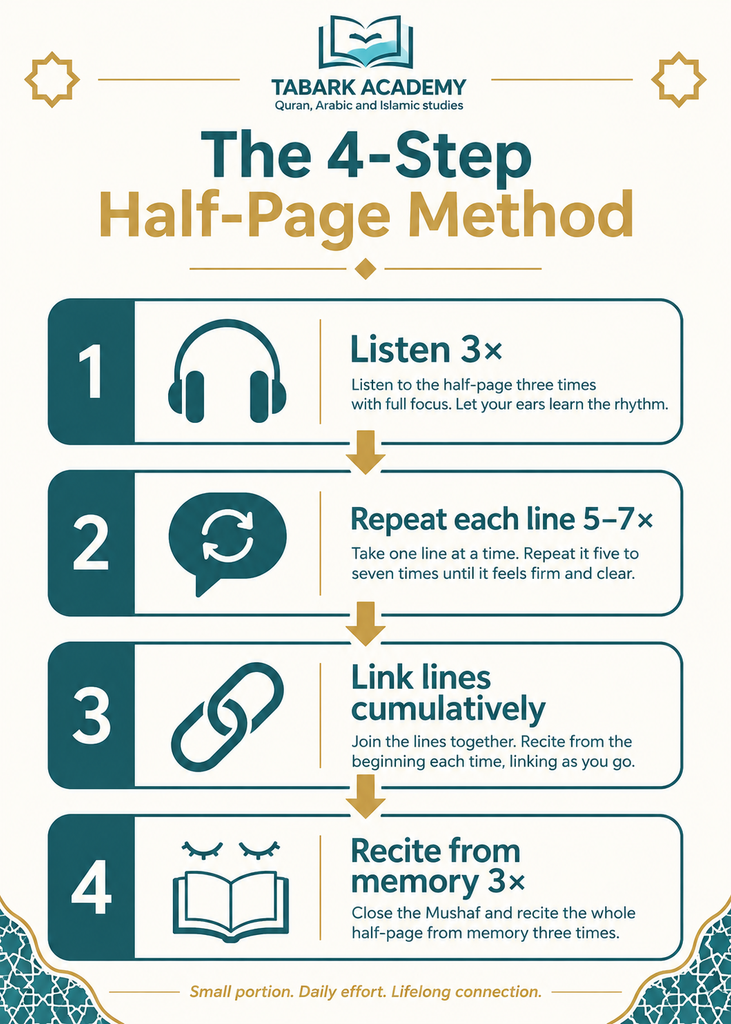
Step 1: Listen Before You Read
Play your chosen reciter’s recording of the exact lines you plan to memorize, three times, while following along in the Mushaf. This builds an auditory template in your mind before your tongue makes a single mistake.
For English-speaking students, this step alone cuts total memorization time noticeably. Choose one reciter and stay with him. Switching between recitation styles mid-Hifz confuses the melody your memory is anchored to.
Use the repeat function on your Quran app to loop the exact verse range rather than the full surah. Hearing the same 7 lines cycle without interruption teaches your ear where each phrase begins and ends, which is the information your memory actually stores.
Listen with your eyes open and moving across the text. Passive background listening while you cook or drive builds familiarity but not recall, so reserve those moments for revision and keep this step deliberate and seated.
Following along in the Mushaf while listening as well allows your eyes and ears to work together, creating a strong foundation for accurate Hifz. This simple habit makes it easier to recognize each line and recall it during recitation.
Step 2: Repeat Each Line 5–7 Times
Recite the first line aloud — out loud, not silently — five to seven times while looking at the text. Then close the Mushaf and recite that line from memory. Silent reading engages far fewer memory pathways than vocal recitation. Your ears, mouth, and eyes should all be working at once.
Keep your voice at a moderate, steady volume rather than a whisper. Whispered repetition feels efficient but gives your ear almost nothing to hold onto, and students who whisper through Hifz consistently report weaker recall two weeks later.
Repeat at recitation speed, not rushed speed. Racing through a line ten times in thirty seconds produces a mechanical blur, while five measured repetitions with correct Tajweed produce a clean, retrievable memory.
Focus on steady, meaningful repetition rather than rushing to complete a set number of repetitions. If you need ten repetitions on a difficult line, take them. The number is a guide, not a quota.
Step 3: Link the Lines Together
After memorizing line two, recite lines one and two together before touching line three. After line three, recite one through three. This cumulative linking is what prevents the most common Hifz failure: knowing every line individually but freezing at the transitions between them.
By the time you reach line eight, you will have recited line one roughly eight times without any extra effort. Pay special attention to the final word of each line and the first word of the next.
That junction is where almost every hesitation lives, so recite the pair of words together a few extra times before moving forward. Never skip a linking round because you feel confident.
Confidence during memorization is measured while the previous line is still fresh in working memory, which is exactly when it is least reliable as a signal.
Step 4: Recite the Half Page Back From Memory
Close the Mushaf and recite all 7–8 lines straight through, three complete times. Mark every spot where you hesitated.
Then return to only those marked lines and repeat them another five times. Targeted reinforcement beats re-drilling material you already know.
Recite the final pass standing, as you would in prayer, rather than seated over the Mushaf. Verses memorized only in a seated study posture often slip when you first attempt them in salah, and this small change closes that gap early.
End the session by reciting the half page once to another person — a spouse, a parent, a study partner, or your teacher. Reciting under observation exposes weak spots that solo recitation quietly forgives.
How Long Does Half a Page Actually Take?
It can take 10-15 minutes of memorization time. But understanding how long it takes to memorize half a page of the Quran can help you set realistic goals and plan your daily Hifz routine.
Every student learns at a different pace, depending on their Arabic reading skills, Tajweed foundation, and memorization experience. The following table gives a practical estimate of the time needed for half a page at different levels.
| Student Level | Time for Half a Page (New Memorization) |
| Complete beginner (limited Arabic reading) | 45–60 minutes |
| Beginner with steady Qaida foundation | 30–45 minutes |
| Intermediate (reads fluently with Tajweed) | 20–30 minutes |
| Advanced | 10–18 minutes |
These are practitioner estimates from supervised lessons, not survey statistics. Your real number depends on verse length, vocabulary familiarity, and how consistent your last thirty days have been.
Students who struggle to reach the intermediate range are almost always missing a recitation foundation rather than memory ability — which is why we start most adults in Tajweed for Beginners before formal Hifz.
Read also: Starting Hifz as an Adult: Beginner’s Guide
The Best Way to Memorize Half a Page of Quran Daily
The best way to memorize half a page of Quran daily is to treat it as two short sessions rather than one long one: new memorization in the morning, revision in the evening. Splitting the load reduces fatigue and takes advantage of the natural consolidation that happens during sleep.
Below are the structural decisions that make the difference between a routine you keep and one you abandon.
Why Half a Page Beats a Full Page for Beginners
A full page memorized shakily and never revised is worth less than half a page memorized firmly. Students who push past their capacity accumulate weak material quietly, then discover after three months that they need to re-memorize large sections.
Half a page keeps your retention honest. You can move to a full page only when last week’s portions still come out cleanly without prompting.
The Split-Session Model
The split-session model divides your daily Hifz into one short morning block for new verses and one short evening block for revision. Two focused sittings of twenty minutes will always outperform a single tired hour.
Your morning session runs for 20 to 35 minutes, ideally right after Fajr, and is reserved entirely for new memorization. Work through the four steps above on your half page and resist the temptation to revise old material here, because the freshest part of your day belongs to the hardest task.
Your evening session runs for 15 to 20 minutes and starts by reciting today’s half page twice from memory. Whatever survives the gap since morning is genuinely memorized, and whatever slips is exactly what tomorrow’s session needs to reinforce.
Spend the remaining minutes revising the previous six days’ portions in order. This evening block is non-negotiable — memorizing without revising is like filling a container with holes in the bottom, and no amount of morning effort compensates for skipping it.
Choose One Mushaf and Never Change It
Use a single printed edition — ideally one where each page begins and ends with a complete verse — for the entire journey.
Your visual memory encodes the position of words on the page, not just the words. Changing editions erases that layer of recall instantly.
Keep a pocket-sized copy of the same edition in your bag for commutes and waiting rooms.
Read also: How To Memorize One Page Of Quran A Day
Experience Our Interactive Learning
Curious about how we teach? Watch these brief video clips from our recent live sessions to see our structured curriculum, advanced learning platform, and dynamic student-teacher interactions firsthand.
Memorize Half a Page of Quran Daily: Tips That Prevent Forgetting
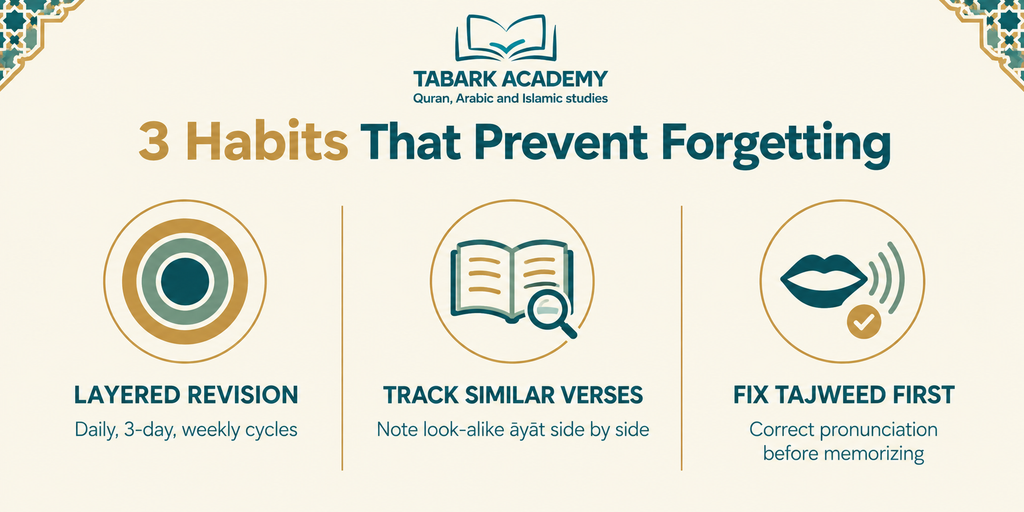
Forgetting is rarely a memorization problem. It is a revision-frequency problem. These three habits protect everything you have built.
1. Build a Three-Layer Revision System
Memorizing half a page of the Quran daily is a rewarding goal, but keeping what you have learned is just as important as memorizing new verses. The following three habits will help you strengthen your Hifz and build a lasting connection with the Quran.
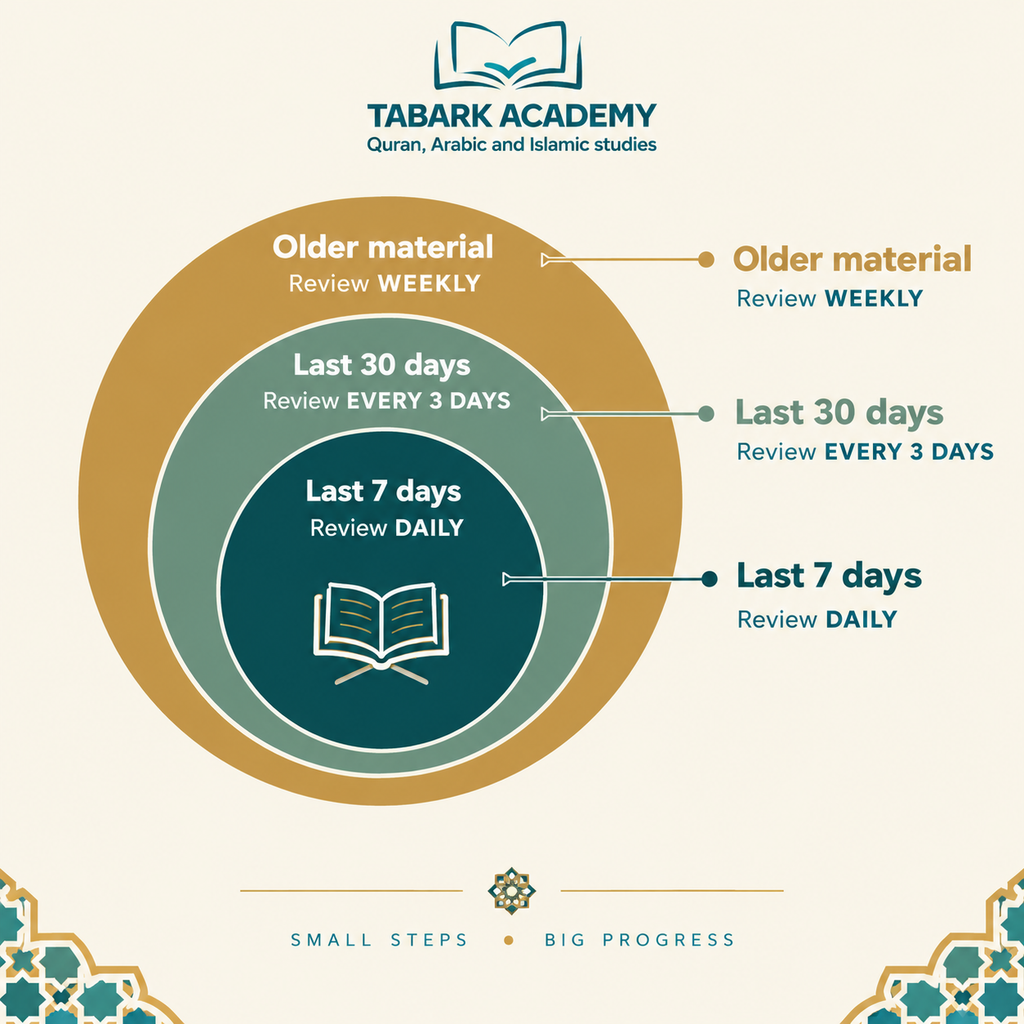
| Layer | What You Review | How Often |
| Recent | Last 7 days’ portions | Every day |
| Short-term | Last 30 days’ portions | Every 3 days |
| Long-term | Everything older | Once weekly |
Run all three layers from your very first week, even when each layer contains only a few lines. Building the habit early is far easier than installing it after you have fifty pages at risk.
2. Track the Similar Verses
Keep a small notebook for verses that resemble each other closely. Write both versions side by side with the surah and verse numbers.
Reviewing these pairs deliberately prevents the drifting that causes a reciter to slide from one surah into another mid-recitation.
3. Fix Tajweed Before You Memorize
If you memorize a word with an incorrect elongation or a mispronounced letter, that error becomes part of the memory itself.
Unlearning it later costs several times what learning it correctly would have cost. This is the most common repair job our teachers do with self-taught students.
A weekly recitation check with a qualified teacher — the model used throughout our Online Hifz Program — catches these errors while they are still cheap to fix.
How to Memorise Half a Page of Quran Daily
The practical challenge is rarely motivation — it is scheduling around long commutes, shift work, and winter days where Fajr and Isha shift dramatically month to month. Half a page a day is specifically suited to those constraints.
Use the Five Prayers as Your Built-In Schedule
Anchor your Hifz to the prayers instead of to clock times. The five daily prayers already divide your day into fixed checkpoints that move with the seasons, so a routine built on them never needs rewriting when the sunrise shifts by two hours.
Recite your new half page inside your voluntary prayers. Reading the fresh verses in the sunnah rak’ahs after Dhuhr or in two rak’ahs before bed forces recall without the Mushaf, which is the strongest test of memorization available to you.
Use the minutes immediately after each fard prayer for quick revision while you are already seated on the prayer mat. Four short recitations spread across the day reinforce the same half page more effectively than one long block.
This approach also removes the most common excuse. You are not adding five new commitments to your calendar — you are attaching Hifz to five appointments you already keep.
Read also: How Many Lines Of Quran Should I Memorize Per Day?
Half a Page a Day for Children
For kids aged roughly 6 to 12, half a page is often too much in one sitting. Split it into two 12-minute blocks: three or four lines after school, the rest before bed. Children memorize through repetition and rhythm far more than through explanation, so let the reciter’s audio do the heavy lifting.
Our Hifz classes for kids are built around these shorter attention windows, with teachers who keep the pace playful rather than pressured.
What Half a Page a Day Actually Adds Up To
At half a page daily, you complete Juz ‘Amma in about 46 days and a standard juz in roughly 40 days. That first milestone matters more than the math suggests. Finishing Juz 30 is the point where most students stop wondering whether they can do this.
If you want that early win, the focused Juz 30 memorization course is designed around exactly this pace.
Step Inside Our Virtual Classrooms
See our engaging teaching methods in action! watch real snippets of our live classes and discover how our expert instructors make learning interactive, memorable, and inspiring for every student.
Read also: How Many Verses Should I Memorize A Day?
Start Your Half-Page-a-Day Routine With a Free Trial Lesson
Book a free trial lesson with Tabarak Academy and get a live assessment of your recitation, plus a personalized daily memorization plan built around your actual schedule — not a generic template.
Our certified teachers are Al-Azhar graduates with years of experience guiding non-Arabic speakers in Canada, the US, and the UK. Every lesson is one-to-one, scheduled at your convenience, and covers Tajweed correction alongside memorization so you never build on a flawed foundation.
Whether you are an adult fitting Hifz around a full workweek, a parent enrolling a child, or a sister looking for private classes, there is a program shaped for you. Start today, half a page at a time.
Start your memorization journey and book your free trial lesson
Our Quran Memorization / Hifz Courses
- Online Hifz Program
- Juz 30 Memorization Course
- Hifz for Kids Course
- Hifz for Adults Course
- Hifz for Sisters Course
- Short Surah Memorization Course
- Hifz Ijazah Course

Conclusion
Learning how to memorize half a page of Quran daily is less about memory talent and more about structure: listen first, repeat each line 5–7 times aloud, link lines cumulatively, and protect everything with layered revision.
Half a page is deliberately modest. That is its strength — it survives busy weeks, travel, exams, and the Canadian winter, which is exactly what a multi-year Hifz journey requires.
The students who finish are rarely the fastest ones. They are the ones who kept a small daily promise through exam season, through a newborn, through a demanding work quarter — and who treated a missed day as a single missed day rather than as proof that the project had failed.
If you take one practical decision from this guide, make it the evening revision block. New memorization feels like progress and revision feels like standing still, but revision is the only thing that turns today’s half page into something you will still be reciting in five years.
Take-away message: Consistency beats intensity. A student memorizing half a page every single day will always finish ahead of the one who memorizes two pages sporadically and re-learns them twice.
Start tomorrow after Fajr with 7 lines. Then do it again the next day.
FAQs
Is half a page of Quran a day enough?
Yes — for most working adults and school-age children, half a page daily is the optimal balance between progress and retention. It completes Juz ‘Amma in about 46 days and the full Quran in roughly three years, while leaving enough daily time for proper revision.
How many lines are in half a page of Quran?
In the standard Madani Mushaf, a full page contains 15 lines, so half a page is 7–8 lines. Editions vary, which is one more reason to commit to a single Mushaf throughout your memorization.
How many times should I repeat each line?
Most non-Arabic speakers need 7–10 repetitions per line when starting, dropping to 5–7 as Arabic recognition improves. Repeat aloud, not silently, and always recite the line from memory before moving to the next one.
What is the best time of day to memorize Quran?
The period immediately after Fajr is widely considered the most effective — the mind is rested, the household is quiet, and distractions are minimal. If Fajr is impossible for your schedule, choose any fixed daily slot and protect it consistently.
Where should a beginner start memorizing?
Beginners are generally advised to start from the end of the Mushaf with the short surahs of Juz ‘Amma. The surahs are brief, many are already familiar from daily prayer, and completing them quickly builds genuine momentum.
How do I stop forgetting what I memorized?
Review the last 7 days’ portions daily, the last 30 days’ every three days, and all older material once a week — and never skip revision to gain extra new memorization. Forgetting is caused by insufficient revision frequency, not weak memorization.