


What Is an Ijazah in the Quran? Meaning, Types, and How to Earn One
If you’ve spent years memorizing the Quran or perfecting your Tajweed, you’ve probably asked: what is ijazah in the Quran, and why do so many serious students pursue one? An ijazah is the formal license that confirms your recitation is accurate enough to teach others — and it’s one of the oldest forms of certification in Islamic scholarship.
This article explains what an ijazah actually certifies, the different types available, who qualifies to give and receive one, and how the process works today, including online.
What Is an Ijazah in the Quran?
An ijazah in the Quran is a formal authorization granted by a qualified Sheikh (called the mujiz) to a student (the mujaz) after the student has proven, through direct oral recitation, that they can recite the Quran accurately according to a specific narration or reading.
The ijazah permits the student to both recite the Quran publicly and teach it to others.
Unlike a school diploma, an ijazah cannot be earned through a written test. It is granted only after the student recites the Quran in front of the Sheikh, letter by letter, with correct Tajweed.
The Meaning of the Word Ijazah
The Arabic word ijazah translates to “permission” or “authorization.” In the context of Quranic studies, it specifically means permission to transmit the Quran’s recitation to the next generation — the same way it has been transmitted since the time of the Prophet ﷺ.
The Sanad Why an Ijazah Is More Than a Certificate
Every ijazah comes attached to a sanad, an unbroken chain of teachers connecting the student, through their Sheikh, back to the Prophet Muhammad ﷺ. Each name in that chain represents a scholar who recited the Quran to their own teacher and was authorized in turn.
This is what separates an ijazah from ordinary coursework. A certificate says you completed a program; a sanad says your recitation has been verified by an unbroken line of qualified reciters stretching back roughly 1,400 years.
Join our Online Tajweed Classes at Tabarak Academy and learn correct pronunciation, articulation points (makharij), and recitation rules directly from qualified teachers — from anywhere in the world.
What is the Importance of Ijazah?
Ijazah holds special importance in Quranic learning because it represents both mastery of recitation and continuity of Quranic transmission.
- Earning an Ijazah motivates the student to memorize and recite the Quran with precision, applying Tajweed correctly and avoiding errors in pronunciation and wording.
- It also qualifies a competent student to teach and transmit the Quran to others with greater confidence and responsibility.
- Most significantly, an Ijazah with a connected sanad links the student through an unbroken chain of qualified teachers and reciters reaching back through the Companions to the Prophet Muhammad ﷺ, making the student part of a centuries-old tradition of preserving and transmitting the Quran.
- The Prophet ﷺ himself valued hearing the Quran from others, as shown when he asked Abdullah ibn Mas‘ud (RA) to recite to him, saying, “I love to hear it from someone else.”
This connection carries both honor and responsibility: the licensed reciter is not simply receiving a certificate, but becoming entrusted with passing Quranic recitation accurately to the next generation.
If you want to pursue this meaningful connection to the Quran, Tabarak Academy provides structured Quran learning with qualified teachers who can help you strengthen your Tajweed, refine your recitation, and progress toward Ijazah with confidence.
Experience Our Interactive Learning
Curious about how we teach? Watch these brief video clips from our recent live sessions to see our structured curriculum, advanced learning platform, and dynamic student-teacher interactions firsthand.
What Are the Different Types of Ijazah?
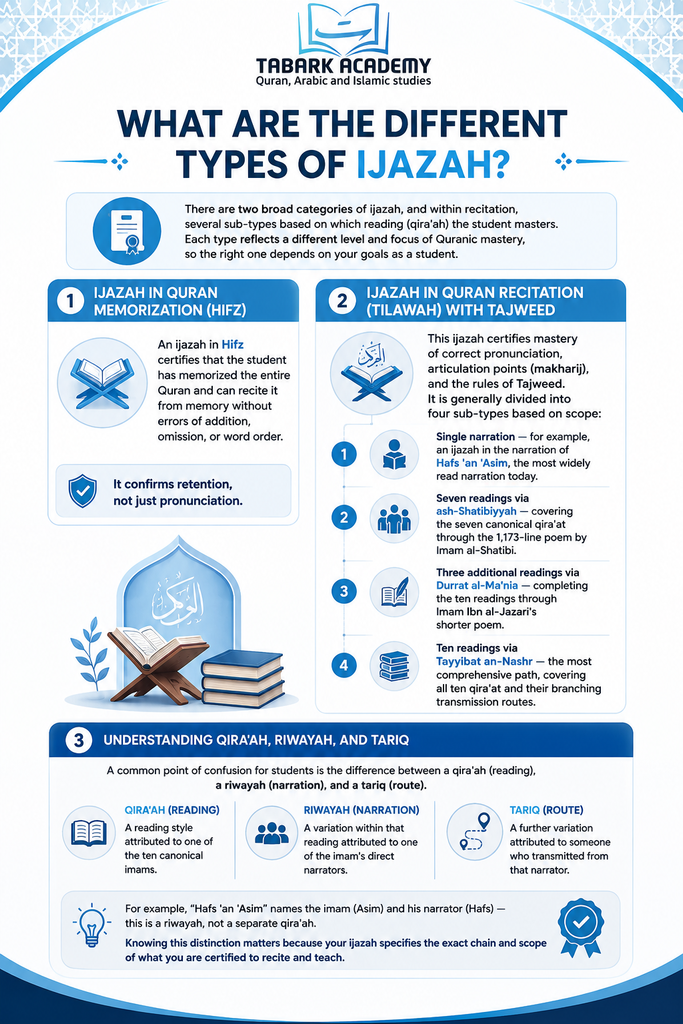
There are two broad categories of ijazah, and within recitation, several sub-types based on which reading (qira’ah) the student masters.
Each type reflects a different level and focus of Quranic mastery, so the right one depends on your goals as a student.
1- Ijazah in Quran Memorization (Hifz)
An ijazah in Hifz certifies that the student has memorized the entire Quran and can recite it from memory without errors of addition, omission, or word order. It confirms retention, not just pronunciation.
2- Ijazah in Quran Recitation (Tilawah) With Tajweed
This ijazah certifies mastery of correct pronunciation, articulation points (makharij), and the rules of Tajweed. It is generally divided into four sub-types based on scope:
- Single narration — for example, an ijazah in the narration of Hafs ‘an ‘Asim, the most widely read narration today.
- Seven readings via ash-Shatibiyyah — covering the seven canonical qira’at through the 1,173-line poem by Imam al-Shatibi.
- Three additional readings via Durrat al-Ma’nia — completing the ten readings through Imam Ibn al-Jazari’s shorter poem.
- Ten readings via Tayyibat an-Nashr — the most comprehensive path, covering all ten qira’at and their branching transmission routes.
Read also:Online Ijazah Program: Path to a Certified Sanad
The Difference Between Qira’ah, Riwayah, and Tariq
Students pursuing an Ijazah often encounter three terms that can seem interchangeable at first: Qira’ah, Riwayah, and Tariq. Understanding the difference between them is important because an Ijazah is granted according to a specific transmitted reading, not simply for “the Quran” in a general sense.
A Qira’ah is a canonical method of Quranic recitation attributed to one of the ten recognized Imams of Qira’at. Each Qira’ah has established rules governing pronunciation, wording, elongation, stops, and other aspects of recitation.
A Riwayah is a transmitted narration of a Qira’ah through one of that Imam’s recognized narrators. For example, Hafs ‘an ‘Asim refers to the narration of Hafs from Imam ‘Asim. Hafs is therefore a narrator of the Qira’ah of ‘Asim rather than the name of a separate Qira’ah.
A Tariq goes one level further and refers to a particular route through which a Riwayah was transmitted by later scholars.
This distinction becomes especially important when receiving an Ijazah because the certificate identifies the specific Riwayah or transmission route in which the student has been authorized.
Read also :The Timeline of an Ijazah: How Many Months or Years Does It Take?
What Are the Conditions for Receiving an Ijazah?
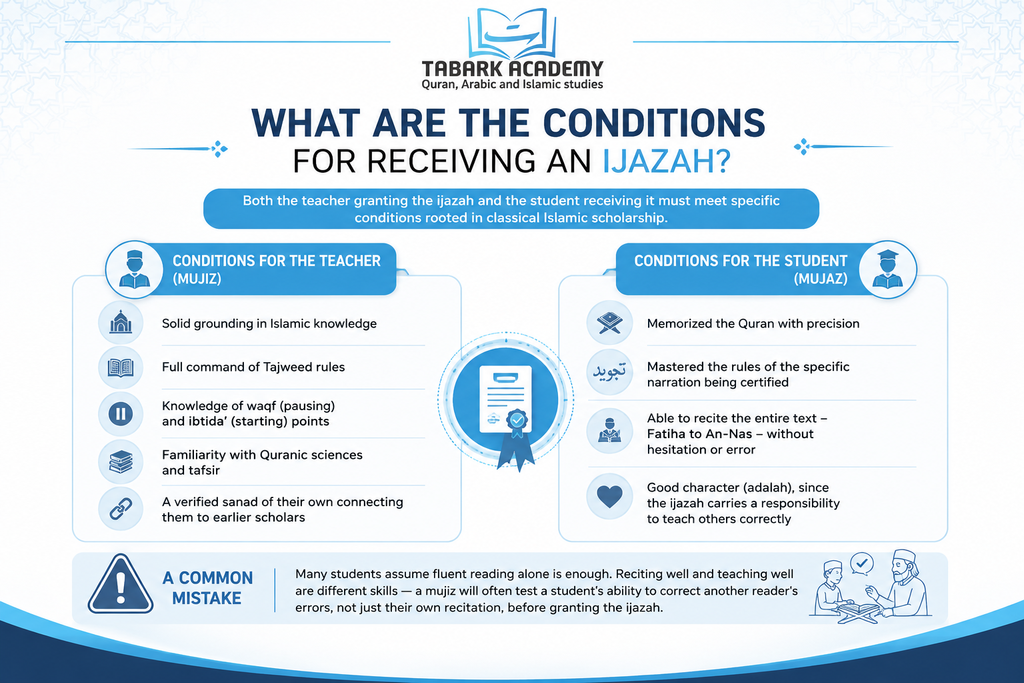
Receiving an Ijazah requires more than being able to read the Quran fluently. Both the teacher granting the authorization and the student receiving it must meet specific standards designed to preserve accurate Quranic transmission.
a. Qualifications a Teacher (Mujiz) Must Have to Grant an Ijazah
A teacher who grants an Ijazah, known as the Mujiz, must have the knowledge and authorization required to assess another person’s recitation accurately.
The Mujiz should have a strong command of Tajweed, including correct pronunciation and application of the rules of the narration being taught. They should also understand waqf and ibtida’ — where recitation may appropriately stop and begin — alongside relevant knowledge of Quranic sciences and Tafsir.
Most importantly, the teacher must possess a verified Sanad of their own. This establishes the teacher’s place within the chain of transmission and confirms that they received authorization from qualified teachers before granting it to another student.
b. Requirements a Student (Mujaz) Must Meet to Receive an Ijazah
The student receiving the Ijazah, known as the Mujaz, must demonstrate consistent and accurate recitation according to the Riwayah in which they are seeking authorization.
This means mastering its Tajweed and recitation rules and being able to recite the Quran from Surah Al-Fatiha to Surah An-Nas with precision and without persistent errors. For an Ijazah connected to memorization, the student must also demonstrate the required level of Hifz.
Good character (adalah) is another important condition because an Ijazah is not merely recognition of personal achievement. It carries a responsibility to preserve what has been learned and, when authorized to do so, transmit it accurately to others.
One common misconception is that fluent recitation alone automatically qualifies someone for an Ijazah. A qualified Mujiz may assess more than the student’s ability to recite correctly, particularly when the authorization includes teaching.
The student may also need to demonstrate that they can recognize and correct recitation mistakes rather than simply avoid those mistakes themselves.
How Do You Get an Ijazah in the Quran?
The Ijazah process is based on direct oral transmission between a qualified teacher and student. The student recites while the teacher listens, identifies errors, and verifies that the required standard has been reached.
This process can take place either in person or through live online instruction.
1. Receive an Ijazah Through In-Person Recitation With a Sheikh
In the traditional in-person method, the student sits directly with a qualified Sheikh and recites the Quran under their supervision.
The Sheikh listens closely to the student’s pronunciation, Tajweed, stopping and starting points, and application of the rules associated with the chosen Riwayah. Mistakes are corrected as they occur, and the student continues studying and reciting until the required standard has been demonstrated.
Once the complete recitation and assessment requirements have been fulfilled, the Sheikh may grant the student an Ijazah connected to their Sanad.
Read also: Everything You Need to Know About Getting an Ijazah in the Quran
2. Receive an Ijazah Online Through Live One-on-One Recitation
An online Ijazah follows the same core principle of direct teacher-to-student recitation, but the sessions take place through live video instead of in the same physical location.
The student recites directly to the Sheikh, receives real-time corrections, and progresses through the required material until they are ready for final assessment.
This is how programs such as Tabarak Academy’s Ijazah courses are structured, with live one-on-one sessions with certified teachers, direct correction, and assessment before an Ijazah is granted.
The essential element is the direct oral transmission and verification between teacher and student. The learning environment may be online or in person, while the Sanad records the chain through which the recitation has been transmitted.
Read also: Best Quran Hifz Schools for Online Quran Memorization
Step Inside Our Virtual Classrooms
See our engaging teaching methods in action! watch real snippets of our live classes and discover how our expert instructors make learning interactive, memorable, and inspiring for every student.
What Is the Difference Between Ijazah and Sanad?
An Ijazah and a Sanad are closely connected, but they do not mean exactly the same thing. The Ijazah is the authorization a qualified teacher grants to a student after verifying that the student has met the required standard of recitation.
Depending on the type of Ijazah, that authorization may also permit the student to transmit or teach what they have learned.
The Sanad, on the other hand, is the chain of transmission behind that authorization. It identifies the succession of teachers through whom the recitation was transmitted, ultimately tracing the Quranic transmission back through earlier scholars.
Put simply, the Ijazah is the authorization, while the Sanad is the chain that supports that authorization.
Understanding this difference also explains why choosing a properly qualified Ijazah teacher matters. The value of the certificate is not simply in having a document with your name on it, but in the verified recitation and recognized chain of transmission behind it.
Read also:How to Verify and Choose an Online Sheikh for Your Quran Ijazah
Start Your Ijazah Journey With Tabarak Academy
Years of memorization deserve a certification that actually verifies it — not a generic course completion badge.
Tabarak Academy connects you with ijazah-qualified teachers for live, one-on-one online sessions in Hifz, Tilawah, or specific narrations like Hafs ‘an ‘Asim. You recite, get corrected in real time, and work toward an ijazah backed by an authentic sanad — from wherever you live.
Our Quran Courses
- Online Quran Classes
- Online Quran Classes for Beginners
- Online Quran Classes for Kids
- Online Quran Classes for Adults
- Online Quran Classes for Men
- Online Quran Classes for Sisters
- Quran Reading Course
- Quran Recitation Course
- Online Ijazah Course
- Online Qirat Course
- Quran for Toddlers / Young Children
- Weekend Quran Classes
- Intensive Quran Course
- Al-Azhar Quran Course
- Zoom Quran Classes
- Noor Al-Bayan Course

An ijazah in the Quran is far more than a diploma — it’s a verified, oral chain of authorization connecting a student’s recitation back through generations of qualified reciters to the Prophet Muhammad ﷺ.
Whether pursued in Hifz, Tilawah, or a specific qira’ah, the process always requires direct recitation to a qualified teacher, never a written exam. Understanding what is ijazah in the Quran and how the sanad system works helps students set realistic goals — and choose a teacher and program that can genuinely certify their recitation, whether in person or online.
Frequently Asked Questions
What does ijazah mean in the Quran?
Ijazah means “permission” or “authorization” in Arabic. In Quranic studies, it refers to a certificate confirming a student can recite the Quran accurately and is permitted to teach it to others.
Can you get an ijazah online?
Yes, an ijazah can be earned online through live video sessions with a qualified Sheikh. The recitation, correction, and final assessment happen the same way as in-person, preserving the oral chain of transmission.
What is the difference between ijazah and sanad?
An ijazah is the certificate confirming a student’s recitation was verified. A sanad is the chain of teachers behind that certificate, tracing authorization back to the Prophet Muhammad ﷺ.
Do you need to memorize the whole Quran to get an ijazah?
Not always. An ijazah in Hifz requires full memorization, but an ijazah in Tilawah can be earned by reading accurately from the mushaf while mastering Tajweed rules and a memorized text on Tajweed principles.
What is the difference between Qira’ah, Riwayah, and Tariq?
A qira’ah is a reading attributed to one of the ten canonical imams. A riwayah is a variation attributed to that imam’s narrator. A tariq is a further variation attributed to someone who transmitted from the narrator.
How long does it take to get an ijazah?
There’s no fixed timeline — it depends on how much of the Quran the student has already memorized, their existing Tajweed level, and how many sessions per week they commit to with their teacher.