
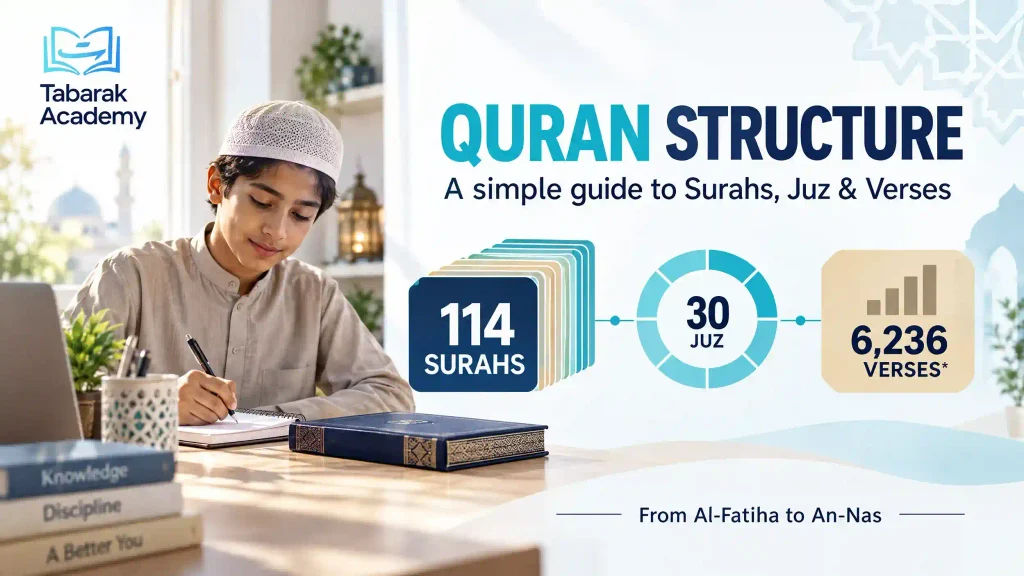
If you have ever opened a Mushaf and wondered how many chapters and surahs are in the Quran, the answer is clear: the Quran contains 114 surahs. In English, each surah is usually called a chapter, so the Quran has 114 chapters and 114 surahs, and both words describe the same thing.
This question is common among new Muslims, parents, and kids who are starting their Quran journey. Knowing the structure of the Quran makes reading, memorizing, and reviewing much easier, because you understand how the Book of Allah is organized from Surah Al-Fatiha to Surah An-Nas.
In this guide, you will learn what the word surah means, how scholars counted the surahs, how the Quran is divided into juz, hizb, and verses, and how the surahs are grouped by length and by time of revelation.
What You Will Learn
- The Quran has 114 surahs, and “chapter” is simply the common English translation of the Arabic word surah.
- The Quran is also divided into 30 juz, 60 hizb, 240 quarters, and 6,236 verses according to the Kufan count.
- Scholars grouped the surahs into four categories by length: Al-Sab’ Al-Tiwal, Al-Mi’un, Al-Mathani, and Al-Mufassal.
- Surahs are also classified as Makki or Madani, depending on whether they were revealed before or after the Hijrah.
- Simple and practical ways to help kids and beginners learn the surahs of the Quran.
How Many Chapters And Surahs Are In The Quran
The Quran is the speech of Allah revealed to Prophet Muhammad ﷺ through the angel Jibreel (Gabriel), and reciting it is an act of worship. The Quran is made up of 114 surahs, and every surah is made up of a number of verses called ayat (singular: ayah).
So, how many chapters and surahs are in the Quran? The answer is 114 in both cases. “Chapter” is not a separate division of the Quran.
The first surah in the Mushaf is Surah Al-Fatiha, and the last surah is Surah An-Nas. This order of 114 surahs is the order of the Uthmani Mushaf, the standard copy of the Quran compiled during the caliphate of Uthman ibn Affan (may Allah be pleased with him).
Why Surahs Are Called Chapters In English
Surahs are called chapters in English because a chapter is the closest familiar idea in English books. However, a surah is not exactly like a chapter in an ordinary book. Each surah has its own name, its own beginning, and its own end, and surahs vary greatly in length.
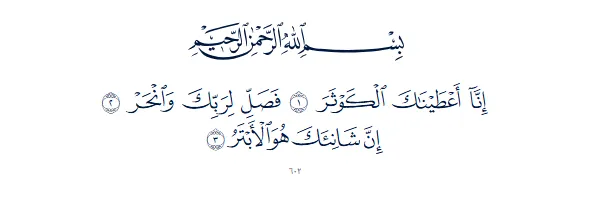
For example, Surah Al-Baqarah is the longest surah with 286 verses, while Surah Al-Kawthar is the shortest with only 3 verses. This is why teachers prefer the Arabic word surah when explaining how many chapters and surahs are in quran.
Did Any Scholar Count 113 Surahs Instead Of 114
Scholars agree that the Quran has 114 surahs. Imam Badr al-Din al-Zarkashi stated in his book Al-Burhan fi Ulum al-Quran that the surahs number 114 by the agreement of the people of knowledge, as written in the Uthmani Mushaf, beginning with Al-Fatiha and ending with An-Nas.
Al-Zarkashi also mentioned a report from Mujahid ibn Jabr that some counted 113 surahs by treating Surah Al-Anfal and Surah At-Tawbah as one surah, since At-Tawbah does not begin with the Basmalah.
What Does The Word Surah Mean In The Quran
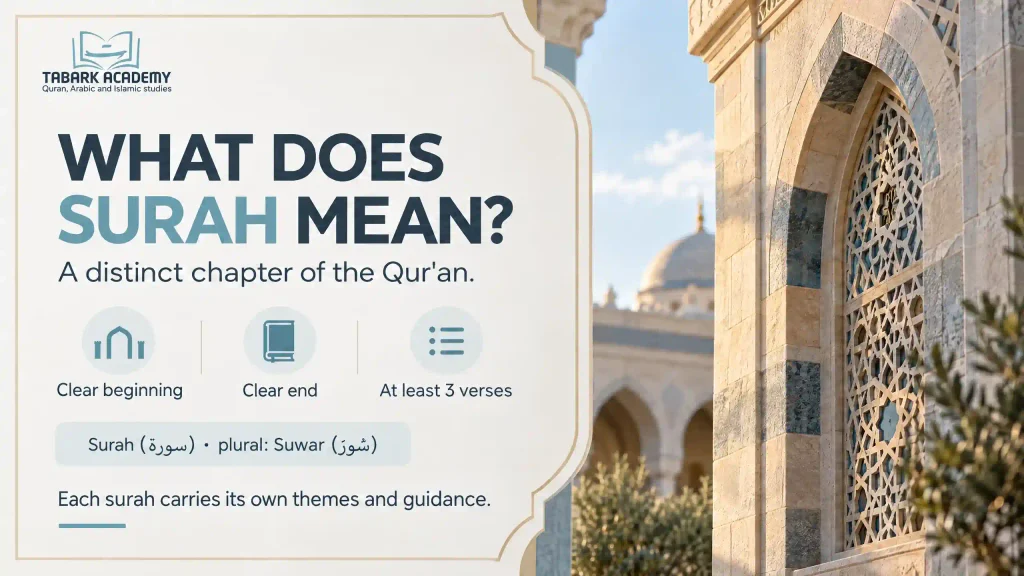
A surah is an independent section of the Quran with its own name, a clear beginning, and a clear end. Each surah contains at least three verses. The plural of surah in Arabic is suwar (سُوَر), and Muslims use the word to refer to the different sections of the Quran.
Linguistically, many scholars link the word surah (سورة) to the idea of a wall surrounding a city, as if each surah encloses its verses and sets them apart. Others connect it to the meaning of a high rank or position. Both meanings reflect the honored status of every surah in the Quran.
Each surah also has its own unique themes and lessons, guiding Muslims in matters of faith, worship, character, and daily life.
1. The Quran Uses The Word Surah For Its Own Sections
The Quran itself uses the word surah to describe its sections. Surah An-Nur opens by describing itself as a surah that Allah has sent down. This shows that the division of the Quran into surahs is part of the revealed Book, not a later invention.
سُورَةٌ أَنْزَلْنَاهَا وَفَرَضْنَاهَا وَأَنْزَلْنَا فِيهَا آيَاتٍ بَيِّنَاتٍ لَعَلَّكُمْ تَذَكَّرُونَ
“[This is] a surah which We have sent down and made [that within it] obligatory and revealed therein verses of clear evidence that you might remember.”
2. The Challenge To Produce A Single Surah
The Quran also mentions the surah in its well-known challenge. In Surah Al-Baqarah, Allah challenges those who doubt the revelation to produce one surah like it. Scholars explain that this challenge includes even the shortest surah, which shows the miraculous nature of every surah in the Quran.
وَإِنْ كُنْتُمْ فِي رَيْبٍ مِمَّا نَزَّلْنَا عَلَىٰ عَبْدِنَا فَأْتُوا بِسُورَةٍ مِنْ مِثْلِهِ وَادْعُوا شُهَدَاءَكُمْ مِنْ دُونِ اللَّهِ إِنْ كُنْتُمْ صَادِقِينَ
“And if you are in doubt about what We have sent down upon Our Servant [Muhammad], then produce a surah the like thereof and call upon your witnesses other than Allah, if you should be truthful.”
Experience Our Interactive Learning
Curious about how we teach? Watch these brief video clips from our recent live sessions to see our structured curriculum, advanced learning platform, and dynamic student-teacher interactions firsthand.
Start Your Quran Learning Journey
Join Tabark Academy today for structured online lessons with qualified tutors, customized to fit your goals.
Book Your Free Trial LessonHow Is The Quran Divided Besides The 114 Surahs
Besides the 114 surahs, the Quran is divided into reading units that help Muslims recite, memorize, and review it in a balanced way. The best-known units are the juz, the hizb, and the rub’ (quarter), along with the verses themselves. These units are based on length, not on topic.
The juz and hizb divisions are not mentioned in the Quran itself. They are practical divisions that Muslim scholars and teachers adopted over time to make regular recitation easier. The surahs and verses, on the other hand, form the original structure of the revealed text.
The table below gives a quick overview of the main ways the Quran is divided. It helps beginners, parents, and teachers explain how many chapters and surahs are in the Quran.
| Unit | Arabic Term | Number | What It Means |
|---|---|---|---|
| Surah | سورة | 114 | An independent chapter with its own name, beginning, and end |
| Juz | جزء | 30 | Thirty roughly equal parts of the Quran |
| Hizb | حزب | 60 | Each juz is divided into two hizb |
| Rub’ al-Hizb | ربع الحزب | 240 | Each hizb is divided into four quarters |
| Ayah | آية | 6,236 | Verses of the Quran according to the Kufan count |
1. The 30 Juz Of The Quran
A juz (plural: ajza) is one of thirty roughly equal parts of the Quran. Many Muslims recite one juz each day during Ramadan so they can complete the whole Quran in a month. The thirtieth juz, known as Juz Amma, contains 37 short surahs, from Surah An-Naba to Surah An-Nas.
Learners who want to cover more of the Quran in less time can benefit from an intensive Quran course, which sets a clear daily plan for reading, correcting mistakes, and reviewing each juz with a qualified teacher.
2. The 60 Hizb And 240 Quarters
A Hizb is half of a Juz, so the Quran contains 60 Hizb in total. Each Hizb is further divided into four quarters, known as Rub’ al-Hizb, giving the Quran 240 quarters altogether.
Many printed copies of the Quran mark these divisions in the margins, making it easier for readers to track their daily recitation and organize their reading portions.
3. How Many Verses Are In The Quran
The Quran contains 6,236 verses according to the Kufan count, which is the count used in the widely printed Mushaf today. Imam Abu Amr al-Dani stated that scholars agreed the Quran has at least 6,000 verses, but they differed about the exact number beyond that.
These differences come from transmitted ways of marking where verses end, not from personal opinion, and they never mean that any word of the Quran is missing or added.
4. How Many Words And Letters Are In The Quran
Scholars also counted the words of the Quran, but their totals differ slightly, with figures such as 77,437 and 77,934 words. Imam al-Suyuti explained that these differences arise because a word can be counted by its pronunciation, its written form, or other considerations.
Letter counts also differ between scholars. Tafsir Ibn Kathir records a count attributed to Mujahid of more than 320,000 letters.
The Four Categories Of Surahs By Length
Scholars of Quranic sciences grouped the 114 surahs into four categories according to their length: Al-Sab’ Al-Tiwal (the seven long surahs), Al-Mi’un (the hundreds), Al-Mathani (the oft-repeated), and Al-Mufassal (the separated). This grouping helps students understand the general structure of the Mushaf.
The categories follow the order of the Quran, beginning with the longest surahs, followed by those with around one hundred verses, then shorter surahs, and finally the many short surahs near the end. Scholars differed about some boundaries, so these categories serve as a general guide rather than a strict classification.
This classification also helps readers recognize the different stages and styles of Quranic recitation throughout the Mushaf.
1. Al-Sab’ Al-Tiwal – The Seven Long Surahs
Al-Sab’ Al-Tiwal are the seven longest surahs at the start of the Mushaf: Al-Baqarah, Aal Imran, An-Nisa, Al-Ma’idah, Al-An’am, and Al-A’raf. Scholars differed about the seventh. Some said it is Al-Anfal with At-Tawbah, since no Basmalah separates them, and others said it is Surah Yunus.
These surahs cover major themes of faith, worship, and Islamic law, alongside accounts of earlier nations and prophets.
2. Al-Mi’un – Surahs of About One Hundred Verses
Al-Mi’un are the surahs that contain around one hundred verses or slightly more. Their name comes from the Arabic word mi’ah, which means one hundred. Examples include Surah Hud, Surah Yusuf, Surah Al-Kahf, and Surah Ta-Ha, each of which has more than one hundred verses.
They follow the seven long surahs in the Mushaf and continue its sequence with substantial passages covering faith, guidance, and the stories of the prophets.
3. Al-Mathani – Surahs Shorter Than the Mi’un
Al-Mathani are the surahs that come after the Mi’un in length, meaning they have fewer than one hundred verses. Scholars gave different reasons for the name: some said these surahs follow the Mi’un, and others said they are repeated in recitation more often.
The word Mathani is also used for Surah Al-Fatiha, as explained below. This group includes surahs with varied lengths and themes that are often recited in daily prayers.
4. Al-Mufassal – The Short Surahs At The End Of The Quran
Al-Mufassal are the short surahs at the end of the Quran, starting from Surah Al-Hujurat according to a well-known opinion and ending with An-Nas. They are called Mufassal because the Basmalah separates them frequently, since these surahs are short and follow one another closely.
Scholars divided the Mufassal into three parts: the long Mufassal from Al-Hujurat to An-Naba, the middle Mufassal from An-Naba to Surah Ad-Duha, and the short Mufassal from Ad-Duha to An-Nas. Many of these are the first surahs Muslims memorize, as this guide on the minimum surahs needed to pray explains.
Why Surah Al-Fatiha Is Called The Seven Oft-Repeated Verses
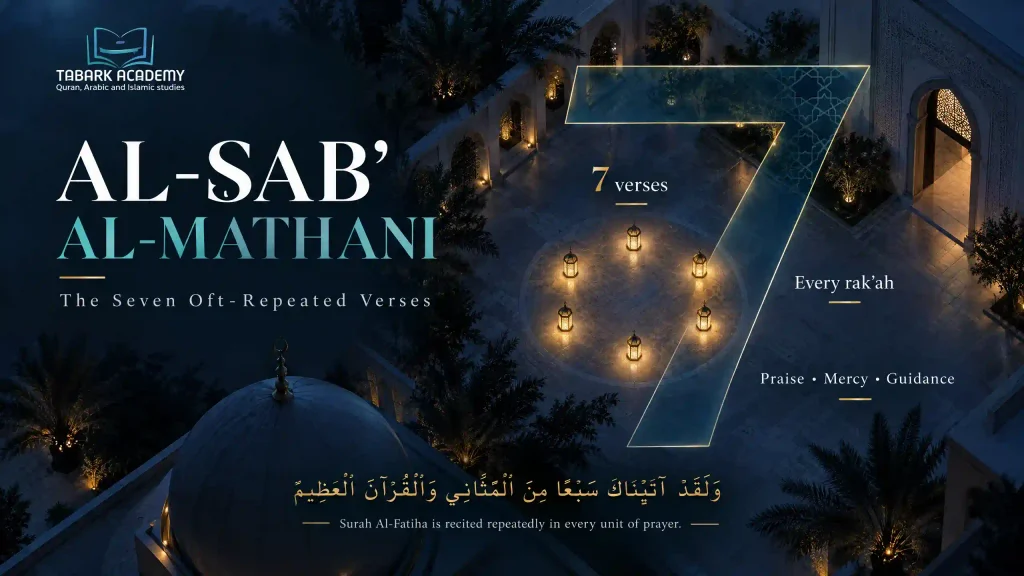
Surah Al-Fatiha is the opening surah of the Quran, and it consists of seven verses that every Muslim recites in each unit (rak’ah) of prayer. For this reason, it is called Al-Sab’ Al-Mathani, meaning the seven oft-repeated verses.
Its recitation is an essential part of Salah, as it brings together praise of Allah, recognition of His mercy and sovereignty, sincere worship, and a supplication for guidance to the straight path. Muslims recite it repeatedly throughout the day, making it one of the most familiar and frequently recited parts of the Quran.
وَلَقَدْ آتَيْنَاكَ سَبْعًا مِنَ الْمَثَانِي وَالْقُرْآنَ الْعَظِيمَ
“And We have certainly given you, [O Muhammad], seven of the often repeated [verses] and the great Qur’an.” Surah Al-Hijr (15:87)
Read also: Which surahs to recite in Salah
How Many Makki And Madani Surahs Are In The Quran
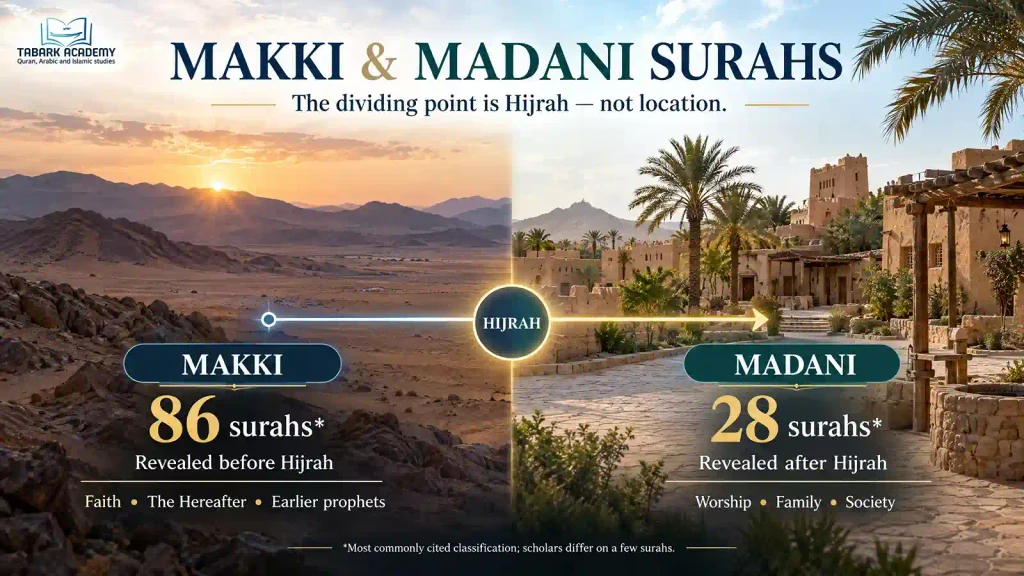
Makki surahs are those revealed before the Prophet’s ﷺ migration (Hijrah) to Madinah, while Madani surahs are those revealed after it, even if some were revealed outside Madinah.
This is the most widely used definition among scholars of Quranic sciences, and it depends on time rather than place. Therefore, the Hijrah serves as the dividing point between the two categories, regardless of where a particular verse was revealed.
Makki surahs often focus on belief in Allah, the Hereafter, and the stories of earlier prophets. Madani surahs often include guidance about worship, family, and society, because they were revealed after the Muslim community had been established in Madinah.
1. Surahs Agreed To Be Makki
According to a classification cited by al-Suyuti in his book Al-Itqan fi Ulum al-Quran, 82 surahs are agreed to be Makki. Examples include Surah Al-A’raf, Surah An-Nahl, and Surah Al-Isra.
Most of the short surahs in the last juz are Makki, which is why they focus strongly on faith and the Day of Judgment. Their verses often remind people of Allah’s power, the reality of resurrection, and the importance of preparing for the Hereafter.
2. Surahs Agreed To Be Madani
The same classification lists 20 surahs that scholars agree are Madani. Examples include Surah Al-Baqarah, Surah Al-Fath, and Surah An-Nasr. Many Madani surahs contain detailed guidance about fasting, marriage, inheritance, and the relationship between Muslims and other communities.
They also explain practical responsibilities and principles that help organize individual and communal Muslim life.
3. Surahs With Different Scholarly Opinions
Scholars differed about 12 surahs, such as Surah Al-Fatiha, Surah Al-Bayyinah, and Surah Al-Ikhlas. Because of these differences, many printed copies of the Quran label 86 surahs as Makki and 28 as Madani. Both counts describe the same 114 surahs from different scholarly angles.
These variations show why scholars distinguish between agreed classifications and surahs whose revelation history has more than one reported opinion.
Step Inside Our Virtual Classrooms
See our engaging teaching methods in action! watch real snippets of our live classes and discover how our expert instructors make learning interactive, memorable, and inspiring for every student.
Interesting Facts About The 114 Surahs Of The Quran
Knowing how many chapters and surahs are in the Quran is a great starting point, and a few simple facts about the surahs make this knowledge easier to remember. These facts are especially helpful for kids and beginners, because they connect numbers with real surahs that learners can open and read.
The table below lists some of the most useful facts about the surahs of the Quran. Each fact is based on the standard Mushaf, and every surah mentioned can be checked by opening it directly. Parents and teachers can turn these facts into short quiz questions to help children review what they have learned.
| Fact | Detail |
|---|---|
| First surah in the Mushaf | Al-Fatiha |
| Last surah in the Mushaf | An-Nas |
| Longest surah | Al-Baqarah (286 verses) |
| Shortest surah | Al-Kawthar (3 verses) |
| Surah that does not begin with the Basmalah | At-Tawbah |
| Surah that contains the Basmalah twice | An-Naml (at its start and in verse 30) |
| Number of surahs in Juz Amma | 37 surahs, from An-Naba to An-Nas |
How To Help Kids And Beginners Learn The Surahs Of The Quran
Kids and beginners learn the structure of the Quran best when numbers are connected to daily practice. Instead of memorizing facts alone, they should read, listen to, and memorize real surahs, starting with the short surahs of Juz Amma and moving gradually toward the longer surahs.
A steady routine, simple goals, and encouragement from family turn the number 114 into a real journey. The following steps help parents and new learners build a lasting connection with the surahs of the Quran.
Help your child learn to read the Quran correctly and memorize short surahs through fun, explore The Quran Course For Kids.
1. Start With The Short Surahs Of Juz Amma
Short surahs such as Surah Al-Ikhlas, Surah Al-Falaq, and Surah An-Nas are easy for children to memorize and are recited often in prayer. Once kids know these surahs well, the idea of 114 surahs becomes familiar and motivating rather than overwhelming.
Children who show a love for memorization can later join a Hifz program for kids that guides them through the Quran step by step with regular revision.
2. Choose A Fixed Daily Time For Memorization
Consistency matters more than long sessions when learning the surahs of the Quran. Many families choose the quiet time after the dawn prayer for memorization, and you can find practical tips on how to memorize the Quran after Fajr to build this habit at home.
Setting a regular time also helps children develop discipline and remember that even a few verses each day can lead to steady progress.
3. Learn Together As A Family
Mothers often guide children’s first steps with the Quran, so it helps when they keep learning too. Women who prefer female teachers and flexible schedules can explore online Quran classes for women and grow in their recitation alongside their children.
Learning together creates a supportive home environment where family members can encourage one another, practice regularly, and celebrate every achievement.
Start Your Quran Learning Journey
Join Tabark Academy today for structured online lessons with qualified tutors, customized to fit your goals.
Book Your Free Trial LessonStart Learning The Quran With Tabarak Academy
Knowing how many chapters and surahs are in the Quran is only the first step. The real goal is to read the 114 surahs correctly, understand their messages, and carry them in your heart. Tabarak Academy offers structured online Quran lessons with qualified tutors for kids, adults, and families.
Each learner follows a plan that matches their level and goals, whether they are beginning with the Arabic letters or reviewing long surahs. Take the first step in your Quran learning journey by booking a free trial lesson and discovering the right learning plan for you or your family.
Our Quran Courses
- Online Quran Classes
- Online Quran Classes for Beginners
- Online Quran Classes for Kids
- Online Quran Classes for Adults
- Online Quran Classes for Men
- Online Quran Classes for Sisters
- Quran Reading Course
- Quran Recitation Course
Conclusion
So, how many chapters and surahs are in the Quran? The Quran has 114 surahs, and because chapter is the English translation of surah, it also has 114 chapters. Scholars agree on this number, which follows the Uthmani Mushaf from Surah Al-Fatiha to Surah An-Nas.
Each surah has its own name and unique message, contributing to the guidance and teachings of the Quran as a whole.
Beyond the surahs, the Quran is divided into 30 juz, 60 hizb, 240 quarters, and 6,236 verses according to the Kufan count. Whoever asks how many chapters and surahs are in quran will also find that scholars grouped the surahs by length and time of revelation, making the Book of Allah easier to learn and review.
These divisions also help Muslims organize their daily recitation, set realistic reading goals, and maintain a consistent connection with the Quran.
Frequently Asked Questions
How Many Chapters Are In The Quran?
The Quran has 114 chapters. In English, the word chapter is the usual translation of the Arabic word surah, so the number of chapters and the number of surahs in the Quran are the same.
Is A Surah The Same As A Chapter?
Yes, a surah is generally translated as a chapter. A surah is an independent section of the Quran with its own name, beginning, and end, and it contains at least three verses.
How Many Juz Are In The Quran?
The Quran has 30 juz. Each juz is a roughly equal portion of the Quran, and each one is divided into two hizb, which gives 60 hizb and 240 quarters in total.
Which Surah Is The Longest In The Quran?
Surah Al-Baqarah is the longest surah in the Quran, with 286 verses. The shortest surah is Surah Al-Kawthar, which has only 3 verses.
Which Surah Does Not Start With Bismillah?
Surah At-Tawbah, the ninth surah of the Quran, is the only surah that does not begin with Bismillah. All the other 113 surahs begin with it.

0 Comments