
Have you ever heard a reciter reach the words تَرْمِيهِم بِحِجَارَةٍ and noticed that the meem never quite lands? It does not sound clear, and it does not fully merge into the next letter either.
That in-between sound is the answer to what is ikhfa shafawi — one of the three rules of Meem Sakinah in Tajweed, and the only one triggered by a single letter.
This guide from Tabarak Academy explains ikhfa shafawi from the ground up: the exact rule, the lip position scholars argue about, the two-count ghunnah, verified Quranic examples, and the errors that quietly follow learners for years.
It also corrects a widespread mistake you will find repeated across many Tajweed websites.
What you’ll learn in this article
- The precise definition of ikhfa shafawi and what each half of the name means.
- Which letter triggers the rule — and why the “four letters” claim circulating online is incorrect.
- How to produce the concealed meem with the correct lip contact and ghunnah length.
- Verified ikhfa shafawi examples from the Quran with surah and verse numbers.
- How to tell ikhfa shafawi apart from idgham shafawi, izhar shafawi, and ikhfa haqiqi.
What is ikhfa shafawi in Tajweed?
Ikhfa shafawi (الإخفاء الشفوي) is the Tajweed rule of concealing a Meem Sakinah (مْ) with a two-count nasal sound (ghunnah) when it is followed by the letter Baa (ب). The meem is neither pronounced clearly nor merged into the baa — it is hidden between the two.
The name describes the rule exactly. Ikhfa (إخفاء) means concealment. Shafawi (شفوي) means labial, from the Arabic word for lips, شفة.
The label is accurate because both letters involved — meem and baa — are articulated from the lips, so the entire rule happens at the same articulation point.
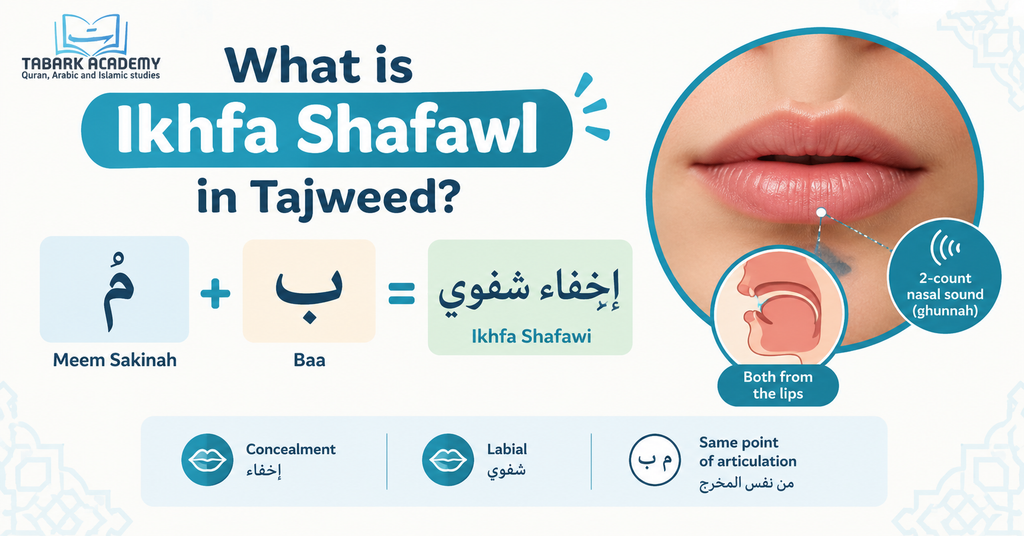
Ikhfa shafawi meaning, stated simply: hide the m sound in the nose for two counts, then release into the b. The sound sits deliberately between clarity and merging — which is exactly why ikhfa in general is defined by scholars as the middle station between izhar and idgham.
Where ikhfa shafawi fits among the Meem Sakinah rules?
A Meem Sakinah is a meem carrying a sukoon (مْ) — no vowel, just the m sound. Every Meem Sakinah in the Quran falls under one of three rules, decided entirely by the letter that comes next:
- Baa (ب) follows → Ikhfa Shafawi (conceal with ghunnah)
- Meem (م) follows → Idgham Shafawi (merge into one stressed meem)
- Any other letter → Izhar Shafawi (pronounce the meem clearly, no ghunnah)
Three rules, one decision point. Students at Tabarak Academy learn to make that decision at reading speed before moving on to the Noon Sakinah rules, because the Meem Sakinah set is the smaller and more mechanical of the two.
Experience Our Interactive Learning
Curious about how we teach? Watch these brief video clips from our recent live sessions to see our structured curriculum, advanced learning platform, and dynamic student-teacher interactions firsthand.
Which letter causes ikhfa shafawi?
Ikhfa shafawi is caused by one letter only: Baa (ب). There is no second letter, no list to memorise, and no exceptions in the standard Hafs recitation.
This matters because several Tajweed articles online state that ikhfa shafawi applies to four letters — ب, ف, م, and و. That is incorrect and worth flagging plainly: ف and و following a Meem Sakinah produces Izhar Shafawi (clear pronunciation), and م following a Meem Sakinah produces Idgham Shafawi (full merging). Only ب produces concealment.
If you memorise four letters, you will apply ghunnah in three places where the meem must stay clear.
Here is a practical rule most guides leave out. In the Quranic text, a Meem Sakinah followed directly by Baa always occurs between two words — the meem ends the first word, the baa begins the second. No single Quranic word contains the sequence مْ ب internally.
That gives you a scanning habit: when your eye reaches a word ending in مْ, check only the first letter of the next word. If it is ب, apply ikhfa shafawi.
In practice, this check is the working answer to what is ikhfa shafawi while you are actually reciting — a one-second decision at a word boundary, not a rule you stop to recall.
Read also: Rules of Meem Sakinah
How to pronounce ikhfa shafawi explained step by step?
Ikhfa shafawi explained that a physical action has two components working together: the lips and the nose.
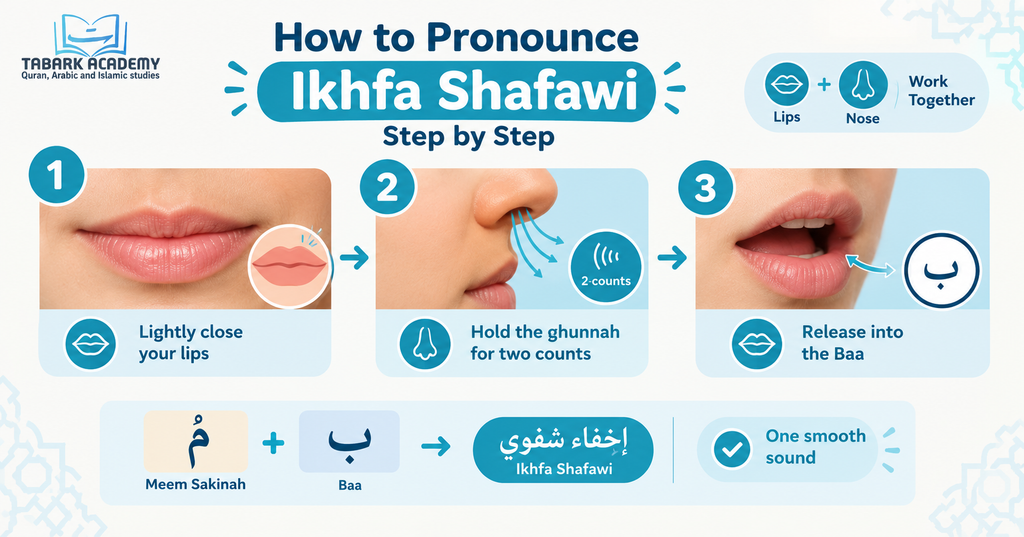
Step 1: Bring the lips together lightly
Close the lips gently, without pressing. A firm, compressed closure produces a clear meem, which turns the rule into izhar shafawi by accident. The contact should be light enough that the lips are already positioned to release into the baa.
Scholars differ here, and it is worth knowing why. One group holds that the lips should touch lightly; another holds that a hair-thin gap should remain so the meem is genuinely concealed rather than articulated.
Both positions are transmitted and both are accepted in recitation. The practical takeaway: the error is pressing hard, not choosing between the two.
Step 2: Hold the ghunnah for two counts
Release the nasal sound through the nose and hold it for approximately two counts — the same duration used in ghunnah throughout Tajweed.
The ghunnah is what performs the concealment; without it, you are simply saying m then b.
Step 3: Release into the Baa
Move straight from the nasal hold into the baa with no pause and no re-articulation of the meem. The transition should sound like one continuous movement, not two separate sounds joined.
Borrow your ghunnah from iqlab
The ghunnah of ikhfa shafawi is functionally the same nasal hold used in iqlab (when Noon Sakinah or tanween is followed by ب). If your iqlab is already correct, you do not need to build a new sound — you need to apply an existing one to a meem.
Reciters who struggle with ikhfa shafawi but recite iqlab cleanly almost always have a lip-pressure problem, not a ghunnah problem.
Start Your Quran Learning Journey
Join Tabark Academy today for structured online lessons with qualified tutors, customized to fit your goals.
Book Your Free Trial LessonIkhfa Shafawi Examples From The Quran
These examples are verified by surah and verse so you can read them in context rather than in isolation.
| Example | Transliteration | Reference |
| تَرْمِيهِم بِحِجَارَةٍ مِّن سِجِّيلٍ | tarmīhim bi-ḥijāratin | Al-Fil 105:4 |
| فَلَمَّا أَنبَأَهُم بِأَسْمَائِهِمْ | fa-lammā anba’ahum bi-asmā’ihim | Al-Baqarah 2:33 |
| وَمَا هُم بِمُؤْمِنِينَ | wa-mā hum bi-mu’minīn | Al-Baqarah 2:8 |
| وَمَا هُم بِخَارِجِينَ | wa-mā hum bi-khārijīn | Al-Baqarah 2:167 |
| وَهُم بِالْآخِرَةِ هُمْ كَافِرُونَ | wa-hum bil-ākhirati hum kāfirūn | Hud 11:19 |
| يَوْمَ هُم بَارِزُونَ | yawma hum bārizūn | Ghafir 40:16 |
| لَّسْتَ عَلَيْهِم بِمُصَيْطِرٍ | lasta ʿalayhim bi-muṣayṭir | Al-Ghashiyah 88:22 |
Notice the pattern: هُم بِ and هِم بِ account for the large majority of occurrences in the Quran. Drilling those two syllable pairs alone covers most of the ikhfa shafawi you will ever meet in recitation — which is why Tabarak Academy tutors start students on these pairs before opening a full surah.
Step Inside Our Virtual Classrooms
See our engaging teaching methods in action! watch real snippets of our live classes and discover how our expert instructors make learning interactive, memorable, and inspiring for every student.
How Does Ikhfa Shafawi Differ From The Rules It Is Confused With?
Most ikhfa shafawi errors are not pronunciation errors. They are identification errors — the student applied the wrong rule because two rules looked similar on the page.
A. Ikhfa shafawi vs idgham shafawi
Idgham shafawi occurs when Meem Sakinah is followed by a voweled meem (م), and the two meems merge completely into one stressed meem with ghunnah, as in لَهُم مَّا يَشَاءُونَ.
In ikhfa shafawi the meem is hidden but never merges — the baa remains a separate, fully pronounced letter. Merging is one sound; concealing is two sounds joined by a nasal bridge.
B. Ikhfa shafawi vs izhar shafawi
Izhar shafawi applies when Meem Sakinah is followed by any letter other than م or ب — for example لَهُمْ فِيهَا. The meem is pronounced clearly with no ghunnah at all.
Adding ghunnah here is one of the most common faults in learner recitation, particularly before و and ف, where the lips are already active.
C. Ikhfa shafawi vs ikhfa haqiqi
Ikhfa haqiqi belongs to a different family entirely: it applies to Noon Sakinah (نْ) and tanween, and it is triggered by fifteen letters (ت ث ج د ذ ز س ش ص ض ط ظ ف ق ك).
Ikhfa shafawi applies to Meem Sakinah and is triggered by one letter. Same concept — concealment with ghunnah — different letter, different trigger set.
Common Ikhfa Shafawi Mistakes And How To Correct Them
These are the faults Tajweed instructors correct most often, with the fix for each.
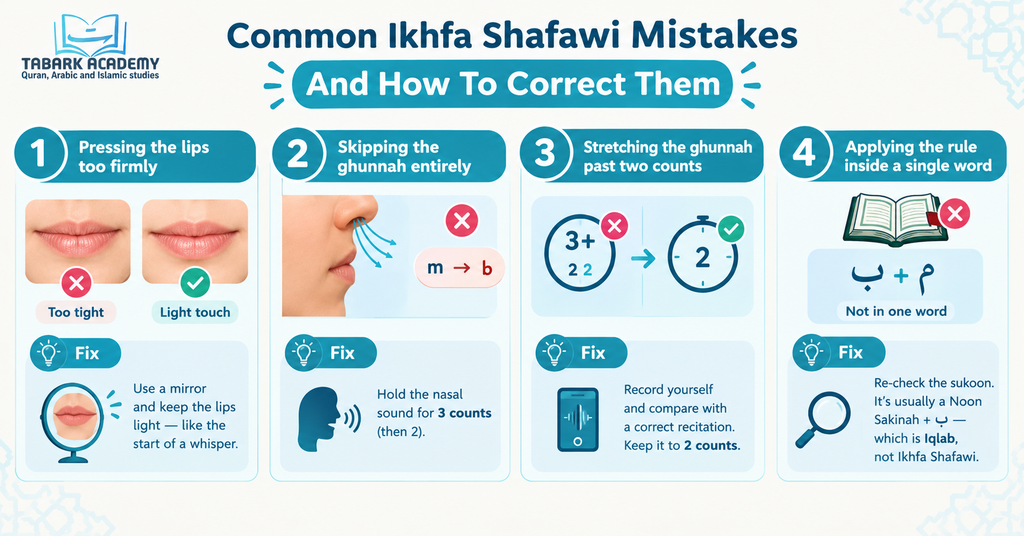
1. Pressing the lips too firmly
A hard closure produces an audible, clear meem — effectively izhar shafawi. Fix: recite in front of a mirror and watch for lip compression. The lips should meet the way they do at the start of a whisper, not the way they do when saying “map”.
2. Skipping the ghunnah entirely
Moving straight from m to b removes the rule. Fix: exaggerate deliberately. Hold the nasal sound for three counts for a week, then reduce to two. Over-correcting first makes the correct length easy to feel.
3. Stretching the ghunnah past two counts
Over-holding sounds artificial and disrupts the rhythm of the verse. Fix: record yourself reading Al-Fil 105:4 and compare against a verified recitation. Two counts is roughly the time it takes to say “one-two” at normal speed.
4. Applying the rule inside a single word
Since مْ + ب never occurs within one Quranic word, a student who “finds” ikhfa shafawi inside a word has misread a letter. Fix: re-check the sukoon. It is usually a Noon Sakinah followed by ب — which is iqlab, not ikhfa shafawi.
Read also: Ikhfa Letters List With Examples
Start Your Quran Learning Journey
Join Tabark Academy today for structured online lessons with qualified tutors, customized to fit your goals.
Book Your Free Trial LessonStart Reciting With Correct Tajweed At Tabarak Academy
Reading about ikhfa shafawi will get you the rule. Only a qualified ear will tell you whether your lips are too tight, your ghunnah too short, or your transition too abrupt — and those are exactly the faults you cannot hear in yourself.
At Tabarak Academy, certified tutors teach Tajweed one-to-one, correct your recitation live, and take you through the full Meem Sakinah and Noon Sakinah rule sets with applied Quranic practice rather than theory alone.
Lessons are online, scheduled around you, and taught in a structured path from beginner to fluent recitation.
Our Tajweed Courses:
- Tajweed Course for Beginners
- Tajweed Course for Kids
- Tajweed Course for Adults
- Tajweed Course for Sisters
- Advanced Tajweed Course
- Amali (Practical) Tajweed Course
- Learn Quran with Tajweed
- Learn Quran with Tajweed for Kids
- Learn Quran with Tajweed for Sisters

Conclusion
If someone asks you what is ikhfa shafawi, the complete answer is short: it is the concealment of a Meem Sakinah with a two-count ghunnah when the next letter is Baa. One trigger letter, one action — light lip contact, nasal hold, release.
It only ever appears between two words, it is caused by ب alone despite what some sources claim, and it is distinguished from idgham shafawi by the absence of merging and from izhar shafawi by the presence of ghunnah.
Master this rule and you have secured one third of the Meem Sakinah system. Practise it on هُم بِ and هِم بِ until the transition is automatic, then verify it with a teacher — the small faults in lip pressure and ghunnah length are the ones that survive years of self-study.
Frequently asked questions about ikhfa shafawi
The questions below cover what learners most often ask after their first lesson on ikhfa shafawi — the letter count, the ghunnah length, and how the rule behaves when you stop at the end of a verse.
1. Is ikhfa shafawi one letter or four letters?
Ikhfa shafawi has one letter only: Baa (ب). Sources listing four letters (ب، ف، م، و) are incorrect: م produces idgham shafawi, while ف and و produce izhar shafawi.
2. How long is the ghunnah in ikhfa shafawi?
The ghunnah in ikhfa shafawi is held for approximately two counts — the standard ghunnah length in Tajweed. Shorter sounds abrupt; longer disrupts the rhythm of the verse.
3. Does ikhfa shafawi apply if I stop at the Meem Sakinah?
No. Ikhfa shafawi requires the following Baa, so if you pause on the meem, the rule does not apply and the meem is pronounced as a clear stopping meem. The rule returns when you resume and connect to the baa.
4. Can ikhfa shafawi occur inside a single word?
No. In the Quranic text, Meem Sakinah followed by Baa always occurs across a word boundary — the meem ends one word and the baa begins the next. If it appears inside a word, re-check the letter; it is likely a noon, making it iqlab.
5. Where can I practise ikhfa shafawi with a teacher?
You can practise ikhfa shafawi with certified tutors at Tabarak Academy, which offers one-to-one online Tajweed lessons with live correction of lip position, ghunnah length, and verse application.
6. What is ikhfa shafawi in simple terms?
What is ikhfa shafawi in simple terms: it is hiding the m sound of a Meem Sakinah (مْ) in the nose for two counts when the next letter is Baa (ب), instead of pronouncing it clearly or merging it. The baa is then pronounced normally.


0 Comments