
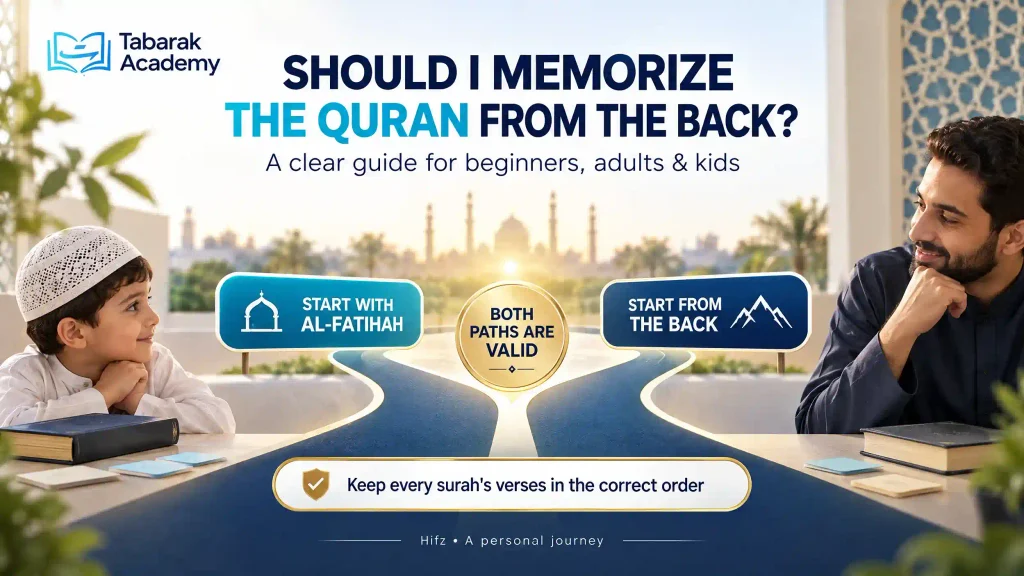
Should I memorize the Quran from the back, or should I begin with Surah Al-Fatihah and move forward? This is one of the first questions Muslims ask when they decide to start Hifz, the memorization of the Quran by heart. Parents ask it for their children, and adults ask it for themselves.
The short answer is that both paths are valid in Islam. No text from the Quran or the Sunnah requires a Muslim to memorize the surahs in a fixed order, as long as the verses inside each surah are kept in their correct sequence.
What You Will Learn
- Memorizing the Quran from the back, starting with Juz Amma, is permissible, and so is starting from the beginning of the Mushaf.
- The order of verses (ayat) inside each surah must always be preserved, whichever surah you start with.
- Starting from the back suits most beginners, children, and non-Arabic speakers because the surahs are short and used in daily prayer.
- Starting from the front suits fluent, motivated learners who want to follow the Mushaf order from day one.
- Correct recitation, steady repetition, and daily revision matter more than the surah you begin with.
Should I Memorize The Quran From The Back
Memorizing the Quran from the back means beginning Hifz with the last surahs of the Mushaf, usually Surah An-Nas, and moving backwards through Juz Amma, the 30th part of the Quran. Most Quran schools use this method with beginners because the final surahs are short, rhythmic, and already familiar from prayer.
Memorizing from the front means starting with Al-Fatihah and then Surah Al-Baqarah, the longest surah in the Quran, and continuing in the order of the Mushaf. Some teachers prefer this route for adults who already read fluently and can commit to longer daily sessions.
So, should I memorize the Quran from the back? For most beginners, yes, it is a practical and widely used starting point.
Is It Permissible To Memorize The Quran In Reverse Order
Yes, it is permissible to memorize the Quran in reverse surah order. Scholars have not reported any text that obliges a Muslim to memorize the surahs in the sequence of the Mushaf, so starting from the beginning, the end, or even the middle of the Quran is allowed.
What must be preserved is the order of the verses within each surah. A student who memorizes Surah An-Nas must learn its six verses in their established sequence.
The Companion Abdullah ibn Abbas mentioned that he had learned the Mufassal, the shorter surahs toward the end of the Quran, while he was still a young boy, as recorded in Sahih al-Bukhari.
إِنَّ الَّذِي تَدْعُونَهُ الْمُفَصَّلَ هُوَ الْمُحْكَمُ، قَالَ وَقَالَ ابْنُ عَبَّاسٍ: تُوُفِّيَ رَسُولُ اللَّهِ صلى الله عليه وسلم وَأَنَا ابْنُ عَشْرِ سِنِينَ، وَقَدْ قَرَأْتُ الْمُحْكَمَ
“Those Suras which you people call the Mufassal, are the Muhkam. And Ibn ‘Abbas said, “Allah’s Apostle died when I was a boy of ten years, and I had learnt the Muhkam (of the Qur’an).””
What The Quran Says About Making Memorization Easy
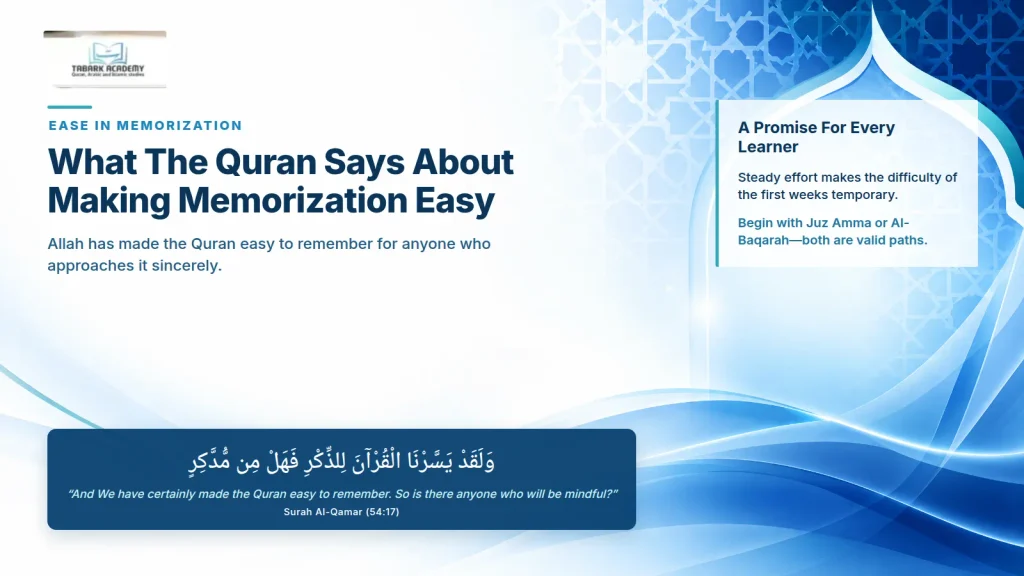
Allah has made the Quran easy to remember for anyone who approaches it sincerely. This promise gives every learner confidence, whether they begin with Juz Amma or with Al-Baqarah. Allah repeats this reminder several times in Surah Al-Qamar, including in this verse:
وَلَقَدْ يَسَّرْنَا الْقُرْآنَ لِلذِّكْرِ فَهَلْ مِن مُّدَّكِرٍ
“And We have certainly made the Quran easy to remember. So is there anyone who will be mindful?” Surah Al-Qamar (54:17)
Classical commentators explained this verse as a sign that Allah facilitated the Quran for memorization and reflection.
For a beginner, it means the difficulty of the first weeks is temporary, and steady effort is a path Allah has made easy, whatever surah you choose to start with.
Benefits Of Memorizing The Quran From The Back
Starting Hifz from the back is the most common method in Quran circles, especially for children and new learners. Teachers often begin with Juz Amma, then move to Juz Tabarak, which opens with Surah Al-Mulk, before working toward the longer surahs at the start of the Mushaf.
This approach allows learners to start with shorter surahs that are easier to memorize and frequently recited in daily prayers, helping them gain confidence as they progress.
If you have been wondering, should I memorise the Quran from the back, the benefits below explain why so many teachers recommend it as a first step for beginners of every age.
Step Inside Our Virtual Classrooms
See our engaging teaching methods in action! watch real snippets of our live classes and discover how our expert instructors make learning interactive, memorable, and inspiring for every student.
Start Your Quran Learning Journey
Join Tabark Academy today for structured online lessons with qualified tutors, customized to fit your goals.
Book Your Free Trial Lesson1. Short Surahs Build Early Confidence
The surahs of Juz Amma have short verses and simple structures, so a beginner can complete a full surah in one or two days. Finishing whole surahs quickly creates a real sense of achievement and removes the fear many people feel when they look at the size of the full Mushaf.
For children especially, completing a surah and reciting it to parents or a teacher turns memorization into a joyful milestone rather than a heavy task.
2. Daily Prayer Becomes Built-In Revision
The short surahs at the end of the Quran are the ones Muslims recite most often in their daily prayers. When you memorize them first, every prayer becomes a chance to review what you have learned, which fixes these surahs firmly in memory without extra study time.
It also improves your prayer, because you can choose from a wider range of surahs instead of repeating the same two or three every day.
3. A Proven Path For Teaching Children
Beginning with the shorter surahs has long been the standard path for teaching children, as the narration of Ibn Abbas shows. Children hold short passages in mind more easily, and the gentle rhythm of Juz Amma suits their attention span and daily routine.
Parents who want to set healthy expectations can read this guide to a realistic Hifz timeline for children before planning their child’s daily target.
4. A Gentle Entry For Non-Arabic Speakers
Learners who do not speak Arabic often find long surahs with lengthy verses challenging at first. Short surahs let them focus on correct pronunciation and the meaning of a few words at a time, which builds both accuracy and a personal connection to the text.
Structured Quran classes for non-Arabic speakers make this stage smoother, because a tutor corrects mistakes before they turn into habits.
Common Starting Surahs When You Memorize From The Back
Knowing which surahs come first helps you plan your memorization in small, realistic steps. The table below lists short surahs that many teachers use at the start of a back-to-front plan. Al-Fatihah is included because every Muslim needs it for prayer, even though it opens the Mushaf.
Verse counts follow the standard numbering used in most printed copies of the Quran. This list can help beginners choose a starting point and track their progress as they gradually memorize more surahs.
| Surah | Surah Number | Number Of Verses | Why It Is A Good Starting Point |
|---|---|---|---|
| Al-Fatihah | 1 | 7 | Recited in every unit (rak’ah) of prayer |
| An-Nas | 114 | 6 | The last surah, short and familiar |
| Al-Falaq | 113 | 5 | Often learned together with An-Nas |
| Al-Ikhlas | 112 | 4 | Short and frequently recited in prayer |
| Al-Kawthar | 108 | 3 | The shortest surah in the Quran |
| Al-Asr | 103 | 3 | Three short verses with a complete message |
| An-Nasr | 110 | 3 | Short with an easy rhythm |
Benefits Of Memorizing The Quran From The Beginning
Starting from Al-Fatihah and Al-Baqarah is the method some teachers recommend for adults and highly motivated students. It follows the order of the Mushaf that the Companions agreed upon, and it suits learners who already read the Quran fluently and can study for longer each day.
Following this sequence also helps learners become familiar with the Quran’s structure from its beginning. This route asks for more effort at the beginning, but it offers clear advantages for the right student.
Before choosing it, make sure you can give the long verses of Al-Baqarah enough daily time for both new memorization and review. A steady routine and guidance from a qualified teacher can help you maintain progress without feeling overwhelmed.

1. Following The Mushaf Order From Day One
Memorizing in the order of the Mushaf trains the student to know exactly where each surah and passage sits in the Quran. This makes it easier to locate verses, follow an imam’s recitation, and connect each section to what comes before and after it.
It also removes the need to adjust later when reciting the whole Quran from beginning to end in its standard order.
2. Tackling The Longest Surahs While Motivation Is High
The long surahs at the beginning of the Quran need the most focus. Starting with them uses the energy of the first months, when motivation is usually strongest. Once a student has memorized Al-Baqarah, the remaining surahs often feel lighter by comparison.
This approach suits disciplined learners who keep a steady daily routine and have a teacher who reviews their progress regularly.
3. Early Exposure To Detailed Rulings And Stories
The early long surahs contain many detailed rulings on worship, family life, and dealings, along with extended accounts of earlier prophets and nations. Memorizing them first gives the student a strong foundation of Quranic knowledge from the very start of the journey.
When combined with a reliable translation or tafsir (Quranic commentary), this route turns memorization into a deeper study of the Quran’s guidance.
Memorizing From The Back Vs From The Front – A Side-By-Side Comparison
Both methods lead to the same goal, which is holding the words of Allah in your heart with accuracy. They differ mainly in pace, difficulty, and the type of learner they suit. If you keep asking, should I memorise the Quran from the back or the front, the comparison below summarizes the key differences so you can see which path matches your situation.
Consider your current recitation level, available study time, and ability to maintain regular revision before making your choice.
| Factor | From The Back (Juz Amma First) | From The Front (Al-Fatihah And Al-Baqarah First) |
|---|---|---|
| Starting difficulty | Easier, with short verses | Harder, with long verses |
| Early progress | Fast, full surahs in days | Slower, long passages in each surah |
| Use in daily prayer | Immediate | Gradual |
| Knowledge of Mushaf order | Built later | Built from day one |
| Best suited for | Children, beginners, non-Arabic speakers | Fluent readers and highly motivated adults |
| Islamic ruling | Permissible | Permissible |
How To Choose The Right Starting Point For Your Hifz
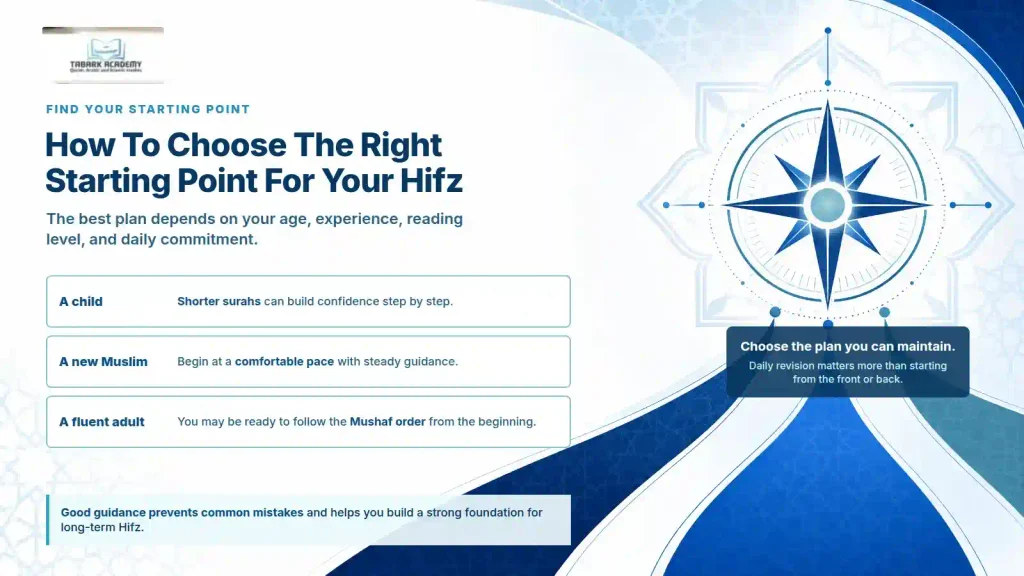
Choosing where to start depends on who you are, your current Quran reading level, and what you can realistically commit to each day. A child, a new Muslim, and a fluent adult reader each need a different starting point based on their age, experience, and learning needs.
Some learners benefit from beginning with shorter surahs to build confidence, while others may be ready to follow the order of the Mushaf from the beginning. The real question is not only should I memorize Quran from back or front, but which plan you can maintain consistently over the years without neglecting revision.
Having the right guidance from the start can help you avoid common mistakes, make steady progress, and build a strong foundation for long-term Hifz.
1. If You Are A Complete Beginner
If you cannot yet read the Quran fluently, your first step is learning to read Arabic letters and words correctly. Memorizing before you can read accurately often leads to mistakes that become hard to correct later on.
A foundation program such as the Noor Al-Bayan course teaches reading from the letters up. Once you read well, starting from Juz Amma is usually the easiest path forward.
2. If You Are Teaching Children
For children, starting from the back is almost always the better choice. Short surahs match their attention span, and they can recite what they memorize in prayer right away. Keep daily portions small, praise consistent effort, and listen to them recite every day.
Children progress best with a patient teacher and a routine that feels encouraging rather than stressful. Enroll your child in a Quran course for kids, with patient tutors and a gentle, step-by-step memorization plan.
3. If You Are An Adult With A Busy Schedule
Adults with work and family responsibilities usually benefit from starting with Juz Amma, because short surahs fit into limited daily time. If you already read fluently and can study for longer sessions, starting from Al-Baqarah is also a strong option.
A flexible online Quran course for men lets you memorize with a tutor at times that suit your routine.
Why Correct Recitation Matters Before You Memorize
Memorization is only as good as the recitation it is built on. If a student memorizes with wrong pronunciation, those errors become locked into memory. This is why teachers emphasize Tajweed, the rules for reciting the Quran correctly. Allah instructs in Surah Al-Muzzammil:
أَوْ زِدْ عَلَيْهِ وَرَتِّلِ الْقُرْآنَ تَرْتِيلًا
“or a little more—and recite the Quran [properly] in a measured way.”
Learning the basics through a Tajweed course for beginners helps you pronounce each letter from its proper place, so what you memorize stays correct for life. It also makes your recitation clearer and helps you avoid repeating pronunciation mistakes as you progress with Hifz.
Practical Tips To Memorize The Quran Successfully
Whatever your starting point, a few proven habits decide whether your memorization lasts. Many students focus only on adding new verses, but strong Hifz depends equally on sincerity of intention, repetition, regular revision, and the right learning environment.
Without reviewing previously memorized passages, even well-learned verses can gradually become difficult to recall. Building a balanced routine from the beginning helps you make steady progress without forgetting what you have already learned.
The tips below apply whether you begin with An-Nas or Al-Baqarah, and they can help you retain what you memorize for the long term.
1. Begin With A Sincere Intention
Memorizing the Quran is an act of worship, so begin by making your intention purely for Allah. A sincere intention helps you stay consistent on difficult days, when progress feels slow or other duties compete for your time.
Renew this intention regularly, and ask Allah for ease and steadiness before each memorization session.
2. Repeat Each Verse Until It Is Firm
Repetition is the core of memorization. Recite each verse many times while looking, then without looking, before linking it to the verse before it.
Listening to a skilled reciter repeatedly also strengthens memory and pronunciation. To set a clear target, read this guide on how many times you should repeat a verse to memorize it.
3. Make Revision A Daily Priority
Revision, known as Muraja’ah, protects what you have already memorized, and many teachers consider it as important as adding new verses. The Prophet ﷺ warned that the Quran slips away quickly from those who neglect it:
تَعَاهَدُوا الْقُرْآنَ، فَوَالَّذِي نَفْسِي بِيَدِهِ لَهُوَ أَشَدُّ تَفَصِّيًا مِنَ الإِبِلِ فِي عُقُلِهَا
“Keep on reciting the Qur’an, for, by Him in Whose Hand my life is, Qur’an runs away (is forgotten) faster than camels that are released from their tying ropes.”
4. Track Your Progress And Choose The Right Time
Recording what you memorize and review each week shows you where you are strong and where you need more revision. Many learners also find that the early morning, especially after Fajr prayer, is a calm time for memorizing with fewer distractions.
You can learn simple ways to track your Quran memorization progress and stay motivated over months and years.
Experience Our Interactive Learning
Curious about how we teach? Watch these brief video clips from our recent live sessions to see our structured curriculum, advanced learning platform, and dynamic student-teacher interactions firsthand.
Virtues Of Memorizing The Quran
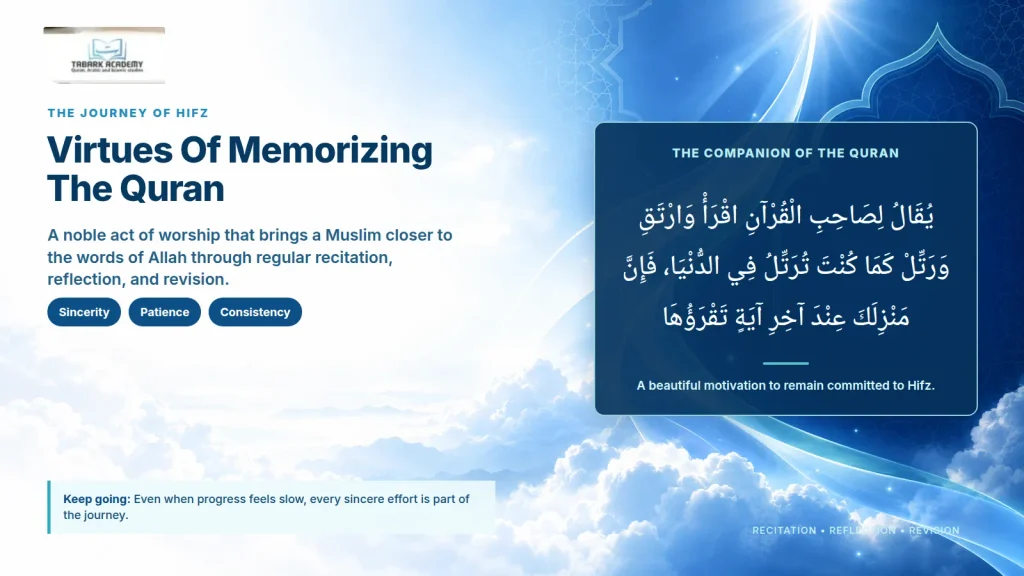
Memorizing the Quran is one of the most honorable acts of worship a Muslim can undertake, whether they start from the front or the back of the Mushaf. It is a journey that requires sincerity, patience, and consistent effort, bringing a Muslim closer to the words of Allah through regular recitation, reflection, and revision.
Authentic narrations describe a special rank in the Hereafter for the companion of the Quran, the one who memorizes it, recites it with care, and strives to live by its teachings. This virtue is a beautiful motivation for every learner to remain committed to Hifz, even when progress feels slow or challenging.
يُقَالُ لِصَاحِبِ الْقُرْآنِ اقْرَأْ وَارْتَقِ وَرَتِّلْ كَمَا كُنْتَ تُرَتِّلُ فِي الدُّنْيَا، فَإِنَّ مَنْزِلَكَ عِنْدَ آخِرِ آيَةٍ تَقْرَؤُهَا
“One who was devoted to the Qur’an will be told to recite, ascend and recite carefully as he recited carefully when he was in the world, for he will reach his abode when he comes to the last verse he recites.”
Start Your Quran Learning Journey
Join Tabark Academy today for structured online lessons with qualified tutors, customized to fit your goals.
Book Your Free Trial LessonBegin Your Hifz Journey With Tabarak Academy
Whether you decide to memorize from Juz Amma or from Al-Baqarah, a qualified teacher makes the journey clearer, more accurate, and more consistent. At Tabarak Academy, tutors build a Hifz plan around your level, age, and goals.
Lessons are structured and online, so you can learn from home with a tutor who listens to your recitation, corrects mistakes, and guides your revision. Book a free trial lesson today and take your first confident step toward memorizing the Book of Allah.

Conclusion
So, should I memorize the Quran from the back? For most beginners, children, and non-Arabic speakers, starting with Juz Amma is often the easiest and most encouraging path. Its shorter surahs help learners build confidence, develop a regular memorization habit, and become familiar with Quranic recitation.
Fluent readers with strong discipline can also begin with Al-Fatihah and Al-Baqarah and follow the Mushaf order from day one. Both methods are permissible in Islam, provided the order of verses within each surah is kept. What truly matters is correct recitation, steady repetition, daily revision, and a sincere intention.
Begin with small steps, seek guidance from a qualified teacher, and ask Allah to make the Quran firm in your heart.
Frequently Asked Questions About Memorizing The Quran From The Back
Is It Wrong To Memorize The Quran From The Back?
No, it is not wrong. Memorizing the Quran from the back, starting with Juz Amma, is permissible and widely practiced. The only requirement is to keep the verses inside each surah in their correct order.
Should I Memorise The Quran From The Back As An Adult?
Yes, many adults benefit from memorising the Quran from the back, because short surahs fit busy schedules and are used in daily prayer. Fluent readers with more time may also start from Al-Baqarah.
What Is The Best Surah To Start Memorizing?
There is no single required starting surah. If you have not memorized Al-Fatihah correctly yet, start with it because it is recited in every unit of prayer, then move to the short surahs of Juz Amma.
Can I Switch From Juz Amma To Al-Baqarah Later?
Yes, switching is permissible. Many students memorize Juz Amma and Juz Tabarak first, then begin Al-Baqarah and continue forward, as long as they keep revising what they have already memorized.
Do I Need To Speak Arabic To Memorize The Quran?
No, you do not need to speak Arabic to memorize the Quran, but you do need to read it correctly. Learning to read with proper Tajweed first, then memorizing short surahs, works well for non-Arabic speakers.
Should I Memorize Quran From Back When Teaching My Child?
Yes, starting from the back is generally the best choice for children. Short surahs suit their attention span, give them quick achievements, and can be recited in their daily prayers right away.


0 Comments