

Most students learn the rules of noon sakinah first, then assume meem sakinah is a smaller, easier afterthought. It is smaller — three rules instead of four — but it decides how you pronounce hundreds of words across the Quran, and it is one of the most common places where otherwise careful recitation slips.
The rules of meem sakinah are three: Ikhfa Shafawi, Idgham Shafawi, and Izhar Shafawi. Which one applies depends entirely on the single letter that comes after the meem.
This guide explains each rule, how to produce it with your lips and nose, how to spot it in the Mushaf, and which mistakes to correct before they become habits.
Meem sakinah is the letter meem (م) carrying a sukoon (ـْ) — a meem with no vowel: no fatha, no damma, no kasra. It appears in nouns, verbs, and particles, and it can fall in the middle of a word or at its end.
Its articulation point (makhraj) is the two lips pressed together. That single fact is why all three rules carry the name shafawi, from the Arabic shafa (lip). Every rule in this family is produced at the lips — which is also why so many of its errors are invisible to the reciter and obvious to a trained listener.
1. The Rule Of Ikhfa Shafawi
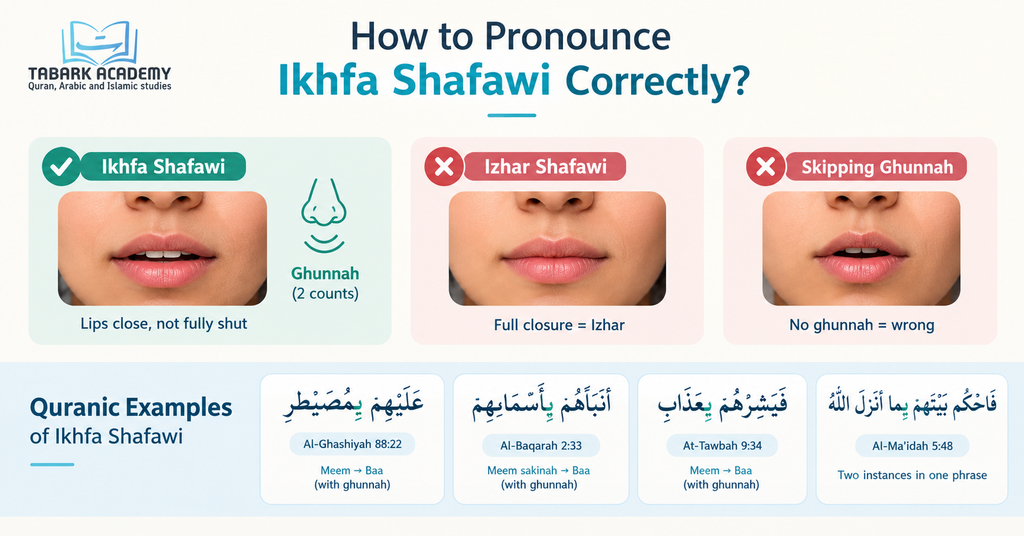
Ikhfa Shafawi occurs when a meem sakinah is followed by the letter baa (ب) — and only baa. Ikhfa means to hide or conceal; shafawi means the lips. The meem is neither fully pronounced nor fully merged. It is concealed inside a nasal sound (ghunnah) held for two counts while the mouth moves toward the baa.
This rule has one letter, it occurs across two words, and it is the only rule of meem sakinah that students routinely over-pronounce.
How to Pronounce Ikhfa Shafawi Correctly?
Bring the lips close together without pressing them shut. A small gap stays open. The sound of the meem is released through the nose as a ghunnah held for roughly two counts, then the baa is articulated.
The common error is sealing the lips completely. Full closure produces a clear meem followed by a baa — that is Izhar, not Ikhfa, and it changes the sound of the word. The opposite error is skipping the ghunnah and running straight into the baa, which erases the rule entirely.
You may notice this sounds close to Iqlab in noon sakinah, where a noon before baa turns into a concealed meem sound. The resemblance is real, because both rules end in the same place: a nasalized labial sound before a baa.
Quranic Examples of Ikhfa Shafawi:
عَلَيْهِمْ بِمُصَيْطِرٍ — (Al-Ghashiyah 88:22)
The meem of ʿalayhim is concealed before the baa of bimusaytir, lips approaching, ghunnah held.
أَنبَأَهُم بِأَسْمَائِهِمْ — (Al-Baqarah 2:33)
Meem sakinah at the end of anba’ahum, baa opening bi-asmā’ihim.
فَبَشِّرْهُم بِعَذَابٍ — (At-Tawbah 9:34)
A short, clean example worth repeating until the gap between the lips becomes automatic.
فَاحْكُم بَيْنَهُم بِمَا أَنزَلَ اللَّهُ — (Al-Ma’idah 5:48)
Two instances of Ikhfa Shafawi in one phrase — the best single practice line in this rule.
Experience Our Interactive Learning
Curious about how we teach? Watch these brief video clips from our recent live sessions to see our structured curriculum, advanced learning platform, and dynamic student-teacher interactions firsthand.
2. The Rule of Idgham Shafawi
Idgham Shafawi occurs when a meem sakinah is immediately followed by another meem (م). The first meem is absorbed into the second, and the two are pronounced as one doubled (mushaddad) meem carrying a full ghunnah of two counts.
Idgham means merging — inserting one letter into another until they become a single letter of the second type.
Because both letters here are identical in makhraj, sifah, and form, this case is classified as Idgham Mithlain Sagheer: mithlain (two alike), sagheer (small — the first letter is sakin, the second is voweled).
When two identical letters meet and the first has no vowel, separating them requires effort the tongue and lips resist. Complete merging is both the natural outcome and the Tajweed ruling. The result is one strong, lengthened meem with clear nasal resonance.
In the Mushaf you identify it by two marks: no sukoon over the first meem, and a shaddah over the second. That pairing is the visual signature of Idgham Shafawi.
Quranic Examples of Idgham Shafawi:
أَنَّهُم مَّبْعُوثُونَ — (Al-Mutaffifin 83:4)
The meem of annahum disappears into the meem of mabʿūthūn, producing one doubled meem with ghunnah.
وَرَائِهِم مُّحِيطٌ — (Al-Buruj 85:20)
عَلَيْهِم مُّؤْصَدَةٌ — (Al-Humazah 104:8)
الَّذِي أَطْعَمَهُم مِّن جُوعٍ — (Quraysh 106:4)
A cross-word merge students read every week in Salah without noticing the rule. The most frequent fault here is not a wrong letter — it is a rushed ghunnah. Students hold the nasal sound for one count and move on.
Across a full Surah, that shortfall is what makes recitation sound hurried rather than measured, and it is one of the first things a tutor corrects by ear in Tabarak Academy’s one-to-one Tajweed sessions, because no written explanation fixes timing the way live correction does.
Read also: Ikhfa Letters List With Examples
Start Your Quran Learning Journey
Join Tabark Academy today for structured online lessons with qualified tutors, customized to fit your goals.
Book Your Free Trial Lesson3. The Rule Of Izhar Shafawi
Izhar Shafawi applies when a meem sakinah is followed by any Arabic letter except meem and baa — twenty-six letters in total. Izhar means to make it clear.
The lips press together to form the meem, then open crisply, and the following letter is pronounced distinctly. There is no ghunnah held and no merging.
It applies whether the meem and the following letter sit inside one word or across two.
Classical Tajweed scholarship singled out two of the twenty-six letters for special attention after meem sakinah — not as a separate rule, but as a warning about where Izhar collapses.
- Before waaw (و): waaw is also a labial letter, so the meem tends to slide into it. The meem must be released clearly from the lips before the waaw is formed.
- Before faa (ف): faa is articulated with the upper teeth against the inner lower lip — close enough to the lips that a careless meem blurs into it. The meem must be fully audible first.
In both cases the risk is the same: the listener hears something resembling Ikhfa and assumes a baa follows. That is why these two letters are flagged in nearly every classical primer on the rules of meem sakinah.
Quranic Examples of Izhar Shafawi:
أَنْعَمْتَ عَلَيْهِمْ — (Al-Fatihah 1:7)
Meem sakinah before taa, inside a single word — Izhar you already recite seventeen times a day.
أَلَمْ يَجْعَلْ كَيْدَهُمْ فِي تَضْلِيلٍ — (Al-Fil 105:2)
Meem before yaa, then meem before faa — the second is the one to slow down on.
لَكُمْ دِينُكُمْ وَلِيَ دِينِ — (Al-Kafirun 109:6)
Meem before daal, twice.
فَلَهُمْ أَجْرٌ غَيْرُ مَمْنُونٍ — (At-Tin 95:6)
Meem before hamzah — clear release, no nasal hold.
Step Inside Our Virtual Classrooms
See our engaging teaching methods in action! watch real snippets of our live classes and discover how our expert instructors make learning interactive, memorable, and inspiring for every student.
How Do Meem Sakinah Rules Compare To Noon Sakinah Rules?
Students who learn both families in the same term often fuse them. Keeping the differences explicit prevents that.
| Feature | Meem Sakinah | Noon Sakinah / Tanween |
| Number of rules | 3 | 4 (Izhar, Idgham, Ikhfa, Iqlab) |
| Ikhfa trigger | Baa only | 15 letters |
| Idgham trigger | Meem only | 6 letters (ي ر م ل و ن) |
| Izhar trigger | The remaining 26 letters | 6 throat letters (ء ه ع ح غ خ) |
| Source of ghunnah | The meem itself | The noon or tanween |
| Rules named shafawi | All three | None |
The practical takeaway: noon sakinah requires memorising letter groups. Meem sakinah requires memorising two letters — baa and meem — and treating everything else as Izhar.
That is why it is the faster of the two families to master, provided the ghunnah timing is trained by ear rather than assumed.
Read also: What Is Ikhfa In Tajweed
Three Mistakes To Correct Before They Become Habits
Most meem sakinah errors are not errors of knowledge — students can name all three rules correctly and still produce the wrong sound. The three faults below account for the majority of corrections made in Tajweed sessions, and each one has a simple physical fix.
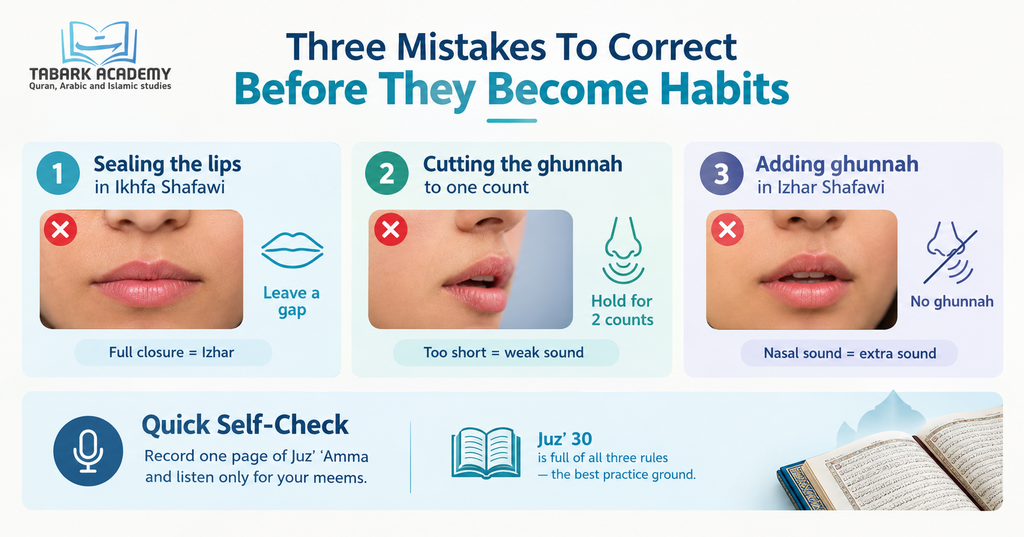
- Sealing the lips in Ikhfa Shafawi: If your lips touch fully before a baa, you are reciting Izhar. Leave a visible gap.
- Cutting the ghunnah to one count: Both Ikhfa Shafawi and Idgham Shafawi require a held nasal sound. Count it deliberately until the duration becomes instinctive.
- Adding ghunnah in Izhar Shafawi: Twenty-six letters require a dry, clean meem. Any nasal hold here is an added sound, not a Tajweed rule — and it is the single most common fault among students who learned the rules from text without oral correction.
A reliable self-check: record one page of Juz’ ʿAmma and listen only for your meems. Juz’ 30 is dense with all three rules, which makes it the most efficient practice ground for the rules of meem sakinah.
Start Your Quran Learning Journey
Join Tabark Academy today for structured online lessons with qualified tutors, customized to fit your goals.
Book Your Free Trial LessonStart Applying The Rules Of Meem Sakinah Correctly
Reading about ghunnah does not train your ear for it. One live session with a tutor who stops you at the exact meem you rushed will move you further than a week of silent review.
Tabarak Academy teaches Tajweed one-to-one, online, on a schedule you choose — meem sakinah, noon sakinah, makharij, and full application of the Quran, in a sequence built for non-native speakers. Start with a free trial lesson and recite for a tutor before you commit to anything.
Our Tajweed Courses:
- Online Tajweed Classes
- Tajweed Course for Beginners
- Tajweed Course for Kids
- Tajweed Course for Adults
- Tajweed Course for Sisters
- Advanced Tajweed Course
- Amali (Practical) Tajweed Course
- Learn Quran with Tajweed
- Learn Quran with Tajweed for Kids
- Learn Quran with Tajweed for Sisters

Conclusion
The rules of meem sakinah form a small, precise system: Ikhfa Shafawi before baa, Idgham Shafawi before meem, Izhar Shafawi before the remaining twenty-six letters. Two of the three require a ghunnah of two counts; the third requires none at all.
The rule names are the easy part. The difficulty is applying them mid-recitation, at speed, without dropping the ghunnah or blurring a meem into a waaw or faa.
That comes from repetition on real verses and correction from someone listening. Work through Juz’ 30 with these three rules in mind, and the rules of meem sakinah will stop being something you recall and start being something you simply do.
Frequently Asked Questions About The Rules Of Meem Sakinah
These are the questions students ask most often when they first apply meem sakinah to live recitation — short answers you can use as a quick reference while you practise.
1. How many rules does meem sakinah have?
Meem sakinah has exactly three rules: Ikhfa Shafawi before baa, Idgham Shafawi before meem, and Izhar Shafawi before the remaining 26 letters. All three are called shafawi because meem is articulated from the two lips.
2. What is the difference between Ikhfa Shafawi and Izhar Shafawi?
Ikhfa Shafawi applies only before baa and conceals the meem with the lips close but not sealed, holding a ghunnah for two counts. Izhar Shafawi applies before all other letters and requires a clear meem with the lips fully sealed then released, with no ghunnah.
3. Why does meem sakinah need extra care before waaw and faa?
Both letters are articulated at or near the lips, so the meem tends to blur into them. Classical Tajweed scholars emphasised releasing the meem clearly before waaw and faa so the listener does not mistake it for Ikhfa Shafawi.
4. Is Idgham Shafawi read with or without ghunnah?
Idgham Shafawi is always read with ghunnah, held for two counts. The two meems merge into one doubled meem, and the nasal sound is sustained before the merged letter is released.
5. Can the rules of meem sakinah occur inside a single word?
Izhar Shafawi occurs both inside a single word and across two words. Ikhfa Shafawi and Idgham Shafawi occur across two words, where a word ending in meem sakinah is followed by a word beginning with baa or meem.
6. How do I recognise each rule in the Mushaf?
Idgham Shafawi shows no sukoon on the first meem and a shaddah on the second meem. Ikhfa Shafawi shows a meem with no sukoon mark followed by a baa with no shaddah. Izhar Shafawi shows a clear sukoon over the meem.

0 Comments