
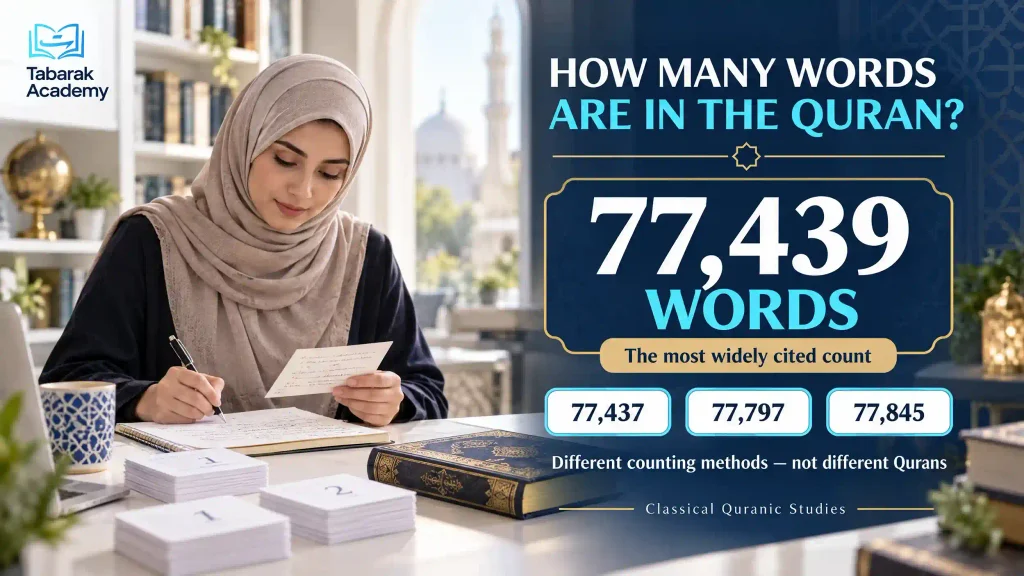
How many words are in the Quran? It is one of the most common questions Muslims, new Muslims, and curious kids ask when they first open the Mushaf. The most widely cited answer is 77,439 words, a figure recorded in classical Quranic studies and repeated in many modern Islamic references.
You may also see slightly different totals, such as 77,437, 77,797, or 77,845 words. These differences do not come from any change in the Quran itself.
They come from different counting rules, such as how scholars treat the disjointed letters, joined words, and the Basmalah.
What You Will Learn
- The most widely accepted answer to how many words are in the Quran is 77,439 words.
- Small differences between word counts come from counting methods, not from any change in the Quranic text.
- The Quran contains 114 Surahs and 6,236 verses according to the Kufan count used in the Hafs Mushaf.
- Authentic Sunnah teaches that every single letter of the Quran you recite carries a reward.
- Simple, practical steps help kids and beginners start reading the Quran word by word.
How Many Words Are In The Quran
The Quran (Al-Qur’an) is the final revealed speech of Allah, sent down to Prophet Muhammad ﷺ in Arabic over about 23 years. When people ask how many words are in the Quran, the most widely cited answer is 77,439 words, counted from the standard Uthmani Mushaf.
The figure of 77,439 words comes from classical works of Ulum al-Quran, meaning the sciences of the Quran. In these works, scholars recorded the number of Surahs, verses, words, and letters, and this total remains the one most teachers and Islamic schools share with students today.
Other credible counts of Quran words sit very close to 77,439. Some classical tallies give 77,437 words, while modern computer counts of the digital Uthmani text often land near 77,430.
Quran Statistics At A Glance
The word count of the Quran is easier to understand when you see it beside the other main numbers of the Mushaf. The Quran is organized into Surahs (chapters), Ayat (verses), and reading divisions such as the Juz (one of thirty parts) and the Hizb (one of sixty parts).
The table below summarizes the most commonly used figures for the standard Mushaf printed in the narration of Hafs, which most Muslims around the world read today.
The figures provide a quick overview of the Quran’s structure and help readers understand how its chapters, verses, and reading portions fit together.
| Feature | Arabic Term | Common Figure |
|---|---|---|
| Chapters | Surah (سورة) | 114 |
| Verses | Ayah (آية) | 6,236 (Kufan count) |
| Words | Kalimah (كلمة) | 77,439 (most widely cited) |
| Letters | Harf (حرف) | More than 320,000 (varies by method) |
| Parts | Juz (جزء) | 30 |
| Sections | Hizb (حزب) | 60 |
| Pages | Safhah (صفحة) | 604 (Madinah Mushaf) |
Experience Our Interactive Learning
Curious about how we teach? Watch these brief video clips from our recent live sessions to see our structured curriculum, advanced learning platform, and dynamic student-teacher interactions firsthand.
Start Your Quran Learning Journey
Join Tabark Academy today for structured online lessons with qualified tutors, customized to fit your goals.
Book Your Free Trial LessonWhy Do Word Counts Of The Quran Differ Slightly
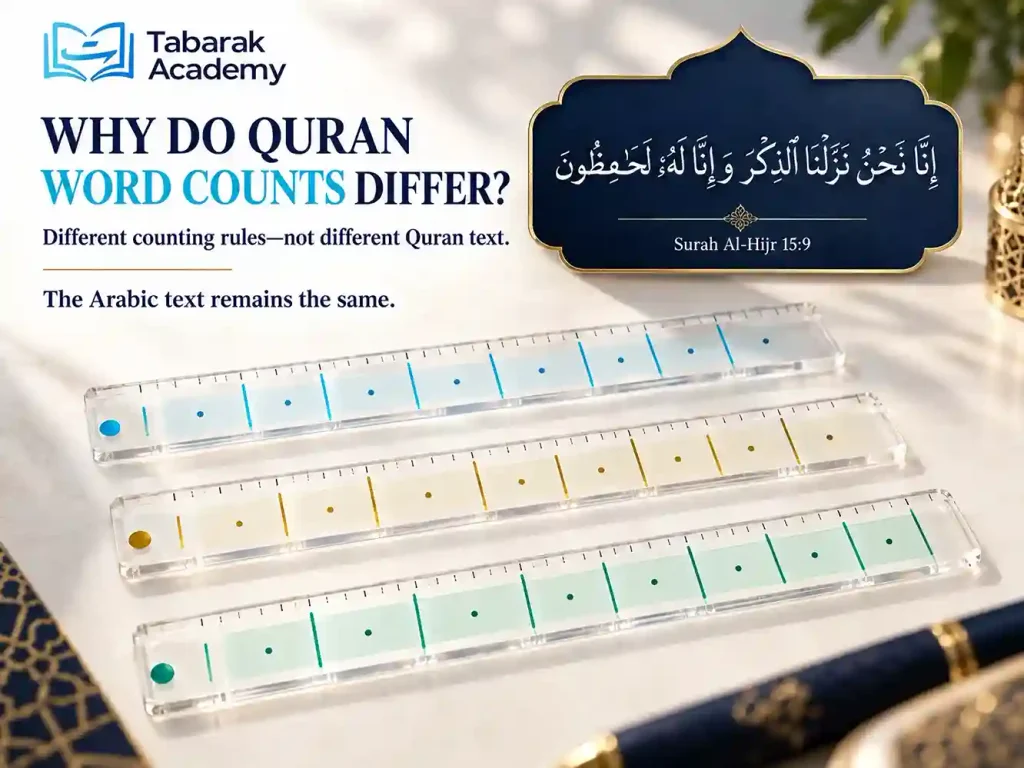
Word counts of the Quran differ slightly because scholars used different counting rules, not because the text is different. Every Muslim community reads the same preserved Quran, and the Arabic letters on the page are identical whichever word count a book reports.
Allah promised to protect the Quran Himself, and this promise is the foundation of the Muslim belief that its text has never changed:
إِنَّا نَحْنُ نَزَّلْنَا ٱلذِّكْرَ وَإِنَّا لَهُۥ لَحَٰفِظُونَ
“Indeed, it is We who sent down the message [i.e., the Qur’an], and indeed, We will be its guardian.”
With this promise in mind, here are the four main reasons the word totals of the Quran vary slightly between sources.
1. The Disjointed Letters (Al-Huruf Al-Muqatta’at)
Al-Huruf al-Muqatta’at are the disjointed letters that open 29 Surahs of the Quran, such as Alif Lam Mim and Ha Mim. Some scholars counted each group as one word, while others treated it as separate letters, which changes the final word count by several words.
A clear example is Surah Ya-Sin, which opens with two disjointed letters. Depending on the counting method, this opening can be recorded as one word or as two separate letters.
2. Words Joined Together In The Uthmani Script
The Uthmani script (Ar-Rasm al-Uthmani) is the original spelling style of the standard Mushaf. In this script, some expressions are written joined, such as innama (indeed, only) and bi’sama (how wretched).
One counter may record a single word where another records two, which slightly changes the total. This is why Quranic word counts may vary slightly between scholarly references, even though the Quranic text itself remains unchanged.
3. Counting The Basmalah At The Start Of Surahs
The Basmalah is the phrase Bismillah ar-Rahman ar-Rahim, meaning “In the name of Allah, the Most Gracious, the Most Merciful.” In the Kufan count, it is a numbered verse only in Surah Al-Fatihah, even though it opens almost every Surah.
Surah At-Tawbah is the only Surah that does not begin with the Basmalah. Counters who add its four words to the opening of every Surah reach a higher word total than those who count it only where it is a numbered verse.
4. Attached Particles In Digital Word Counts
Arabic often attaches small particles directly to words, such as wa (and), fa (so), bi (with), and li (for), along with pronoun endings. Modern software usually counts any letters between two spaces as one word, which is why digital Quran word counts can differ from traditional grammatical analysis.
As a result, a digital tool may count a connected expression as one word, while a linguistic analysis may identify several separate grammatical elements within it.
Comparison Of Common Quran Word Counts
If you search online for how many words are in Quran, you will meet several numbers that may look confusing at first. Each figure is linked to a specific counting approach, and none of them suggests that a single word of the Quran has been added or removed.
The table below groups the most frequently quoted totals with the explanation usually given for each one, so you can recognize them easily when you see them in books or online.
It also highlights why different sources may report different totals while referring to the same Quranic text.
| Word Count | How It Is Usually Explained |
|---|---|
| 77,439 | The most widely cited classical figure, common in teaching and reference books |
| 77,437 | A classical figure linked to treating the disjointed letters in a different way |
| 77,797 and 77,845 | Other reported totals based on different rules for joined words, particles, and the Basmalah |
| About 77,430 | Modern computer counts of space-separated words in the digital Uthmani text |
How Many Verses And Surahs Are In The Quran
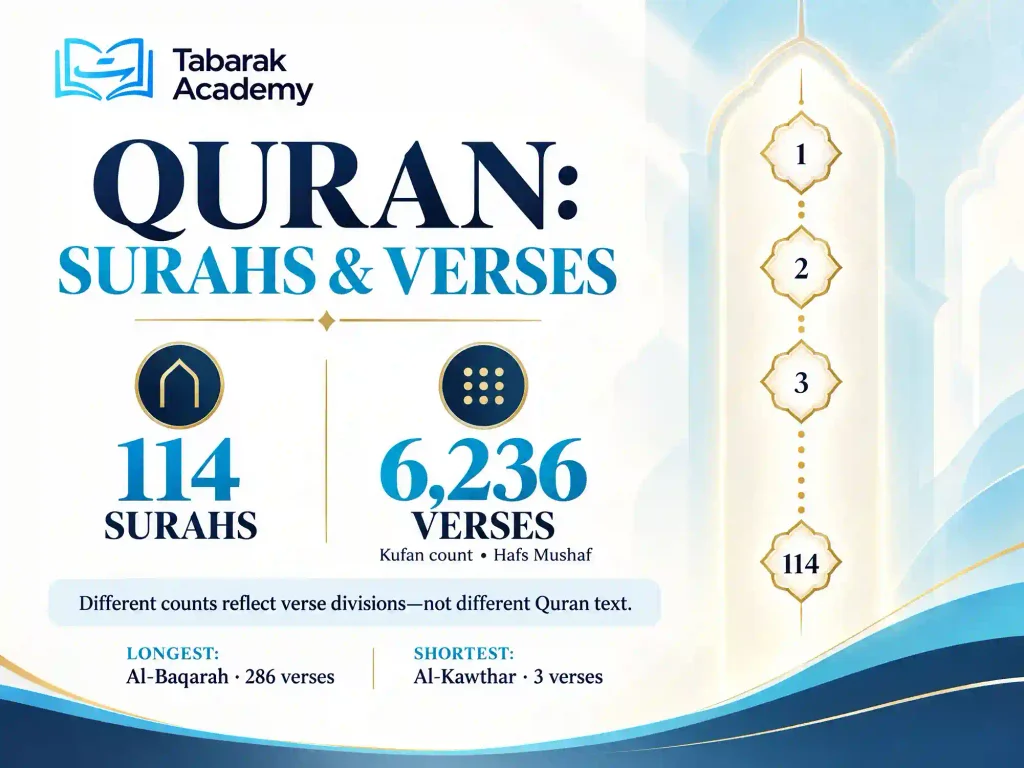
The Quran contains 114 Surahs. Its number of verses is 6,236 according to the Kufan count, which is the verse-numbering system used in the Hafs Mushaf printed in most of the Muslim world today.
Scholars agree that the Quran has more than 6,000 verses, but early counting schools linked to cities such as Kufa, Basra, Madinah, Makkah, and Sham divided some verses differently. Reported totals include 6,204, 6,214, 6,219, 6,226, and 6,236 verses, all describing the same Quranic text.
The longest chapter is Surah Al-Baqarah, with 286 verses, while the shortest is Surah Al-Kawthar, with only three verses and ten words. Both are among the well-known Surahs of the Quran.
Word Counts Of Short Surahs Beginners Often Memorize
Looking at the word counts of short Surahs makes the large number of 77,439 feel more personal. These Surahs are usually the first ones children and new Muslims memorize, and they are recited daily in Salah, so their words are already familiar to many readers.
The counts below are based on space-separated words in the Uthmani Mushaf. The Basmalah is included only for Al-Fatihah, where it is counted as the first verse in the Kufan system.
| Surah | Verses | Words |
|---|---|---|
| Al-Fatihah | 7 | 29 |
| Al-Ikhlas | 4 | 15 |
| Al-Asr | 3 | 14 |
| Al-Kawthar | 3 | 10 |
The Most Repeated Words In The Quran
The most repeated word in the Quran is the name Allah, which appears roughly 2,700 times according to computer-based counts of the Arabic text. Other frequently repeated words include Rabb (Lord), qala (he said), and words connected to belief, mercy, and the Day of Judgment.
Learning high-frequency Quranic words is a powerful shortcut for beginners. You can explore them in detail in our list of the most frequent words in the Quran, which helps you recognize words you will meet on almost every page.
If your child is starting with these short Surahs, the online Quran course for kids at Tabarak Academy teaches them step by step with patient tutors and engaging lessons.
What The Quran Says About The Words Of Allah
The Mushaf contains about 77,439 words, yet Allah teaches that His words in their full reality can never be counted or exhausted. This verse reminds readers that Allah’s knowledge and speech are without limit:
قُل لَّوْ كَانَ ٱلْبَحْرُ مِدَادًا لِّكَلِمَٰتِ رَبِّى لَنَفِدَ ٱلْبَحْرُ قَبْلَ أَن تَنفَدَ كَلِمَٰتُ رَبِّى وَلَوْ جِئْنَا بِمِثْلِهِۦ مَدَدًا
“Say, “If the sea were ink for [writing] the words of my Lord, the sea would be exhausted before the words of my Lord were exhausted, even if We brought the like of it as a supplement.””
Allah also made the words of the Quran easy to remember, so that every believer can carry them in the heart:
وَلَقَدْ يَسَّرْنَا ٱلْقُرْءَانَ لِلذِّكْرِ فَهَلْ مِن مُّدَّكِرٍ
“And We have certainly made the Qur’an easy for remembrance, so is there any who will remember?”
What The Sunnah Says About The Reward For Every Letter
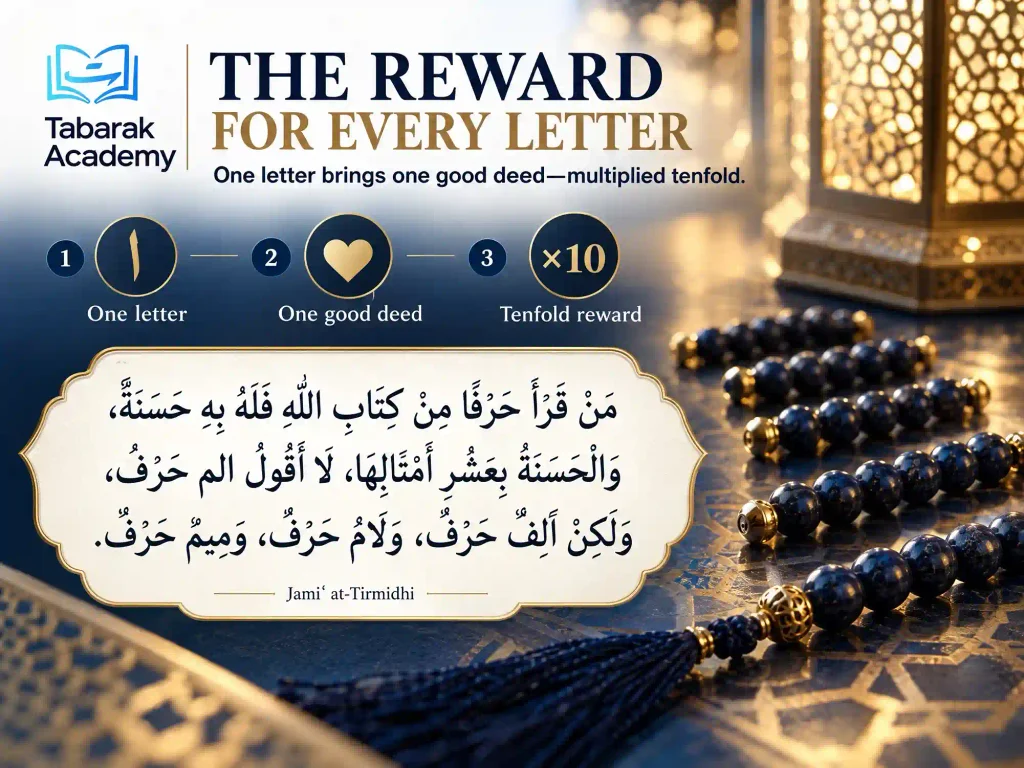
The Sunnah of Prophet Muhammad ﷺ teaches that reciting the Quran is rewarded not only word by word, but letter by letter. This authentic Hadith also mentions the disjointed letters Alif Lam Mim, which connects directly to how scholars count Quranic words and letters.
The Prophet ﷺ explained that each letter carries a reward multiplied by ten, showing the great virtue of Quran recitation. This encourages Muslims to read regularly, even if they can only manage a few verses each day.
مَنْ قَرَأَ حَرْفًا مِنْ كِتَابِ اللَّهِ فَلَهُ بِهِ حَسَنَةٌ، وَالْحَسَنَةُ بِعَشْرِ أَمْثَالِهَا، لَا أَقُولُ الم حَرْفٌ، وَلَكِنْ أَلِفٌ حَرْفٌ، وَلَامٌ حَرْفٌ، وَمِيمٌ حَرْفٌ
“Whoever recites a letter from Allah’s Book, then he receives the reward from it, and the reward of ten the like of it. I do not say that Alif Lam Mim is a letter, but Alif is a letter, Lam is a letter and Mim is a letter.”
Why Muslim Scholars Counted The Words Of The Quran
Muslim scholars counted the words of the Quran to protect the text, organize its teaching, and study its language. This work was an act of service to the Book of Allah, carried out with remarkable care by generations of reciters and scholars.
One of the best-known references on this subject is the work of the Egyptian scholar Imam Jalal al-Din al-Suyuti, who gathered and compared earlier reports on Quranic counts.
His encyclopedia of Quranic sciences, Al-Itqan fi Ulum al-Quran, includes a dedicated chapter on the number of Surahs, verses, words, and letters in the Quran.
1. Protecting The Text Of The Mushaf
Exact word counts gave copyists and teachers a practical way to check handwritten copies of the Quran. If a copy had a missing or extra word, comparing it with recorded counts helped reveal the error.
This careful checking supported memorization, which has always been the primary way the Quran is preserved. Together, written records and oral transmission helped maintain the accuracy of the Quran across generations.
2. Organizing Daily Recitation And Memorization
Counting the words of the Quran helped scholars divide it into balanced portions, such as 30 Ajza and 60 Ahzab. These divisions allow a Muslim to complete the Quran in a month by reading one Juz daily, a habit many keep in Ramadan, and they help Hifz students set realistic targets.
Smaller reading portions also make it easier to track progress, maintain consistency, and balance new memorization with regular revision.
3. Studying The Language Of The Quran
Word counts opened the door to studying how often Quranic words repeat and in which contexts. Scholars of Arabic and Tafsir used this knowledge to explore the precision, balance, and eloquence of the Quranic style.
Such studies also help readers appreciate the depth of Quranic vocabulary and the significance of how words are used throughout different Surahs.
Step Inside Our Virtual Classrooms
See our engaging teaching methods in action! watch real snippets of our live classes and discover how our expert instructors make learning interactive, memorable, and inspiring for every student.
How Many Words Are In Quran Translations Compared To Arabic
Any English translation of the Quran contains far more words than the 77,439 words of the Arabic original. Translators often need several English words to express one Arabic word, so translation word counts vary widely from one edition to another.
A famous example appears in Surah Al-Hijr (15:22), where one written Arabic word combines a connecting particle, a verb, its subject, and two attached pronouns.
That single Quranic word, fa-asqaynakumuhu, needs about six English words, such as “so We gave it to you to drink.” This is why the Arabic count, not a translation count, is the true answer to how many words are in the Quran.
The Quran reading course at Tabarak Academy helps beginners move from single letters to fluent reading of complete verses.
How To Start Reading The Quran Word By Word
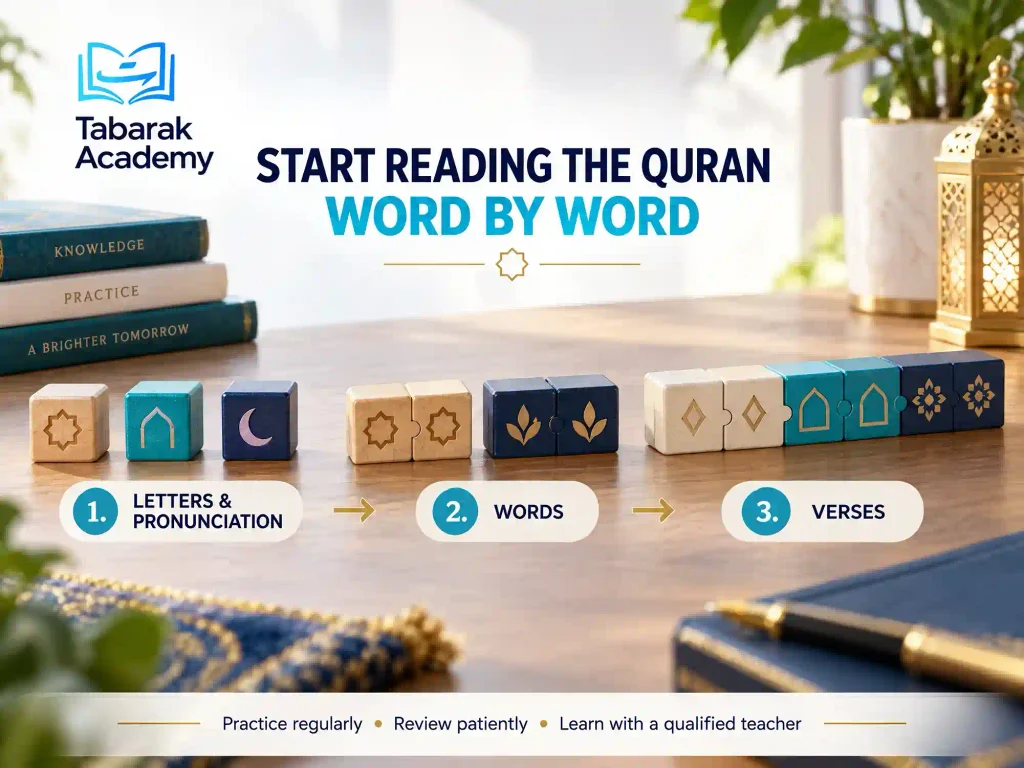
Knowing how many words are in the Quran can inspire you to read every one of them and appreciate the depth of its guidance. Any beginner, child or adult, can build this skill step by step with the right method, a clear plan, and a qualified Quran teacher.
Starting with Arabic letters, learning their correct pronunciation, and gradually moving to words and verses makes the journey easier and more manageable.
With regular practice, patience, and consistent revision, learners can improve their recitation, develop confidence, and build a lasting connection with the Book of Allah. Every small step brings them closer to reading the Quran accurately and understanding its beautiful message.
1. Learn The Arabic Letters With Noorani Qaida
Noorani Qaida is a beginner’s book that teaches Arabic letters, their shapes, and how they join to form Quranic words. Starting with a Noorani Qaida course with Tajweed builds correct pronunciation from the very first lesson.
Learning the Qaida properly means a student reads Quranic words accurately from the beginning, instead of spending months correcting habits and pronunciation mistakes later.
2. Recite With Tajweed And A Measured Pace
Tajweed is the set of rules for pronouncing every letter of the Quran correctly, giving each sound its proper place and quality. Allah commands believers to recite the Quran slowly and clearly:
أَوْ زِدْ عَلَيْهِ وَرَتِّلِ ٱلْقُرْءَانَ تَرْتِيلًا
“Or add to it, and recite the Qur’an with measured recitation.”
A structured Quran recitation course gives you a teacher who listens to every word you recite and corrects your Tajweed in real time.
3. Review Regularly To Keep What You Learn
Muraja’ah is the Arabic term for regularly reviewing what you have learned or memorized from the Quran. Losing your place while reciting in prayer is common for learners.
Our guide on what to do if you forget a verse during Salah offers calm, practical steps based on Islamic guidance. Regular revision helps strengthen memory, improve fluency, and reduce hesitation during recitation.
Start Your Quran Learning Journey
Join Tabark Academy today for structured online lessons with qualified tutors, customized to fit your goals.
Book Your Free Trial LessonStart Learning The Quran With Tabarak Academy
Every one of the 77,439 words of the Quran is worth learning, reciting, and understanding. Tabarak Academy offers structured online Quran lessons with qualified tutors for kids, adults, and complete beginners, customized to fit your goals.
Whether you want to read your very first Quranic word or perfect your Tajweed, book your free trial lesson today and take the first step toward reading the whole Quran with confidence.

Our Quran Courses
- Online Ijazah Course
- Online Qirat Course
- Quran for Toddlers / Young Children
- Weekend Quran Classes
- Intensive Quran Course
- Al-Azhar Quran Course
- Zoom Quran Classes
- Noor Al-Bayan Course
Conclusion
So, how many words are in the Quran? The most widely cited answer is 77,439 words, spread across 114 Surahs and 6,236 verses in the Kufan count. Other figures, such as 77,437 or about 77,430, come from different counting methods, not from any difference in the text.
These careful counts reflect how deeply Muslims have honored the Book of Allah. Since every letter recited carries reward, the best way to appreciate these numbers is to keep reading, learning, and living by the words of the Quran.
Even a small daily portion can help you build a consistent habit and strengthen your connection with Allah’s words. May Allah make the Quran a light for our hearts and a source of guidance in our lives.
Frequently Asked Questions About How Many Words Are In The Quran
How Many Words Are In The Quran Exactly?
The Quran contains 77,439 words according to the most widely cited count. Some sources give 77,437 or about 77,430 words because they follow different rules for the disjointed letters, joined words, and the Basmalah.
How Many Letters Are In The Quran?
The Quran contains more than 320,000 Arabic letters, but exact totals differ between classical and modern counts. The variation comes from counting rules and the spelling conventions of the Uthmani script, not from differences in the text.
Which Surah Has The Most Words In The Quran?
Surah Al-Baqarah has the most words of any Surah in the Quran. It is the longest Surah, with 286 verses, and it also contains the longest single verse, the verse of debt (2:282).
Do Different Word Counts Mean The Quran Has Changed?
No, different word counts do not mean the Quran has changed. All Muslims read the same preserved text, and the small variations come only from different methods of counting words, not from different wording.
How Many Words Are In Quran Translations In English?
There is no single word count for English translations of the Quran. Each translation follows its own style, and English usually needs several words to express one Arabic word, so translations are much longer than the 77,439-word Arabic original.

0 Comments