

Most students learn the six Idgham letters in an afternoon and then mispronounce them for years. The reason is simple: the difference between idgham with ghunnah vs idgham without ghunnah is not a difference in letters — it is a difference in sound, and sound cannot be learned from a chart. One group keeps a nasal hum for two beats; the other erases the nasal sound completely.
Idgham is the second rule of Noon Sakinah (نْ) and Tanween (ً ٍ ٌ) in Tajweed, and it governs some of the most frequently recited phrases in the Quran — mir-rabbihim, hudal-lil-muttaqeen, may-ya’mal. Getting it wrong changes the texture of your recitation on nearly every page.
This guide from Tabarak Academy breaks down both types: the letters, the two-beat ghunnah, complete vs incomplete merging, the four words where Idgham is forbidden, the Hafs exceptions, and the three mistakes that keep most self-taught reciters stuck.
What you’ll learn in this article
- The core distinction in idgham with ghunnah vs idgham without ghunnah and why it is a difference in sound, not in letters.
- The exact letters of Idgham with ghunnah (يَنْمُو) and Idgham without ghunnah (ل ر).
- Why some Idgham is kamil (complete) and some is naqis (incomplete).
- Verified Quranic examples for all six Idgham letters with verse numbers.
- The four Quranic words where Idgham never applies — and why.
- The three most common Idgham mistakes and how to correct each one.
What Is Idgham in Tajweed?
Idgham linguistically means “insertion” or “merging.” In Tajweed, Idgham is the complete or near-complete blending of a Noon Sakinah (نْ) or Tanween into the letter that immediately follows it, so the two sounds become one doubled (mushaddad) letter instead of two separate, choppy sounds.
Classical scholars collected the six Idgham letters in the mnemonic word يَرْمَلُون (Yarmaloon): ي ر م ل و ن. Those six letters split into two groups based on one question only: does a nasal resonance — the ghunnah — survive the merge?
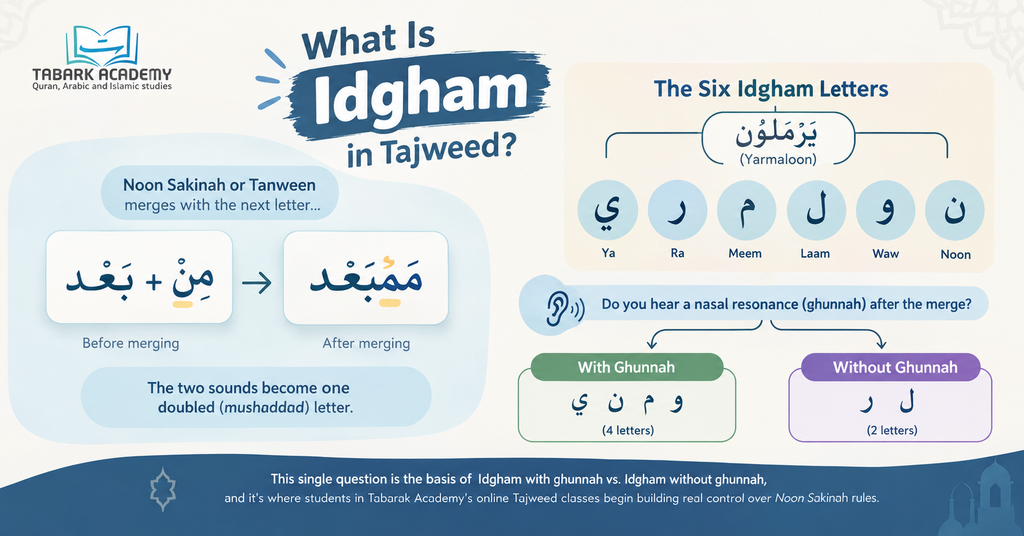
That single question is the entire basis of idgham with ghunnah vs idgham without ghunnah, and it is where students in Tabarak Academy’s online Tajweed classes begin building real control over Noon Sakinah rules.
The two-word condition that governs every case of Idgham
Idgham requires that the Noon Sakinah and its triggering letter sit in two separate words. The Noon ends the first word; the Idgham letter begins the next.
When both appear inside a single word, Idgham is forbidden and the Noon must be pronounced clearly. Scholars call this Izhar Mutlaq (absolute clarity). Only four words in the entire Quran trigger it:
| Word | Arabic | Verse | If wrongly merged |
| Ad-Dunya | ٱلدُّنۡيَا | 2:85 | “ad-duyya” |
| Bunyan | بُنۡيَٰان | 61:4 | “buyyan” |
| Qinwan | قِنۡوَان | 6:99 | “qiwwan” |
| Sinwan | صِنۡوَان | 13:4 | “siwwan” |
Merging inside these words would destroy the root and make each one sound like a different word entirely. That is the whole reason the exception exists.
Experience Our Interactive Learning
Curious about how we teach? Watch these brief video clips from our recent live sessions to see our structured curriculum, advanced learning platform, and dynamic student-teacher interactions firsthand.
What Is Idgham With Ghunnah?
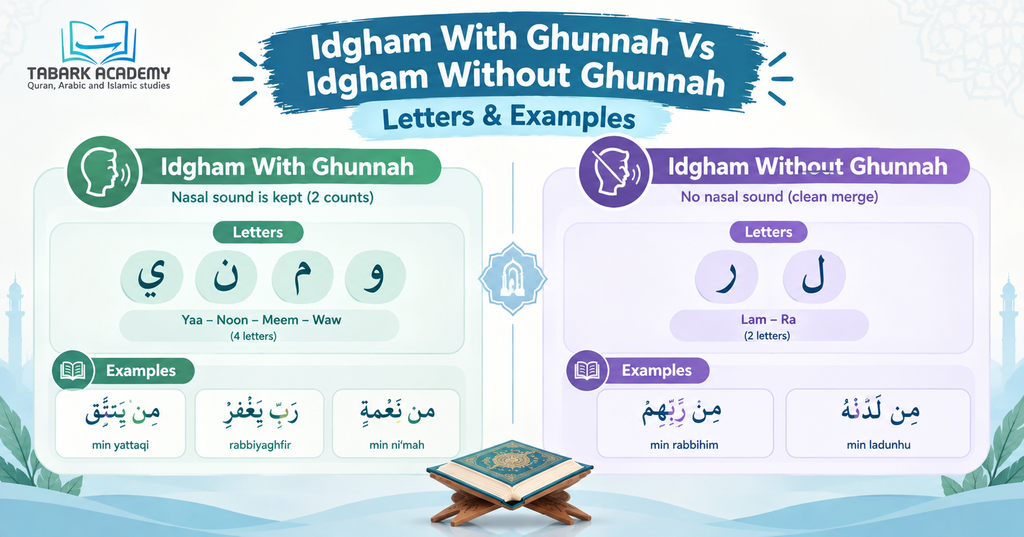
Idgham with ghunnah (الإدغام بغنة) is the merging of Noon Sakinah or Tanween into one of four letters — ي، ن، م، و — while holding a nasal sound for approximately two counts (harakatayn), roughly the time it takes to say “one-two.”
The Noon or Tanween stops existing as an independent sound. The ghunnah, however, remains clearly audible throughout the merge. This is the most common type of Idgham in the Quran.
The four letters of Idgham with ghunnah: يَنْمُو
The letters are gathered in the mnemonic يَنْمُو (Yanmu):
- ي (Ya).
- ن (Noon).
- م (Meem).
- و (Waw).
Tabarak Academy’s Ijazah-certified instructors note a pattern worth knowing: students who were never trained to listen for the ghunnah often produce it correctly by accident — but inconsistently.
They hit it in familiar verses and lose it in unfamiliar ones. The fix is ear training before rule memorization, which is why our Tajweed sessions always begin with guided listening.
Quranic examples of Idgham with ghunnah
The four letters of يَنْمُو appear in both forms — after a Noon Sakinah ending one word, and after Tanween. The table below pairs each letter with a verified example of each case, so you can see the rule applied in the two contexts you will actually meet while reciting.
| Letter | With Noon Sakinah | Verse | With Tanween | Verse |
| ي (Ya) | ﴿مَن يَقُولُ﴾ | 2:8 | ﴿وُجُوهٞ يَوۡمَئِذٍ﴾ | 88:2 |
| ن (Noon) | ﴿مِّن نِّعۡمَةٖ﴾ | 16:53 | ﴿يَوۡمَئِذٖ نَّاعِمَةٞ﴾ | 88:8 |
| م (Meem) | ﴿مِن مَّآءٖ﴾ | 2:164 | ﴿مَثَلٗا مَّا﴾ | 2:26 |
| و (Waw) | ﴿مِن وَالٍ﴾ | 13:11 | ﴿وَرَعۡدٞ وَبَرۡقٞ﴾ | 2:19 |
In ﴿فَمَن يَعۡمَلۡ مِثۡقَالَ ذَرَّةٍ خَيۡرٗا يَرَهُۥ﴾ (Az-Zalzalah 99:7), the Noon of faman is never pronounced as a clear “n.” It flows directly into the Ya, carrying the nasal hum: famay-ya’mal. The same verse contains a second case — khayran yarah — where Tanween merges into Ya the identical way.
Idgham Kamil Vs Idgham Naqis Within The Ghunnah Group
Not all four ghunnah letters behave the same way, and this is the detail most beginner guides skip.
- Idgham Kamil (complete) — with ن and م. The Noon disappears entirely, body and attributes. What you hear is a fully doubled Noon or Meem carrying its own natural ghunnah. ﴿مِّن نِّعۡمَةٖ﴾ is read min-ni’mah with one stressed Noon.
- Idgham Naqis (incomplete) — with و and ي. The body of the Noon vanishes, but its defining attribute (the ghunnah) stays behind, blended into the Waw or Ya. ﴿مَن يَقُولُ﴾ is read may-yaqool — the nasal sound is still there on the Ya.
- This is why the Medina Mushaf does not place a full shaddah on a Waw or Ya following a merged Noon.
The script itself is telling you the merge is incomplete. Reading the Mushaf’s diacritics as instructions rather than decoration is one of the fastest skill jumps a student can make, and it is a core habit taught in Tabarak Academy’s Tajweed for Beginners course.
What Is Idgham Without Ghunnah?
Idgham without ghunnah (الإدغام بغير غنة) is the complete merging of Noon Sakinah or Tanween into ل (Lam) or ر (Ra) — the two remaining letters of Yarmaloon — with zero nasal resonance. The Noon and its ghunnah both disappear, leaving a single strengthened letter.
This merge is always complete (Kamil). There is no partial absorption and no residual nasal quality with Lam and Ra.
Why does the ghunnah disappear with Lam and Ra?
Lam, Ra, and Noon all share articulation from the tip of the tongue. Because the articulation points are so close, the nasal sound dissolves completely into the new letter rather than surviving the transition.
Classical scholars described this as the pursuit of phonetic lightness — holding a nasal sound before Lam or Ra would introduce unnecessary heaviness into connected recitation.
Many students find Idgham without ghunnah easier to execute than its counterpart, precisely because there is only one quality to produce: a clean, uninterrupted merge.
Quranic examples of Idgham without ghunnah
Lam and Ra behave identically whether they follow a Noon Sakinah or a Tanween: the merge is complete and silent of any nasal sound.
These examples are among the most frequently recited phrases in the Quran, which makes them the fastest way to test whether the rule has become automatic for you.
| Letter | With Noon Sakinah | Verse | With Tanween | Verse |
| ل (Lam) | ﴿فَإِن لَّمۡ﴾ | 2:24 | ﴿هُدٗى لِّلۡمُتَّقِينَ﴾ | 2:2 |
| ر (Ra) | ﴿مِّن رَّبِّهِمۡ﴾ | 2:5 | ﴿غَفُورٞ رَّحِيمٌ﴾ | 2:173 |
In ﴿مِّن رَّبِّهِمۡ the Noon of min vanishes so completely that the phrase is read mir-rabbihim — a single emphasized Ra with no trace of nasalization. In ﴿هُدٗى لِّلۡمُتَّقِينَ﴾ (Al-Baqarah 2:2), the Tanween on hudan bypasses the “n” sound entirely: hudal-lil-muttaqeen.
Say ﴿غَفُورٞ رَّحِيمٌ﴾ out loud. If you hear Ghafoorun Raheem, the Idgham has not happened. The correct reading is Ghafoo-rur-Raheem.
Tabarak Academy’s Al-Azhar-trained instructors correct your ghunnah timing in real time, on your own recitation.
Read also: What Is Idgham In Tajweed?
Start Your Quran Learning Journey
Join Tabark Academy today for structured online lessons with qualified tutors, customized to fit your goals.
Book Your Free Trial LessonIdgham With Ghunnah vs Idgham Without Ghunnah: Side-by-Side Comparison
The table below condenses every operational difference between the two types.
| Feature | Idgham With Ghunnah | Idgham Without Ghunnah |
| Letters | ي ن م و (يَنْمُو) | ل ر |
| Ghunnah present? | Yes — held 2 counts | No — none at all |
| Merge quality | Kamil with ن م · Naqis with و ي | Always Kamil |
| Word condition | Must be two separate words | Must be two separate words |
| Applies to Tanween? | Yes | Yes |
| Mushaf sign | Shaddah on ن م · no shaddah on و ي | Shaddah on the Lam or Ra |
| Hafs exception | يسٓ + وَٱلۡقُرۡءَانِ → Izhar | مَنۡۜ رَاقٖ → Sakt, no merge |
How does the Mushaf itself signal which Idgham applies?
The Uthmani script encodes the rule before you apply it. Four signals to train your eye on:
- A merged Noon carries no sukun: Compare ﴿مِنۡ عِندِ﴾ (sukun visible → Izhar) with ﴿مِن مَّآءٖ﴾ (no sukun → Idgham).
- Shaddah on the next letter means complete Idgham: ﴿مِّن نِّعۡمَةٖ﴾, ﴿فَإِن لَّمۡ﴾.
- No shaddah on Waw or Ya means incomplete Idgham: ﴿مَن يَقُولُ﴾, ﴿مِن وَالٍ﴾ — keep the ghunnah.
- Staggered Tanween marks signal Idgham or Ikhfa; stacked marks signal Izhar: This single visual cue resolves most Tanween cases at a glance.
Step Inside Our Virtual Classrooms
See our engaging teaching methods in action! watch real snippets of our live classes and discover how our expert instructors make learning interactive, memorable, and inspiring for every student.
Exceptions in the Narration of Hafs ‘an ‘Asim
Three places in the Quran place an Idgham letter after a Noon, yet no Idgham occurs in Hafs ‘an ‘Asim via ash-Shatibiyyah. These are resolved by transmitted authority (riwayah), not by the general rule.
| Place | Ruling |
| ﴿وَقِيلَ مَنۡۜ رَاقٖ﴾ — Al-Qiyamah 75:27 | Sakt: a brief silent pause on the Noon, marked by the small seen (ۜ). The pause prevents the merge. |
| ﴿يسٓ * وَٱلۡقُرۡءَانِ﴾ — Ya-Sin 36:1–2 | Izhar of the Noon in Ya-Seen, despite Waw being a ghunnah letter. |
| ﴿نٓۚ وَٱلۡقَلَمِ﴾ — Al-Qalam 68:1 | Izhar of the Noon in Noon. |
A practical decision rule for students: when a recited Mushaf and your rule-chart disagree, the transmitted recitation wins. Rules describe the recitation — they do not generate it.
Three Common Idgham Mistakes And How To Fix Them
Almost every error in idgham with ghunnah vs idgham without ghunnah traces back to one of three habits. These are the mistakes Tabarak Academy instructors correct most often in adult beginners who studied Idgham independently, along with the drill that fixes each one.
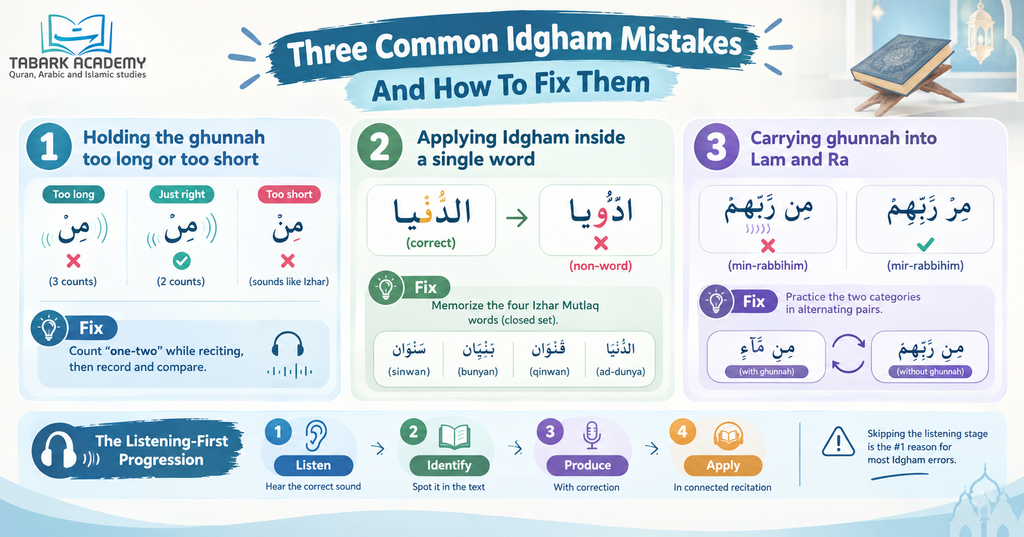
1. Holding the ghunnah too long or too short
The nasal resonance in Idgham with ghunnah must last exactly two counts. Stretching it to three drifts toward a different rule; clipping it makes the ghunnah inaudible and the merge sounds like plain Izhar.
Fix: count internally — “one-two” — while reciting the same verse ten times, then record yourself and compare against a qualified reciter.
2. Applying Idgham inside a single word
Students who learned the letters before the condition merge the Noon in ٱلدُّنۡيَا automatically, because they know Waw and Ya are Idgham letters. The result is ad-duyya — a non-word.
Memorize the four Izhar Mutlaq words as a closed set: ad-dunya, bunyan, qinwan, sinwan. There are no others.
3. Carrying ghunnah into Lam and Ra
After heavy practice on يَنْمُو, the nasal habit leaks into Idgham without ghunnah, producing min-rabbihim with a hum instead of a clean mir-rabbihim.
Fix: practice the two categories in alternating pairs, never in isolation. ﴿مِن مَّآءٖ﴾ then ﴿مِّن رَّبِّهِمۡ﴾, back to back, until the switch becomes automatic.
The listening-first progression
The sequence Tabarak Academy uses in its online Tajweed classes is deliberate: listen first → identify in the text → produce with correction → apply in connected recitation.
Skipping the listening stage is the single root cause of most Idgham errors, because the student ends up producing a sound they have never accurately heard.
Practice Exercises With Answers
Apply both rules to these verses before checking the answers.
| # | Verse | Answer |
| 1 | ﴿فَمَن يَعۡمَلۡ مِثۡقَالَ ذَرَّةٍ خَيۡرٗا يَرَهُۥ﴾ (99:7) | Two cases, both Noon/Tanween + Ya → incomplete Idgham with ghunnah |
| 2 | ﴿وَيۡلٞ لِّكُلِّ هُمَزَةٖ لُّمَزَةٍ﴾ (104:1) | Two cases, both Tanween + Lam → Idgham without ghunnah |
| 3 | ﴿هُدٗى مِّن رَّبِّهِمۡ﴾ (2:5) | Tanween + Meem → complete Idgham with ghunnah; Noon + Ra → Idgham without ghunnah |
| 4 | ﴿مِن طَلۡعِهَا قِنۡوَانٞ﴾ (6:99) | Noon + Waw inside one word → no Idgham (Izhar Mutlaq) |
Read also: Is Adult Memorization Slower Than Childhood Memorization?
Start Your Quran Learning Journey
Join Tabark Academy today for structured online lessons with qualified tutors, customized to fit your goals.
Book Your Free Trial LessonMaster Idgham Correctly — Start With Tabarak Academy Today
You can memorize يَرْمَلُون in five minutes. Producing a two-count ghunnah consistently, catching your own Izhar Mutlaq errors mid-verse, and keeping Lam and Ra clean takes a qualified ear listening to your recitation.
Tabarak Academy’s Al-Azhar-trained, Ijazah-certified instructors teach Noon Sakinah and Tanween rules the way they were transmitted — by sound, with correction, verse by verse. Flexible scheduling, one-to-one sessions, and a structured path from Tajweed basics through full Ijazah.
Our Tajweed Courses:
- Online Tajweed Classes
- Tajweed Course for Beginners
- Tajweed Course for Kids
- Tajweed Course for Adults
- Tajweed Course for Sisters
- Advanced Tajweed Course
- Amali (Practical) Tajweed Course
- Learn Quran with Tajweed
- Learn Quran with Tajweed for Kids
- Learn Quran with Tajweed for Sisters

Conclusion
The distinction between idgham with ghunnah vs idgham without ghunnah comes down to a single variable: the survival of the nasal sound. With the four letters of يَنْمُو (ي ن م و), the Noon or Tanween merges while a ghunnah is held for two counts — complete with Noon and Meem, incomplete with Waw and Ya.
With Lam and Ra, the merge is total and silent of any nasalization, producing one strengthened letter.
Both types share the same non-negotiable condition: the Noon must end one word and the Idgham letter must begin the next. Inside a single word, the ruling flips to Izhar Mutlaq, and only four Quranic words trigger it.
Master those two tables and the four exception words, and you have resolved the most frequently applied rule of Noon Sakinah in the entire Quran. The remaining work is auditory — and that is best done with a teacher listening.
Frequently Asked Questions About Idgham With and Without Ghunnah
Below are the questions students most often raise when first studying idgham with ghunnah vs idgham without ghunnah, answered directly and briefly for quick reference.
1. What are the letters of Idgham?
The letters of Idgham are six, gathered in the word يَرْمَلُون (Yarmaloon): ي، ر، م، ل، و، ن. Four take ghunnah (يَنْمُو: ي ن م و) and two do not (ل، ر).
2. What is the difference between Idgham with ghunnah and Idgham without ghunnah?
The difference is the nasal sound. Idgham with ghunnah (ي ن م و) holds a nasal resonance for two counts during the merge, while Idgham without ghunnah (ل ر) erases the Noon and its nasal sound completely, leaving one fully doubled letter.
3. Can Idgham happen within one word?
No. Idgham of Noon Sakinah and Tanween occurs only across two separate words. Inside a single word the ruling is Izhar Mutlaq, and only four Quranic words apply: ٱلدُّنۡيَا، بُنۡيَٰن، قِنۡوَان، صِنۡوَان.
4. Does Idgham apply to Tanween as well as Noon Sakinah?
Yes. Both types of Idgham apply equally to Tanween (ً ٍ ٌ) and Noon Sakinah (نْ), as in ﴿غَفُورٞ رَّحِيمٌ﴾ without ghunnah and ﴿وَرَعۡدٞ وَبَرۡقٞ﴾ with ghunnah.
5. Why is there no Idgham in مَنۡۜ رَاقٖ?
In Hafs ‘an ‘Asim, a Sakt (brief silent pause) is applied to the Noon in ﴿مَنۡۜ رَاقٖ﴾ (Al-Qiyamah 75:27), marked by a small seen in the Mushaf. The pause blocks the merge, and the ruling is transmitted rather than derived from the general rule.
6. How long should the ghunnah be held in Idgham?
The ghunnah is held for two counts (harakatayn) — roughly the time needed to say “one-two.” Holding it longer or cutting it short are the two most common timing errors in Idgham with ghunnah.



0 Comments